

Today, the bogus charges against an Olympic athlete for allegedly damaging the Lincoln Memorial Reflecting Pool were dropped. Of course it was done on a late Friday afternoon. I shared my concerns about this story last June in this post.1
As shown in the video, U.S. Attorney Jeanine Pirro stated in unequivocal terms, that she had evidence beyond a reasonable doubt that David Hearn, a former Olympic canoeist, vandalized the pool and was responsible for the damage. Donald Trump also jumped in, and it’s in the video, and claimed, without evidence, that the failed renovation and resulting liability were the result of sabotage.
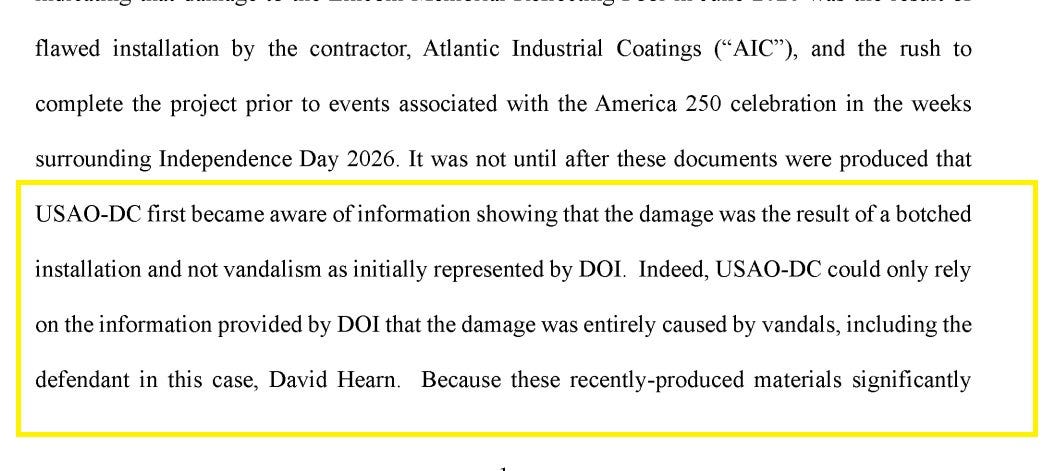
Today, prosecutors admit what we all figured out a month ago. They concluded in a court filing that the contractors hired by Trump “botched” the renovation, and they dropped all charges against Hearn. Court documents show the damage to the pool “was the result of a flawed installation by the contractor, Atlantic Industrial Coatings, and the rush to complete the project prior to events associated with the America 250 celebration on July 4.”
I’m sharing this tonight because we need to be worried as Americans. There isn’t a single thing this administration tells you that you can believe. If they feel the need to lie to you over something as benign as a construction issue and algae, what do you think they’re willing to do when it comes to disclosing the true facts of war or cryptocurrency conflicts of interest relating in profits in the billions?
Wake up. They aren’t interested in the truth, and they don’t care about the truth, so long as what they say and do helps them look good and in Trump’s case, make money for his family.
This is not why we pay them with our taxpayer dollars. This is not their job. Their job is to tell the truth, do the right thing, and protect all Americans. It’s not to prosecute innocent Olympic athletes for federal crimes, exposing them to up to 10 years in prison for something they didn’t do. If they can do this to someone like Mr. Hearn. They can do it to you.
You need to vote in the midterms. You need to give Congress the power to take back the majority. You need to give Congress the power of oversight to investigate these false allegations. You need to give Congress the power of the purse to cut off funding for the hundreds of millions of dollars in vanity projects Trump is undertaking with your tax dollars. You need to give Congress the power to reclaim its separation of powers authority and rein in this rogue administration before another American citizen is wrongfully charged, defamed, and indicted.
Mitch Jackson, Esq.
What Can David Hearn Actually Do About This?
A Plain-English Guide to His Legal Options (Updated on August 1, 2026)
DISCLAIMER: This is general information and does not provide legal advice. Having said that, based upon the reported facts, this is my take. Always do your own due diligence and consult with an experienced professional in your state, region or country.
First, put yourself in David’s shoes
You’re 67 years old. You’re on a bike ride. You stop at the Lincoln Memorial Reflecting Pool because you’ve read that the new blue coating is peeling and you’re curious. You reach into the water, touch a loose piece of liner, and let go when a worker tells you to stop. His interview beings 10 seconds into this clip.
Within minutes you’re in handcuffs. You spend about five hours in a Park Police facility. By your account, nobody reads you your rights, nobody lets you make a phone call, and nobody tells you what you’re actually being charged with.
Two weeks later a grand jury indicts you on a felony carrying up to ten years in prison. The U.S. Attorney announces it publicly. The President blames vandals for a botched renovation project he’d been bragging about.
Then, six weeks after that, prosecutors file a document admitting the damage came from a flawed installation by the contractor and a rush to finish before the July 4 celebrations. Not from you. They move to drop the case.
You’re relieved. And then you ask the question anybody would ask: is anyone going to answer for this?
Here’s the honest answer.
The one detail that changes everything
Most people assume that because a federal prosecutor charged him, this was a federal case. It’s more complicated, and the complication matters enormously.
Washington, D.C. has a legal system unlike any state. The U.S. Attorney, a federal official, prosecutes ordinary local crimes in D.C. Superior Court, which is not a federal court. It functions like a state court.
Hearn’s case ran in two stages:
The arrest (June 19): U.S. Park Police — federal officers — arrested him on a misdemeanor allegation of destroying government property.
The indictment (July 2): A grand jury charged him with one felony count under D.C. Code § 22-303, a local law that allows up to 10 years in prison when the damaged property is worth $1,000 or more.
So: federal officers, a federal prosecutor, a local charge, a local court. That mix complicates every option below.
And the case isn’t technically over. Prosecutors moved to dismiss. A judge still has to grant it, and whether it’s dismissed “with prejudice” (gone forever) or “without prejudice” (theoretically refileable) hasn’t been settled.
Option 1: Clear his name on the record — and get it sealed
Start here, because this is the one he’s most likely to win, and most coverage ignores it.
D.C. law lets someone who was arrested or charged under the D.C. Code, and whose prosecution ended without a conviction, ask the court to seal every record of the arrest and the case on grounds of actual innocence. He can file at any time.
Two features make this powerful:
The burden is manageable if he moves promptly. Filed within four years of the case ending, he has to prove innocence by a “preponderance of the evidence” — meaning more likely than not. Wait longer than four years and the standard jumps to “clear and convincing evidence,” which is much harder.
The court doesn’t just quietly file the case away. If the facts support it, the judge must rule as a matter of law that he did not commit the offense, or that no offense occurred at all, and summarize the circumstances of the arrest in a written order he can obtain a copy of any time.
Think about what that is. It’s a judge, not a press release, not a prosecutor’s motion, formally declaring that an innocent man was arrested for something that never happened. For most people in this situation, that document is worth more than money.
The money: none. This is about the record, not damages.
Option 2: Ask a court to make the government pay his legal bills
The Hyde Amendment lets someone who beats a criminal case make the government reimburse attorney’s fees, but only if the court finds the government’s position was “vexatious, frivolous, or in bad faith,” and only if no “special circumstances” make an award unjust.
Think of it as: you dragged me through this for no reason, so you’re covering my costs.
What’s good about his position. He hired private lawyers, so there are real bills. And the strongest fact in his favor is the government’s own filing: prosecutors admitted the grand jury was shown vandalism evidence sourced from Interior Department and Park Police reports, and defense lawyers surfaced testimony from a Park Service official that the pool was already leaking with a torn liner before Hearn ever touched it.
The problems.
Problem one, and it’s a big one: The Hyde Amendment appears to be built for federal court. Every appeals court that discusses it describes it as something a federal district court can do. Hearn’s case was in D.C. Superior Court. Whether the law reaches a local D.C. Code prosecution appears to be unanswered. In my quick research, I didn’t find a case deciding it either way, but the consistent judicial language cuts against it. That fight would come before anyone argued about bad faith.
Problem two: The standard is brutally hard. In a case called Shaygan, a trial judge awarded a defendant over $600,000 after finding real prosecutorial misconduct, and an appeals court took it all away, reasoning that if the original decision to charge was reasonable, bad behavior during the case doesn’t count. That ruling doesn’t control in D.C., but the government would lean on it hard.
Problem three: Appeals courts review a denial only for “abuse of discretion.” Translation: if the trial judge says no, that no almost always sticks.
Why his facts still fit. The Shaygan rule punishes people whose complaint is about misconduct in the middle of a case. Hearn’s complaint is that the case should never have been brought at all. That’s precisely what this law was written for.
The money. Fees and litigation expenses only. Nothing for the humiliation, the fear, or the five hours in a holding room. The statute’s baseline rate is $125/hour, which courts can and often do raise for inflation or other special factors. And a fundraiser has already raised over $175,000 for his defense. That doesn’t bar a claim, but any fee request has to be honest about it.
The clock. Not thirty days from the dismissal, as it’s often described. Thirty days from “final judgment,” meaning after the window to appeal closes. Still short.
Option 3: Sue the United States for the arrest and prosecution
The Federal Tort Claims Act (FTCA) is how you sue the U.S. government itself. Normally the government can’t be sued, however this law carves out exceptions. One covers false arrest, malicious prosecution, and abuse of process by federal law enforcement officers. Park Police qualify.
This is the option that could produce money for what he went through, not just his legal bills.
The problems.
The wall is a 1983 case called Gray v. Bell. A former acting FBI director was indicted, prosecutors later admitted the case was weak and dropped it, and he sued. The D.C. Circuit threw the case out, holding that the decision about whether, when, and against whom to bring charges is a “discretionary function” the government can’t be sued over. That’s almost exactly Hearn’s fact pattern, and it’s binding law in Washington.
And the Supreme Court closed the workaround last year. In Martin v. United States (2025), the Court held that the law-enforcement exception can’t rescue a claim the discretionary-function rule independently blocks.
Where the opening might be. Gray bars attacks on the charging decision. It doesn’t obviously bar a claim about what individual Park Police officers wrote in an arrest report or told prosecutors, that’s arguably a separate act, not a policy judgment. The false arrest claim may travel better than the malicious prosecution claim, since arresting someone isn’t the same kind of discretionary call as charging them.
The procedure people get wrong. You can’t walk into court first.
File an administrative claim (Standard Form 95) with the agency within two years of when the claim “accrues.” Accrual isn’t always the date of the incident, a malicious prosecution claim generally can’t accrue until the case ends in your favor, which for Hearn is happening now.
If the agency denies it, you have six months to sue.
If the agency does nothing for six months, which happens constantly, you can treat it as denied and file suit.
Miss a deadline and you are in serious trouble. But contrary to what’s often said, you are not automatically finished: the Supreme Court held in 2015 that these deadlines can be extended in fairness where a claimant had a genuinely good reason for filing late. Don’t count on it.
The money. Real damages: lost income, emotional distress, harm to reputation, and legal costs. With hard limits:
No punitive damages. You cannot financially punish the government, no matter how bad the conduct.
No jury. A judge decides everything.
Your recovery is generally capped at the dollar figure you wrote on the SF-95. There’s a narrow exception for genuinely new information that surfaces later, but courts read it strictly. Ask for more than you think you need.
Attorney’s fees are capped by statute, 20% if the claim settles administratively, 25% if it’s resolved after a lawsuit is filed. That comes out of your award, not on top of it.
Option 4: Sue the individual officers personally
A “Bivens” claim, named after a 1971 case where federal agents searched a man’s home without a warrant, lets you sue federal officers personally for violating your constitutional rights. Unlike the FTCA, this allows punitive damages and a jury. I’ve handled these cases in the past and even tried a tragic wrongful death case premised around this, and a few related theories, that resulted in a $5.5M verdict for my clients. They’re tough cases to win but it can be done.
Against the U.S. Attorney: not available. Prosecutors have absolute immunity for deciding to charge someone and for presenting a case, under Imbler v. Pachtman. Even a prosecution brought in bad faith is protected. That door is closed and locked.
Against the Park Police officers: theoretically open, practically very difficult. An unlawful arrest claim is the closest thing to what Bivens was originally about, which is the best available starting position. But the Supreme Court’s 2022 decision in Egbert v. Boule directed lower courts to reject these claims in nearly any situation that isn’t a close copy of the original case, and judges have read “new situation” very broadly since. A claim built on misleading reports would almost certainly be labeled a new situation and dismissed.
One more catch even if he won. The judgment would run against the officers personally. The government may choose to cover it. It doesn’t have to.
Option 5: Sue for defamation over the public statements
Short answer: no. This door is closed twice over.
Interestingly, prosecutors do not get absolute immunity for talking to the press, the Supreme Court said so in Buckley v. Fitzsimmons. It doesn’t help, because:
As a constitutional claim, damage to your reputation isn’t treated as a constitutional injury (Paul v. Davis).
As an ordinary defamation claim, the government substitutes itself as the defendant, and the FTCA specifically excludes libel and slander from what you’re allowed to sue over.
So the most publicly damaging part of this, being named as a vandal by the U.S. Attorney while the President amplified the accusation, is legally the least actionable part.
What’s left that isn’t a lawsuit
A complaint to DOJ’s Office of Professional Responsibility. No money. But it creates an official record, and official records occasionally move settlement conversations that litigation can’t.
A disciplinary complaint to the D.C. Bar’s Office of Disciplinary Counsel against the individual attorneys involved.
The public record itself. The government’s filing conceding the damage came from a botched installation is now permanent. Congressional oversight, journalism, and public pressure aren’t legal remedies, but in cases like this they’re often the only ones that work.
The honest bottom line
If you’re the average American in David Hearn’s shoes, understand this:
The law is not built to make you whole after something like this. It’s built to protect the government’s ability to make charging decisions without being second-guessed in court. That protection exists for real reasons, you don’t want prosecutors terrified of every defendant they can’t convict, but the cost is that the wrongly accused person usually absorbs the damage.
Obviously, the problem in these situations is when you have a vindictive or corrupt Department of Justice and administration going after people for retribution or to cover their mistakes, instead of legitimate crimes. Then it becomes a real problem, and I think that’s what we’ve got going on here
The realistic path here isn’t a courtroom windfall. It’s two things: a sealing order that puts a judge’s finding of innocence on the permanent record, and whatever negotiated resolution the government’s own admission makes possible. That admission, that its contractor caused the damage, after it publicly told the country an innocent man did, can’t be walked back. It’s the strongest thing David has. And I believe a good lawyer can leverage the arguments and this admission to successfully negotiate a large financial settlement.


