

Executive Summary
On August 6, 2026, the Federal Communications Commission voted to scrap the rule that stops any single broadcaster from reaching more than 39% of American homes.
It’s a big deal.
The Trump administration holds the approval switch on every merger, license, and lawsuit these media companies need to survive, and it has not been shy about reaching for it. ABC paid $15 million, Paramount paid $16 million and got its merger cleared three weeks later, and the FCC waived a congressional ownership cap so one company could take 265 local stations, with a vote today to erase that cap for good. What gets said in the private calls and the closed-door meetings is not on the public record, and nobody involved is going to volunteer it. What is on the record is the pattern, and the pattern is consistent: pressure applied, coverage adjusted, deal approved.
A CEO with a merger pending and a presidential lawsuit on the calendar knows exactly what is expected. So the country hears about socialism and communism while the actual numbers go unreported: two-thirds of Republican voters back federal child care funding, health care costs now outrank every other economic worry, and families are absorbing tariffs the Supreme Court already ruled unlawful. Republicans hold the House, the Senate, and the White House, so that record belongs to them, and it reaches you only if you go find it yourself before November 3.
The Rules Just Changed
The Federal Communications Commission voted to scrap the rule that stops any single broadcaster from reaching more than 39% of American homes and replace it with case-by-case review by the chairman. Congress wrote that number into federal law in 2004, on purpose, after the FCC tried to raise it to 45% and got overruled.
This is despite the fact that right now, more than 1,200 television stations, 855 radio stations, thousands of syndicated affiliates, the highest rated cable news network in America, and the largest conservative podcasting machine in the country are concentrated in the hands of a tight circle of corporate right wing Republican players.1
Anna Gomez, the lone Democratic commissioner, called it an “unlawful effort to hand control of the public airwaves to billionaire buddies of this administration.” Newsmax CEO Chris Ruddy, who is no liberal, said the plan violates federal law and objected that Carr will now decide which groups get to exceed the limit.
You need to know that removing this cap gives these TV companies the green light to play a bigger game and stop leaving money on the table. By snapping up more local stations across the country, they instantly gain massive leverage to demand higher fees from cable and satellite companies, stand toe-to-toe with national networks to keep more of their profits, and pitch huge, multi-market ad packages that compete with giants like Google and Meta. Add in the fact that scaling up lets them eliminate duplicate overhead and share content across hundreds of markets, and suddenly they aren’t just expanding their reach, they are fundamentally boosting their bottom line.
Lifting the ownership cap also enables large, conservative-leaning media groups favored by this administration (and its regulatory oversight) to acquire stations in major new markets, allowing them to replace traditional local reporting with centralized, nationally right-wing slanted political commentary. Furthermore, shifting to a subjective, case-by-case review process gives right-wing MAGA political appointees regulatory leverage to favor ideologically aligned media conglomerates over independent voices.
The Leverage Machine
Right now, the federal government through the Trump administration controls the approval switch on the deals these companies need, and it has made the price of approval visible to every executive watching.
Since December 2024, two networks have paid a combined $31 million to settle the president’s personal arm-twisting lawsuits, one of them three weeks before the FCC cleared its merger, and a late-night host was pulled off the air within hours of the FCC chairman telling broadcasters they could do it the easy way or the hard way. The agency then waived a congressional ownership cap so one company could take 265 local stations, cleared a $111 billion deal that carries CNN with it, and opened a license review of every ABC station after Disney stopped cooperating. Federal judges have since frozen both mergers at the request of attorneys general, while the president continues to sue the Times, the Journal, and the BBC for $35 billion combined without ever having won such a case.2
Now here’s the reality. Let’s say you run one of these media companies with a merger pending, a license renewal docket open, and a personal lawsuit from the president on your calendar. You owe a fiduciary duty to shareholders. A transaction worth tens of billions turns on one signature from a regulator in the Trump administration. You do not need an instruction to take a certain action about your programming and what’s reported. You need an incentive, and you have several.
That is how a news story gets softened and managed. Segments get shelved. Coverage of a Democratic candidate becomes a debate about socialism instead of a debate about rent, the Republican record since Trump’s second term, and the Iran war. Carr said it plainly on Fox News, describing seismic changes across the media landscape and tracing them to President Trump. Here’s what most Americans are saying…
What Voters Actually Say
Trump’s approval sits at a record low in polling averages. For good reason, economist put his net approval at minus 28 in late July, a second-term low. Among independents, major polls him at minus 52. Democrats lead the generic congressional ballot by roughly seven points in aggregate polling.
In January 2026, only 21% of Americans said the president was focused on the right priorities. It’s lower today. For the first time since 2010, voters told pollsters they trust Democrats more than Republicans on the economy.
On the war with Iran, Reuters found 27% approval against 43% disapproval when the strikes began at the end of February. Another major poll put disapproval at 59%, with 62% saying the president should get congressional approval before further military action. By the March 17, disapproval hit 59%. The Strait of Hormuz has been largely closed to shipping since. Gas prices climbed. This week, senior commanders warned that Pentagon interceptor stockpiles are dangerously low.
On tariffs, the Supreme Court ruled 6-3 in Learning Resources Inc. v. Trump on February 20, 2026, that IEEPA gives the president no authority to impose them. Chief Justice Roberts wrote the opinion. Gorsuch and Barrett joined it. Rather than respecting the law of the land, the administration rebuilt the tariffs under different statutes within days. Everyday Americans continued to suffer.
What that costs your household depends on who counts. The Tax Foundation estimates $400 per household in 2026 from the remaining Section 232 tariffs. Yale Budget Lab puts it near $600. The Joint Economic Committee’s Democratic staff, extrapolating from January revenue, projects more than $2,500 per family and over $330 billion nationally. That spread is wide, and you should know it is wide. What nobody disputes is the New York Fed’s finding that roughly 90% of tariff costs land on American firms and consumers rather than foreign governments, and that the average effective rate reached nearly 17% before February, the highest since the early 1930s.
On what families rank first, KFF’s tracking finds two-thirds of Americans worry about affording health care, outranking groceries, rent, utilities, and gas as an economic anxiety, and about nine in ten say it will influence their vote in November. On child care, a January 2026 survey conducted by UpOne Insight for the First Five Years Fund, an advocacy organization, found 80% of voters calling the situation a crisis or a major problem, including 65% of Republicans, and 82% saying federal child care funding would lower costs, including 69% of Republicans.
All of these problems are happening because of a Republican-led House and Senate taking a knee to a Republican president. But you wouldn’t know it from watching and listening to the news. No, you’d think it was all the fault of a group of people who are actually in favor of stopping the war and improving all of these things for all Americans.
Your Permission Slip
You do not need a cable network to tell you what you are allowed to think. Go look.
Zohran Mamdani took office in New York on January 1. In six months he secured state funding for free child care for two-year-olds, appointed the rent board that moved to freeze rents on regulated units, redesigned bus routes, and released a 112-page plan to build 200,000 affordable homes and preserve 200,000 more over a decade. His own administration concedes the rent freeze reaches only about half the city’s rental apartments, which is why the building plan sits alongside it. Read the plan. Read the coverage of the plan.
On Tuesday Dr. Abdul El-Sayed won Michigan’s Democratic Senate primary, 48.6% to 47.4%. Haley Stevens conceded and endorsed him. He won while outspent by more than eight to one and opposed by party leadership. He is a physician and a former county health director. He talks about getting money out of politics and putting money back in your pocket. This morning the president posted that El-Sayed’s win was “great news for the Republican Party,” calling him a “Communist loser.”
Read that again. The President of the United States called an educated doctor who has literally spent his entire life trying to help people a “Communist loser.”
That word is the entire strategy. It is cheap and it works, because it spares everyone the labor of arguing about the policy. Nobody has to explain why a rent freeze is wrong. Nobody has to explain why 69% of Republicans are also backing child care funding. The label does the work, the segment ends, and you leave without ever hearing the number.
So check it yourself. Read The Ground News. Do your own research and due diligence. None of it is hidden. It is simply not placed in front of you at 6 p.m.
Who Actually Holds The Power
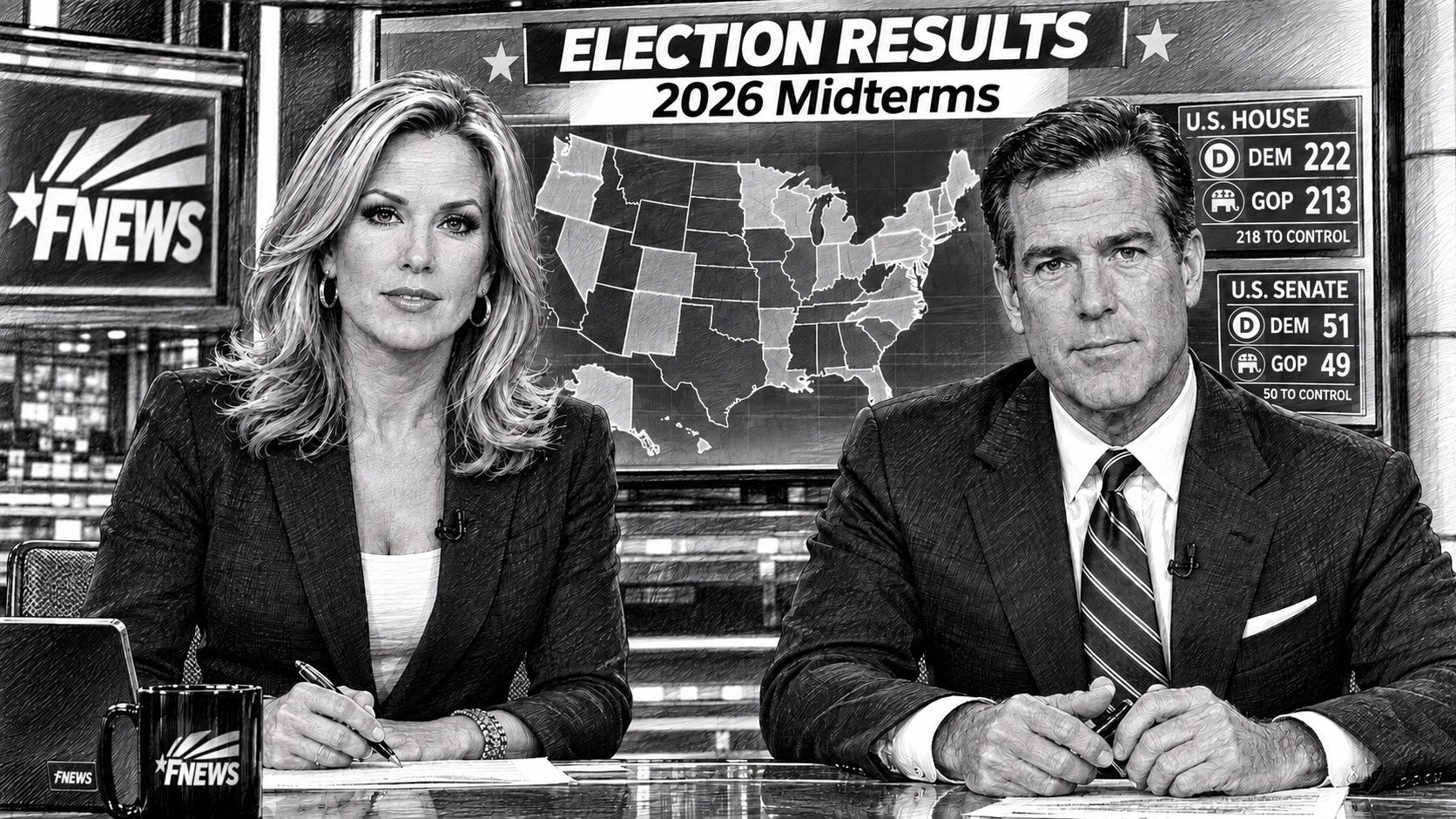
Republicans hold the House, 218 to 214 with three vacancies. Republicans hold the Senate, 53 to 45, with two independents caucusing with Democrats. Republicans hold the White House. No divided government to blame, no filibuster-proof minority to hide behind. When you judge the last nineteen months, you judge one party working every lever, on margins so thin that a handful of members could have changed nearly any outcome. But they didn’t. They are the reason there is so much division and economic harm in the United States right now.
That record includes a tariff program the Supreme Court found unlawful and the administration restarted within days. It includes a war with Iran that most Americans opposed from the opening week and that is still running. It includes Roe, overturned in 2022 by a Court seated with three appointees from this president.
It includes a Justice Department run by a corrupt attorney general. I shared several detailed articles here on Substack highlighting my concerns. Use the search feature. and plug in Todd Blanche’s name.
And there’s is the money. Reuters documented roughly $2.3 billion in pretax crypto income flowing to Trump’s family between November 2024 and April 2026, while outside investors in those same ventures (everyday people like you and me) lost approximately the same amount. Forbes put his net worth at $6.5 billion in March 2026, up $1.4 billion in a year, with crypto accounting for an estimated $1.8 billion of the gain. His own 927-page disclosure reports more than $1 billion in 2025 income: over $500 million from World Liberty Financial, over $600 million from the memecoin, and more than $50 million from media settlements. I went live to talk about Trump’s crypto grift with Molly White. You can watch the show here.
Said another way, money news organizations paid to settle presidential lawsuits appears as income on Trump’s personal financial disclosure. The regulator who approves those same companies’ mergers reports to him.
What To Do Between Now And November 3
Read and share my March 2026 post, The Right Wing Media Machine: Who Owns It, How It Works, and Why It Serves Trump. Next, treat a broadcast as a starting point. Read one primary source a week, each day if you can: a poll’s crosstabs and its sponsor, a court opinion, a financial disclosure, an agency filing. I read The Ground News to get updates and the position of each side on the breaking news stories you see me writing and talking about.
Check who owns the news outlet you watch and what that owner currently needs from Washington. When you hear a label attached to a candidate, find the policy underneath it and read the candidate’s actual position and policies.
Then talk to two people who disagree with you, and bring the facts instead of the label.
The bottom line is that you are not confused, you’re being managed. And it’s not OK.
The midterms are in November. Register, verify your registration, confirm your polling place, and make your plan now.
Mitch Jackson, Esq.
Become Part of the Uncensored Objection Community
Stop waiting for someone with a merger pending to tell you what they stand to gain. That call is not coming. Subscribe free and get the reporting, or go paid and make sure you have all the tools to let you do a deep dive on all the facts and details.
The corporate Republican party playbook: December 2024: ABC pays $15 million to settle a defamation claim from the incoming president. July 2, 2025: Paramount pays $16 million to settle his lawsuit over a 60 Minutes edit. July 17: CBS cancels The Late Show with Stephen Colbert. July 24: the FCC approves the Skydance-Paramount merger, and Carr’s announcement cites written commitments on viewpoint diversity and the elimination of DEI practices. David Ellison then installs Bari Weiss, a commentator with no broadcast news background, as editor in chief of CBS News after buying her outlet for a reported $150 million.
In September 2025, Carr told broadcasters they could do it “the easy way or the hard way.” Hours later, after Sinclair and Nexstar threatened to preempt the program, ABC pulled Jimmy Kimmel off the air. The suspension lasted six days. Kimmel returned September 23 to more than six million viewers, and Sinclair and Nexstar kept preempting him on roughly a quarter of ABC’s affiliates until September 26. The system bent for six days, then held. Both halves belong in the story.
When Disney stopped bending, the FCC in April 2026 ordered ABC to file license renewals for every station it owns by May 28. The agency says the review concerns a probe of Disney’s diversity initiatives. Press freedom advocates and Commissioner Gomez call it retaliation for keeping Kimmel on the air. Gomez wrote directly to Disney leadership: the $15 million settlement told this administration that pressure works, and told every other company watching that capitulation was an option.
Then came the big one. On March 19, 2026, the FCC’s Media Bureau approved Nexstar’s $6.2 billion acquisition of Tegna and waived the national ownership cap. The full Commission never voted, which drew criticism from members of both parties. The combined company owns 265 stations across 44 states and the District of Columbia, reaching about 80% of the population, or 54.5% of the national audience under the FCC’s own discounted formula. Either number clears 39% by a wide margin.
Eight state attorneys general and DirecTV sued the day before approval. Nexstar closed anyway on March 19. Judge Troy Nunley of the Eastern District of California issued a restraining order on March 28 and a preliminary injunction on April 17, finding the plaintiffs likely to prove an antitrust violation and ordering Tegna to operate independently until trial. Five more attorneys general, some Republican, joined by May. If Nexstar loses, it may have to unwind a merger it already completed.
Paramount’s $111 billion acquisition of Warner Bros. Discovery, which carries CNN with it, slipped to 2027 after twelve states filed their own antitrust suit and Judge Araceli Martinez-Olguin found they raised serious questions. Paramount faces more than $1.9 billion in ticking fees if the delay runs to June 2027. Ellison reportedly hosted the president and administration officials at a private dinner while federal approval was pending, with Weiss seated at the president’s table.
Meanwhile the president is personally suing The New York Times for $15 billion, The Wall Street Journal for $10 billion, and the BBC for $10 billion. A federal judge partially dismissed the Journal case in April 2026 for failure to show actual malice, and Trump amended his complaint in May. Legal analysts note he has never won a defamation case against a news organization across decades of filings. Winning may not be the point. The legal budget and the message to every media general counsel in America do the work by themselves.
When they own all the information they can bend it all they want. https://youtu.be/oBIxScJ5rlY?si=Mw9m1nzPPRd-uzE9&t=79
There’s a great Substack called ‘Decoding Fox News’, and I found her through retired FBI agent’s Substack Frank Figliuzzi and Lincoln Square podcast. I wish someone covered the psychological techniques of persuasion on “State Media”. Dr Hassan covers some persuasion techniques occasionally.