

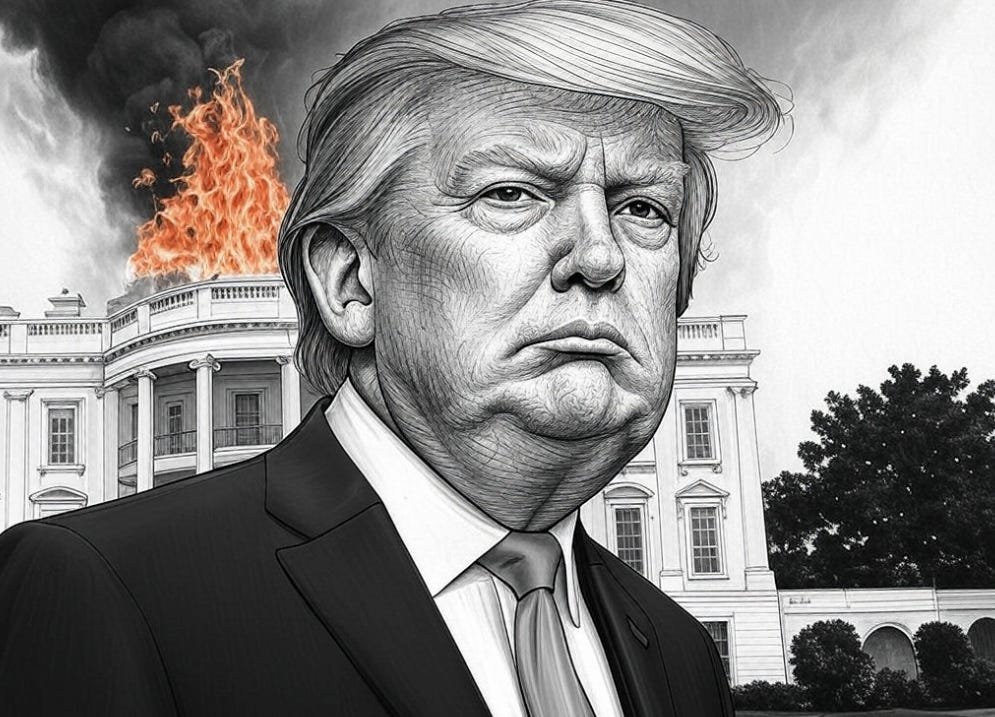
Preface
It’s been a full century since the world watched in stunned disbelief as the United States—once a beacon of democracy and reason—descended into the circus that was Donald Trump’s presidency. A hundred years have passed, and yet the question still lingers like a bad historical hangover: How in the hell did this happen?
The very idea that an unqualified, twice-impeached, criminally indicted man could not only be elected but re-elected sounds as laughable as electing a medieval jester to run a modern economy.
But it happened. It really happened.
And looking back, all we can do is ask ourselves over and over: What the actual @#$%?! were they thinking?
Introduction
It’s almost comical in hindsight — if it weren’t so utterly tragic. A full century ago, Americans willingly handed the keys of the White House to Donald J. Trump not once, but twice. Yes, twice – the only U.S. president to be impeached two times during one term somehow clawed his way back for an encore. Sitting here in 2125, sipping ethically-grown coffee in our solar-powered newsroom, we’re still shaking our heads in disbelief. How on Earth did it happen? How did the land of Washington and Lincoln allow the Trump era – a carnival of corruption, deceit, and incompetence – to run its course? Buckle up, as we travel back to the early 21st century to relive this bizarre chapter of American history, with all the scandalous details that still make us roll our eyes 100 years later.
The Rise of a Twice-Impeached President (Wait, That Can Happen?)
To properly appreciate the absurdity, start with this: Donald Trump became the first and only U.S. president ever impeached twice . The Founders probably never imagined a scenario where one impeachment wasn’t enough to shame a man out of politics. Trump shrugged off impeachment number one (late 2019) as if it were a parking ticket – that one stemmed from him trying to strong-arm Ukraine’s president for political dirt. Then came impeachment number two in January 2021, a week before his first term expired. This time? “Incitement of insurrection” after a pro-Trump mob attacked the U.S. Capitol in an attempt to overturn an election he lost, egged on by Trump’s own exhortation to “fight like hell” against the results . Historic doesn’t even begin to describe it – a president fomenting a violent assault on American democracy, in real time, on live TV.
And yet… in the ultimate reality-defying twist, tens of millions of Americans decided they were okay with all of that. A year or two later, many of the same people who watched Trump sic a mob on Congress were nodding along to his grievances and even considering putting him back in office. The WTF factor here is off the charts: getting impeached twice would have ended any other politician’s career forever. For Trump, it became a twisted badge of honor among his followers – proof that he was somehow the victim of the “establishment.” Instead of slinking away in disgrace, he plotted a comeback, and American voters (or at least a disturbingly large chunk of them) welcomed him back for a second term.
Yes, you read that right. The same man who made “You’re fired!” his catchphrase effectively told accountability to get lost – and enough Americans enabled it to make him president again. It’s the kind of plot twist even a trashy political thriller would reject as too implausible.
A Firehose of Lies: Post-Truth Presidency
One of Trump’s most jaw-dropping legacies is the sheer volume of lies that spewed from his mouth (and Twitter fingers). We’re not talking normal political spin or a few fibs to save face – we’re talking a tsunami of untruth drowning the nation daily. Fact-checkers literally could not keep up. By the end of his time in office, The Washington Post had logged over 30,000 false or misleading claims by Trump. Thirty. Thousand. Let that sink in. That’s an average of well over 20 lies per day during his presidency. The man lied about everything – big stuff, small stuff, trivial stuff. Crowd sizes? Check. (He insisted his inauguration drew the biggest crowd ever – photographic evidence be damned.) Weather maps? Check. (He once literally drew on a hurricane forecast map with a Sharpie to pretend he’d been right all along. Yes, really.) Health crises? Oh boy, check. (“It’s just one guy from China, we have it under control,” he said about COVID-19, before the virus proceeded to kill over a million Americans on his watch.)
Trump’s relationship with reality was so estranged that an entire cottage industry of fact-checking emerged just to document the daily barrage of B.S. He lied about the 2020 election (more on that later). He lied that he’d “done more than any president ever” (historians spat out their coffee). He even lied in ways that hurt himself – like constantly bragging about accomplishments that didn’t exist, which only drew more scrutiny. And the truly absurd part: a huge segment of the American public didn’t care. They either believed him (scary), or they knew he was lying but enjoyed the show (scarier). Truth became a trivial matter, something for suckers. The President of the United States was a pathological liar, and roughly half the country just shrugged. Talk about democracy in distress.
The Bully-in-Chief: Name-Calling and Divide-and-Conquer
If the lies weren’t juvenile enough, Trump brought playground-level name-calling into the Oval Office. Future generations are still perplexed by this: the leader of the free world spent his days slapping ugly nicknames on anyone who displeased him. He christened rivals with monikers like “Crooked Hillary,” “Sleepy Joe,” “Lyin’ Ted,” “Little Marco,” and “Sloppy Steve,” to name just a few. Foreign leaders weren’t spared – “Rocket Man” for North Korea’s Kim Jong Un, for example. It was petty, it was mean, and it was absolutely unprecedented at this level of American politics. As one historical account drily notes, “Donald Trump became widely known during his political career for using nicknames to criticize, insult, or otherwise express commentary about media figures, politicians, and foreign leaders.” That’s a polite way to say he turned the presidency into a roast session.
But the name-calling was just one symptom of Trump’s divisive rhetoric. He didn’t merely insult individuals – he pitted Americans against each other. He called Mexican immigrants “rapists,” described white supremacist marchers as “very fine people,” and told four congresswomen of color (all U.S. citizens) to “go back” to the countries he assumed they came from. His rallies were festivals of grievance and taunts, with Trump mocking a disabled reporter one day and encouraging chants to “lock up” his opponents the next. The tone from the top was toxic, and the country’s unity frayed like never before in modern times.
What’s mind-blowing is how many Americans indulged this behavior or even cheered it on. Instead of demanding basic decency from their president, his supporters reveled in the put-downs as entertainment. Meanwhile, others just became numb. The unending stream of bullying eroded norms so much that by the time he was calling his own Cabinet members “idiots” or labeling the free press “the enemy of the people,” it almost seemed normal. It wasn’t. It was dangerous. Trump’s words emboldened extremists and drove wedges between communities. Presidents are supposed to unite – this one gleefully divided. The fact that America tolerated a Bully-in-Chief for so long is going to baffle historians forever.
Assault on Democracy: The Big Lie and January 6th Insurrection
Of all Trump’s attacks on American norms, nothing compares to his assault on democracy itself in late 2020 and early 2021. Faced with electoral defeat, Trump did something no U.S. president had ever done: he refused to concede and instead tried to burn down the system on his way out. He cooked up the “Big Lie” – the false claim that the 2020 election was “stolen” from him – and he repeated it endlessly, loudly, and with escalating fury. Never mind that his own officials (and dozens of judges) found zero evidence of any significant fraud. Trump just would not accept reality. He and his minions filed and lost more than 60 lawsuits challenging the vote. They pressured state officials to “find votes” that didn’t exist (Trump was caught on tape begging Georgia’s secretary of state to magically conjure exactly the number of votes needed to overturn Biden’s win). When the courts and state leaders held firm, Trump’s team even toyed with outright illegal schemes – like deploying fake electors or seizing voting machines. This was no longer reality TV; this was an attempted coup in slow motion.
It all came to a head on January 6, 2021. On that day, Congress met to certify the election results – a typically ceremonial step. But Trump had other plans. He summoned a massive crowd of his most ardent supporters to Washington with a rallying cry to “Stop the Steal.” There, he whipped them into a frenzy with lies about a rigged election and not-so-subtle directives to “fight like hell” or they “won’t have a country anymore.” The result was one of the darkest days in American history: a violent mob of Trump supporters stormed the U.S. Capitol, attacking police, smashing windows, and sending lawmakers fleeing for their lives. They erected a gallows and chanted about executing the vice president. The Confederate flag was paraded through the halls of Congress. People died. The peaceful transfer of power, a cornerstone of democracy, was literally under siege.
And where was President Trump? Hunkered in the White House, reportedly gleeful at the chaos in his name. He delayed sending help and instead tweeted attacks at his own vice president even as the Capitol was overrun. It was unbelievable – the commander-in-chief watching a siege on the Capitol he sparked, as if it were a pay-per-view special.
The immediate aftermath brought a swift, if overdue, consequence: a bipartisan majority of the House of Representatives impeached Trump for “incitement of insurrection,” making him the only president impeached twice . Even some Republicans who had loyally defended him finally broke ranks – briefly. The Senate, however, failed to muster the two-thirds needed to convict (surprise: enough GOP senators still couldn’t turn on their cash cow). So Trump faced no real punishment at the time – legally, at least.
The scariest part? After January 6th, millions of Americans remained in Trump’s thrall. Rather than universally rejecting a leader who literally inspired an attack on our Capitol, a large chunk of the country started downplaying the insurrection. They echoed Trump’s baseless claims that the rioters were just “patriots” or that the whole thing was somehow staged by the left. This national gaslighting was perhaps Trump’s cruelest legacy: he got a significant portion of Americans to doubt what they had just seen with their own eyes.
It’s no wonder that today, in 2125, scholars use the Trump era as a case study in how fragile democracy can be. The fact that American democracy survived this attempted self-sabotage was thanks to a few brave officials and the sheer inertia of institutions – but it came perilously close to unraveling. And yet, astonishingly, the nation was not done with Donald Trump.
Lawlessness and Order: A Legal Nightmare
If Donald Trump ever had an ideological principle, it was simple: Donald Trump can do no wrong. From day one, he acted as if laws and rules were for suckers and other people. He openly said “I have an Article II, where I have the right to do whatever I want as president.” That mindset set the stage for four years (and then some) of legal chaos.
Consider this laundry list: Trump fired the FBI director for investigating him. He interfered in Justice Department cases (trying to shield his guilty pals and target his enemies). He stonewalled every congressional subpoena during his first impeachment inquiry, effectively declaring himself above oversight. He dangled pardons to discourage associates from testifying against him. His personal lawyer even argued in court that Trump couldn’t be investigated at all while in office – not even if he shot someone on Fifth Avenue (yes, they really argued that). The man’s view was literally that he was immune from accountability of any kind.
That attitude caught up with him, eventually. By the time he was running for a second term, the legal system had finally started to bite back. Multiple criminal indictments came down – unprecedented in U.S. history. He was indicted for financial crimes in New York, for hoarding classified documents at his Florida mansion, for election interference at the federal level, and for election tampering in Georgia. It was as if every scheme he’d attempted was boomeranging back with a vengeance. His resume of infamy included being a twice-impeached, multiply-indicted ex-president facing the real prospect of prison.
In fact, in 2024 a Manhattan jury did something many had long thought impossible: it found Donald Trump guilty on 34 felony counts of falsifying business records, all related to a hush-money payoff to a porn star he’d slept with, which he had tried to bury during the 2016 election. Think about that for a second. The 45th President of the United States was convicted of felonies stemming from an affair with a porn star and a cover-up scheme involving phony business records. The surreal scandal that would have annihilated any other politician’s career barely made Trump’s supporters blink. They simply added it to the long list of “attacks” on their martyr and moved on.
Trump’s entanglements with the law didn’t stop there. After leaving office, he was found liable for sexual abuse in a civil trial brought by writer E. Jean Carroll – a jury concluded that Trump sexually assaulted her in a luxury department store back in the 1990s and then defamed her by calling her a liar, ordering him to pay $5 million in damages. Yes, an American president was adjudicated in court as a sexual abuser – and still remained the de facto leader of one of the country’s two major parties. It’s the kind of rot that is hard to fathom. By that point, over two dozen women had publicly accused Trump of sexual misconduct over the decades, from groping to outright assault. He infamously bragged on tape about grabbing women without consent (“when you’re a star, they let you do it,” he smirked). Any one of these episodes should have ended a career. For Trump, it was Tuesday.
Meanwhile, Trump continuously tried to game the legal system to his advantage. He delayed, appealed, and obstructed at every turn. He often acted like the law simply did not apply to him – and for a long time, he got away with it. He even floated the idea (with a straight face) that as president he could pardon himself preemptively for any crimes and that he had “absolute immunity” from prosecution. This was a man who apparently mistook himself for an emperor rather than a public servant. The truly maddening part is how many officials and judges bent over backwards to indulge these delusions for years, treating him with kid gloves because he was a former president, even as evidence of serious wrongdoing piled up.
Looking back now, the Trump legal saga represents a stress test of the American justice system. For a while, it seemed like rich and powerful really did mean above the law. Only after enormous damage was done did accountability finally catch up to Trump – and even then, it was half-hearted until the very end of his reign. The WTF question for posterity is: why did it take so long? Why did so many who knew better (from attorneys general to Republican senators) enable his legal tantrums instead of stopping the madness early? We may never fully understand that cowardice.
Foreign Policy by Flattery and Folly: Embracing Dictators, Undermining Allies
If Trump’s domestic behavior was chaotic, his foreign policy was outright upside-down. The man had a bizarre soft spot for dictators and strongmen – and a glaring contempt for America’s democratic allies and alliances. It was as if decades of U.S. leadership in the free world got tossed out the window in favor of whatever autocrat last flattered Trump’s ego.
Trump repeatedly fawned over Vladimir Putin, the Russian president – even against America’s own interests. Famously, after a meeting in Helsinki, Trump publicly took Putin’s word over the unanimous conclusion of U.S. intelligence agencies that Russia had interfered in the 2016 election. When Putin launched a brutal war against Ukraine in 2022, what did Trump do? He praised Putin for his “savvy” and called the invasion “genius” and “wonderful” – jaw-dropping words as Russian bombs fell on Ukrainian cities . In Trump’s distorted worldview, apparently Russia wasn’t the aggressor at all. He even went so far as to claim that Ukraine “should never have started” the war, absurdly suggesting Russia didn’t start the conflict – effectively blaming the victim of the invasion. Yes, the one-time leader of the free world parroted Kremlin talking points, to the horror of anyone with a moral compass.
His stance on Ukraine only got more deranged during his second term. Less than a month into that term, Trump outright denounced Ukraine’s president, Volodymyr Zelenskyy, as “a dictator” and warned that Zelenskyy should make a deal with Putin fast or “he’s not going to have a country left”. The irony was stupendous: Trump slobbered praise on actual dictators (Putin, North Korea’s Kim Jong Un, China’s Xi Jinping) while smearing a democratically-elected leader fighting for his nation’s survival. European allies were alarmed and aghast – and rightly so. Trump’s cozy relationship with Putin and his hostility toward Ukraine made it feel like NATO had an adversary within its own ranks.
Ah, NATO – another Trump target. For decades, NATO has been the cornerstone of Western security, deterring Russian aggression. Trump treated it like a scam where allies were out to rip off America. He repeatedly mused about the U.S. quitting NATO, calling the alliance “obsolete,” and he publicly browbeat allies (especially Germany) to pay more for defense in the most undiplomatic ways. At his very first NATO summit, the American president refused to explicitly endorse Article 5, NATO’s mutual defense clause – leaving allies uncertain if the U.S. would come to their aid if Russia attacked . It was unprecedented and sent shivers through Europe. Later, he suggested that if he got a second term, maybe the U.S. wouldn’t defend certain NATO countries unless they paid up, effectively turning American security guarantees into a mafia-style protection racket. The long-term damage to U.S. credibility was severe. Allies started preparing contingency plans, unsure if Washington could be trusted.
Meanwhile, Trump embraced every dictator in sight. He boasted about the “love letters” he exchanged with North Korea’s Kim (declaring “we fell in love,” no joke). He heaped praise on China’s President Xi (“he’s a very good friend of mine,” Trump cooed, even as Xi cracked down on Hong Kong and mused about invading Taiwan). He welcomed Hungary’s autocratic prime minister and the Philippines’ strongman to the White House with open arms. When Saudi Arabia’s crown prince orchestrated the murder of a U.S.-based journalist, Trump’s reaction was to defend the Saudis and say business was business. Time and again, Trump sided with or excused the world’s most repressive regimes, undercutting America’s moral authority.
This foreign policy of flattery and folly left allies staggered and adversaries delighted. Russia and China couldn’t have scripted it better: an American president undermining NATO from within and sowing discord in the Western alliance. And yet a segment of Americans – egged on by partisan media – somehow believed Trump was making America “respected” again internationally. (In reality, global polls showed trust in U.S. leadership plummeted during those years.) It’s a lasting WTF moment: the nation that championed freedom and democracy after WWII had a president who openly preferred the company of dictators. The damage took years to repair.
The “King of Debt” Reigns: Fiscal Hypocrisy and Economic Mayhem
Donald Trump loved to portray himself as a business genius, a dealmaker extraordinaire who would run America like one of his “successful” businesses (never mind the multiple bankruptcies). He railed against the national debt on the campaign trail, promising he’d eliminate it completely (an outrageous claim nobody should have believed). Instead, once in power, Trump proved to be, in his own words, the “King of Debt” – and not in a good way.
Under Trump’s watch, the United States’ finances went deep into the red at a pace rarely seen outside of wartime or recession. In fact, the national debt ballooned by about $7.8 trillion during just his first four years – a spike equivalent to nearly 40% increase. To put that in perspective, that’s almost twice the total amount of debt the U.S. accumulated during the entire 1980s. It was one of the largest debt expansions under any president, ever. And this was before Trump’s chaotic second term added even more red ink to the ledger. By the end of his era, Trump had added tens of trillions of dollars to the debt, ensuring that future generations would be footing the bill for his folly.
How did the self-proclaimed fiscal savior wind up nuking the budget? Start with his 2017 tax cuts – a massive giveaway to corporations and the wealthy that Trump promised would “pay for itself.” It didn’t. Instead, it blew a huge hole in the deficit with no meaningful growth bump to show for it. Then add Trump’s free-spending habits (he was never one to say no to an expensive whim, whether a military parade or farm subsidies to band-aid his trade war damage). And speaking of trade wars: his tariff-happy policies hurt American businesses and consumers without achieving their stated goals, acting like a self-imposed tax hike that stunted economic growth and ironically reduced tax revenue. Finally, factor in the emergency spending during the pandemic (which was necessary, but which Trump treated as an excuse to spend big without a plan). The result was a trajectory where by 2025, U.S. debt was skyrocketing toward levels never seen before.
The astonishing part was the silence of the so-called deficit hawks in Trump’s party. Republicans who screamed about debt under previous presidents (remember the Obama-era tirades about every dollar of spending?) suddenly didn’t seem to mind when Trump was in charge. Trillions added to the debt for tax cuts and stimulus during a boom? Sure, no problem, as long as their guy was signing the checks. The hypocrisy was galling. It became obvious that all the moralizing about fiscal responsibility was just a cudgel to use against political opponents, not an actual principle.
Trump had promised to “make America rich again,” but instead he mortgaged the country’s future. After 100 years and now, in 2125, we can thankfully report that through a combination of reforms and frankly a century of hard work, America climbed out of that fiscal hole. But it took decades. The Trump debt hangover acted like a millstone on the economy for a generation. It’s a lasting reminder that bluster is no substitute for sound policy. And it’s beyond ironic that a man who wrote a book called The Art of the Deal made one of the worst deals imaginable for America’s finances – all while pretending everything was great.
Personal Decay: Scandals, Sex, and Something Called “Integrity”
By now it should be clear that Donald Trump’s presidency was a perfect storm of ethical failures. But we’d be remiss not to delve into the personal scandals and moral cesspool that accompanied this man everywhere he went. Because it’s truly mind-blowing that Americans — many of them religious “family values” voters — were willing to look the other way at Trump’s behavior.
Let’s start with the marital infidelity. Trump managed the hat trick of cheating on all three of his wives. His first marriage, to Ivana Trump, collapsed when his affair with a younger model, Marla Maples, burst into the tabloids in the early 1990s (complete with Marla’s cringe-worthy boast that sex with Donald was the “best” she ever had — too much information, thanks). He married Marla, but that union didn’t last long either, amid rumors of further philandering. By the time he was with his third wife, Melania, Trump hadn’t exactly reformed. In 2018, the world learned that Trump’s lawyer had paid $130,000 in hush money to adult film star Stormy Daniels to keep her quiet about a tryst she had with Trump in 2006 – a time when Melania was at home caring for their infant son. This payoff was made days before the 2016 election, effectively buying silence to boost his campaign, and later led to the criminal case that got Trump indicted and eventually convicted. Imagine the scandal: a sitting president found to have illegally covered up an affair with a porn star. It’s the kind of thing that would have ended past presidencies in an instant. Under Trump? No big deal. His supporters either dismissed it as “personal” (suddenly morality didn’t matter) or spun wild conspiracies that all his accusers were lying. The cognitive dissonance was insane.
And it wasn’t just Stormy Daniels. Another woman, Playboy model Karen McDougal, also alleged an affair and received a hush payment via Trump’s friends at the National Enquirer. Plus, by the end of Trump’s first term, at least 26 women had accused him of sexual misconduct ranging from harassment to assault. Twenty-six women. That included the aforementioned E. Jean Carroll, who won her case against him – a jury legally branding the former president a sexual abuser. Other accusations dated back decades, with strikingly similar stories: Trump would corner women, grope them, kiss them against their will. He infamously bragged about this behavior on the Access Hollywood tape, caught on a hot mic in 2005 saying “grab ’em by the py*” and “when you’re a star, they let you do it.” That tape became public just weeks before the 2016 election. In any normal universe, that would have been game over for a candidate. For Trump, it barely made a dent. Many of his voters shrugged it off as “locker room talk,” and astonishingly, some evangelical Christian leaders gave him a mulligan for it. The same people who once hounded Bill Clinton for his morals were suddenly willing to forgive anything as long as Trump delivered their political agenda. The hypocrisy was the size of Trump Tower.
Under Trump, the presidency’s dignity hit rock bottom. Here was a commander-in-chief who paid off mistresses, basked in crude jokes about his sex life, and faced more sexual misconduct claims than all previous presidents combined. Yet a huge portion of America either excused it or outright denied it was real. It’s a case study in tribalism: for those enthralled by Trump, no amount of personal disgrace was too much. They’d simply twist themselves into pretzels to defend him (“we elected a president, not a pope,” they’d say, or “he’s flawed, but he’s fighting for us”). Meanwhile, the rest of the country looked on in horror, wondering what happened to basic standards? The Oval Office was once occupied by the likes of Jimmy Carter – who famously admitted lusting in his heart was his greatest moral failing. Now it was occupied by a man who raw-dogged a porn star while his wife was home with a baby, and paid her off to win an election. The contrast is stark enough to give one whiplash.
The Trump years forced America to ask: Do character and integrity mean anything in our leaders? For a while, disturbingly, the answer from many was “not if he gives us what we want.” This moral flexibility proved corrosive. It sent a message that winning was more important than decency. Only after Trump was gone did some of his allies quietly admit they’d made a devil’s bargain. But by then the damage to the nation’s conscience was done.
Earth Last: Trump’s War on the Planet
Climate change, environmental protection, science – in a sane world, these would be non-negotiable priorities for any modern government. Not so in the Trump era. Trump took office proclaiming “America First,” but when it came to the environment it was more like “Earth Last.” He unleashed an unprecedented rollback of environmental safeguards, all in the name of short-term gain and spite for his predecessor’s policies.
Trump’s administration was basically a wish list for polluters. Environmental regulations of all kinds were slashed or sabotaged. Protections against air and water pollution? Weakening them was a priority. Conservation of public lands? He opened up vast tracts of wilderness for mining and drilling. Action on climate change? Forget about it – Trump literally withdrew the United States from the Paris Climate Accord, making America the only country in the world at the time to formally reject the global agreement to reduce carbon emissions. It was a moment of profound shame for many Americans: the nation that once led on environmental progress voluntarily became a rogue state on climate under Trump.
Over four years, Trump’s government took at least 74 separate actions to weaken environmental protection – an absolute blitzkrieg on decades’ worth of bipartisan green initiatives. He gutted the Environmental Protection Agency’s budget and staff. Scientists were muzzled or driven out; climate experts in government were reassigned or silenced. He rolled back rules on power plant emissions, vehicle fuel efficiency, clean water standards, you name it. Perhaps one of the most absurd was the rollback of Obama-era lightbulb efficiency rules – yes, Trump was pro-incandescent bulb, because apparently even the color of light could be a partisan issue. His motive seemed part ideology (a fervent belief that any regulation is bad) and part sheer contrarianism (if Obama did it, Trump wanted to undo it out of spite).
The phrase “climate change is a hoax” was something Trump had tweeted back in 2012, and disturbingly, he governed as if he truly believed it. This, during a time when climate-fueled disasters – hurricanes, wildfires, heatwaves – were pummeling the country. Trump responded to these crises with denial and deflection. When California burned, he falsely claimed the state just needed to “rake” its forests better. When Puerto Rico was devastated by hurricanes, he feuded over how many people died and tossed paper towels to survivors in a photo-op. The lack of empathy and foresight was breathtaking. America, which had once championed global environmental efforts, became an obstructionist, laggard, even an active saboteur on Trump’s watch.
The American public’s reaction? Mixed, tragically. There were certainly many who were outraged – young people especially mobilized in climate marches, and states tried to enforce their own environmental standards to fill the void. But Trump’s base largely cheered the rollbacks, buying into the short-term promise of “bringing back coal” (he didn’t) or simply enjoying the fact that their guy was sticking it to the liberals and the scientists. The long-term cost – an exacerbated climate crisis – was not something they appeared to consider.
Looking back now, in our era of carbon-neutral cities and climate restoration projects, the Trump years are seen as precious lost time in the fight against global warming. The fact that Americans tolerated such reckless anti-environmental policies is another head-scratcher. It took years of effort after Trump to regain global trust and momentum on climate action. The only silver lining: the backlash to Trump’s policies helped galvanize a new generation of environmental leaders who ensured that, once he was out, the U.S. not only rejoined the Paris Accord but went further than ever in pursuing clean energy. But we will always wonder how much further ahead we’d be if Trump’s term hadn’t been such an environmental black hole.
Enablers and Appeasers: The Cowardice of Those Who Knew Better
Perhaps the most infuriating aspect, when we reflect on the Trump saga, is this: He couldn’t have done it alone. Donald Trump by himself was a deeply flawed, one-man wrecking crew, sure. But he needed enablers. And boy, did he have them – in Congress, in his administration, in the media, and among the wealthy donor class. Many of these people initially opposed Trump, or at least recognized his unfitness, yet they eventually embraced and empowered him, putting power and profit over principle. Their hypocrisy and cowardice were the secret sauce that made Trump’s toxic recipe possible.
Remember the 2016 Republican primary? Almost every one of Trump’s rivals blasted him at the time. Senator Ted Cruz, for instance, famously called Trump “utterly amoral” and a “pathological liar” — in Cruz’s own words, “morality does not exist for him”. Strong words, right? Fast forward a few years: Ted Cruz became one of Trump’s most sycophantic defenders, even after Trump insulted Cruz’s wife and father. Why? Because Cruz smelled political opportunity – attaching himself to Trump’s base was his ticket to power, principles be damned.
Or take Senator Lindsey Graham. In 2015, Graham warned that if Republicans nominated Trump, “we will get destroyed… and we will deserve it.” He called Trump a “race-baiting, xenophobic, religious bigot.” Pretty accurate, one might say. Yet by year two of Trump’s term, Lindsey was golfing with Trump and praising him on Fox News as the best thing since sliced bread. He had flip-flopped so hard it was like watching a spinning top. The reason was obvious: influence. Graham decided he liked being in the inner circle of power more than he cared about his own prior integrity. In one particularly stomach-churning quote, Graham quipped, “He’s a jackass, but he’s our jackass.” That about sums up the attitude of so many in the GOP: Yes, he’s awful – but he’s useful to us.
Even people like Mitt Romney, one of the few Republican senators who maintained some criticism of Trump, still voted with Trump’s positions the vast majority of the time and only gently pushed back on occasion. House Speaker Paul Ryan privately bemoaned Trump’s behavior, but in public he enabled Trump’s agenda every step of the way, refusing to hold him accountable. By the end of Trump’s reign, nearly the entire Republican Party had morphed into Trump’s party, even those who once plotted to stop him. They defended or ignored his worst abuses, from the Muslim travel ban to the Ukraine quid pro quo, all in the pursuit of tax cuts, judges, and the adulation of the MAGA base.
And it wasn’t just elected officials. Media moguls and propagandists played their part. Fox News, which in early 2016 was skeptical of Trump, quickly became his personal cheerleading squad, spreading his lies (especially the election lies) to millions. They knew better – internal communications later showed many Fox personalities disbelieved Trump’s fraud claims, but they promoted them anyway to keep ratings up. You would have thought that Fox News paying Dominion $787.5 million in a lawsuit settlement, and acknowledging it had broadcasted false statements about Dominion, would have turned things around. It didn’t.
Money talked, truth walked. Social media giants, too, largely gave Trump free rein to spread misinformation for years, only stepping in with mild fact-checks very late in the game. And let’s not forget the donor class: billionaires who found Trump distasteful at cocktail parties but loved the fat tax cuts he gave them. They wrote checks and funded pro-Trump PACs, helping to bombard the airwaves with pro-Trump messaging, all while privately wringing their hands about his “tweets.” Profiles in courage, they were not.
This grand tapestry of enabling extended even to those in Trump’s own administration. We saw a parade of officials who knew Trump was unhinged (some wrote tell-all books later, spilling how unstable or ignorant he was behind closed doors), yet while in power they did little to stop him. Aides would anonymously leak that Trump had to be managed “like a toddler,” but then they’d smile and nod in meetings as he ranted nonsense. Some cabinet members, like General Jim Mattis or Rex Tillerson, did eventually quit and voice alarm, but only after serving long enough to lend Trump unearned credibility on their watch. Others, like Attorney General Bill Barr, drew a line very late (Barr finally told Trump his election fraud claims were “bullshit” – but this was after years of enabling Trump’s abuses and effectively acting as his personal lawyer rather than the nation’s). By the time a few grew a spine, the damage was done.
The collective failure of these enablers is one of the great cautionary tales of the Trump era. It showed that our system’s checks and balances are only as strong as the people who uphold them. In Trump’s case, far too many people who should have checked his worst impulses instead chose expediency. They thought they could ride the tiger and get off whenever they wanted. But when you ride a tiger, you end up inside it. Many of their careers ended in disgrace or irrelevance, and their reputations – if they cared – were tarnished. Unfortunately, the country paid a much higher price for their complicity.
It’s easy, from the vantage of 2125, to say “Shame on them.” And indeed, shame. But it’s also a reminder: the next time a demagogue rises, it’s not enough for just the opposition party to resist. It takes honorable people on all sides to stand up for democracy and truth. During Trump’s reign, those people were distressingly few. The ones who did – a tip of the hat to folks like the late Senator John McCain, or Rep. Liz Cheney and Adam Kinzinger who sacrificed their political careers to oppose Trump’s Big Lie – were ostracized by their party. The lesson was stark: in that period, loyalty to Trump mattered more than loyalty to country within one of America’s major political parties. That was a dangerous development, and it took a near-catastrophe to finally break the spell.
The Breaking Point: When America Finally Had Enough
So how did this saga end? For a long time, it felt like America was stuck in a bad reality show that would never get canceled. But even the most patient audience has a breaking point. By the latter half of Trump’s chaotic second term, Americans across the spectrum finally hit “enough.” The exact trigger is still debated by historians – was it a fresh scandal that made Watergate look tame? A complete economic meltdown? Or just fatigue and accumulating disgust reaching a tipping point? In truth, it was probably all of the above.
Trump’s second term (2025-2029) was, if you can believe it, even more tumultuous than the first. Freed from ever facing voters again, Trump doubled down on his worst instincts. The guardrails were gone. Reports emerged of even more flagrant abuses of power – from attempts to use the military against domestic opponents, to brazenly trying to cancel parts of the Constitution to cling to power. The corruption, the incompetence in crises, the relentless scandals – it all just kept piling up. The nation’s patience wore thin. His poll numbers, which had been seemingly impervious to scandal for so long, began to sink as some of his 2016 and 2024 voters finally peeled away, horrified by what they saw or simply exhausted.
In Congress, the mood shifted. The very Republicans who had shielded Trump started seeing him as a liability to their own survival. It didn’t hurt that by this point, multiple criminal trials were allowed to move forward because of new laws and legislation. Enough was enough. Each trial reaching conclusion. One by one, the legal dominoes fell. Trump was convicted in several courts – not just the New York case, but also on federal charges. Seeing a sitting (or soon-to-be-ex) president potentially head to prison was beyond the pale. The symbolism was profound: the justice system, slow and plodding, had finally caught up with the decades of wrongdoing.
The final straw came in mid-2028, when evidence emerged of something so egregious that even Trump’s loyalists could not defend it – an act that blatantly put the nation in danger (some accounts say it was proof he’d personally profited from facilitating foreign interference in that year’s election; others point to a constitutional crisis where he defied a Supreme Court ruling and tried to seize emergency powers). Whatever it was, it shattered the remaining support in Congress. In a rapid turn of events, the House launched a fresh impeachment – Trump’s third, an unheard-of scenario. This time, as the country and even much of his base turned on him, the Senate finally found the courage (or the cover) to convict. As 2029 dawned, Donald J. Trump was removed from office, a mere few weeks shy of the natural end of his term. It was a humiliating end: escorted out of the White House, impeached for a record third time – and this time convicted, barred from ever holding office again.
The aftermath was a mixture of national relief and international jubilation. Crowds actually poured into the streets to celebrate the restoration of sanity, as if a war had been won. Trump, furious and still proclaiming his victimhood to whoever would listen, didn’t have long to rant: the criminal convictions ensured that he soon traded his designer suits for a prison jumpsuit. In a twist of poetic justice, the man who once bellowed “Lock her up!” about his opponent himself got locked up. It was the culmination of a saga that many doubted would see real accountability. At long last, the spell was broken.
Americans, chastened by this close brush with authoritarianism and chaos, set about repairing their democracy with a fervor not seen in generations. In the 2030s, a wave of reforms swept the land. Election laws were strengthened to safeguard against the kind of subversion Trump attempted. Ethics rules were tightened drastically: no more could a president so easily ignore conflicts of interest or obstruct justice without consequence. Some even pushed for a constitutional amendment to ensure that no person so hostile to democratic values could ever rise to power again – for instance, by barring those who incite insurrection from holding office (an idea actually rooted in the 14th Amendment that suddenly got fresh traction). Civics education was revitalized to inoculate future voters against demagogues. And perhaps most importantly, there was a renewed social commitment to truth and integrity. Fact-checking and accountability in media became the norm, not an afterthought. Major media outlets that had trafficked in Trump’s lies faced public reckonings and reformed or faded away.
It didn’t happen overnight, and it didn’t happen without backlash (the end of Trump’s reign was messy – there were isolated violent protests by the hardest of his hardcore fans, but they fizzled without their leader’s backing). But the ship of state slowly righted itself. In the decades that followed, America experienced a kind of democratic renaissance. Leaders of both parties (yes, the GOP survived, after a radical makeover and purge of the Trump cult influence) embraced a new ethic: country over party, truth over tribalism. It became politically toxic to be seen as another Trump; his name became synonymous with disgrace. Future politicians would sometimes still test the waters of demagoguery – we are not perfect – but the collective memory of the Trump debacle served as a potent warning. “Do you want to end up like Trump?” became an effective ad hominem to shut down would-be imitators.
And so, the American experiment endured. As we pen this in 2125, the Trump presidency stands as a cautionary tale taught in every history class: how a great nation can lose its way when charlatans are given free rein, and how dangerous it is when good people stay silent. It took far too long for America to wake up. The frustration, the face-palming incredulity we feel even now – what were they thinking back then? – is tempered by the relief that, eventually, Americans did rise to the occasion and reclaim their democracy. The ship nearly sank, but it didn’t.
In the end, Donald Trump – with all his impeachments, lies, insults, insurrections, crimes, and scandals – did not destroy America. If anything, America ultimately used the painful lessons of his era to strengthen the guardrails of our republic. We established new standards of ethical conduct, laws that ensure a future president who tries Trump’s tricks will be swiftly checked or removed. We recommitted to truth as the foundation of our public discourse. It took a national near-death experience to get there, but the United States emerged more resilient.
Still, the question lingers: Why did we have to learn the hard way? Why did so many decent Americans allow themselves to be gaslit and led astray by someone so obviously unfit? That’s a question for the psychologists and sociologists, perhaps. From a journalist’s perspective, the Trump saga reinforces something fundamental: democracy is not a spectator sport. The moment citizens tune out and stop demanding integrity and accountability, someone like Trump can waltz in with a red hat and a catchy slogan and wreak havoc.
So here’s hoping that 2125’s citizens remember this lesson well. We came harrowingly close to losing it all a century ago. Let’s never let that kind of mass civic negligence happen again. America, after all the WTF moments of the Trump years, proved that it could correct its course. The truth won out. Integrity and decency made a comeback. Democracy survived – battered, but intact.
And to that, we say: about damn time.
Mitch Jackson, Esq. | links
This post is free.
But free doesn’t build the future.
Independent journalism only works when people like you choose to lean in—not just with attention, but with support.
If this work matters to you, today’s a great day to take the leap.
$5 a month. $50 a year. For you or gift to a friend.
A small investment in something bigger than all of us.

Now it’s all becoming clear! The Republican’s South African leader and his orange lapdog have given them the audacity to let their masks fall away.. the masks of Christianity, compassion, love for your neighbor, of not judging others, of taking care of widows and orphans, the weak and the poor,.. all these masks have fallen away and we now see the real bigots and know their fear. . .they’re a bunch of scared small minded fools who will and have sold their souls to retain some semblance of relevance.
While Trump himself bears significant responsibility, his enablers in Congress, the media, and elsewhere are indeed arguably more culpable, as they often recognized his unfitness yet supported him for political gain.
These enablers, despite initially opposing Trump, ultimately embraced and empowered him, prioritizing party loyalty and personal ambition over the national interest. For instance, figures like Ted Cruz and Lindsey Graham, who once harshly criticized Trump, became some of his most ardent defenders. This hypocrisy and opportunism were crucial in normalizing Trump's behaviour and agenda.
These enablers need to be held accountable and removed from public office. Their willingness to support Trump, despite recognizing his detrimental impact on democratic norms and institutions, makes them complicit in the potential erosion of American democracy. Their actions are particularly egregious because they often possess the knowledge and experience to understand the consequences of their support.
Ultimately, addressing the threat posed by Trump requires not only focusing on him but also on the broader network of enablers who have made his political resurgence possible. Voters and civil society must work to ensure that those who prioritize power over principle are not allowed to continue shaping the country's future.