

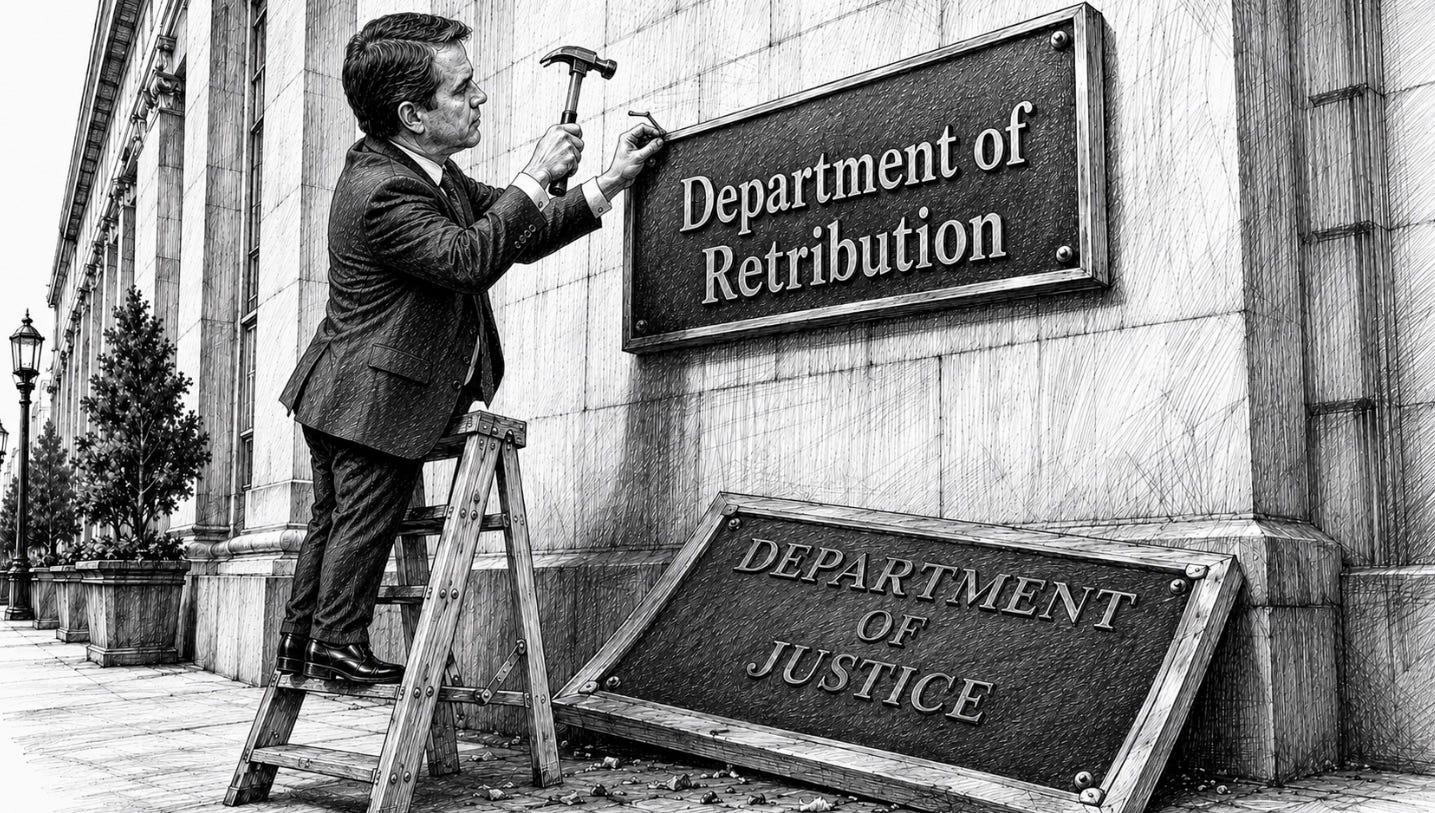
Monday. The Docket.
Here is the week ahead. What I expect from this administration. What the courts decide. What Congress votes on. What Trump says. And which slice of all of it lands on your kitchen table.
The Docket usually runs short and fast. Today it runs long, because of two men. The soon to be Attorney General, Todd Blanche. And the man Blanche once told, out loud, “I love you.” Donald Trump. Stay with me to the end.
Everything you file under normal is about to change.
I am telling you this the same way I open a trial. Before the first witness takes the stand, I tell the jury exactly what is coming and why. I tell them what the evidence will show. By the end of the case, I ask them to make sure I kept my promise and if so, to deliver justice to my client.
Consider this my opening statement to you. What follows lands over the next seven days and keeps landing through New Year’s Eve.
Brace yourself. Read every word, because at the end I hand you a job.
Four Thirty in the Morning
Picture the Senate floor at four thirty on a Saturday morning. Lights humming. Air thick with cold coffee and old carpet. A clerk reads names into a microphone and the sound bounces off the marble because almost no one is left in the room to catch the words. Fifty yes. Forty nine no. Two Republicans, Susan Collins and Lisa Murkowski, stood with every Democrat and voted no.
The gavel dropped in the dark. And Todd Blanche, the lawyer who sat at Donald Trump’s elbow while a New York jury convicted Trump of thirty four felonies, became the next Attorney General of the United States.
Ask yourself when you last did something honest at four thirty in the morning. Then ask why the Senate booked this one vote for the middle of the night, in the dark, with the whole country asleep.
They picked that hour on purpose. Hold onto that.
The Man They Handed the Keys To
You know the résumé. Blanche defended Trump in the hush money trial. He served as Deputy Attorney General under Pam Bondi. Trump fired Bondi in April, slid Blanche into the acting seat, and spent the summer leaning on the Senate to make the job permanent.
Look at what he did with a temporary badge.
He built a fund holding close to one point eight billion of your tax dollars, stamped it anti weaponization, and aimed it at paying people who claim the government came after them. Some of those people were charged over January 6. He signed a deal permanently blocking the IRS from chasing tax claims against Trump, his oldest sons, and the family businesses.
A federal judge named Kathleen Williams read the lawsuit behind that deal and found an improper purpose sitting inside it. Former judges looked at the same arrangement and reached for two words. Collusion. Fraud on the court. Judge Williams mailed her order to the New York bar and to the District of Columbia bar, where Blanche and his colleague hold their law licenses, and asked those bars to decide whether the two of them deserve discipline.
I have practiced law for four decades. Reading that stops me cold. A sitting judge refers the nominee for Attorney General to two bar associations for possible discipline, during the same weeks the Senate weighs whether to confirm him. This does not happen to lawyers. This does not happen to judges. Folks, nowhere close to normal.
He then rescinded the fund in a signed memo, the kind of memo carrying zero legal force, timed to lock down Republican votes right before the count.
Then there is James Comey. Charged with threatening the president over a photograph of seashells lined up on a North Carolina beach to read 8647. Posted, then deleted. Two federal counts. Over shells in the sand.
Then there is Epstein. Blanche flew to Florida, sat with Ghislaine Maxwell across two days, generated more than three hundred pages of transcript, and never once pressed her on the lies a jury already rejected. Congress passed a law ordering the Epstein files released. Blanche is sitting on three million of them and handing Congress and the courts a raised middle finger. The survivors are furious. Most of the country stands with them.
What This Monday Morning Looks Like
The confirmation is finished. The swearing in follows. Once Blanche takes the oath, the temporary label falls away and he owns the title, the seal, the budget, and every federal prosecutor in the country reporting up to his desk.
Watch the file cabinet. The rest of the year already sits on the calendar. Here is the docket, case by case.
Comey, track one. September 15.
A federal appeals court in Richmond hears this one on September 15. One question sits on the table. Did Lindsey Halligan hold the legal power to charge James Comey and Letitia James in the first place.
Halligan got installed to run the federal prosecutor’s office covering northern Virginia, Richmond, and Norfolk. Senior Judge Cameron Currie, a Clinton appointee, ruled she never held the job lawfully.
The judge assignment tells its own story. Currie normally sits in South Carolina. The chief judge of the appeals court brought her in from out of state because the Virginia federal judges have an official role in filling that prosecutor post, and he wanted to protect public confidence in fair administration of justice. Translation. The local judges had skin in the game, so an outsider took the case. Three appeals judges decide, and their names stay sealed until the morning of argument.
Understand what a win actually buys the Department. No do over. The original charges against Comey come back and nothing else. Prosecutors filed against him days before the deadline expired, and Currie signaled they hold no power to bring fresh ones, because that clock ran out at the end of September 2025.
Every crime carries a filing deadline. Miss it and the case dies, no matter how strong the evidence looks. The government cut this one to the wire.
On the Letitia James side, the Department already handed the question to ordinary citizens and lost. Before charges move forward, a grand jury of regular people has to agree the evidence is there. Those panels almost always say yes. Grand juries in Norfolk and Alexandria each refused to charge her. Two panels. Two rejections. Not enough evidence.
Stack up every one of these failures and you would expect the light to come on. You would expect Blanche and his DOJ to turn their time and resources toward the Jeffrey Epstein cases. Toward justice for the survivors. Toward hunting down real predators.
Wrong.
I wish I were kidding.
Real criminals hold no interest for this crew. Blanche and his DOJ are doubling down on charging Trump’s enemies with more invented crimes. They plan to reshape your world between now and the midterm elections.
The name for this is political retribution. It gets uglier every week between now and the end of the year.
Back to the crystal ball.
Halligan left the Virginia office in late January. In February the Virginia federal judges unanimously picked James Hundley, a veteran trial lawyer, and Chief Judge M. Hannah Lauck swore him in on a Friday evening in Richmond. Two hours later Blanche fired him in a social media post. Blanche ran the Department as its number two at the time. He wrote that Virginia judges do not pick the U.S. Attorney, the President does. Somebody handed Blanche those marching orders. You already know the name.
Theo Stamos runs the office now, twice elected as Arlington’s top local prosecutor. Some reporting calls her the first assistant serving as chief prosecutor. Other reporting calls her acting U.S. Attorney. Still no Senate confirmed leader.
So here we stand. A federal chief judge swore a man in, and the Justice Department fired him before dinner. The man who sent that post now runs the whole Department. The instinct rode in with him.
Comey, track two. August 18
The seashell case is a separate prosecution, in a different state, on its own clock. Federal court in eastern North Carolina, Judge Louise Flanagan, a George W. Bush appointee.
The charge. Threatening the president with a photo of seashells on a beach arranged to read 8647.
Comey’s lawyers want it thrown out. Dictionaries, context, prior rulings, and plain common sense knock the legs out from under the claim that a beach photo carried a real threat. Anyone who has worked a shift in a bar or a restaurant knows what 8647 means. The Department’s written answer comes due August 18. Mark your first date.
A second motion goes straight at the government’s motives. His lawyers allege vindictive and selective prosecution, the legal way of saying the government built this case to punish him. They claim Trump pushed the Secret Service to tail Comey and his wife on their drive back to Washington, including a stop at their deceased son’s grave. Other motions ask for the grand jury audio over claimed irregularities and move to block certain evidence.
Survive all of it, and Comey enters his plea September 30 with trial opening October 21 in New Bern.
Here is what should keep Blanche awake, and I say this as a lawyer who has argued these motions in front of live judges.
A vindictive prosecution motion pries open the government’s own files. The defense gets to ask who ordered this case, when, and why. Emails, notes, internal decisions normally locked in a drawer become fair game. The prosecutors end up on the wrong side of the questions.
Now add the timeline already sitting in front of the judge. Comey’s lawyers told the court Matthew Petracca became an assistant U.S. attorney on April 26. The case got filed April 28. By late May he was gone from it.
Read that twice. A brand new federal prosecutor, two days on the job, files one of the most explosive cases in the country, then vanishes from it inside a month.
That timeline goes in front of a federal judge this fall. The Attorney General owns every piece of it.
Anthony Fauci. Weeks, not months.
Rand Paul’s committee voted eight to five on August 6 to hold Anthony Fauci in contempt of Congress and hand delivered the referral to the Justice Department the same day, to the Attorney General and to the top federal prosecutor in Washington. The Department confirmed receipt and said it will work with the Senate accordingly.
Contempt of Congress means refusing to cooperate with a congressional investigation. Congress prosecutes no one. Congress hands the file to the Justice Department and asks.
This one moves fastest on the board.
Give the other side its best shot, because a lawyer who ducks the strongest argument against him loses.
Fauci took the Fifth. That right protects you from being forced to say something used to convict you later. Republicans say he faced no such risk. Biden already pardoned him for that period, and Senator Hawley cited Brown v. Walker, an 1896 Supreme Court decision holding a pardoned witness loses the power to refuse to answer.
Real case. Real argument. Nobody gets to wave it off.
Here is the answer. Biden’s pardon covers federal offenses from January 1, 2014 through January 19, 2025. Nothing after. I wrote about this in detail here.1
That gap decides everything. The hearing happened in July 2026, seventeen months past the cutoff. Every word Fauci spoke in that room sits outside the shield. Prosecutors could turn around and charge him with lying under oath at the hearing itself, a fresh crime the pardon never reaches. A presidential pardon only stops federal charges. It does nothing to state prosecutors. Attorneys general in Florida, West Virginia, and Louisiana say they are subpoenaing him right now.
Sit in that chair for a second. Three states circling. Every sentence you speak turns into a possible federal perjury count. Silence there is not evasion. Silence there is exactly what any competent lawyer tells you to do.
Then there is the paperwork problem. Senate rules normally route a contempt resolution through a full Senate vote before it lands with prosecutors. A former senior counsel to that committee’s ranking Democrat says skipping the vote creates a defect weakening the Department’s power to prosecute at all. Paul skipped it. That shortcut might have broken the case before it started.
My call. Blanche opens a file and lets it sit.
Think about what a trial here demands. Put an eighty five year old infectious disease scientist in the dock for a misdemeanor because he invoked a constitutional right. Then talk a Washington grand jury into signing off first, in the same city where a grand jury recently refused to charge six Democratic members of Congress and delivered one more rebuke to the campaign to prosecute the president’s foes.
Filing this buys a public loss with the Attorney General’s fingerprints all over it. Watch for a quiet non decision. A file nobody closes and nobody moves, stretching past November.
Jack Smith. The referral with the longest fuse.
Start with who these people are. Jack Smith is the prosecutor who once brought two federal cases against Trump. Jim Jordan chairs the House Judiciary Committee. Smith sat for questioning by that committee in December 2025.
On July 22, Jordan sent Blanche a formal letter accusing Smith of making willfully and intentionally false statements during that December questioning. The Department confirmed it received the letter and said it will investigate all evidence of criminal conduct.
Understand what the letter is. A criminal referral is a request. Any member of Congress sends one. It carries no legal force and obligates no one to file a single charge. It amounts to a formal note reading, please look at this person.
The signal came earlier, at Blanche’s job interview. Senator Hawley asked whether he had thought about investigating Smith for perjury. Blanche answered that the Department takes testimony before that body seriously.
Read that as a yes.
Smith’s lawyers call the referral meritless. I agree. Their point is precise and it decides the case. The accusation is not that Smith said something false. The accusation is that he failed to volunteer that his team had obtained text messages belonging to members of Congress.
Sit with the distinction.
Lying under oath means saying something untrue. Leaving out something nobody asked about is a different animal. A prosecutor who fails to point to one sentence and call it false has no case. He has a complaint about the impression a listener walked away with.
I have cross examined witnesses for forty years. You win a false statement charge by putting the transcript in front of the jury and reading the lie out loud. Nothing substitutes for that moment. A prosecutor forced to explain what a witness supposedly implied has lost the jury before he finishes the sentence.
Now the clock. Federal law generally gives prosecutors five years to bring this kind of charge. The testimony happened in December 2025, so the deadline runs to 2030. Blanche feels zero time pressure.
Expect him to open an investigation. Expect stories about the investigation to leak. Expect no actual charges before the snow melts.
Brennan. Two tracks, and only one sits on friendly ground.
Two separate investigations aim at John Brennan, the former CIA director. Most coverage mashes them into one. Pull them apart and the real picture snaps into focus.
Track one. The grand conspiracy case. The sweeping theory that Obama era officials secretly coordinated for years to damage Trump.
Joe diGenova, eighty one, a former Trump campaign lawyer who backed the effort to overturn the 2020 election, was named counsel to the Attorney General and put in charge of the investigation. He works from a grand jury seated in Fort Pierce, Florida, in a courthouse run by Judge Aileen Cannon. Axios reported in March the effort had already generated more than one hundred thirty subpoenas, sweeping in Comey, Peter Strzok, Lisa Page, and James Clapper.
Pay attention to the address. Fort Pierce is a small courthouse where Cannon is the only federal judge sitting. She is the same judge who handled Trump’s classified documents case and drew heavy criticism for how favorably she treated him. Prosecutors normally file where the alleged crime happened. Choosing this courthouse guarantees which judge you draw. The choice is the tell.
Track two. The perjury theory. Narrower target. What Brennan told Congress in 2023 about a 2017 intelligence report on Russian election interference. This one moved to Washington, because South Florida holds no legal connection to it.
Courts require a link between the crime and the location. Brennan testified in Washington, so prosecutors issued subpoenas for grand jury testimony there in April, signaling any case gets filed where he spoke.
That detail matters more than it sounds. It pulls the case out of Cannon’s friendly courthouse and drops it in front of a D.C. grand jury.
Now the part that got buried. The career prosecutor handling the Brennan file in Miami, national security section chief Maria Medetis Long, told her boss the evidence was not there. She was removed from the case.
Understand why the theory shifted at all. The events at the center of this happened in 2016 and 2017, far past the deadline for charging anyone. Prosecutors hold no way to reach that far back. So the theory changed shape. They stopped chasing what he did in 2016 and started chasing what he said about 2016 when he testified in 2023. Newer statements, newer clock.
My call. Florida produces the headlines, the subpoenas, and the drama, and Cannon gives that room to run. The perjury case has to clear a D.C. grand jury, and that panel keeps telling this Department no. Expect noise out of Florida sooner rather than later. Expect an actual Brennan indictment to take far longer than the people promising it want you to believe.
Adam Schiff. The investigation that turned around.
Be honest about the calendar. Public reporting stops last December, and no charges have followed.
The accusation held that Senator Adam Schiff lied on mortgage paperwork. Federal prosecutors in Maryland worked it for months and never found enough to charge him.
Then it flipped.
The Maryland U.S. Attorney’s office and the FHFA inspector general opened a new investigation into whether people impersonated federal agents while working the mortgage cases against prominent Democrats.
Read that again. The government started investigating its own investigation.
A subpoena asked one witness about anyone claiming to work for the Justice Department, for Ed Martin, or for housing agency director Bill Pulte. Prosecutors are weighing whether Martin improperly pulled in two outsiders to help investigate Schiff.
Here sits the problem. Federal investigations run on rules about who holds the authority to carry a badge and ask questions. Bring in people who lack that authority, and the evidence gets tossed while the people who brought them face charges of their own.
Prosecutors are also examining whether secret grand jury material from the Letitia James case got shared illegally. Schiff has denied wrongdoing and has never been charged.
That reversal is the tell. Once the evidence against the target dries up, the record of how the case got built becomes the evidence. And that record points straight back at the builders.
Blanche controls both halves of the file. He decides whether the second half ever sees daylight.
The Comstock Problem and a Woman’s Right to Choose.
Todd Blanche has already told you where he wants to take abortion medication.
Start with the law. The Comstock Act passed in 1873, an anti obscenity statute from the era of horse drawn mail. It bans sending certain items through the mail, including items connected to abortion. It never came off the books. It sat there for a century while courts and Congress left it alone.
Now it is back.
At his July 15 confirmation hearing, Ted Cruz pressed him. Blanche said he would take a fresh look at the 2022 Justice Department opinion permitting physicians to mail abortion pills, and he agreed to commit to enforcing the Comstock Act. John Cornyn got the same promise. Asked about the government’s position in the Louisiana suit against the FDA, Blanche said the Department is in no way defending what Biden did.
Then came the part nobody planned to make public. On July 30, on a White House Faith Office call with thousands of religious leaders, Blanche told the Christian group Intercessors for America the Department is putting practices and policies in place so other states and organizations cannot do things like mail order drugs. The work is taking longer than they want, he said, and the victory would be permanent. Someone posted the audio. It came down days later.
On August 4 the Department pushed back, saying critics had twisted the remarks into a call for federal control over state abortion policy, when Blanche was describing an effort to stop mail order abortion drugs from reaching states that ban them. Hold onto that framing. It is the line the Department will stand behind in court.
For everyone who supports a woman’s right to make decisions about her own body, and I do, here is what should worry you.
The opinion Blanche wants to revisit is no invention of a Biden lawyer’s imagination. I read it. It concludes the statute does not bar mailing abortion medication when the sender holds no intent for the drugs to be used unlawfully, and it rests on a judicial reading Congress ratified and the Postal Service accepted.
Look how far back that runs. Federal appeals courts started narrowing this law in 1915 and kept narrowing it into the 1940s. Congress amended the Act in 1955, 1958, 1971, and 1994, and never touched the language those courts construed. A 1945 House report put those decisions directly in front of Congress.
Silence like that carries weight. When lawmakers watch courts read a statute the same way for generations and decline to rewrite it, they are signaling agreement.
Be fair about what an Attorney General gets to do. He gets to revisit a prior administration’s legal position. He gets to advance a President’s lawful policies. None of that counts as a scandal.
The line runs somewhere else. An Attorney General should never pick the destination first, then bend the Department’s legal analysis and prosecuting power until it arrives. Lawyering points you toward the honest answer. Errand running points you toward the boss’s answer. The Department’s own standards say its Office of Legal Counsel must give candid, independent, and principled advice even on the days that advice cuts against what policymakers want. That standard exists because everyone knew the temptation would come.
Watch where the pressure originates. Cornyn and Tillis sent Blanche a letter the day of his hearing urging him to settle the Louisiana case, now before the Fifth Circuit with a September hearing, where Senator Hawley’s wife Erin helps represent Louisiana. Hawley also sent the Department a criminal referral aimed at Plan C, a group that publishes information about how to obtain abortion medication.
Read that last one twice. The referral targets an organization whose main work is telling people what the law allows.
Here is how the system is supposed to run. If Congress wants to change abortion law nationwide, Congress debates it in the open, casts recorded votes, and answers to voters. Every member owns that vote at the next election.
The other path skips all of it. The executive branch takes a criminal statute courts narrowed for a hundred years, reinterprets it, and lands in the same place without a single vote. No debate. No roll call. Nobody on a ballot.
An Attorney General’s obligation is to follow the law wherever it leads. That obligation counts most on the days it leads somewhere the White House hates. Watch which path this one takes.
Election Integrity, or the Setup for November.
Blanche told you his plans back in spring.
At CPAC in Texas on March 26, he asked why anyone would object to sending ICE officers to polling places. He also told that crowd his Department has charged twenty times more election fraud cases in a year than were charged under Biden. In April, on Steve Bannon’s show, he described investigations into the 2020 results in Arizona, Pennsylvania, and Fulton County. At his July hearing, Senator Klobuchar asked him to promise not to send armed agents to polling places. He would only say he would follow the law.
Now the machinery. Pam Bondi started the voter roll campaign in September 2025 by suing six states. It grew to roughly thirty states plus Washington, D.C., all sued for refusing to hand over voter files with driver’s license and partial Social Security numbers. Seventeen states handed theirs over without a fight.
Here is what most coverage buries. Not one court at any level has ruled for the Justice Department. On June 24 a federal appeals court threw out the Michigan case, and the Department is asking for a rehearing.
On July 7 the Department announced monitors for fifteen places in six states, promised a bigger program for November, and mailed every state a letter warning election officials they could face criminal charges over noncitizen voting. Officials called the monitoring routine, noting nine places in 2022 and twenty seven in 2024. NOTUS reported in June, citing three sources, that the Department canceled election crime training for prosecutors and FBI agents, deleted its 281 page prosecution guide, fired most of its Public Integrity Section, left the Election Crimes Branch without a director, and never set up its usual Election Day command center.
My read as a lawyer. Forget about agents storming a precinct. If it happens at all it will be a rare exception. Do not misread me. Even one such stunt is wrong. The real danger sits somewhere quieter.
The real danger is the paperwork. Watch the paperwork.
The Department told a court that without the voter data there is no other process to ensure a fair election in 2026.
That line was not written to win a case. It has not won any. It was written to be quoted on November 4.
Here is why the tactic works. A lawsuit builds a public court record even when it fails, and sworn government filings sit in that record forever. Come November, the administration points at them and argues that results in specific states cannot be trusted. Losing does not break the plan. Losing is the plan.
Add the threat letters and the squeeze lands on county clerks and secretaries of state, who now weigh federal prosecution against their own state privacy laws.
The monitors are the wrong thing to fear. Michigan’s August primary ran smoothly with no interference reported. That program is decades old and both parties have used it.
Four things actually matter between now and Election Day. First, whether the bigger November monitoring program stays inside its legal limits. Second, whether federal agents show up at polls, testing the statute that bars sending armed men to polling places except to repel armed enemies. Nobody has settled whether that law reaches ICE, which is exactly why the question keeps getting dodged. Third, whether ICE ever produces the thousands of documents its own lawyers admitted might exist about poll deployment plans. Fourth, whether the Department drops a wave of noncitizen voting charges in October.
Blanche told the Senate he will follow the law. He would not say what he thinks the law is or what it forbids. Perhaps he plans to ask Trump or Stephen Miller for guidance.
The Pattern Under the Pattern
Six of the matters above put a name in the crosshairs. Two more point the same instinct at policy. Different courts. Different statutes. Different theories. One sequence every single time. Pick the person first, then go hunting for the charge.
That sequence loses in front of judges who read a docket in order, and the record already proves it. Erik Siebert declined to charge Comey and James after career prosecutors found insufficient evidence in both cases, and Trump forced him out. His replacement was a former White House aide who had never prosecuted a case. The Department later admitted the operative indictment against Comey never went in front of the full grand jury. Two grand juries then refused to indict James. A D.C. grand jury refused to indict six sitting members of Congress.
Now watch what happens to the people who say no.
Siebert said the evidence was not there. Gone. James Hundley took the oath from a federal chief judge on a Friday evening and got fired by social media post two hours later. Maria Medetis Long told her boss the Brennan case could not be made and got removed from it. Matthew Petracca filed the seashell indictment two days into the job and disappeared from the case within weeks.
A prosecutor’s most important job is hearing the words we do not have it and stopping. Every institution built to deliver that answer has delivered it to this Department. Career prosecutors delivered it. Grand juries delivered it twice on James and again on six members of Congress. Federal judges delivered it in writing. This Department’s answer has been to replace the messenger and file again.
The machine also keeps widening past politicians. On April 21 the Department indicted the Southern Poverty Law Center on an eleven count federal fraud case over its paid informant program, announced by Blanche himself. During his acting tenure the DOJ issued subpoenas seeking to identify journalists’ sources. Grand jury subpoenas went out in Georgia and Michigan in the Lisa Cook investigation, though she has not been charged. A civil rights organization. Reporters and their sources. A sitting Federal Reserve governor. The retribution list grows longer with each passing day.
Watch the anti weaponization fund, too. Blanche issued an order days before his committee vote stating there is no Fund. Durbin correctly argued the order does not prevent revival after confirmation and does not stop the administration from compensating Trump allies through an existing claims process. A promise that unlocks votes expires the moment it stops being needed.
So run the résumé one more time. A nominee sitting under a federal judge’s referral to two state bars for possible fraud on the court, during the same weeks the Senate weighed his fitness. A record of removing every official who told him no. A department that has lost in front of career prosecutors, grand juries, and federal judges, and has answered by trying again with different people.
Fifty senators looked at all of that and voted yes anyway.
The system has been returning the same verdict since last September. This Department is not listening. It now holds a confirmed Attorney General in place of an acting one, and Election Day sits eighty six days out.
The Cross Examination
He told senators he would keep the Department independent.
Now put him on the stand and walk the record.
He built the fund. He signed the tax deal. He sat across from Ghislaine Maxwell for two days and asked soft questions. He charged a man over seashells on a beach. A federal judge sent his name to two state bars over a possible fraud on the court.
Folks, sit with how far this has fallen.
Now ask the second question, and ask it out loud where somebody can hear you. When a prosecutor picks the person first and hunts for the crime second, nothing stops that same machine from turning toward your union hall, your church, your school board, the business you spent thirty years building, or the post you wrote last Tuesday.
Nothing stops it. No statute. No memo. No promise made under oath at a confirmation hearing, because you already watched what those promises are worth.
But remember this. The DOJ/Blanche machine has already been stopped, four separate times, and not once by a politician. Career prosecutors stopped it. Grand jurors stopped it, ordinary people who took a day off work and said the evidence was not there. Federal judges stopped it in writing. Every one of them was a regular American doing an unglamorous job and refusing to look away.
That is the whole defense. That is all of it. Regular people, paying attention, refusing to stay quiet.
So be one of them today.
You are reading this because something made your stomach turn. Do not let that feeling drain out by dinner. Feelings that go nowhere are exactly what an empty Senate chamber at four thirty in the morning is counting on.
Forward this to five people who have no idea any of it happened. Leave a comment below with the name of your state and the one thing here that made you angriest, because other readers need to see they are not alone. Say it at work tomorrow. Say it at church. Say it at the school board meeting where everyone assumes nobody is watching.
Then keep reading, because the next section tells you exactly who to call and what to ask.
The Closing Argument
A courthouse is a public road. Every American pays for the pavement, and every American holds the same right to drive on it. Todd Blanche has spent his time at the Justice Department turning that road into his boss’s private driveway. A gate. A guard. A list of who gets through.
You did not authorize that. Nobody asked you. And you need nobody’s permission to say so out loud.
That last part matters more than you think. Most people stay quiet about this because they are waiting for someone with a title to go first. A lawyer. A senator. A cable anchor. Somebody official.
Here is what forty years in courtrooms taught me. The people with titles move last. Grand jurors moved before the senators did. Career prosecutors moved before the pundits did. Ordinary people with no platform and no protection looked at the evidence and said no, and they are the only reason any of this has been stopped so far.
You already hold everything you need. You pay for that courthouse. That makes it yours.
So carry this line and repeat it word for word. This Justice Department now has one client, and you are not him.
And carry this story, because a story travels where an argument cannot. A man walks on a beach. He finds shells in the sand, snaps a photo, posts it, deletes it. Federal agents build a case. A grand jury returns two counts. He now faces prison over shells and sand.
Remind everyone at dinner tonight about the shell case. Watch the table go quiet.
Then watch what happens next. Somebody at that table asks a question. Somebody else pulls out a phone. That is how this actually moves, one quiet table at a time, and it does not start until a regular person decides to open their mouth.
Be the one who opens their mouth.
What You Do Now
Call both of your United States senators this week. Not an email. A phone call, with your name and your town, and one question. Reach them through the Capitol switchboard at 202 224 3121. Ask each of them to say publicly where their line sits, and ask what they will do the first time this Attorney General indicts an American over a photo, a vote, or a lawsuit against the president.
Democracy does not die at noon in front of witnesses. Democracy dies at four thirty in the morning, in an empty room, while good people sleep.
Wake up your neighbors. Time to stand tall and be loud.
Mitch Jackson, Esq.
Every week I take the stories that get buried in legalese and walk you through what they actually mean, the way I would walk a jury through the evidence: what happened, what it costs you, and what to do about it. Subscribe free to get it in your inbox, or go paid for the deep case files, the live interviews, and Sidebar AI, my legal analyst built on the same method I use in trial.
I will re iterate what some including RonF have said.
This is a gangster govt, an organized crime syndicate, with a different label.
I think the A-weaponization fund is basically just buying votes.
The same thing that a lot of Republicans complain about claim Biden was doing by having open borders, even though they weren't / arent voting.