

Historical Profits
Right now, as you read this sentence, a barrel of oil and a dead teenager in Tehran are making the same group of American CEOs and shareholders richer. You feel the war every time you fill your tank. You watched the price jump back to four dollars a gallon this month, you cursed under your breath, and you moved on with your day. At the same time, someone else did not curse. Someone else poured a drink and smiled.
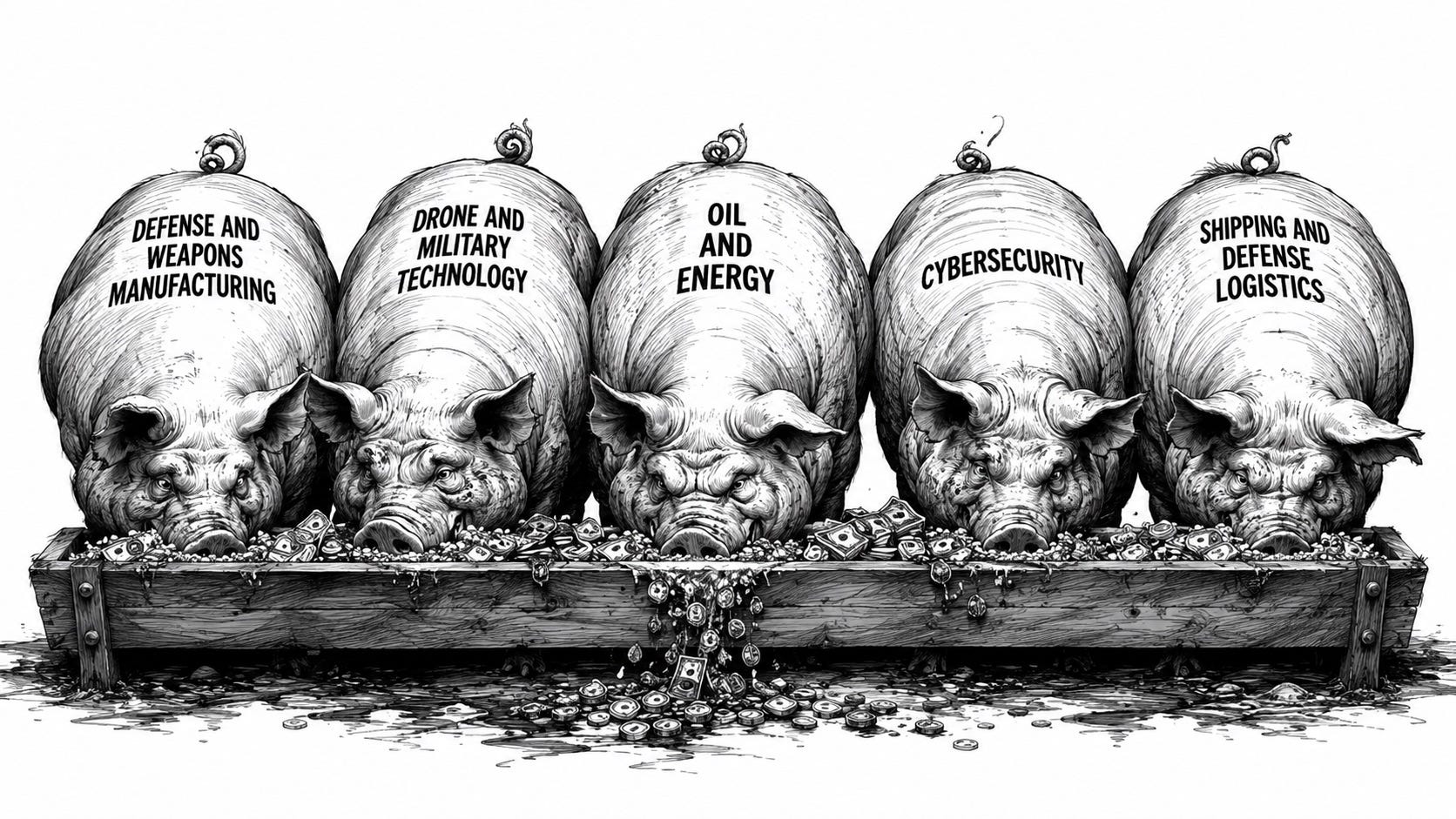
Five American industries turned the 2026 war with Iran into the most profitable stretch of business in their history, and by the time you finish reading this you will know their names, and you will understand why the wealthiest people in this country, many who are personal friends of Donald Trump, need your sons and daughters in uniform for as long as the money keeps flowing.
I want you to sit with a word before we go further. Profiteer. Not soldier. Not patriot. Profiteer. A person who feeds on the suffering of others and calls the meal a growth opportunity.
The war with Iran started on the twenty eighth of February. American and Israeli forces struck first. The opening blow killed Iran’s supreme leader and unleashed a flood of missiles and drones across the region. A ceasefire in early April brought a fragile calm. A June memorandum promised a durable peace. By the middle of July the whole arrangement collapsed, the Strait of Hormuz closed again, and the strikes came roaring back. Thousands are dead. Millions are displaced. And a small circle of executives spent the same window building the best earnings reports of their careers. These are the pigs of war. Let me introduce you to all five.
The Weapons Makers, Feasting First and Feasting Biggest
Start with the giants whose entire business model runs on things exploding. Lockheed Martin. RTX, the company you grew up calling Raytheon. Northrop Grumman. General Dynamics. Boeing’s defense arm. L3Harris. When a missile leaves a launcher and finds a target, somebody has to build the next one, and these are the somebodies.
Watch how the money moved. As tension with Iran built toward war and the first shots landed, Lockheed Martin’s stock surged close to forty percent and hit an all time high above six hundred seventy dollars a share by early March. Your retirement account did not do forty percent in ten weeks. The rally did not run clean. Defense shares dropped more than twenty percent at the peak of the fighting, and Lockheed drifted back to around five hundred ten dollars by the middle of July, still up on the year. The retreat changes nothing about the machine underneath.
Lockheed builds the THAAD interceptor system now knocking Iranian missiles out of the sky, and each interceptor runs about twelve point seven seven million dollars. Back in January the Pentagon signed a deal to quadruple THAAD production, from ninety six a year to four hundred. RTX is racing to expand production of Tomahawk cruise missiles and AMRAAM missiles. Patriot interceptor output is tripling. Every one of those numbers lands as a number on a shareholder statement.
Then look at the size of the trough. The United States plans to spend one trillion dollars on defense in 2026, and the request for next year climbs toward one and a half trillion, the largest jump in American history if Congress approves it. On top of the baseline, the White House asked for an eighty seven point six billion dollar supplemental package tied directly to the Iran war, with roughly twenty one billion aimed at replacing spent munitions.
The administration also cleared more than twenty one billion dollars in separate weapons sales to Saudi Arabia, Kuwait, and the United Arab Emirates, a different pot of money entirely, and Lockheed and RTX sit first in line to fill those orders. A February executive order titled America First Arms Transfer Strategy exists to grease exactly this pipeline.
Here is the part nobody says out loud at the shareholder meeting. A depleted missile stockpile is a sales opportunity. Every interceptor you launch to save a life in Tel Aviv or Bahrain is a future purchase order in Bethesda. The longer the war runs, the emptier the shelves, the fatter the contract. No conspiracy sits behind this. The plain arithmetic of the business drives everything, and the people running these companies understand the arithmetic better than anyone alive.
The Drone and Battlefield Technology, Growing Up Fast On Your Dime
A second industry rose right behind the giants, younger and hungrier. This is the world of attack drones, surveillance drones, autonomous targeting, and battlefield software. The names include Anduril, Shield AI, AeroVironment, Kratos, Saronic, and the data company Palantir.
Modern war runs on cheap machines and expensive code now, and the Pentagon understands the shift. Purchases from defense technology startups accelerated as drones became the center of how this fighting gets done. Anduril landed a seat on the Golden Dome missile defense program alongside the old giants, proof of the new money and the old money eating from the same table. Palantir sells the software built to stitch sensors and targeting data into one screen for a commander, and a war is the best product demonstration a battlefield software company will ever get.
Understand what happened here. The war handed these firms something no marketing budget buys. Combat proof. A drone with a confirmed kill in combat is a drone with a sales record. When the shooting stops, the record becomes a pitch deck, and the pitch deck becomes a contract with the next nervous government on earth. The war is their trade show, and the admission price is human life. See this recent related post, The Longer This War Runs, the Richer They Get
Oil and Energy, Cashing The Check Written By Fear
The third pig wears a suit and drives a tanker. ExxonMobil. Chevron. Shell. BP. ConocoPhillips. These companies win when the world gets scared, because fear lives inside the price of a barrel.
Follow the whipsaw, because the whipsaw is the whole game. One fifth of the world’s oil normally moves through the Strait of Hormuz. When the war began, the passage nearly slammed shut, and Brent crude went vertical. The benchmark tore past one hundred dollars a barrel in March and touched roughly one hundred twenty six dollars by late April, a four year high, and the physical grade traders watch most closely reportedly ran past one hundred forty, the highest since 2008. Your national average gas price climbed from around two dollars and ninety three cents to past three dollars and seventy cents inside a single month, and by late April the national average hit four dollars and thirty cents, a four year high of its own, with drivers in Los Angeles staring at seven dollars on the sign.
The price does not stay high in a clean straight line. The market floods with enough supply, the number falls back toward seventy, and drivers exhale. Then a single attack on a tanker sends the whole thing screaming upward again, and this week Brent pushed back above ninety dollars as the pump number sits near four dollars for you all over again.
Every one of those spikes lands as pure profit on oil already pumped and already sitting in storage. The company did nothing new. The company drilled no new well, hired no new worker, and earned no new efficiency. Fear did the work. A dead sailor in the strait did the work. Your anxiety at the pump did the work, and the check cleared in Houston.
Cybersecurity, The Quiet Industry Racking In Cash
The fourth pig moves in silence. Palo Alto Networks. CrowdStrike. Fortinet. SentinelOne. Google’s Mandiant. Every kinetic war now carries a shadow war inside the wires, and when the missiles fly, the money for digital defense flies with them.
Security analysts warned repeatedly of elevated Iranian cyber activity tied to the conflict, and warnings like those open wallets across the whole economy. Federal agencies raise their cyber budgets. Electric utilities and water systems harden their controls. Banks pour more into defense. The weapons makers themselves lock down their own networks against retaliation. Each of those decisions becomes a contract for a handful of security firms, and the war supplies a fresh reason to sign every quarter.
The genius of this pig lives in how responsible the product feels. Nobody protests a bank protecting your account. Nobody marches against a hospital shielding your records. The spending hides behind the language of safety, and the invoices grow in the dark as the public nods along.
Shipping and Defense Logistics, Riding The Storm They Profit From
The fifth pig is the messiest of the litter. Maritime security contractors. Defense logistics companies. Military sealift firms. Some of the shippers themselves, depending on the route and the paperwork.
Look at what danger did to the price of moving a boat through the strait. War risk insurance premiums exploded from a quarter of one percent of a ship’s value to somewhere between three and ten percent. Run the math on a one hundred million dollar tanker, and a premium of roughly two hundred fifty thousand dollars swelled into a bill of three to ten million dollars, per voyage. In the war’s opening days, tanker traffic through Hormuz collapsed from fifty six ships on one Friday to seven a couple of days later. Around six thousand seafarers ended up trapped in the region as the world figured out who would pay to get them home.
Not every company in this group wins. A shipper with cargo stuck in the wrong port bleeds cash. The winners are the ones selling armed escorts, the ones writing the sky high insurance policies, the ones running the naval logistics contracts, and the ones rerouting freight at premium rates. Danger became a price list, and a whole tier of contractors learned to read the list as a menu.
Now Connect The Dots To The White House
You elected a government, and the government made choices. President Trump ordered the opening strikes, called openly for regime change in Tehran, and this week signaled the bombing continues on his personal say so. Every escalation flowed downhill into the earnings of the five industries you now know. The trillion dollar budget, the eighty seven billion dollar war supplement, the arms sale bonanza to the Gulf, the executive order built to speed weapons out the door, all of these carry his administration’s fingerprints, and all of these land as revenue.
I am not asking you to believe these executives phone the president and order a war. I am asking you to see a system with its incentives pointed in one ugly direction. A ceasefire is a threat to a growth forecast. A durable peace is a quarterly headwind. When the fighting peaked and defense shares dropped more than twenty percent, the smart money bought back in, because a simple truth governs the sector. Stockpile replenishment outlasts any ceasefire, and a nation permanently at war is a permanent customer. The people writing the checks in Washington and the people cashing them in the defense corridor share a comfort with endless conflict deep enough to chill you to the bone.
And you are the one holding the bill. You pay at the pump. You pay in the taxes funding a trillion dollar habit. You pay in the standing of a country the world once trusted and now watches with worry. Your kids and your grandkids will pay for decades in debt and in the slow repair of alliances this administration torched for applause. The pigs eat now. The family pays later.
What You Do With This
You are not powerless, and I refuse to let you believe otherwise. Knowledge is the first weapon, and you now hold names, numbers, and a clear picture of who profits as the country bleeds. Use them.
Talk about this at your dinner table until your teenager rolls their eyes. Raise the subject with the coworker who shrugs and says both sides are the same. Call the office of your senator and your representative and ask one direct question. Who in your district takes money from these contractors, and how did they vote on the war supplement. Make them answer on the record. Vote in every election down to the school board, because the culture of endless war grows from the top and rots all the way down. Follow the money the way a reporter would, and share what you find with people who trust you.
The pigs count on your silence. It’s their profit margin. They count on you cursing at the gas sign and then forgetting by dinner. Prove them wrong. Forward this to five people who still believe their outrage matters, because your outrage does matter, and because a country full of citizens who follow the money is the one force these industries fear most.
Mitch Jackson, Esq. | recommendations
Related: When the Casino Meets the War Room: Prediction Markets, Insider Trading, and the Iran Problem
The pigs of war count on you filling their trough and looking away. Upgrade to a paid subscription to Uncensored Objection, and help fund the journalism that keeps their dirty snouts in full public view.
*On the re-post here and on Linked-In.
-------
A biting criticism of what could be viewed as capitalism’s killer instinct, quite literally. More like ‘Animal Harm’ than Orwell’s ‘Animal Farm’.😕
Mitch Jackson documents carefully, and connects skillfully into a cohesive case, unconnected information many us of already have but have not ordered.💡
Mr Jackson does not articulate a ‘conspiracy theory’ but a coincidence of interests that hardens into mis-guided, sub-optimal, and, ultimately, harmful policy.🫣
Mr Jackson closes by informing the reader that each citizen may feel powerless, but that, acting in unison, the citizenry can break (¿brake?) this spill-over malevolence.💪
Related: When the Casino Meets the War Room: Prediction Markets, Insider Trading, and the Iran Problem https://mitchthelawyer.substack.com/p/when-the-casino-meets-the-war-room?r=2fe7t3&utm_campaign=post-expanded-share&utm_medium=web