

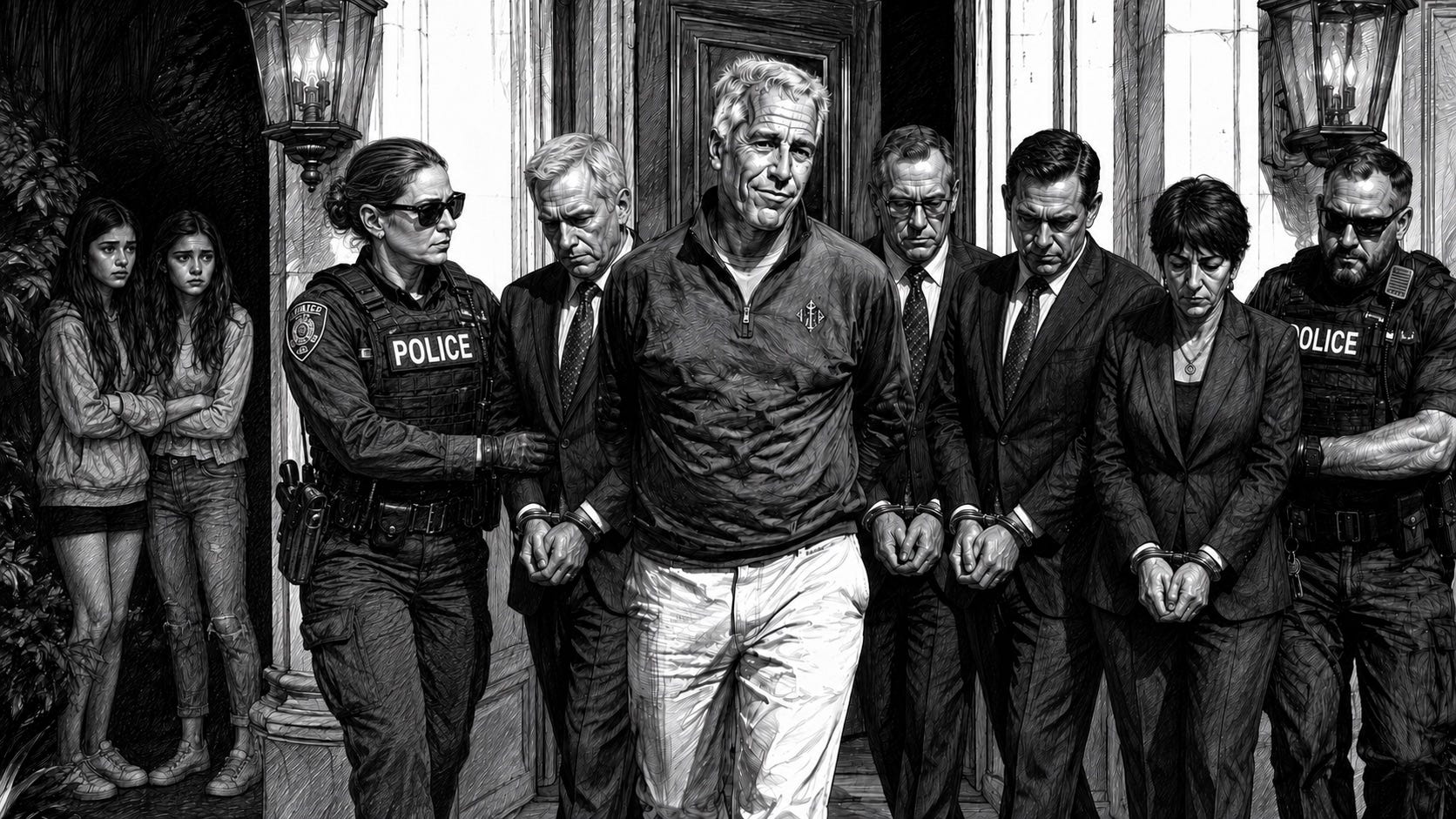
The Department of Justice and the Attorney General keep acting like prosecuting the men in the Jeffrey Epstein case would be improper, impossible, some legal maze nobody can solve. I’m calling bullshit. They have the documents. They have the records. They have the victims who have already come forward. The only thing left to do is the investigation. They didn’t do it back then, because Epstein surrounded himself with rich and connected friends who helped bury the crimes. They are not doing it now because as Trump told Marjorie Taylor Greene, “My friends will get hurt.” So in this post I thought it would be helpful to show you how these cases get prosecuted, how they should have been prosecuted years ago, and how they can still be prosecuted today under state and federal law. The Department of Justice dropped the ball. The FBI dropped the ball. Local law enforcement dropped the ball.
Thousands of girls. Hundreds of wealthy men. One financier who connected them. Almost nobody charged.
Sit with those numbers, because they hide a question nobody in power wants said out loud. How does a man sexually exploit children, teens and young adults for years, hand other wealthy men private access to them, leave behind flight logs and wire transfers and phone records, and still watch nearly every one of those men walk away clean?
You have been told the answer is complicated. You have heard the case described as delicate, the evidence as too old, the victims as too fragile, the defendants as too connected to touch. Set every piece of that aside. I spent years inside the legal system and and I will walk you through a hypothetical showing you exactly how these men should have been investigated and prosecuted, from the moment a teenage girl tells a local cop what happened to the day an appeals court affirms his conviction. I also make the argument this can still happen today.
By the end you will see the truth the Attorney General’s office keeps dancing around. This was never rocket science. For every victim there is a perpetrator. For every transaction there is cash, a card, a bank account, or a wire. The trail was always there. Someone chose not to follow it.
The crime that should have started everything
Here’s the scenario. Someone in Jeffrey Epstein’s orbit recruits a girl of fifteen and brings her to the Palm Beach house under the cover of a paid massage. Inside that house she meets a man Epstein wants to impress. He runs an international banking operation. He flies in private. He moves money across borders for a living. He engages in illegal sexual activity with her, hands her cash, and flies out a few days later like nothing happened.
For a long time she says nothing. Shame does that. Fear does that. Grooming does that. Then one day she tells her mother, who drives her to the local police station to file a report.
That moment is the hinge. Everything good or rotten about American justice flows from what the people behind that counter do next.
The first hours, done right
A patrol officer takes the initial report and does one thing above all else. He listens, he writes down her words, and he resists the urge to interrogate a traumatized teenager. He flags it immediately as a felony sexual offense involving a child and routes it to detectives in the special victims or crimes against children unit. A case like this never belongs to a single beat cop working it on the side.
Within hours a trained detective arranges a forensic interview at a Child Advocacy Center. This matters more than people realize. A child forensic interviewer uses open ended, non leading prompts so the account stays clean and survives a defense attack years later. The detective watches through a one way glass and feeds questions through the interviewer. The recording becomes evidence.
A Sexual Assault Nurse Examiner runs a medical exam if the timeline allows for physical evidence, collects DNA, documents injuries, and preserves a rape kit with a clean chain of custody. The detective secures her clothing, her phone, and anything she touched in that house if it remains recoverable. The clock on biological evidence runs fast, so the detective moves fast.
Then the detective does the thing that breaks these cases wide open. He treats her as the first thread, the opening into a much larger case. He asks how she got to the house, who drove her, who recruited her, who paid her, what rooms she saw, who else was there, and what the man looked like and called himself. Every answer points to another witness and another record.
Building the state case in Florida
Florida law gives a serious prosecutor everything needed here. Sexual battery on a minor under 794.011 and lewd or lascivious offenses under 800.04 carry heavy penalties, and Donna’s Law removed the statute of limitations for qualifying sexual battery offenses committed against a victim under 18. The age of the case is no excuse. A prosecutor in 2026 charges conduct from years ago and stands on solid statutory ground.1
The detective and an assistant state attorney build corroboration around the girl’s account, because corroboration turns a single voice into a conviction. They pull phone toll records that tie the recruiter to the household. They request a pen register and, where the facts justify it, a court authorized wiretap under Florida’s Chapter 934, the state counterpart to the federal Title III order, to capture ongoing coordination. They identify the drivers, the housekeepers, the schedulers, and the pilots, then they interview each one.
Some of those low level facilitators will lie. A smart prosecutor offers the smallest fish limited immunity in exchange for truthful testimony against the men at the top. That is standard practice in every drug ring, every mob case, every trafficking operation in the country. The recruiter who booked the girl becomes the cooperating witness who sinks the banker.
Investigators draft search warrants for the Palm Beach residence and seize computers, hard drives, photographs, message books, ledgers, and any recording devices. Digital forensics examiners image every device. In a house built around exploitation, the evidence of exploitation lives on those devices.
Florida is an all party consent state for recordings, and the law carves out an exception for law enforcement. A controlled phone call from the victim or a cooperating recruiter to the banker runs lawfully under that exception with one party’s consent and police direction, no court order required. Done right, that call captures the target acknowledging the girl, the money, or the arrangement in his own voice. Recorded admissions win trials.
When the case crosses state lines and oceans
The banker flew in from another state or another country. He wired money. He used phones and email across borders. The instant those facts surface, this stops being only a Florida case.
The lead detective contacts the FBI, which holds jurisdiction over the transportation and trafficking of minors. Homeland Security Investigations takes the international travel and cross border movement, the space HSI lives in. IRS Criminal Investigation joins for the financial side, because nobody traces dirty money better than the agents who trace tax fraud for a living. The Florida Department of Law Enforcement supports the state side, and the Justice Department’s Child Exploitation and Obscenity Section lends specialized prosecutors.
The federal charges write themselves from the conduct. Transporting a minor across state or international lines for illegal sexual activity falls under 18 U.S.C. 2423(a), which carries a ten year mandatory minimum and exposure up to life. Using a phone or the internet to entice a minor falls under 2422(b), with its own ten year minimum reaching life. Moving a person for commercial sex falls under the Mann Act in 2421 and 2422. Recruiting or benefitting from a child in commercial sex falls under the sex trafficking statute, 1591. The man who flew here intending to abuse a child violated several of these the moment he boarded the plane, because the law punishes the intent and the travel, not only the act.
The international banking angle opens a second front. Investigators work through Mutual Legal Assistance Treaties to obtain foreign bank records, route requests through Interpol, and coordinate with foreign financial intelligence units. A man who hides behind borders learns that treaties cross borders too.
The money never lies
Here is the part the public rarely hears. It is the heart of why these prosecutions were always possible.
Every act of exploitation in this network left a financial fingerprint. Recruiters got paid. Victims got cash. Travel got booked. Hotels got charged. A banker who deals in money for a living cannot abuse a child for free without touching the very system he commands.
IRS CI and the FBI subpoena bank records, credit card statements, and wire transfer logs. They pull Suspicious Activity Reports filed by banks under federal anti money laundering rules. They map shell companies, trace structured deposits, and follow the cash from the banker’s accounts to Epstein’s operation to the people who delivered children to that house. When the money moved to conceal the source or purpose of illegal proceeds, the government adds money laundering counts under 18 U.S.C. 1956 and 1957, which carry their own long sentences and trigger asset forfeiture.
A financial summary chart, built by an agent and shown to a jury, turns abstract spreadsheets into a story twelve jurors understand in five minutes. Follow the money and the money names the man.
Proactive investigation, not passive waiting
A serious investigation does not sit and wait for victims to wander in. It goes hunting.
Investigators run surveillance on the residence, log who arrives and departs, and identify license plates and private aircraft tail numbers. They flip a recruiter into a cooperating informant who wears a wire into meetings under law enforcement direction. Undercover agents pose as part of the moneyed circle to draw out the arrangement and confirm the target’s role on tape. They subpoena flight manifests and depose the pilots, because pilots keep logs and pilots remember passengers. Each new victim identified through this work becomes another count, another witness, another nail.
This is ordinary police work. Vice units, narcotics task forces, and trafficking squads do it every single week against defendants who lack a fraction of the money these men have. The tools never depended on the size of the defendant’s bank account, except in the Epstein cases.
The indictment, charged the way it should be
Once the facts are locked, you charge in parallel and you charge hard.
The state attorney presents the case to a Florida grand jury and secures an indictment for sexual battery under 794.011 and lewd or lascivious conduct under 800.04, one count for each victim and each occasion the evidence supports. Separate counts protect the case, because a jury convicts on the strongest counts even if a weaker one falters.
The United States Attorney presents the federal case to a federal grand jury and obtains an indictment under 2423(a), 2422(b), 1591, and the money laundering statutes. The federal and state prosecutors coordinate timing and custody so neither case undercuts the other.
You do not bury this indictment under seal as a favor. You do not let it gather dust in a drawer. You file it, you arraign the defendant, you seek detention based on his wealth and foreign ties and clear flight risk, and you put the charges on the public record where they belong.
The political problem, and how a real prosecutor handles it
Now we reach the reason so many of these men were never touched. This is where you need to pay close attention, because the failure was never legal. It was a failure of nerve.
Look at what happened in Florida the first time. Palm Beach police built a strong case after a parent reported abuse in 2005. The local state attorney took it to a grand jury and walked out with a single solicitation charge that insulted the evidence. The police chief was so disgusted he carried the case to the FBI himself. Federal investigators identified more than thirty underage victims and drafted a sprawling indictment that could have put Epstein away for decades. Then the United States Attorney negotiated a nonprosecution agreement that let Epstein plead to minor state charges, serve about thirteen months in a county jail with a work release deal that let him leave for most of the day, and walk. The deal even extended protection to his accomplices, and prosecutors failed to notify the victims, a violation a federal judge later confirmed under the Crime Victims’ Rights Act.
That collapse teaches the exact playbook a principled prosecutor follows to avoid it.
You recuse anyone with a personal, social, or financial tie to the defendant or his lawyers, and you document the recusal. You appoint or request a special prosecutor when the connections reach into your own office. You honor victim rights under the federal Crime Victims’ Rights Act and Florida’s Marsy’s Law, confer with victims before any plea, and give them a voice on the record. You refuse to immunize the accomplices who fed the machine. You resist the parade of marquee defense lawyers whose entire strategy is to convince you the case is too novel and too complex to win, because that argument is theater. You memorialize every decision in writing so no quiet phone call from a connected friend ever rewrites the outcome. You treat a billionaire’s victim exactly as you would treat a janitor’s victim.
A prosecutor who does those things cannot be steered. The politics only work on people willing to be moved.
Discovery, where Florida hands you an edge
Florida runs one of the most open criminal discovery systems in the country, and it allows discovery depositions in felony cases, a tool most states deny. A prepared prosecutor uses that openness as a weapon.
You turn over Brady and Giglio material in good faith, because hiding evidence is how convictions get reversed and careers end. You disclose your witness list, your experts, and your exhibits on schedule. You depose defense witnesses under oath and lock them into stories they cannot change at trial. You fight the inevitable motions to suppress the search and the recordings by proving your warrants were clean and your controlled calls were run lawfully under the law enforcement exception. You litigate motions in limine to keep the defense from putting a child victim’s clothing or social life on trial, and Florida’s rape shield law backs you up.
Trial
You pick a jury patiently and screen for people who will hold a wealthy, charming defendant accountable. You let the victim testify with a support structure in place, and you prepare her so the courtroom does not retraumatize her. You call an expert on delayed disclosure and grooming, so the jury understands why a frightened teenager waited years to speak, and why delay signals trauma rather than fabrication.
You stack corroboration on top of her words. The pilot’s logs. The recruiter’s cooperation. The hotel charges. The wire transfers. The financial summary chart. The recorded admission. You build a structure so dense that the defense cannot pull a single thread without the jury seeing the whole pattern. Then you argue the evidence plainly, you tie the money to the man, and you ask twelve citizens to do what a string of officials refused to do.
None of this guarantees a verdict, because proof beyond a reasonable doubt is never automatic, and aged cases test memories and witnesses. The failure in these cases was never the inability to win. The failure was the refusal to investigate and charge in the first place.
Appeal
A conviction this well built holds up. On appeal, the court reviews legal rulings without deference and weighs the evidence in the light most favorable to the verdict. Because you preserved your objections, disclosed your evidence, ran lawful searches, and grounded every count in testimony plus corroboration, the record gives an appellate court nothing to seize on. The conviction gets affirmed, and the sentence stands.
What this all means for you
Run that sequence back in your mind. A girl reports. A detective listens and pulls the threads. A nurse and a forensic interviewer preserve the evidence. Recruiters flip. Phones and warrants and computers fill in the picture. The FBI, HSI, and IRS join the moment the conduct crosses a state line. The money names every man who paid to be there. Grand juries indict. Prosecutors refuse to flinch. Juries convict. Appeals courts affirm.
None of that required a miracle. It required will.
So when the DOJ and Attorney General’s office tells you these cases are too hard, too sensitive, too tangled to bring, you now know enough to call that what it is. For every one of those hundreds or thousands of victims, there was a man. For every encounter, there was a payment that left a record in a bank, a card statement, or a wire. The roadmap to identify those men, investigate those men, and convict those men has existed in plain sight the entire time.
The system did not lack the tools. It lacked the courage to use them on people who were used to being untouchable.
If that makes you angry, good. Share this with someone who still believes the official story that it was all too complicated. Send it to a survivor who was told to stop asking questions. Push your representatives to demand the financial records and the flight logs and the prosecutions that should have happened years ago. The names are findable. The money is traceable. The cases are winnable.
Accountability was always possible. It still is. Refuse to let anyone tell you otherwise.
Mitch Jackson, Esq. [more about Uncensored Objection]
If you believe the public deserves the real facts behind today’s biggest political, legal, and business stories, then subscribe to Uncensored Objection right now, free or paid, and stand with me. My job is to cut through the spin and show you what’s actually going on, and your support is what keeps that work coming.
Quick note before we dive too far into this hypothetical overview and example. For the most part, I’m using today’s laws to walk you through this. Some read exactly the way they did in the late 1990s and early 2000s. Some have shifted since. Here is what matters. Every tool I’m about to show you existed then, and every one still exists now. I’m not here to argue statute numbers from twenty years ago. I’m here to show you how these cases get investigated and how these men get prosecuted. The tools were always there. Somebody refused to pick them up.
It sure seems like releasing the fucking files with ALL names (except victims) and all situations is ALL that would be needed to blow this out if the water. Nobody deserves protection. Release ALL the files. Unredacted.
Thank you for this detailed description of what should have happened, and what can still happen — what NEEDS to happen.