

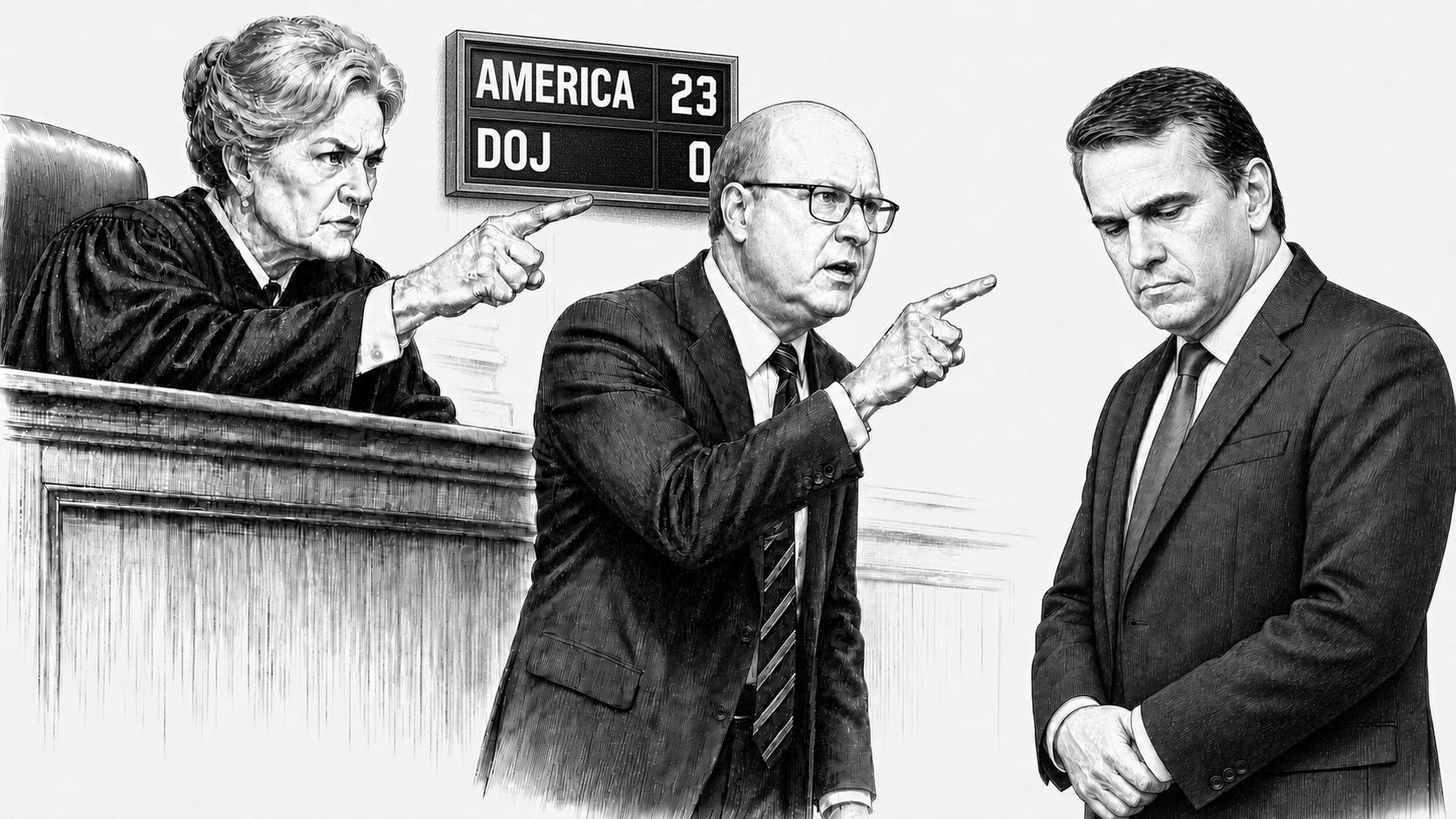
The Justice Department has lost 23 straight federal cases trying to force states and Washington, D.C., to hand over complete, unredacted voter-registration files. Not close losses. Twenty-three merits rulings, twenty-three defeats, judges appointed by presidents of both parties.
You probably have not heard about it. A win for your privacy does not get the coverage a scandal does, so the story disappears while the litigation keeps going.
Here is what it means. Right now, lawyers and federal judges are the only thing standing between this administration and a federal file containing your date of birth, your driver’s license number, and your Social Security digits.
What’s happening is important to appreciate because apparently, after losing the first five cases, the DOJ decided the judges misunderstood the law. After ten losses, it maintained that the judges still misunderstood the law. After twenty, a reasonable institution might have reconsidered its legal theory. But not the DOJ, it kept on litigating.
Here’s the thing. The requests at issue were not ordinary demands for voter information already available under state law. States frequently offered the DOJ the public versions of their voter files. In these cases the DOJ wanted the unredacted versions, which generally included sensitive fields such as complete dates of birth, driver’s-license numbers and partial Social Security numbers.
In other words, the federal government wanted confidential identifying information belonging to millions of Americans, without first establishing that Congress had authorized such sweeping access.
A federal data sweep with your identity attached
DOJ said it needed the information to determine whether states were properly maintaining accurate voter rolls and complying with federal election laws. Then came the more revealing admission.
During the Rhode Island litigation, a DOJ attorney acknowledged that the department intended to share voter information with the Department of Homeland Security so it could be checked through DHS’s SAVE citizenship-verification system. In follow-up interviews and court documents, the DOJ denied that it is building an unlawful national voter database. However, voting-rights organizations contend that collecting state files and running them through one federal system effectively creates the machinery for centralized voter surveillance and potentially broad voter-removal efforts.
Whatever label one chooses, the government’s admitted plan should concern every American.
SAVE is not infallible. Citizens have reportedly been inaccurately flagged by the system. Outdated records, common names, incomplete information and data-entry errors can create false matches. Naturalized citizens may face particular risks when government records do not accurately reflect their current status. This is why handing over millions of confidential records without transparent safeguards presents a serious risk.
DOJ tried to extract a power Congress never clearly granted
Across these substantially parallel lawsuits, DOJ relied on different combinations of three federal laws: Title III of the Civil Rights Act of 1960, the National Voter Registration Act and the Help America Vote Act. None expressly says that the attorney general may demand every state’s complete confidential voter database.
Title III requires election officials to preserve certain voting records for 22 months and permits the attorney general to inspect covered records when enforcing federal election laws.
The provision arose from Congress’s effort to preserve evidence of racial discrimination in voting. DOJ attempted to use it for a very different purpose: investigating whether people appearing on voter rolls might be ineligible.
That change in purpose does not automatically make DOJ’s position unlawful. Statutes can apply beyond the precise evil that led Congress to enact them. The decisive problem was textual: courts repeatedly found that DOJ was attempting to obtain records beyond those covered by the language Congress actually adopted.
In Michigan, for example, the Sixth Circuit held 2–1 that the statewide electronic file was not a record that “came into” election officials’ possession within Title III’s meaning. It was a database the state created from underlying information.
Minnesota reached the same conclusion. Judge Katherine Menendez also held that HAVA requires states to maintain accurate computerized voter lists but contains no provision requiring them to disclose those databases to DOJ. The court ruled that preserving records does not necessarily mean surrendering an entire database. Along the same lines, requiring a state to maintain a database does not necessarily mean giving the executive branch a copy.
DOJ tried to bridge those statutory gaps with litigation. Twenty-three district courts refused to let it.
Courts do not authorize fishing expeditions merely because DOJ brings them
Another recurring problem involved the basis for DOJ’s demands.
Title III requires the attorney general to state the demand’s basis and purpose. DOJ maintained that investigating possible violations of federal voting laws was sufficient. Courts in several cases concluded that its explanations were inadequate or that it had failed to state a viable claim.
Minnesota illustrates the necessary nuance. DOJ initially made broad demands concerning list maintenance. After the lawsuit began, it cited a reported case in which one alleged noncitizen had been charged with registering and voting. DOJ claimed that incident justified examining whether other ineligible people remained registered.
The court still dismissed the case, not because a single suspected illegal vote could never be investigated, but because Minnesota’s statewide database was not a covered record under Title III and HAVA did not provide the disclosure authority DOJ claimed.
That distinction matters.
The government possesses legitimate authority to investigate actual violations of federal election law. What it cannot do is expand that authority beyond the boundaries Congress imposed merely because a larger database would make its investigation easier.
In Rhode Island, the court characterized DOJ’s proposed data search as the kind of fishing expedition the governing statutes did not authorize. The DOJ wanted access first and planned to determine what the data might reveal afterward.
In all these cases the Federal judges kept asking the same essential question: Where, exactly, did Congress authorize that? In response, the DOJ never produced an answer that persuaded a court deciding the merits.
Twenty-three merits decisions. Twenty-three defeats.
Federal district courts rejected DOJ’s attempt to compel unredacted voter information in Arizona, California, Colorado, Connecticut, Illinois, Kentucky, Maine, Maryland, Massachusetts, Michigan, Minnesota, Nevada, New Hampshire, New Jersey, New Mexico, New York, Oregon, Pennsylvania, Rhode Island, Virginia, Washington, D.C., West Virginia, and Wisconsin.
Those courts did not all write identical opinions. They relied on overlapping grounds involving statutory language, DOJ’s stated basis and purpose, the absence of a HAVA disclosure provision and the limited reach of the NVRA. But every merits result reached the same disposition:
The DOJ could not compel the jurisdiction to surrender the unredacted database under the legal theory presented.
A separate Georgia lawsuit was dismissed because DOJ filed it in the wrong federal district (of course it did). The DOJ has since refiled it, so that procedural ruling is not included in the 23 merits losses.
Washington state’s case also remained pending when Minnesota was decided and is not part of the 23.
I believe the distinction is important because the facts are damaging enough without inflating them.
DOJ’s answer: The courts keep getting it wrong
DOJ has appealed many of these dismissals. Its position remains that the courts have interpreted Title III too narrowly.
So far, the only federal appellate court to decide the merits has rejected that argument. The Sixth Circuit affirmed Michigan’s dismissal in a divided 2–1 decision and later denied panel and full-court rehearing. Additional appeals remain pending, and Supreme Court review remains possible.
That means “0–23” is an accurate description of DOJ’s district-court merits record as of Minnesota’s dismissal, not a final pronouncement that every legal question has been settled nationwide. But any way you slice or dice it, it’s still an extraordinary record.
This is especially true when you consider all the different jurisdictions and judges appointed by presidents of both parties. Add to that the different formulations of the same general theory and what you have is the law saying to the DOJ, talk to the hand.
Here’s what I’m seeing. The government has yet to persuade one trial court deciding the merits to order the requested production. The DOJ has one explanation for twenty-three defeats: every judge in the country misread the law. That explanation is not a legal argument. It is an excuse for filing the twenty-fourth case.
Marc Elias’s firm helped stop it
My understanding is that the Elias Law Group intervened for voters and organizations including Common Cause, the League of Women Voters and groups representing older Americans.
The firm’s clients had interests distinct from those of the state governments. They were the people whose information DOJ sought and whose rights could be affected if unreliable database comparisons generated erroneous eligibility challenges.
ELG helped force DOJ to answer the central statutory question:
Where did Congress authorize this?
Not where DOJ believed the authority ought to exist. Not where an executive-branch memorandum concluded it could be found. Where does the enacted language permit the federal government to compel complete voter databases containing confidential identifiers?
Twenty-three courts found DOJ’s answer insufficient.
To be precise, the states and their attorneys general were the principal defendants, and other civil-rights lawyers also contributed to these victories. “ELG is undefeated” is Marc Elias’ triumphant shorthand, not a claim that his firm acted alone. He doesn’t make the claim and I’m not making it here. But I am grateful and thankful for his hard work on all of these cases. Marc’s Democracy Docket is worth supporting and reading.
Why every American should take this personally
This is not merely a contest between Democratic state officials and a Republican administration. It concerns federal power, personal privacy and the government’s obligation to operate within authority granted by Congress.
I wrote the book Privacy in America because most Americans don’t have a clue how much of their personal information is being obtained and used on a daily basis. In my opinion, all of us should be offended that DOJ demanded confidential identifying information belonging to millions of voters without first establishing a clear statutory right to possess it. Especially after the first or second loss.
We should be offended that laws enacted to protect voting rights were stretched to support a data-collection effort that could place lawful voters under mistaken suspicion.
We should be offended that the department continued pursuing substantially parallel claims after judges across the country repeatedly rejected its interpretation.
We should be offended by the idea that the federal government may gather our information first and settle the boundaries of its authority later.
And we should demand more than assurances that the information will be used responsibly. Sensitive data should be collected only pursuant to clear legal authority, defined purposes, meaningful security protections and public accountability.
The Justice Department is supposed to protect Americans from unlawful government action. It should never ask Americans to accept federal overreach simply because the agency seeking the power has the word “Justice” above its door.
After 23 losses, DOJ has not proved that resistant states were violating federal voter-list laws. It has demonstrated something else: how quickly “election integrity” can become a justification for collecting private information and expanding executive authority. And in my view, that threatens privacy, federalism and the rule of law.
Americans should not have to surrender one to prove they care about the others.
Mitch Jackson, Esq.
Most Americans never find out what their government is doing with their personal information until it is already gone. I watch the news and read the filings, the statutes, and the rulings, then I write about the issues in plain English so you can see it while you can still do something about it. Subscribe free to Uncensored Objection, or go paid and help me keep the work coming.
What if we belong to one of the red states which already handed all our data to Trump? Can we get it back?
Thanks for reminding us how critical this issue is to preserving our democracy. Clearly an authoritarian attempt by the Trump administration to manipulate our election system. The fact they are 0-23 and still trying says it all about their intentions.