

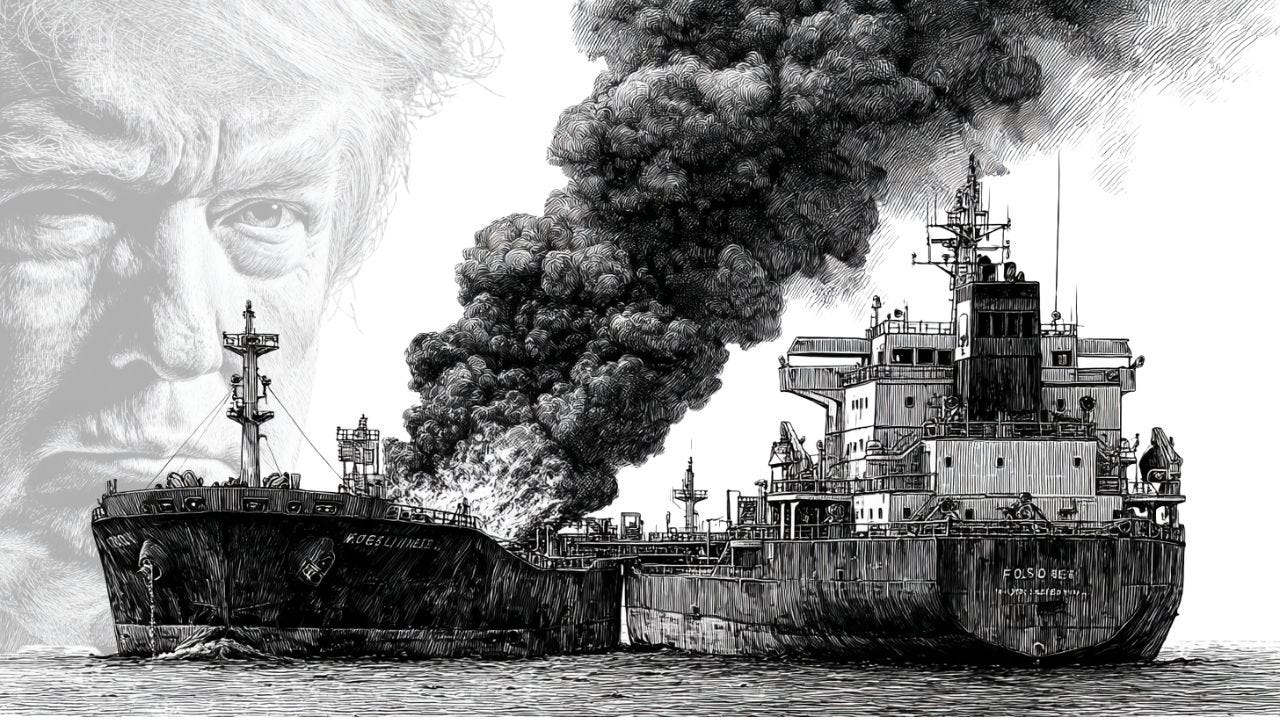
Two tankers are burning in the Strait of Hormuz and experts are already calling the oil disruption the worst in history, which means the consequences of this war are no longer theoretical, they are happening right now and the entire world is about to feel it.
Donald Trump’s war on Iran did not stop at the blast zone. It moved straight into the legal and financial machinery that keeps the global economy alive. On February 28, the United States and Israel launched strikes on Iran. Within days, marine insurers were canceling policies, widening exclusion zones, repricing war-risk cover in real time, and forcing shipowners to decide whether a voyage through the Persian Gulf was still worth the risk.
That matters because ships do not sail on courage. They sail on contracts, financing, and insurance. Reuters reported that major insurers including Gard, Skuld, NorthStandard and others canceled war-risk coverage for vessels operating in Iranian and surrounding Gulf waters, while Japan’s MS&AD halted underwriting in the area. Bloomberg separately reported that the world’s largest maritime insurance mutuals moved to withdraw war-risk cover for ships entering the Persian Gulf. London remains the center of this market and is still offering cover, though now at much higher prices and on much narrower terms.
That is the correction a lot of people are missing. The market did not simply shut its doors. It did something almost as damaging. It made coverage scarcer, more expensive, more conditional, and harder to obtain at the exact moment global trade needed stability. Reuters reported that war-risk premiums have surged by more than 1000% in some cases. Other reporting shows pricing rising from roughly 0.25% of a ship’s value to as much as 1.5% for a single transit. On a large tanker, that means hundreds of thousands of dollars in added cost before a ship even burns fuel.
Now follow the money. The Strait of Hormuz is one of the most important economic chokepoints on the planet. In 2024, about 20 million barrels of oil a day moved through it, equal to roughly 20% of global petroleum liquids consumption, and about 20% of global LNG trade also passed through that corridor. Reuters reported on March 11 that the U.S.-Israeli war on Iran has effectively shut the strait, cutting off a fifth of the world’s daily oil and LNG supply and forcing major producers such as Saudi Arabia, Iraq, and Kuwait to cut production because they cannot load ships.
This is where insurance becomes inflation. When ships cannot get affordable war-risk cover, fewer ships move, cargoes get delayed, freight rates spike, and energy markets tighten even more. Reuters has reported stranded vessels, damaged tankers, halted oil and gas shipping, and emergency U.S. efforts to backstop maritime losses with up to $20 billion in reinsurance through the U.S. International Development Finance Corporation. The government does not build a $20 billion emergency backstop unless the private market is already buckling under the stress.
American families are already paying for that failure. Reuters reported on March 11 that U.S. gasoline prices have climbed to $3.58 a gallon, up 20%, and economists warned the energy shock could add as much as a full percentage point to March inflation. Another Reuters report described the broader market damage plainly: oil prices have surged, share markets have skidded, and investors are reassessing corporate earnings because higher energy costs ripple through trucking, airlines, manufacturing, agriculture, and retail.
The global damage goes further. This war is not only an oil story. Reuters has reported that the closure of Hormuz is also disrupting fertilizer supply just as farmers head into planting season, threatening food prices and agricultural output. The United Nations warned this week that the same shipping and airspace disruptions are driving up freight costs, undermining humanitarian aid delivery, and straining already fragile supply chains around the world. Goldman Sachs told Reuters that even a temporary rise in oil to $100 a barrel could shave 0.4 percentage point off global growth.
So here is the truth in plain English. Trump started a war in one of the most economically sensitive regions on earth, and the first institutions to panic were not think tanks or politicians. They were insurers, reinsurers, shipowners, traders, and lenders. They understood immediately what reckless political leadership means in the real world. It means exclusions. It means premium spikes. It means stalled cargo. It means higher fuel, higher food, higher freight, lower growth, and a global economy forced to absorb the price of somebody else’s impulsive use of force.
This is how modern wars punish the public. Not only with body bags and burning ports, but with invisible legal language rewritten overnight in London, canceled cover in the Gulf, and a bill delivered one tank of gas, one grocery cart, and one inflation report at a time. That is the real scandal here. Trump did not just ignite a war. He detonated the insurance architecture beneath global trade, and now the American and global economies are paying the premium.
If you want to stop this kind of reckless leadership from dragging the country and the global economy into crisis again, make sure you are registered to vote, show up in the midterms, and bring your family and friends with you.
Mitch Jackson, Esq.
Mortgage Rates Rise as Iran War Ripples Through Financial Markets
https://www.nytimes.com/2026/03/12/business/mortgage-rates-rise-above-6-percent.html?unlocked_article_code=1.SlA.Vdty.frUVSlpqDJxC&smid=url-share
Mitch, this is absolutely bonkers — and it’s hard to understand how anyone connected to this decision-making process could be so utterly disconnected from reality. The implications are staggering, and it’s clear now that this has gone far beyond politics or policy blunders. We’re looking at consequences that touch every household and business on the planet. There’s no walking this back — we’ve reached a point of no return, and it’s terrifying to see how recklessness at the top has detonated real-world systems that keep the global economy steady.