

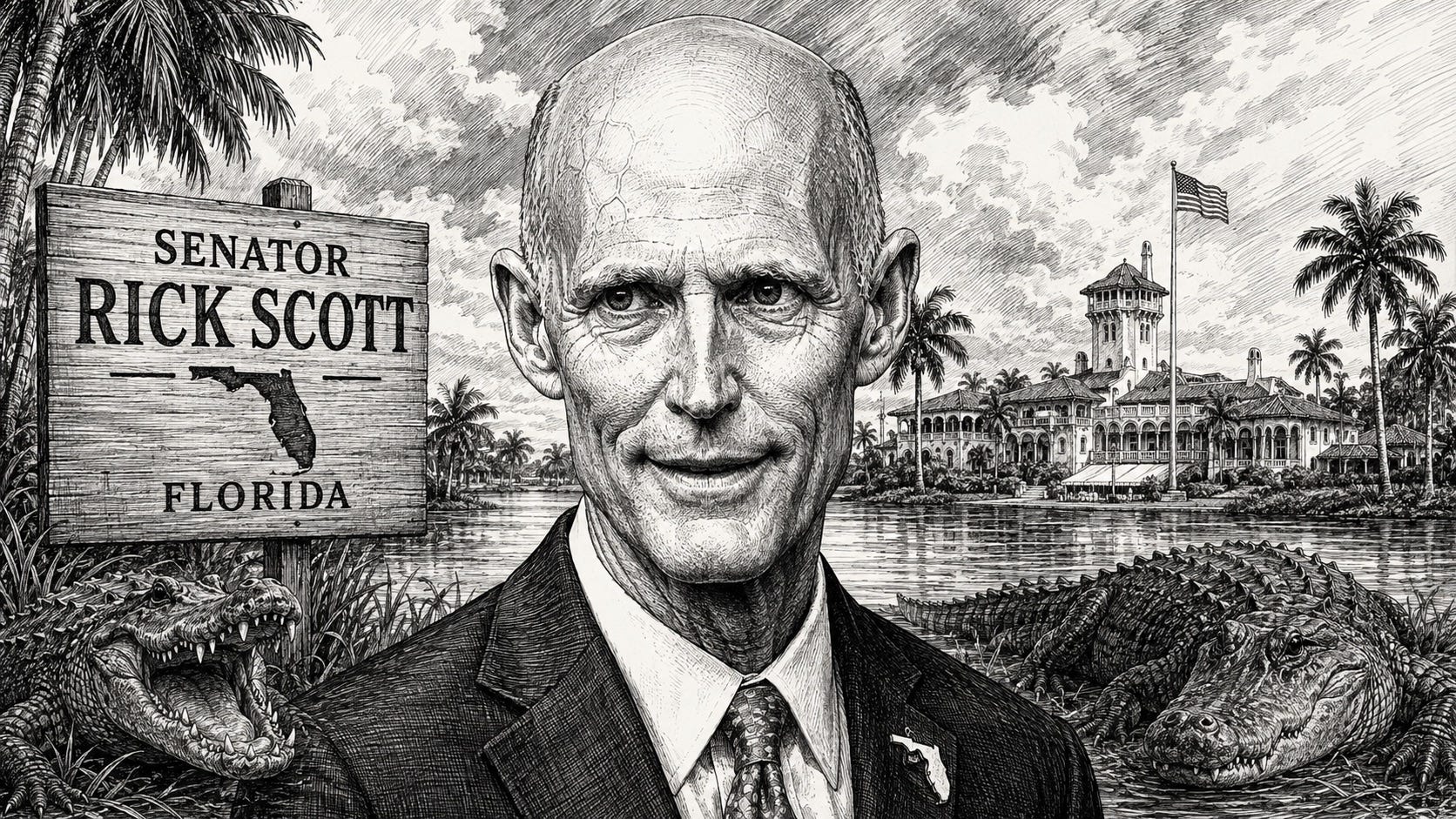
Senator Rick Scott built a fortune running the company that committed the largest health care fraud in American history at the time, then walked away with roughly ten million dollars in cash, three hundred million dollars in stock, and a cushy consulting deal while his company pleaded guilty to fourteen felonies and paid one point seven billion dollars in fines. He pleaded the Fifth seventy five times under oath, never faced a single criminal charge, and now he sits in the United States Senate writing health care policy and lecturing the country about Medicare fraud. Here’s what you need to know.
Rick Scott sits in the United States Senate today because the federal government decided his company would take the fall and he would take the money.
Read that again. The company pleaded guilty to fourteen felonies. The company paid $1.7B in fines, then the largest health care fraud recovery in American history. Rick Scott collected a roughly ten million dollar cash severance package, kept ten million shares of stock then valued at around three hundred million dollars, and walked into a five-year consulting contract worth almost a million dollars a year.
He has never been charged with a crime. He has never been convicted of anything. And in a 2000 civil deposition, he invoked his Fifth Amendment right against self-incrimination 75 separate times.
This is the man currently lecturing the country about Medicare fraud.
The Raid
March 19, 1997. Federal agents from the FBI, the IRS, and the Department of Health and Human Services served search warrants at Columbia HCA facilities in El Paso and on dozens of doctors with suspected ties to the company. The raid did not happen because some bureaucrat got bored. It happened because whistleblowers inside the company had been telling federal investigators for years that something was deeply wrong with how Columbia HCA billed the United States government. Over thirty whistleblowers filed complaints against the company in the 1990s.
Eight days after that first raid, Rick Scott signed his last SEC report as a hospital executive.
The federal pressure kept building. On July 16, 1997, the FBI executed search warrants at eighteen Columbia hospitals and fifteen other locations across six states. Nine days after that second wave, the board of directors forced Scott out. He resigned as chairman and chief executive officer of the company he had built.
The board did not throw him out empty handed. Public reporting and the company’s own SEC filings show his exit package included roughly $10M in cash, 10M shares of company stock then worth approximately $300M, two years of paid office and secretarial expenses, and a five-year consulting deal worth about $950K per year. Thomas F. Frist Jr. replaced him as chairman and CEO. Rick Scott took his money home.
The board knew. The annual reports to shareholders had been warning for years that the financial incentives Columbia HCA offered doctors could run afoul of the federal anti-kickback law, the same law passed specifically to limit conflicts of interest in Medicare and Medicaid. The board kept paying out anyway. The board kept the scheme running anyway. When the federal government finally knocked on the door, the board paid the founder to leave and called it a day.
What The Company Admitted
In settlements reached in 2000 and continuing through 2003, Columbia HCA pleaded guilty to 14 felonies. The company admitted, in writing, in federal court, to the following.
Systematically overcharging the government by claiming marketing costs as reimbursable expenses.
Striking illegal deals with home care agencies.
Filing false data about the use of hospital space.
Fraudulently billing Medicare and other federal health programs by inflating the seriousness of patient diagnoses. That practice has a clinical name in fraud investigations. It is called upcoding. Sicker patients generate bigger reimbursements. Columbia HCA made patients look sicker on paper than they were in the bed.
Giving doctors partnerships in company hospitals as a kickback for referring patients to HCA.
Filing false cost reports.
Fraudulently billing Medicare for home health care workers.
Paying kickbacks in the sale of home health agencies.
Paying kickbacks directly to doctors for patient referrals.
Giving doctors loans that were never intended to be repaid. Giving them free rent. Giving them free office furniture. Giving them free drugs from hospital pharmacies.
That is not a list of allegations. That is a list of admissions. The company said yes, we did all of this, please let us pay the fine and move on.
The Numbers Tell The Story
In December 2000, HCA subsidiaries pleaded guilty to substantial criminal conduct and paid more than $840M in criminal fines, civil damages, and penalties.
In June 2003, HCA agreed to pay the federal government an additional $631M in civil penalties plus interest, and $17.5M to state Medicaid agencies. The company had already paid $250M to the Centers for Medicare and Medicaid Services to resolve outstanding cost report claims.
Total recovery to the United States government: $1.7B. At the time, the Justice Department called it the largest recovery ever in a health care fraud investigation. Whistleblowers received a combined share of $151,591,500, then the largest qui tam award the government had ever paid. The whistleblower share alone was bigger than most fraud settlements.
The Columbia HCA total has since been surpassed by Glaxo Smith Kline at $3B in 2012, Pfizer at $2.3B in 2009, and Johnson and Johnson at $2.2B in 2013. The Columbia HCA case held the record for almost a decade.
Now look at what Rick Scott paid.
Nothing.
Not a fine. Not a judgment. Not a criminal sentence. Not even a federal interview as part of the criminal investigation, according to Scott himself.
Seventy Five Times
In 2000, Rick Scott sat for a sworn deposition in a civil lawsuit between Nevada Communications Corp. and Columbia HCA. The case was about a communications contract dispute, not the federal Medicare fraud investigation. On the advice of his attorney, Steven Steinbach, Scott declined to answer every substantive question by invoking his Fifth Amendment right against self-incrimination.
Seventy five times.
His attorney explained on the record that Scott was invoking the Fifth because of “the pendency of a number of criminal investigations relating to Columbia around the country.”
Honest writers must acknowledge what the deposition was not. It was not a federal criminal proceeding. Only one question in the entire transcript touched directly on Columbia’s “improper billing practices,” when a lawyer asked Scott whether a separate Columbia lawsuit against Florida Software was designed to obscure those practices. He pleaded the Fifth on that one too.
Here is what legal scholars said at the time. Nancy Dowd, a University of Florida Levin College of Law professor, told reporters that the Fifth Amendment “is not a shield against fishing expeditions” and applies only “for the reason that your answer could result in criminal liability.” Bruce Jacob, a Stetson University law professor, added: “You should not use the Fifth Amendment privilege if you don’t think there’s possible criminal liability.”
Scott’s own attorney conceded on the record that his client was invoking the Fifth because of ongoing criminal investigations. That is the standard he was working under. That is what seventy five invocations means in context.
Where The Indictments Did Land
The federal government did indict individuals in the Columbia HCA case. Four mid-level Florida-based Columbia HCA executives were charged. Two were convicted of defrauding Medicare in 1999 and sentenced to prison. A third was acquitted. A jury could not reach a verdict on the fourth. The two convictions were later overturned on appeal.
That is the universe of individual criminal accountability the Columbia HCA fraud produced. Four mid-level executives. Zero convictions that stuck. Zero senior leadership. Zero Rick Scott.
The man who ran the company during the conduct the company pleaded guilty to never faced an indictment. He says he was never even interviewed by federal investigators in the criminal probe.
The Political Reinvention
Rick Scott moved to Florida. He started Richard L. Scott Investments. He bought into other health care companies, including founding Solantic Corporation in 2001. He spent roughly $78M running for governor of Florida in 2010. He won by about sixty eight thousand votes, a 1.29 percent margin over Democrat Alex Sink. He served two terms as governor. He ran for the United States Senate in 2018 and defeated incumbent Democrat Bill Nelson by just over ten thousand votes out of more than eight million cast. He won reelection in 2024.
Along the way he developed a rehearsed talking point. He says he made mistakes. He says the company made mistakes. He says he took responsibility.
Taking responsibility is what you call it when you write a check, sign an apology, and submit to consequences. Rick Scott did none of those things. The company wrote the checks. The shareholders absorbed the losses. The taxpayers paid for the fraud that built the empire that paid Rick Scott his fortune.
That is not responsibility. That is escape.
During his 2024 Senate reelection campaign, Scott told reporters that the Clinton Justice Department had targeted him politically. The Clinton Justice Department, for the record, was the same Justice Department whose career prosecutors and FBI agents secured fourteen felony guilty pleas from his company and $1.7B in fines.
I Shared All This Because I Want You To Know What’s Going On
Right now, in late 2025 and into 2026, Senator Rick Scott of Florida has positioned himself as one of the MAGA Republican Party’s lead voices on health care reform. He has convened House and Senate conservatives to develop GOP alternatives to the Affordable Care Act. He has unveiled his own proposal called the More Affordable Care Act, which would create “Trump Health Freedom Accounts” and let the enhanced ACA tax credits expire. He has warned his colleagues about a “slow creep” toward single payer health care and the dangers of Medicare fraud.
The man who ran the company at the center of the then-largest Medicare fraud case in American history is now the man telling Americans how to fix Medicare.
A normal political system would not allow that. A normal political system would have produced a criminal indictment, a trial, a verdict, and a permanent disqualification from public office. Instead, our system produced a severance package, a stock windfall, two governorships, two Senate terms, and a seat at the table where Medicare policy gets written.
Rick Scott did not beat the system. The system beat the taxpayers. He just walked through the door it left open.
Remember that the next time he stands up on the Senate floor and lectures someone else about fraud.
He is the case study.
He is the warning.
He is the man who got away.
Mitch Jackson, Esq.
If you want the receipts on the people who got away, the deals that got buried, and the accountability nobody else is willing to demand, subscribe to Uncensored Objection and support the case. Every issue gives you the objective analysis, through the eyes of an experienced trial lawyer, that you need and the full accountability they hope you never ask for.
If ever there was a criminal who 'got away with it', it's this man. No wonder he aligns himself so closely with the present administration. And Florida seems to not really concern itself with it. He's been in elected office as governor and then senator since 2011. I will never understand people who constantly vote against their best interests.
THANK YOU FOR PICKING UP ON THIS!! I’m sure he fits in well where he is!! This is not an honorable man! Signed a Floridian 😊