

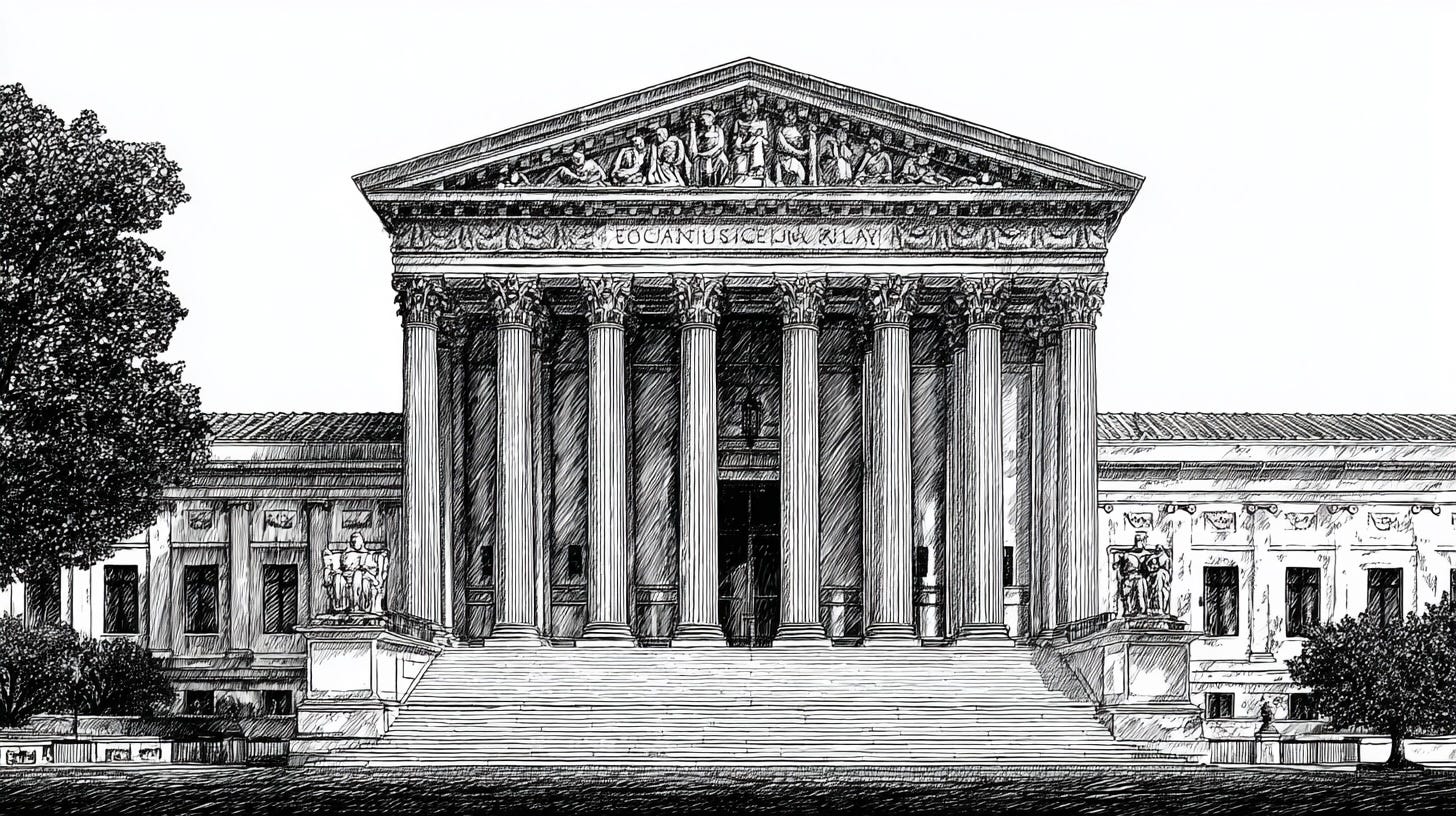
We grabbed today’s Supreme Court transcript the second it dropped and ran it through our firm’s legal AI system with one simple question. Predict how the Court will rule on birthright citizenship. Here’s what it told us.
Listen to a 21 minute audio overview here.
Trump v. Barbara will fall 7-2 against the executive order
The Supreme Court will resoundingly reject President Trump’s attempt to redefine birthright citizenship by executive fiat. Based on the oral argument dynamics of April 1, 2026, each justice’s jurisprudential philosophy, the weight of precedent from Wong Kim Ark through 150 years of settled practice, and the near-unanimous consensus of constitutional scholars, the most likely outcome is a 7-2 decision striking down Executive Order 14160. Justices Thomas and Alito will dissent. The majority will reaffirm that the Citizenship Clause of the Fourteenth Amendment, as interpreted in United States v. Wong Kim Ark (1898) and codified in 8 U.S.C. § 1401(a), guarantees citizenship to virtually all persons born on U.S. soil — including children of undocumented immigrants and temporary visitors — with only the historically recognized narrow exceptions for children of diplomats and hostile occupying forces.
Every lower court to consider this question ruled against the executive order. One Reagan-appointed federal judge in Seattle called it “blatantly unconstitutional.” The government’s core theory, that “subject to the jurisdiction thereof” means allegiance-based-on-domicile rather than the common law territorial rule, was rejected by the overwhelming majority of legal scholars, including prominent originalists. Even Trump-appointed Fifth Circuit Judge James C. Ho wrote a 2006 originalist defense of birthright citizenship, concluding that “birthright citizenship is a constitutional right, no less for the children of undocumented persons than for the descendants of passengers of the Mayflower” — though he has since revised his position to argue the principle does not apply in cases of what he characterizes as “invasion” at the border. At oral argument, at least four of the six conservative justices openly challenged the government’s historical and textual foundations.
The predicted vote: a decisive 7-2 rebuke
The Court will likely produce a majority opinion joined by Roberts, Gorsuch, Kavanaugh, Barrett, Sotomayor, Kagan, and Jackson. The most probable opinion author is Chief Justice Roberts, given his seniority, his pointed questioning at oral argument, his institutional interest in writing a landmark reaffirmation of constitutional citizenship, and his track record of assigning himself the most consequential cases. A secondary possibility is Justice Gorsuch, whose textualist credentials could lend particular force to the opinion. Justices Thomas and Alito will dissent, likely writing separately to articulate different versions of the government’s originalist argument.
The decision could rest on constitutional grounds alone (reaffirming Wong Kim Ark), statutory grounds alone (the EO violates 8 U.S.C. § 1401(a)), or both. Justice Kavanaugh’s oral argument questions about the 1940 and 1952 congressional codifications suggest some justices may prefer the statutory off-ramp, but the ACLU urged a constitutional ruling to foreclose future attempts. The most likely outcome is a ruling on both grounds, the executive order violates both the Constitution and federal statute.
Justice-by-justice predictions
Chief Justice John Roberts — VOTES AGAINST the executive order
Roberts will vote to strike down the executive order and likely author the majority opinion. His skepticism at oral argument was unmistakable, his retort that “It’s a new world. It’s the same Constitution” was the argument’s most quoted line, and his characterization of the government’s supporting examples as “very quirky” and “idiosyncratic” signaled he found the leap from narrow historical exceptions to a sweeping exclusion of all children of undocumented immigrants untenable. Roberts is the Court’s foremost institutionalist; he takes stare decisis seriously, as demonstrated by his concurrence in the judgment in Dobbs (where he refused to join the majority in fully overturning Roe) and his June Medical vote to follow precedent he had previously opposed. A 128-year-old precedent in Wong Kim Ark, on which millions of Americans’ citizenship depends, is precisely the kind of deeply embedded ruling Roberts would refuse to disturb. His majority opinion in Department of Commerce v. New York, where he broke with conservatives to block a pretextual executive action on the census citizenship question, previews his willingness to check executive overreach on citizenship-adjacent questions.
Justice Clarence Thomas — VOTES FOR the executive order (DISSENT)
Thomas will be the most forceful dissenter, likely writing a lengthy opinion arguing that Wong Kim Ark was wrongly decided or should be read narrowly. His oral argument question, “How much of the debates around the 14th Amendment had anything to do with immigration?” revealed his sympathy for the government’s position that the Citizenship Clause was designed solely to constitutionalize the citizenship of freed slaves. Thomas is the Court’s most aggressive originalist and has repeatedly called for overturning precedents he considers demonstrably erroneous, from Griswold to Obergefell; he would not hesitate to challenge a 128-year-old ruling if he believed the original public meaning demanded it. His dissent will likely invoke Senator Trumbull’s “not owing allegiance to anybody else” language, the Elk v. Wilkins “completely subject to their political jurisdiction” formulation, and the government’s 12 post-ratification treatises to argue the Fourteenth Amendment adopted a republican conception of allegiance rather than the English common law rule.
Justice Samuel Alito — VOTES FOR the executive order (DISSENT)
Alito will join the dissent, though his opinion may differ from Thomas’s in emphasis and scope. At oral argument, he was the justice most sympathetic to the government’s “changed circumstances” framing, suggesting that illegal immigration was “basically unknown” when the Fourteenth Amendment was adopted and that the jurisdictional language should accommodate modern realities. His Burkean jurisprudence, which emphasizes evolving tradition and practical consequences, gives him a framework for arguing that longstanding practice can be reexamined when underlying conditions change fundamentally. Alito offered Sauer an intellectual lifeline by suggesting Wong Kim Ark‘s domicile references may have been strategic rather than incidental, providing rhetorical cover for a Chinese immigrant’s citizenship in an era of fierce anti-Chinese sentiment. However, there is a non-trivial chance (perhaps 20-25%) that Alito ultimately votes with the majority, since his own Gamble v. United States dissent treats a precedent’s age and endurance as strong factors supporting stare decisis, and even he pressed Sauer on the weaknesses of his historical arguments.
Justice Sonia Sotomayor — VOTES AGAINST the executive order
Sotomayor will vote to strike down the executive order with the greatest possible force, likely writing a concurrence emphasizing the stakes for immigrant communities and the amendment’s protective purpose. She has already shown her hand more than any other justice: during last year’s oral arguments in Trump v. CASA, she declared the government’s position “makes no sense whatsoever” and warned the order could leave some children “stateless.” At oral argument in Trump v. Barbara, she devastated the government’s allegiance theory by pointing out that even lawful permanent residents owe primary loyalty to their country of citizenship, meaning the domicile test would strip birthright citizenship from children of green card holders, a result even the government disclaimed. Her personal connection as a child of Puerto Rican parents and her consistent role as the Court’s most vocal defender of immigrant rights ensure she will write with particular passion about the Fourteenth Amendment’s design as a bulwark against government officials deciding who does and does not belong.
Justice Elena Kagan — VOTES AGAINST the executive order
Kagan will join the majority, bringing her formidable skills as the Court’s foremost defender of stare decisis. Her oral argument intervention was surgically effective: she told Sauer directly that “the text of the clause, I think, does not support you” and characterized the government’s historical sources as “pretty obscure,” while framing the core question as whether the Court should accept a “revisionist” theory against “more than a century” of settled understanding. Kagan’s concurrence in Kimble v. Marvel — “Respecting stare decisis means sticking to some wrong decisions” — and her extraordinary vote to uphold the Apodaca precedent she likely disagreed with in Ramos v. Louisiana demonstrate that she treats precedent-following as a near-absolute institutional value. She may press for the broadest possible ruling, though her pragmatic instincts could also support a dual constitutional-and-statutory holding that forecloses multiple avenues of future challenge. Kagan’s question to Wang about what the “20 domicile words” in Wong Kim Ark were “doing there” showed intellectual honesty, but her overall posture left no doubt she considers the government’s argument fundamentally unsound.
Justice Neil Gorsuch — VOTES AGAINST the executive order
Gorsuch will vote to strike down the order, and his textualist credentials make him a likely candidate to write or join a concurrence emphasizing the plain meaning of the Citizenship Clause. He challenged the government’s domicile theory at oral argument, making the devastating historical point that in 1868 there were no federal immigration restrictions, so the concept of “illegal immigration” was meaningless — and even under the government’s own test, anyone who showed up and established domicile was “perfectly fine.” His landmark majority opinion in Bostock v. Clayton County demonstrated his willingness to follow text wherever it leads, even to results uncomfortable for political conservatives; “All persons born... in the United States” is precisely the kind of sweeping textual command Gorsuch takes at face value. His libertarian streak — visible in his criticism of pandemic-era government overreach and his sympathy for immigrants’ procedural rights on the Tenth Circuit, reinforces his skepticism of executive power claims that override individual constitutional rights. Multiple news outlets reported that he and Barrett “ripped into” the government’s arguments, and media coverage confirmed that conservative justices expressed notable skepticism of the administration’s position.
Justice Brett Kavanaugh — VOTES AGAINST the executive order
Kavanaugh will vote against the executive order, likely emphasizing the statutory dimension alongside the constitutional one. His oral argument questions were a roadmap to his reasoning: he pressed Sauer on why the Fourteenth Amendment used different language than the 1866 Civil Rights Act (”Why didn’t they say the same thing?”) and why Congress in 1940 and 1952 repeated the same birthright citizenship language if it wanted to limit Wong Kim Ark — a point that implicates his view that statutory stare decisis is even stronger than constitutional stare decisis because Congress can fix statutory errors and chose not to. His concurrence in Ramos v. Louisiana laid out a stare decisis framework built around reliance interests, the age of precedent, and workability, all of which cut decisively against overturning a 128-year-old constitutional interpretation on which millions of Americans’ citizenship rests. His earlier questions in Trump v. CASA about the practical impossibility of the order revealed deep concerns about workability. Kavanaugh also pushed back directly on Sauer’s citation of foreign countries’ practices, telling him, “I’m not seeing the relevance as a legal constitutional interpretive matter.” His vote against the order is secure.
Justice Amy Coney Barrett — VOTES AGAINST the executive order
Barrett will vote to strike down the order, applying the textualist and originalist methodology she has championed in her academic writing and judicial career. Her most devastating oral argument moment came when she noted that the government’s domicile-allegiance theory would logically exclude the very people the Fourteenth Amendment was designed to protect, newly freed slaves whose parents were forcibly brought to America and could not have established “domicile” under the government’s definition. When Sauer retreated to a purposivist argument, Barrett cut him off: “That’s not textual. How do you get there?” — revealing that the government’s theory requires abandoning textualism at precisely the point it matters most. Her academic work on “super precedents” — cases so deeply embedded in constitutional fabric that they cannot be disturbed — provides the intellectual framework for treating Wong Kim Ark as beyond reconsideration. Barrett has demonstrated independence from political pressure, joining the 6-3 majority opinion in Learning Resources Inc. v. Trump that struck down Trump’s IEEPA tariffs in February 2026, and her practical concerns about adjudicating parental domicile (”What if you don’t know who the parents are?”) signal she finds the government’s alternative rule unworkable.
Justice Ketanji Brown Jackson — VOTES AGAINST the executive order
Jackson will vote emphatically against the executive order, likely writing a concurrence grounded in her distinctive “progressive originalist” approach to the Fourteenth Amendment. At oral argument, she laid out a crisp two-hurdle framework the government must clear, proving the framers were not importing the common law rule and proving they were adopting domicile instead, and then systematically dismantled both. Her most powerful intervention invoked the treatment of children born to Japanese “enemy aliens” detained during World War II, who were recognized as citizens despite their parents’ classification as enemies of the United States, a historical fact that obliterates the government’s allegiance theory at its strongest possible application. Jackson’s landmark dissent in Students for Fair Admissions demonstrated her deep engagement with the Fourteenth Amendment’s original meaning and the “Second Founding” that created it; as a descendant of enslaved people who became citizens through the very amendment at issue, she brings both scholarly rigor and personal gravity to this question. Her quip about “bringing pregnant women in for depositions” underscored the practical absurdity of the government’s position, but her deeper contribution will be a historically grounded argument that the Fourteenth Amendment was specifically designed to place citizenship beyond the reach of hostile government officials.
Why the government’s theory fails on multiple fronts
The Solicitor General’s domicile theory suffers from three fatal weaknesses that the oral argument exposed. First, it is textually unsupported: the Citizenship Clause says “All persons born... in the United States,” with no reference to parents, allegiance, or domicile. As Barrett noted, Sauer’s retreat to purposivism, the amendment was “meant for” freed slaves, contradicts the textualist methodology his own side champions. Second, it is historically contradicted: the framers specifically considered and rejected limiting birthright citizenship despite anti-Chinese and anti-immigrant sentiment. Senator Conness voted for the clause knowing it would cover children of Chinese immigrants; Senator Wade confirmed the only exception was for children of foreign ministers. Third, the theory is self-defeating on its own terms: many enslaved persons were brought to America illegally after the 1808 slave trade ban, and their descendants could not have established “domicile” under the government’s definition, meaning the theory undermines the amendment’s acknowledged core purpose.
The 12 treatises from 1881-1922 that the government cites as evidence of a narrower understanding are outweighed by Wong Kim Ark itself, which the Supreme Court decided during that very period and which adopted the common law rule. The government’s reliance on Elk v. Wilkins fares no better, that case involved the constitutionally unique status of Indian tribes as quasi-sovereign nations, not ordinary foreign nationals.
What the ruling will mean
A 7-2 decision will represent one of the most significant reaffirmations of constitutional citizenship in American history. It will foreclose not only this executive order but any future executive or congressional attempt to narrow birthright citizenship without a constitutional amendment. The breadth of the majority, spanning the Court’s ideological spectrum from Sotomayor to Gorsuch, will lend the ruling exceptional institutional authority. The decision will likely be announced by early July 2026, and its practical effect will be to permanently block enforcement of Executive Order 14160, confirming the citizenship of the estimated 150,000-255,000 children born annually to parents the order sought to exclude. For the Roberts Court, it will stand as a rare moment of near-unanimity on a question that, despite the political controversy surrounding it, has a remarkably clear legal answer: the Constitution means what it says.
Justice Predicted Vote Confidence Roberts (CJ) Strike down EO Very high Thomas Uphold EO (dissent) High Alito Uphold EO (dissent) Moderate-high Sotomayor Strike down EO Certain Kagan Strike down EO Certain Gorsuch Strike down EO Very high Kavanaugh Strike down EO Very high Barrett Strike down EO Very high Jackson Strike down EO Certain
Predicted outcome: 7-2, with the outside possibility of 8-1 if Alito’s Burkean respect for longstanding practice overcomes his sympathy for the government’s “changed circumstances” argument.
Given the magnitude of this case and the number of separate opinions likely to be written (a majority opinion, probable concurrences from Sotomayor and Jackson, and at least one dissent from Thomas with Alito potentially writing separately), we are looking at a decision sometime between mid-June and the first week of July 2026.
What do you think will happen?
Mitch Jackson, Esq.
Let hope that life follows A.I.
Listen to a 21 minute audio overview here...
https://mitchthelawyer.substack.com/p/audio-version-legal-ai-analyzed-every?utm_campaign=post-expanded-share&utm_medium=web