

What Happened Late This Afternoon
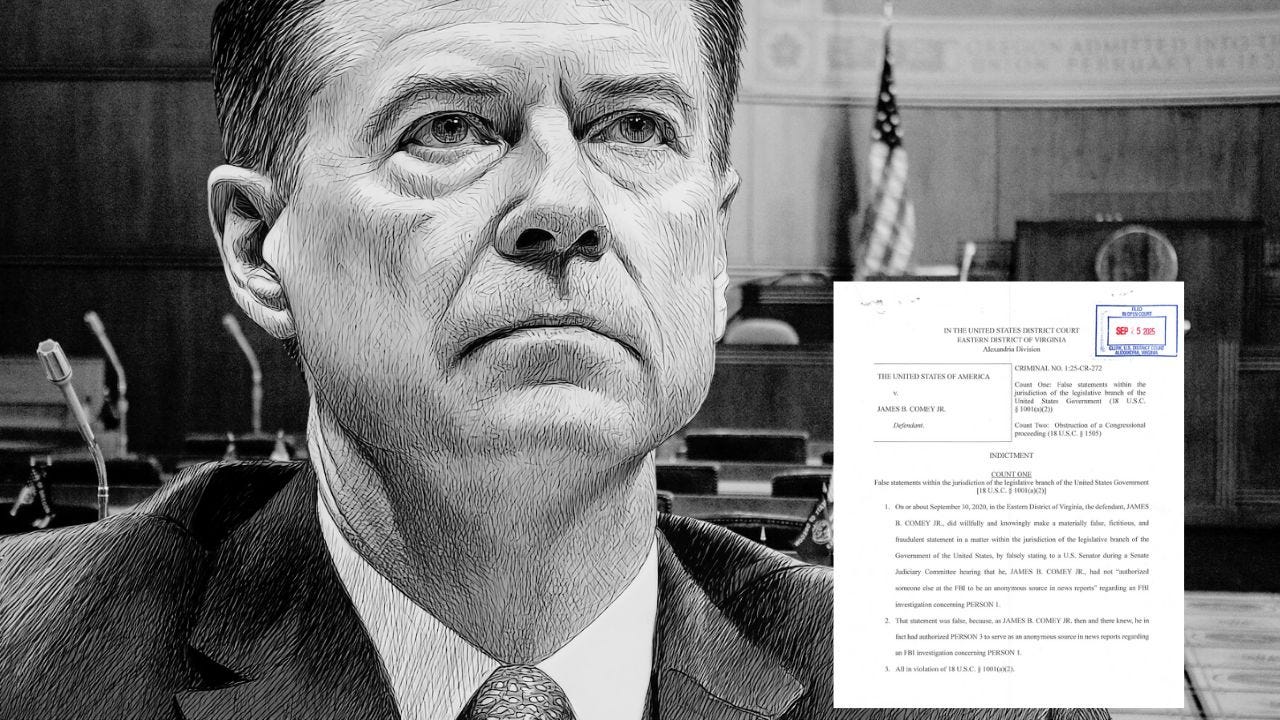
Former FBI Director, James Comey, was indicted in the Eastern District of Virginia on two felony counts. This has never happened before and is without precedent in American history.
I went through the indictment line by line, and as someone who has spent years in the courtroom, I want to share exactly what I see and explain why it matters.
What’s Being Alleged
The indictment charges Comey with making false statements to Congress and obstructing a Congressional proceeding. The allegations focus on testimony he gave on September 30, 2020 during a Senate Judiciary Committee hearing.
Prosecutors claim Comey told a Senator that he had not authorized anyone at the FBI to serve as an anonymous source in news reports about an FBI investigation involving an unnamed individual. The government alleges that this was false because Comey had in fact authorized another FBI official to provide information to the press.
The second count accuses Comey of corruptly trying to impede the Committee’s inquiry by giving false and misleading statements during that same hearing.
You can read the two-page indictment here.

What is an Indictment
An indictment is a formal charge voted by a grand jury. It does not prove guilt. It is the first step in a criminal case and signals that prosecutors believe there is probable cause to move forward.
Under 18 U.S.C. §1001, the government must prove far more than a simple mistake or a poorly worded answer. Prosecutors will have to show that James Comey made a statement to Congress that was false, that the falsehood involved a material fact capable of influencing the actions or decisions of the Senate Judiciary Committee, and that he acted knowingly and willfully.
Knowingly means he understood what he was saying at the time and was aware that it was false. Willfully means he intended to deceive or mislead, not that he misspoke or misunderstood a question. The government must also establish that the statement was made in a matter within the jurisdiction of the legislative branch, which in this case means an official Senate hearing where Congress was exercising its constitutional oversight powers.
Each of these elements must be proven beyond a reasonable doubt, and failure to prove even one will require an acquittal on this count.
Under 18 U.S.C. §1505, the government must meet an equally demanding set of requirements. Prosecutors need to show that there was a valid and ongoing Congressional investigation or proceeding, that James Comey knew about this proceeding, and that he corruptly endeavored to influence, obstruct, or impede the committee’s work.
The word corruptly carries a specific legal meaning. It requires proof that he acted with an improper purpose, such as to obstruct the truth-finding process, and that he took some affirmative step to interfere with the due and proper exercise of Congressional authority. It is not enough to show that his testimony was confusing or incomplete.
The prosecution must prove he intended to derail or hinder the committee’s inquiry and that his actions had the natural and probable effect of doing so. Only if each of these elements is proven beyond a reasonable doubt can a jury return a guilty verdict on the obstruction charge. Failure to prove even one of these elements will require an acquittal on this count.
Comey’s Defenses
Comey is coming out swinging with a defense that packs real weight. After the indictment dropped he went straight to the public, posting a video declaring his innocence and laying down a clear message that he is ready to fight every accusation head-on.
The specific defenses I expect Comey to assert include the defense of lack of material falsity by arguing that his statements, even if imperfectly worded, were accurate as he reasonably understood the questions and therefore not materially false. He can raise lack of mens rea by showing he lacked the specific intent required for both charges, meaning he did not knowingly and willfully make a false statement or act with corrupt purpose.
He can also rely on the defense of ambiguity by demonstrating that the Senate questions were vague or imprecise, which makes it legally impossible for the government to prove a deliberate falsehood beyond a reasonable doubt. He may also invoke the good faith defense, presenting evidence that he believed his answers were true and acted in honest reliance on his understanding of the facts.
His long record of public service, his careful preparation for congressional testimony, and his consistent adherence to legal protocols will reinforce these arguments and support a narrative that he acted without the corrupt intent required for conviction.
What The Next Year Will Bring
Next comes the grind of the federal criminal process. Comey will be arraigned in federal court in Alexandria where he will enter a plea of not guilty and the judge will set release conditions, almost certainly allowing him to remain free while the case moves forward.
The court will issue a scheduling order that sets deadlines for pretrial motions, discovery, and status conferences. Prosecutors will begin turning over evidence through a process called discovery, which includes witness statements, grand jury transcripts, FBI interview reports, and any exculpatory material that could help the defense.
Comey’s lawyers will file motions challenging the sufficiency of the indictment, seeking dismissal for failure to state an offense, and asking for detailed disclosures about the grand jury process. They may also move to suppress testimony if they believe the questioning before the Senate Committee was ambiguous or improperly framed.
As those motions are argued, both sides will prepare for trial. The government will line up witnesses, review transcripts of the 2020 Senate hearing, and work to prove intent beyond a reasonable doubt.
The defense will continue its own investigation, identify expert witnesses on congressional procedure, and press for internal DOJ communications about the earlier decisions not to prosecute. Pretrial hearings will draw national media attention as each filing exposes new details about the Justice Department’s internal debates and the political pressure behind the charges.
Unless the court dismisses the case or the parties reach an unexpected resolution, a trial date will be set for next year, setting the stage for a public test of the government’s evidence and the constitutional limits of executive power.
It Appears This Case is Politically Motivated
The history of this investigation underscores its political overtones and will provide fertile ground for the defense. Internal Justice Department memoranda generated during the initial review concluded that the available evidence did not meet the threshold for a criminal prosecution. These internal findings reflected the assessment of senior career attorneys who weighed the credibility of witnesses, the clarity of the alleged false statements, and the difficulty of proving criminal intent beyond a reasonable doubt.
The first prosecutor assigned to the matter was Erik Siebert, a veteran federal attorney with a long record of complex white collar and public corruption trials. After months of analysis, Siebert reportedly advised that the proof was insufficient and either resigned in protest or was removed after expressing those concerns to department leadership. His exit signaled deep unease within the ranks about the merits of the case and the risk of bringing charges that could not survive judicial scrutiny.
Following Siebert’s departure, the case was reassigned to Lindsey Halligan, who had recently been appointed Acting U.S. Attorney for the Eastern District of Virginia. Halligan is known for work aligned with Trump’s political allies and has no prior record of prosecuting major federal trials. Her decision to bring the indictment against Comey despite the earlier findings of insufficient evidence gives the defense a clear narrative of political motivation.
The shift from a seasoned career lawyer who doubted the evidence to a newly appointed attorney with political ties to Trump and little courtroom experience will allow Comey’s lawyers to argue that the decision to charge was driven by pressure from the Trump administration rather than by the strength of the case.
Will Comey Be Found Guilty?
If this case goes to trial the government faces an uphill battle. Proving that a former FBI Director intentionally lied in a public hearing is difficult, especially when the alleged falsehood involves a nuanced question about authorizing sources for news reports. The obstruction charge rests on the same testimony and will rise or fall with the false statement count. A jury may find the evidence too thin to convict beyond a reasonable doubt.
It must be remembered that this prosecution arrives in the climate of Donald Trump’s second term, a time when his administration has repeatedly targeted critics and stretched constitutional boundaries. The indictment of a former FBI Director who investigated Trump is not happening in a vacuum. It sends a message to public servants, journalists, and voters. It tells them that those who speak out can become targets of criminal process even when earlier reviews found no case.
Mitch Jackson, Esq. | links
PS: Release all the Epstein files now!
NOTES
Check back because I’m going to keep this section updated as the case progresses.
UPDATE 09-24-25:
Comey’s testimony in 2020
In the hearing, Senator Cruz falsely claimed McCabe said Comey “directly authorized” a press leak. Comey flat-out denied it.
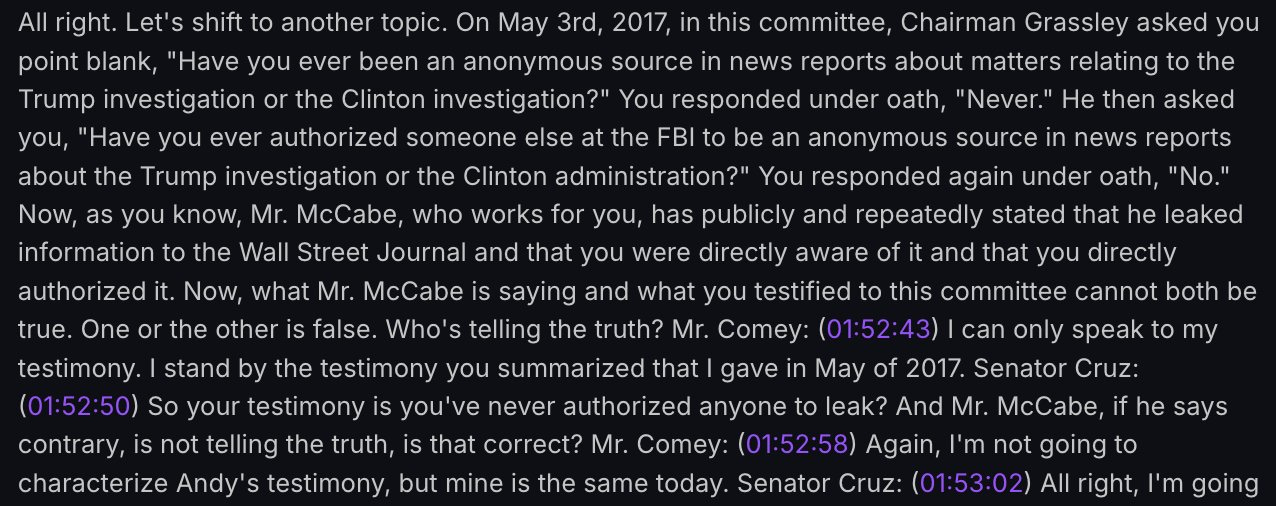
McCabe NEVER SAID Comey authorized the leak at all. The Inspector General Report Cruz cites makes that clear.


I do my best to share facts, accurate commentary and opinion, and push back against misleading and false political BS. If you enjoyed this post, please become a subscriber (free and premium).
Thanks as always for your factual analysis, Mitch. Question: Would Comey’s legal defense also include the ability to call Siebert to the stand to testify as to the reasons he chose not to bring a case?