

This article is for general informational purposes only. It does not provide legal advice or create an attorney client relationship. Election law and immigration law change fast, and some rules depend on your state and your immigration status. These are risk reduction suggestions and not guarantees. Calm compliance does not guarantee an officer will behave lawfully, and asserting a right does not guarantee immediate release. I want you to do everything legally possible to protect your rights and your vote without putting yourself, or anyone standing next to you, in harm’s way.
A Tuesday Morning in November
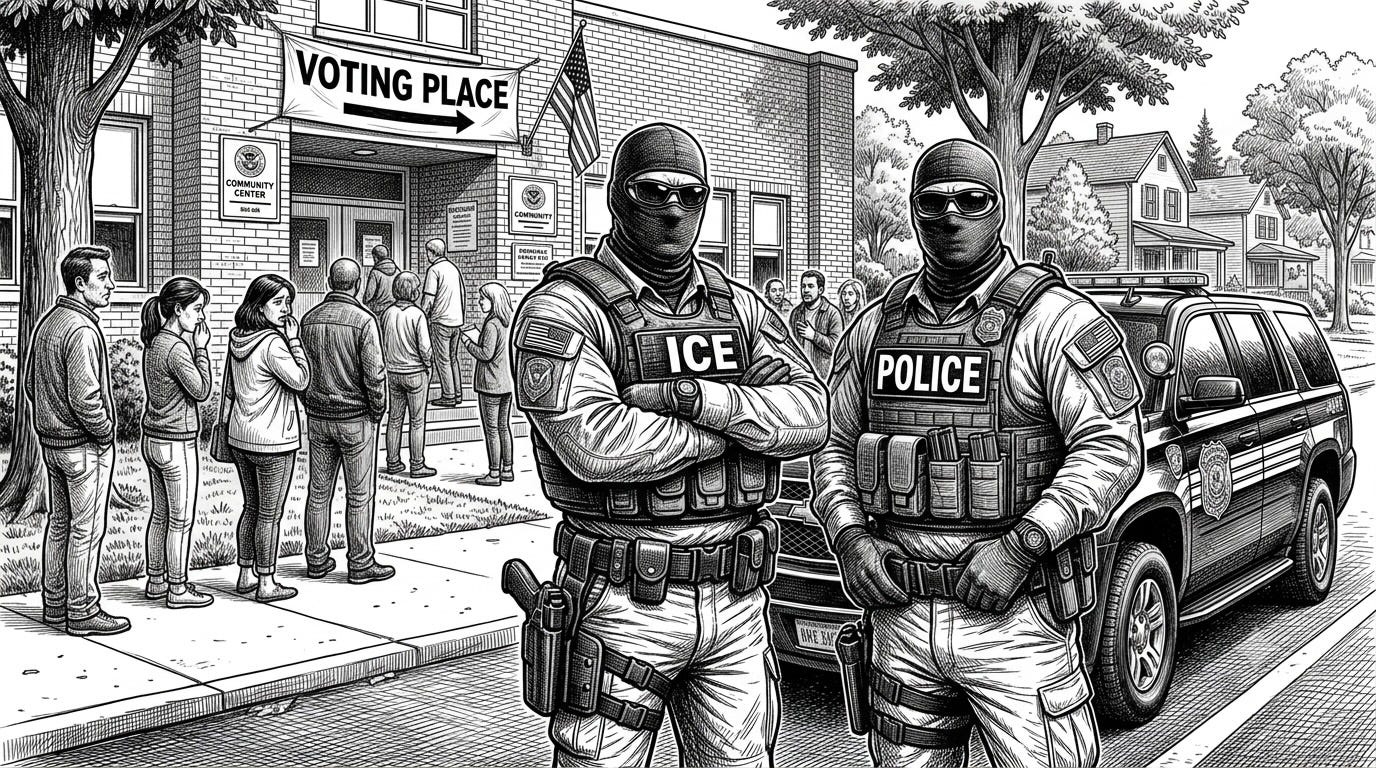
You pull into the parking lot of the elementary school where you have voted for twenty years, you grab your coffee, you walk toward the door with your sample ballot folded in your back pocket, and you see two black SUVs with no plates parked by the entrance and a man in a vest with three letters on the back standing beside them. Your stomach drops. You slow down. You check your phone for a reason to stay in the car. The woman in front of you turns around and walks back to her car.
That is the whole play. Nobody has to arrest a single voter. Fear does the work.
I am a trial lawyer, and I have spent forty years watching what happens when people in charge bet that regular people do not know the rules. This November the bet is on you. So here are the rules, in plain English, for the moment armed federal agents, or any government officers, show up where you vote.
The Law Has Been Clear Since 1865
A polling place is the one room in America where the government has to wait outside.
Congress wrote this rule in the middle of the Civil War, and it has stayed on the books for 161 years because every generation since understood the danger. Federal law makes it a crime for any officer of the military, or any person in the civil service of the United States, to order, bring, keep, or control troops or armed men at any place where a general or special election is held. The only exception covers force needed to repel armed enemies of the United States. Break that law and you face up to five years in prison and a permanent ban from holding federal office.
Read those words again. Armed men in the civil service of the United States. That is ICE.
In 1909 Congress went back and removed a second exception that had allowed troops to “keep the peace at the polls.” Lawmakers deleted it because they understood that a president who wants soldiers at the ballot box will always find a disturbance to point at. They closed the loophole on purpose, and it has stayed closed for 117 years.
Federal law adds more walls around the voting booth. A separate statute makes it a crime for any member of the armed forces to prevent, or attempt to prevent, a qualified voter from casting a ballot through force or intimidation. The Hatch Act bars federal employees from using their official position to influence a federal election. The National Voter Registration Act makes it a federal crime to intimidate or threaten any voter, or anyone helping a person vote, which covers poll workers and the volunteers handing out water in line. The Voting Rights Act lets any voter who is intimidated go straight to court for an order stopping the conduct, and under that law you only have to prove that you were intimidated, never that the agent meant to intimidate you.
Every state also has its own law against voter intimidation. California makes it a crime, chargeable as a felony, for anyone with a firearm, or any uniformed peace officer or private guard, to be stationed at or near a polling place without written authorization from the county elections official, and it is a separate crime to hire or arrange for someone else to do it. The only carve out for officers covers a peace officer conducting official business or showing up to cast a vote. California and Colorado go further and create a legal presumption that a person carrying a weapon near election activity is intimidating voters. That presumption applies fully to federal agents. State officers doing their jobs are exempt from it.
What They Have Said Out Loud
Now hold that law up against what the people running this administration have been saying all year.
In February, White House press secretary Karoline Leavitt told reporters she had not heard the president discuss any formal plan to put ICE outside polling locations, and in the same breath said she was unable to guarantee it would not happen. On February 25, Heather Honey, the DHS deputy assistant secretary for election integrity, told the secretaries of state on a national call that any suggestion of ICE at polling places was disinformation. Three weeks later Markwayne Mullin sat in his confirmation hearing to run DHS and refused to rule it out, saying ICE would be sent to polling places if a specific threat arose. Steve Bannon called the ICE deployments to airports perfect training for the fall of 2026 and urged Trump to call up the 82nd and 101st Airborne to surround every poll.
In May, a reporter asked Trump directly whether he would send National Guard troops or ICE to polling places during the midterms. He answered that he would do anything necessary to make sure we have honest elections. In July, Todd Blanche, then the acting attorney general, brushed aside the concern in an interview about ICE and the midterms. On July 31, after a dozen senators sent a letter warning that armed federal agents at voting sites would be illegal, a DHS official wrote back that ICE is not planning operations targeting polling locations, and then added that plans depend on available intelligence and are subject to change.
Then came September 1. Standing at a news conference in New York, Secretary Mullin said ICE is not there to patrol polling places, and in the next sentence said agents will enter a polling place if there is a threat to it or if they are serving a warrant on someone they have been tracking down. He said if they are serving a warrant, they will be where they need to be.
One hundred and eighty eight days of “we have no plans,” and then the man in charge of ICE announces the plan.
Here is my read. The administration keeps two stories running at once. One story, aimed at election officials and courts, says nothing is planned. The other story, aimed at you, says agents go wherever they want. The second story is the product. The first story is the alibi. When a government wants a group of people to stay home on Election Day, it does not need a single armed agent at a single door, because a rumor repeated often enough by the people in charge does the same job at a fraction of the cost and with none of the legal exposure.
It Already Happened Twice
In January 2025, DHS scrapped the longstanding guidance that told immigration agents to stay away from schools, churches, hospitals, and polling places. The results showed up this spring.
On May 20, during early voting in the Texas primary runoff, a state trooper pulled over a blue pickup in front of the Las Palmas Branch Library on San Antonio’s West Side, an active polling site. Within minutes, plainclothes ICE agents wearing ballistic vests swarmed the truck. Bexar County Sheriff Javier Salazar drove to the scene and told the federal agents to leave the polling place, and witnesses said the agents were already pulling out as he arrived. Nobody saw an agent approach or question a single voter.
On June 2, California primary day, voters at the Rancho Simi Recreation and Park District center in Simi Valley found a black Nissan Pathfinder with no plates parked near the vote center door, an ICE vest on the passenger seat, and a masked agent standing nearby. Volunteers blew whistles, filmed, alerted their rapid response network, and notified poll officials. Park rangers walked over and told the agents they were not allowed at a voting center. The agents left after about thirty minutes and never entered the voting area.
Notice what worked in both cases. Nobody argued with the agents, nobody blocked a vehicle, and nobody got arrested for interfering, because the citizens on the scene understood that their job was to document everything and the job of the local officials with authority over the site was to show up and enforce the law. Keep that pattern in your head.
Your Rights as a Citizen at the Polls
You have the right to vote without anyone stopping you at the door to ask where you were born. No federal agent has authority to check citizenship as a condition of entering a polling place. That job belongs to the poll workers, and they do it with the voter roll and your state’s ID rules. ICE has no role in running elections. Zero.
An ICE agent in a public parking lot is allowed to ask you a question, the same way any stranger is allowed to ask you a question. You are allowed to keep walking. If an agent asks whether you are a citizen, you have the right to say “I choose to remain silent” and continue toward the door. If an agent blocks your path, touches you, takes your ID, or tells you to stop, ask one thing: “Am I free to leave?” If the answer is yes, go inside and vote. If the answer is no, you are being detained, and a detention requires reasonable suspicion grounded in specific facts about you, and the fact that you are standing in line to vote in a neighborhood the agent happens to find suspicious is a fact about the neighborhood and the agent. It says nothing about you.
Do not lie. Ever. A citizen who tells the truth about citizenship has nothing to fear from that answer, and a citizen who chooses silence is exercising a constitutional right that no agent is permitted to punish.
You have the right to stay in line. If you are in line when the polls close, you vote. If agents show up and the line scatters, get back in it. If you were turned away or intimidated, ask a poll worker for a provisional ballot and write down the time. Courts have ordered polls to stay open late when voting was disrupted, and lawyers are standing by in every swing state this year to ask for exactly that order.
You have the right to record in public. Federal agents in a school parking lot have no expectation of privacy. Film from a distance and keep your hands visible. Never step between an agent and the person they are focused on.
You have the right to report. Call 866-OUR-VOTE, which is 866-687-8683, and tell the volunteer lawyer what you saw and when you saw it. Spanish speakers use 888-VE-Y-VOTA. Tell the poll worker inside. Tell your county election office. Those calls are how a judge learns there is a problem in time to fix it.
If You Are Undocumented and Standing Near a Polling Place
You do not have the right to vote in a federal election, and you must never try. Voting as a noncitizen is a federal crime, and so is registering by falsely claiming citizenship. A single ballot is not worth deportation and a prison sentence, and no organizer, no relative, no candidate, no online post is worth listening to on that point. Noncitizen voting is already illegal and already vanishingly rare, which is exactly why the loud claims of millions of illegal votes fall apart every time a court asks for the evidence.
You do have the right to be near a polling place. Driving your citizen daughter to vote is legal. Waiting in the car is legal. Standing beside your wife in line is legal. Walking your father with the bad knee to the door is legal, and in most states you are allowed to go inside as an assistant if he needs help reading or marking the ballot, subject to your state’s rules on who qualifies. In California a voter is allowed to bring up to two people into the booth to help, and the only people barred from that role are the voter’s employer and the voter’s union representative. The Constitution protects you on that sidewalk exactly as it protects the citizen next to you. The Fourth Amendment does not check papers.
Everything I wrote in my earlier article about sidewalk encounters with ICE applies here with one added fact: the agents are standing at a place where federal law says armed federal officers are forbidden to be. Say “I choose to remain silent.” Say “I do not consent to a search.” Ask “Am I free to leave?” Ask for a lawyer. Do not run. Do not carry false documents. Do not claim to be a citizen. Do not sign anything you do not understand, and ask for an interpreter and a copy of any paper they put in front of you.
Silence keeps you from handing them evidence, and it preserves every argument your lawyer needs later. A lawful arrest will still happen, and your silence will still have been the right call.
The polling place itself changes the risk math. In San Antonio and Simi Valley, local officials arrived within minutes and made the agents leave. Poll workers, election observers, neighbors, and rapid response volunteers are watching these sites in a way no grocery store parking lot ever gets watched. You are still at risk there. You are also far less alone there than anywhere else, and witnesses will exist if something goes wrong.
Make a plan before Election Day. Decide who drives, who waits in the car, who carries the hotline number, and who has the lawyer’s number saved. Rapid response networks in most cities now run a hotline for ICE sightings, and the volunteers who staffed Minneapolis, Chicago, Portland, and Los Angeles during the raids have been training all year for November.
Police, Sheriffs, the Guard, and the Military
Local police are a different question, and the answer starts with who commands them. Your county sheriff and city police work for your county and your city. They have a duty to keep polling places safe, and in the two incidents this year they were the ones who made ICE leave. Many states limit uniformed officers at the polls unless they are responding to a specific problem, because even a friendly officer in the doorway lowers turnout among people who have learned to fear a badge. A police officer at your polling place has zero authority to ask about your citizenship, exactly like an ICE agent. The same four sentences work on either one. Use them.
The National Guard has two bosses, and the boss decides the law. When the governor commands the Guard, the federal ban on troops at the polls does not apply, and a governor is allowed to use those troops for law enforcement support. Several states have their own laws keeping the Guard away from voting sites even under state command. When the president federalizes the Guard, those soldiers become part of the United States military, and the 1865 law bars them from any place where an election is held, full stop.
The active duty military faces the highest wall of all. The Posse Comitatus Act of 1878 makes it a crime to use the armed forces to enforce civilian law inside the United States without specific authority from Congress or the Constitution. The Pentagon’s own 2018 directive states that troops and federalized Guard members will not conduct operations at polling places. In April, the chief of the National Guard Bureau told Congress that his troops would follow that law. And when Trump federalized the Illinois Guard and sent it toward Chicago last fall, a federal judge blocked the deployment and the Seventh Circuit kept the block in place. On December 23, 2025, the Supreme Court refused by a 6 to 3 vote to lift it, writing that the government had failed to identify any source of authority allowing the military to execute the laws in Illinois. The troops went home, and in April a judge dismissed the case because there was nothing left to fight about.
The Insurrection Act is the escape hatch people worry about. It lets a president use the military for domestic law enforcement to restore order during an actual rebellion or a breakdown of law that states are unable to handle. It does not repeal the 1865 ban on troops at the polls, and it does not create any general power to police elections. A manufactured emergency invoked on the eve of a vote would meet lawyers in federal court within the hour.
If you see soldiers or federalized Guard at a polling place, you may be looking at a federal crime in progress, and the response is the same one that worked in San Antonio: document, report, stay out of the way, and let the people with authority remove them.
In the Moment
Stay calm and keep your hands visible.
Keep walking toward the door if nobody stops you. Ask “Am I free to leave?” if someone does. Say “I choose to remain silent” and “I do not consent to a search” if the answer is no. Do not run, do not resist, do not touch anyone, and do not argue the Constitution in a parking lot. Get the agency name, the vehicle description, the time, and the faces of any witnesses, and write all of it down the moment you are safe, because a judge at two in the afternoon needs facts you gathered at eight in the morning.
Then vote. Walk inside and cast your ballot, because the entire purpose of the SUV in the lot was to make sure you did not.
Vote Before They Get the Chance
The single most effective way to beat intimidation at the polls on November 3 is to have already voted by November 2. Check your registration today at vote.gov. Request a mail ballot if your state offers one. Find your early voting dates and your nearest drop box. Return your ballot in person if you have any doubt about the mail. There are close to 100,000 polling sites in this country, and any deployment the administration dared to attempt would reach a handful of them in a few swing counties, which means the fear they are selling is designed to travel a great deal farther than the agents themselves ever will.
Then bring four people with you. Your parents, your neighbor, the coworker who says his vote does not matter, the cousin who is scared. Send them this article. Save 866-687-8683 in every phone in your house.
Call your two senators and your House member at 202-224-3121 and ask a simple question: will you publicly oppose any armed federal agents at polling places, and will you say so before November 3? Get the answer on the record.
The Closing Argument
Every fear tactic depends on the target not knowing the rules, and now you know them. An armed federal agent at a polling place is committing a crime that Congress named in 1865 and sharpened in 1909. A federalized soldier at a polling place is committing that same crime. A president who invokes an emergency to put them there will lose in court, the way he lost in Chicago.
A citizen who stands in line, says four sentences, films from a distance, and calls the hotline has done the real work of protecting this democracy, and a citizen who votes early, checks the registration, brings four people, and saves the hotline number in every phone in the house has already beaten the whole scheme before the first SUV ever pulls into the lot.
The room where you vote is the one room where the government waits outside, and on November 3 you are going to walk into it.
Mitch Jackson, Esq.
Share this with the four people you are bringing to the polls, because a voter who knows the rules is the one thing this administration’s fear campaign was never built to survive. Then subscribe to Uncensored Objection, free or paid, and you will have an experienced trial lawyer in your corner every week with plain English answers on how to protect your constitutional rights, at the ballot box and everywhere else the government tries to test them.
Just the fact you even have to write this should be enough to impeach every senator and congressman that enables this behavior to continue.
Great advice.
Completely nuts that in 2026, a literal government sanctioned Kidnapping and Kill Squad exists in this country.