

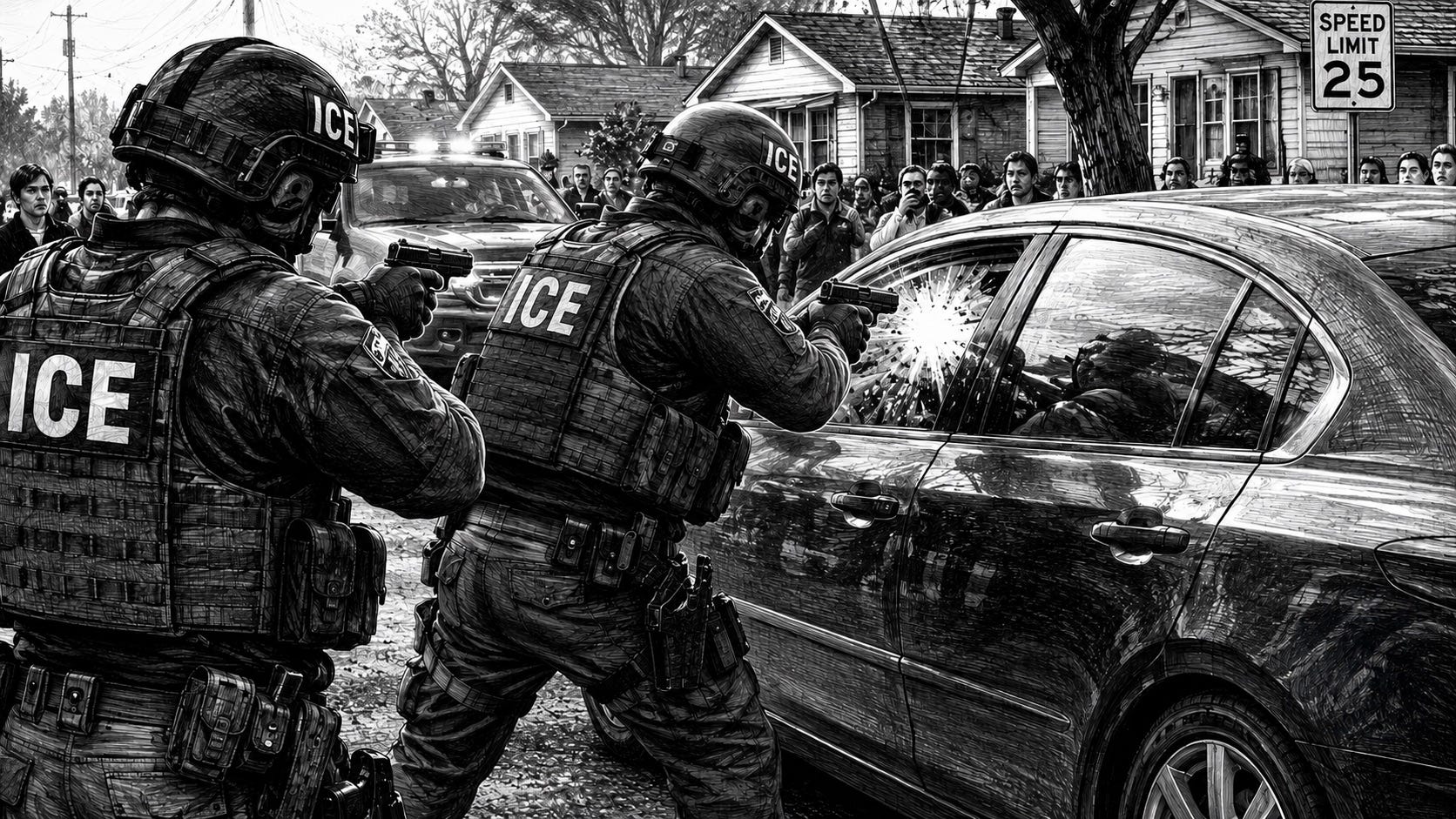
You’re stopped on an ordinary morning, on your way to work. The radio’s on. You can smell the coffee going cold in the cup holder. Then vehicles you don’t recognize swing in around you, unmarked. Men climb out. You’ve never seen them. There’s no uniform you’d trust. One of them has a hand on a gun, and he’s coming at your window, fast.
Your heart’s in your throat. Your hands go tight on the wheel. Maybe you think they’re here to rob you. And somewhere underneath your thinking, I mean the primitive stuff, the survival instinct wired into you long before reason ever showed up. Your foot starts hunting for the pedal.
Freeze it right there. That half-second, foot moving, car rolling, is the moment everyone wants to fight about.
Let me say the hard part first, because if I don’t, you shouldn’t believe a word after it.
Sometimes an officer can shoot a driver. The law allows it, and it should. When a person turns two tons of steel into a weapon and points it at a human being, or barrels through a chase that’s already putting other lives in danger, an officer doesn’t have to stand there and take it. The Supreme Court has said exactly that. I’m not going to tell you it never happens, or that it’s never justified, because you’d catch me lying and you’d be right to.
So here’s what I’m not asking you to believe: that driving away is always innocent, or that either of these two men did nothing.
Here’s what I am asking you.
Since September, federal immigration operations have involved more than twenty shootings. Nearly every person who came under gunfire was inside a vehicle. Several of those encounters ended in death.
Twice in the last seven days, an ICE agent fired into a car and killed the driver. In Houston, agents killed Lorenzo Salgado Araujo, a 52-year-old homebuilder who’d lived here 35 years and was driving his crew to a job site. He wasn’t the man they were looking for. His son thinks his dad may have believed the strangers in the unmarked vehicles were coming to steal his tools.
In Biddeford, Maine, an agent killed Joan Sebastian Guerrero, 26, a Colombian delivery driver, authorized to work, a Social Security number in his wallet, a partner and a three-year-old daughter at home. He wasn’t the man they were looking for either.
Both times, the government’s answer is some version of the same sentence you’re going to keep hearing: He tried to flee, the car became a weapon, the officer feared for someone’s safety.
Read that sentence again. Notice what it does. It starts the clock at the trigger. It asks you to look only at the last second — the car, the fear, the shot — and to look away from everything that came before it.
Now here’s the part almost nobody’s told you.
Last year, the Supreme Court looked at that exact excuse and threw it out. Unanimously. All nine justices, left and right, no dissent. In a case called Barnes v. Felix, they said a court cannot judge a police shooting by staring at the final second alone. Justice Kagan put it in words you won’t forget: judges don’t get to wear “chronological blinders.”
Translation? You don’t get to freeze the frame at the shot. You have to rewind the tape.
Now, the Court was careful. It didn’t finish the job. It didn’t rule on exactly how much it matters when officers create the danger themselves, it left that fight for another day. But it settled the thing that counts for you and me: you cannot look only at the last second. You have to watch the whole reel.
And when you rewind it, the questions change completely. Not just was the car moving toward someone. Ask these:
Why was the car stopped in the first place? Did the people inside have any way of knowing the men rushing them were federal officers and not carjackers? Were the vehicles marked? Were there lights, sirens, plain commands, a beat to comply? Who boxed the car in? Who stepped into its path? Could the agents have simply moved?
You can feel the difference in your gut, can’t you. There’s a world of space between a person using a car as a weapon and a person using a car to get away from men he’s terrified of. The law lives in that space. So does the truth.
In Houston, the men who survived, the eyewitnesses in that van, say no agent was ever in front of it, and that the shots came from the side, not the front. In Biddeford, a neighbor watching from his window says the agents’ SUV rammed the small car. And as they pulled Guerrero out and he lay bleeding in the street, that neighbor says he heard him say four words: I tried to stop.
Now let me hand you the part that should keep you up.
In both cities, the agents weren’t wearing body cameras. No footage of either shooting has surfaced. In Houston, the surviving witnesses are in ICE custody, held by the very agency that fired the shot. And one of them, the dead man’s own brother, has now been ordered into deportation proceedings that could put him on the other side of a border before anyone independent hears his account. The local district attorney says he still can’t get straight answers.
So sit with this. One party does the shooting. That same party holds the witnesses, and can ship them out of the country. That same party keeps the recordings, the trajectory, the evidence. And then that party hands you a press release and asks you to call it the record. If this happened with Renee Nicole Good and Alex Pretti, we would not have ever learned the truth.
Let me make it small enough to hold.
Imagine your neighbor shoots a man in his driveway. Then he locks the only two witnesses in his basement. He keeps the doorbell camera to himself. And he slips a note under your door: I feared for my life. Trust me.
Would you call that note the truth? Or would you call it a story you’re not allowed to check?
You already know the answer. You knew it before I finished the sentence.
That’s the whole thing, and here it is in words you can carry to the next person who repeats that government sentence at you:
Flight is not a death sentence. The last second is not the whole story. Rewind the tape.
You don’t have to decide these officers did something wrong. That’s not your job, and it’s not mine, it’s the job of investigators who don’t answer to the agency that fired the shot. You only have to decide one thing: that you will not accept a verdict from the one party that can’t be a witness, a jailer, and a judge all at once. A party who lied to you about Renee and Alex.
So when a shooting like this lands in your feed, don’t stop at the headline and don’t stop at the government’s sentence. Say the quiet part out loud to the people around you. Ask your senator and your representative the plain questions, where’s the video, where are the witnesses, why no body cameras, why can’t the local prosecutor look into a death that happened on their own street? Demand that the eyewitnesses stay put and get a lawyer before anyone’s deported. Demand independent ballistics. Demand the tape.
Because a country that lets an agency shoot a man, hold his witnesses, keep the footage, and grade its own homework isn’t asking for your trust.
It’s asking you to keep the blinders on.
Take them off. Rewind the tape.
Mitch Jackson, Esq.
Related: ICE Agents Are Using Phones to Track You
Subscribe/Upgrade/Support: Look, you just read a whole piece about not taking anyone’s word for it, so don’t take mine either. Build the habit of checking the record yourself, and subscribe to Uncensored Objection right now to get the tools that make it easy. Here’s what I want you to do: upgrade to paid today, because I’ve just added three new perks for readers who refuse to keep the blinders on. In addition to all other exclusive benefits, you now get:
#1: my book “Privacy in America” (PDF version of all 21 chapters),
#2: my political fact-checking prompt that works in almost any AI (the same approach we use at my law firm (it’s good), and
#3: access to my “Sidebar AI” platform that lets you interrogate this article, or any story you see on your phone, laptop, or TV, in real time.
You already know how to rewind the tape, now go do it on the news yourself, and grab all the details at the top of my Substack via the new “Paid Subscriber Perks” link.
Outstanding analysis. You must be an excellent trial attorney.
I was unable to finish reading as rage was building up inside of me.