

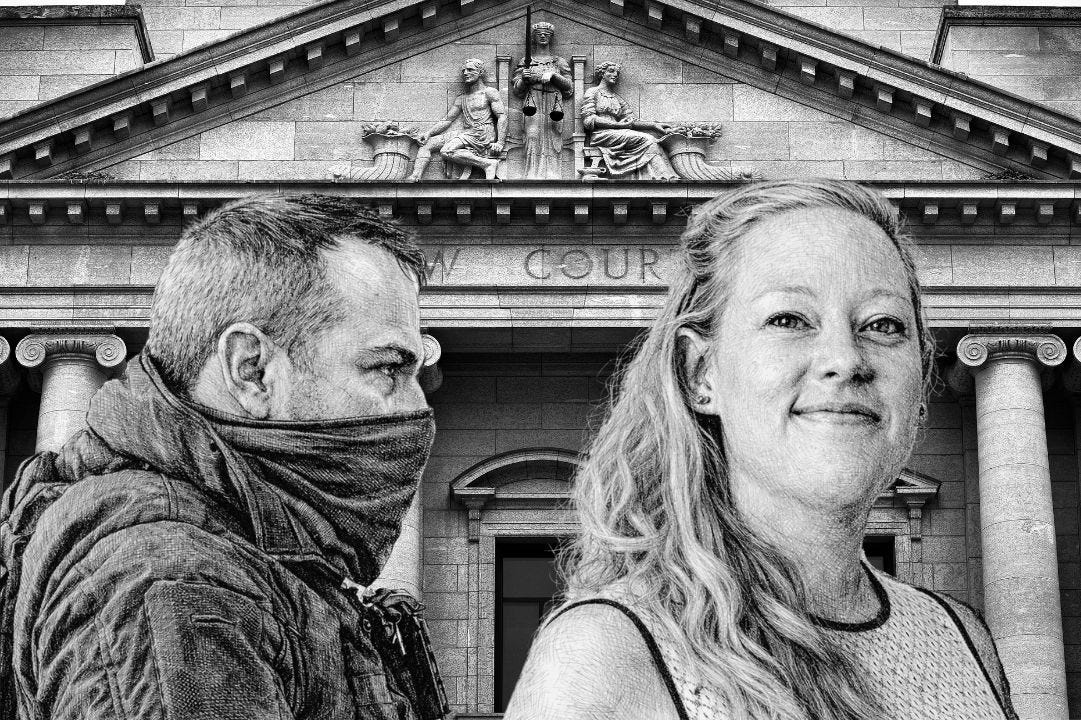
DISCLAIMER: This article is a legal analysis and commentary based on publicly available information as of the date of publication. It is not a finding of fact, a determination of guilt, or an accusation, and nothing herein should be construed as asserting that any individual has committed a crime. All persons referenced are presumed innocent unless and until proven guilty in a court of law.1
If the Law Applies to Everyone, It Applies Here
I spent years as a lawyer. I’ve filed claims and tried cases against police officers and won. I also declined cases when the law did not support them. I wish none of this was happening, but it is.
Under the Dual Sovereignty Doctrine, and from what I’ve seen to date, this case clears the charging threshold and ICE agent Ross should be prosecuted at the state and federal levels.
This is not about politics. It is about evidence, statutory elements, and accountability.
Ross fired three rounds into a moving vehicle and killed Renée Nicole Good, a United States citizen and mother of three. The government immediately labeled her a domestic terrorist. Video evidence does not support that claim. Independent experts have disputed intent. Local officials were sidelined while federal authorities seized evidence and controlled the narrative. See my earlier post.
The question is not whether Ross feared something. The question is whether the law permits what he did.
It does not.
Below are the primary charges that should be brought, first under Minnesota law, then under federal law.
I. State of Minnesota Charges
Primary Jurisdiction and Strongest Case
1. Second Degree Manslaughter [Minn. Stat. § 609.205(1)]
Minnesota law defines second degree manslaughter as causing the death of another by culpable negligence, whereby the person creates an unreasonable risk and consciously takes chances of causing death or great bodily harm.
This is the cleanest and strongest state charge.
Minnesota law does not require intent to kill. It requires proof that the defendant acted with reckless disregard for human life.
Here, the evidence supports that conclusion.
Ross fired into a vehicle that was moving away and turning. The video does not show him being knocked down, trapped, dragged, or run over. He remained upright. At worst it appears the hand he was using to hold his phone may have come into contact with the hood or side portion of Good’s vehicle.
He fired as distance was being created. The driver was not armed. She was not the target of an arrest. Less lethal options and disengagement were available.
This conduct fits squarely within Minnesota’s definition of culpable negligence.
2. Murder in the Third Degree [Minn. Stat. § 609.195(a)]
Minnesota’s depraved mind murder statute applies when a person causes the death of another by committing an act eminently dangerous to others and evincing a depraved mind, without regard for human life.
This charge may be brought in the alternative.
Discharging multiple rounds into a vehicle in a residential area during a non felony encounter can constitute an act eminently dangerous to others. Minnesota courts have litigated whether the statute applies when conduct is directed at a single person, and that issue can be contested at trial. Prosecutors are nonetheless permitted to present the charge where the act itself endangers the public at large.
The law allows a jury to decide whether that threshold is met.
3. Unlawful Discharge of a Firearm [Minn. Stat. § 609.66 subd. 1a(a)(2) and (3)]
Minnesota law separately criminalizes intentionally discharging a firearm under circumstances that endanger the safety of another, as well as recklessly discharging a firearm within a municipality.
Three rounds fired in a neighborhood during a nonviolent encounter satisfy the statutory elements of this offense.
II. Federal Charges
Federal charges are not optional here. They exist precisely for cases where local accountability is compromised or preempted by federal involvement.
1. Deprivation of Rights Under Color of Law [18 U.S.C. § 242]
This is the central federal statute governing criminal civil rights violations by law enforcement officers.
To convict, the government must prove that the defendant acted under color of law, willfully deprived a person of a constitutional right, and that death resulted.
The constitutional right at issue is the Fourth Amendment right to be free from unreasonable seizure and excessive force.
Willfulness does not require malice. It requires proof that the officer knew his conduct was unlawful. Training, experience, and departmental policy are used to establish that element. Here, Ross’s experience weighs against him.
When lethal force is used without probable cause of an imminent threat of death or great bodily harm, § 242 applies.
III. Sample Minnesota Indictment (Illustrative Only)
COUNT I
Second Degree Manslaughter [Minn. Stat. § 609.205(1)]
That on or about January 7, 2026, in Hennepin County, Minnesota, the defendant, Jonathan Ross, did cause the death of Renée Nicole Good by culpable negligence, whereby he created an unreasonable risk and consciously took chances of causing death or great bodily harm by discharging a firearm into a moving vehicle without lawful justification.
COUNT II
Murder in the Third Degree [Minn. Stat. § 609.195(a)]
That the defendant caused the death of Renée Nicole Good by committing an act eminently dangerous to others and evincing a depraved mind, without regard for human life.
IV. Sample Federal Indictment (Illustrative Only)
COUNT I
Deprivation of Rights Under Color of Law [18 U.S.C. § 242]
That Jonathan Ross, while acting under color of the laws of the United States, willfully deprived Renée Nicole Good of the right secured by the Constitution to be free from unreasonable seizure and excessive force, resulting in her death.
V. A Few Additional Thoughts
Two concepts are being intentionally blurred in the public messaging around this case: self defense and qualified immunity. They are not the same. They operate in different legal lanes. And neither one rescues what happened here.
Why Self Defense Fails Legally
Under Minnesota law, the use of deadly force by a peace officer is governed by Minn. Stat. § 609.066. Deadly force is justified only when necessary to protect the officer or others from apparent death or great bodily harm.
Necessity is the controlling word.
Deadly force is not justified to stop flight. It is not justified to enforce compliance. And it is not justified when disengagement or lesser force is available.
The available videos show the vehicle moving slowly, turning, and creating distance. It does not show the officer being run over, dragged, or incapacitated. Any risk present was shaped by the officer’s tactical positioning. Minnesota law permits juries to consider whether an officer’s choices made deadly force unnecessary or unreasonable.
That is not hindsight. That is statutory analysis.
Qualified Immunity Versus Criminal Liability
Qualified immunity does not apply here.
Qualified immunity is a civil doctrine. It shields officers from monetary damages in civil lawsuits when the law is not clearly established. It has no application in criminal prosecutions.
Criminal liability asks a different question. Did the defendant’s conduct satisfy the elements of a crime beyond a reasonable doubt.
Experience, training, and policy matter. The more experienced the officer, the harder it is to claim mistake. What is framed as protection in public rhetoric often becomes exposure in court.
This case does not turn on unsettled law. The governing standards are well established. They are applied to facts by juries, not press secretaries.
If the government can instantly label a citizen a terrorist without evidence, but cannot bring charges when video contradicts the narrative, the law becomes performative.
If federal agents are immune from the statutes used daily against civilians, the Constitution becomes conditional.
That is not justice.
That is permission.
And permission kills.
Mitch Jackson, Esq. | About Uncensored Objection
If this analysis matters to you, don’t stop here.
The Premium Uncensored Objection community is where the real work happens after the headlines fade. No spin, no slogans, just full access to clear legal analysis, hard questions, and a community that believes the law must apply to everyone.
If you care about truth, accountability, and protecting the future we’re handing to our children and grandchildren, this is where you belong.
Legal Disclaimer: This article is a legal analysis and commentary based on publicly available information as of the date of publication. It is not a finding of fact, a determination of guilt, or an accusation, and nothing herein should be construed as asserting that any individual has committed a crime. All persons referenced are presumed innocent unless and until proven guilty in a court of law. No legal advice is given.
The discussion of potential charges, statutes, and legal theories is presented for educational and informational purposes only, reflecting how prosecutors may analyze evidence and applicable law. This article does not constitute legal advice and should not be relied upon as such. Investigations referenced herein are ongoing, facts may evolve, and legal conclusions may change as additional evidence becomes available.
I should have been clear about this too. In most civil wrongful death cases, evidence of a felony conviction is not just relevant. It is powerful. It can be admitted, it can shape the case, and it can fundamentally change the outcome for Good's family seeking accountability.
Thank you for your work and sharing the analysis of this situation!