

I was born and raised in the Arizona desert. I know what it means to love a landscape that most people drive through without stopping. Southern Arizona has mountains that rise out of the earth like something ancient and permanent. Northern Arizona has forests and canyons that make you feel small in the most beautiful way. I love that state. I carry it with me.
And then I came to California. Forty years ago. And I never left.
That matters to you because it means what I am about to share is not the opinion of someone who arrived three years ago, got excited about the weather, and wrote a blog post. This comes from four decades of watching, listening, working, raising a family, building a career, meeting neighbors, and learning this state the way you learn anything worth knowing: slowly, and from the inside.
I am writing this because the noise has gotten loud. The political attacks on California have become relentless, and a great deal of what is being said is simply not accurate. For example, when Trump ordered ICE, the National Guard and Marines to show up in Los Angeles, it was all for political reasons. Our mayors and governor never needed or asked for help, and the story broadcasted to the rest of the country by right-wing news outlets bore little resemblance to what was actually happening on the ground. Most protests were peaceful and occurred within a small stretch of downtown Los Angeles, and the Trump administration used social media to highlight several clashes while most demonstrations remained peaceful. If you drove near the areas (and I did) you wouldn’t even know a protest was taking place.
A federal judge ultimately reviewed the situation and found there was no rebellion, and that civilian law enforcement was not unable to respond to the protests and enforce the law. Some very small clashes did occur, and I am not going to pretend otherwise. What I am telling you is that the picture painted for the rest of the country by this administration was a gross distortion of the reality on the ground.
So let me set the record straight. Not with talking points. With verified facts.
The Economy That Feeds the Country and Funds the World
Start here, because the numbers are too large to ignore.
California’s economy grew 5 percent in 2025 to reach a record nominal GDP of $4.25 trillion, outperforming every other state in the nation, continuing a 16-year growth streak. That is not a talking point. That is the U.S. Bureau of Economic Analysis. California’s GDP represents 13.8 percent of the entire U.S. economy, and it gained more raw GDP than any of the other 49 states, including Texas, Florida, and New York.
California was ranked the fourth largest economy in the world in 2025. That ranking means that a single U.S. state produces more economic output than any other state in American and also Germany, France, or the United Kingdom. When someone tells you California is failing, ask them which country California is trailing that was ahead of it a decade ago.
California leads the nation in new business starts, venture capital investment, manufacturing, and agriculture, and it sends over $83 billion more to the federal government than it receives in federal funding. That is real money flowing from California to support programs in states across the country. Every American benefits from California’s economy, whether they know it or not.
Nearly 70 percent of all U.S. venture capital funding in early 2025 went to California, and seven of the 10 largest investment deals in the Americas this year occurred in-state. Entrepreneurs around the world come here because this is where capital meets ideas, where talent clusters, and where the future gets built before it goes anywhere else.
Silicon Valley and the AI Revolution Happening Right Now
The tech story in California is not about the past. The Valley is not coasting on the legacy of what it built in the 1990s or the 2000s. It is at the center of the single largest technological transformation of this generation.
California is home to the most tech companies in the nation and remains the global leader in technology, leading the world in AI development while working to protect the public through forward-looking laws.
The tech sector and AI are forecast to fuel another year of strong economic growth in 2026, with significant business investment and strong consumer spending by workers in the industry. Nationally, AI-related investment has grown at a staggering pace. Projected AI-related investment in 2025, originally estimated at $250 billion nationally, has already surpassed $405 billion, with further increases expected in 2026, and California sits at the heart of that investment surge.
The challenges that come with that level of growth are real. Grid capacity, permitting timelines, and data center energy demands are issues requiring serious policy attention. By 2040, California’s peak power demand is forecast to increase by the amount of electricity needed to run 20 million homes, more than the total number of homes in the state today. California is working through those constraints in real time, and the people tackling them are among the best scientists, engineers, and policymakers in the world.
Clean Energy That Is Actually Working
The clean energy story here deserves to be told loudly, because it stands in direct opposition to the narrative being pushed by the current federal administration.
California has added more than 30,000 megawatts of new clean energy and storage capacity since 2019, which is enough power to meet roughly half of California’s record peak electricity demand. That is not a projection or a target. That capacity is built and operating.
California has sold more than 2.5 million new zero-emission vehicles as of 2025, and the state created the nation’s first standards for buildings and appliances, saving Californians more than $200 billion on energy costs.
California’s largest eight clean energy companies have seen the value of their stocks appreciate an average of 56 percent since 2019, compared to 40 percent for their global peers. Clean energy here is not an ideology. It is the most cost-effective new power generation available, and California made that bet early.
Yes, our gas prices at the pump are higher than in most other states. That is real. Embedded in that price are taxes and fees that fund clean air standards, smog reduction programs, and environmental protections. The trade-off has been made, and for millions of people who care about the environment and for others who have asthma and respiratory conditions, it has been the right one.
California is also investing in fusion energy, the same process that powers the sun, working toward a safe, carbon-free, and virtually limitless source of electricity that could reshape the global energy future. This state does not wait for the federal government to catch up. It moves.
Civil Rights as a Practice, Not a Promise
What California does for civil rights is not symbolic. It shows up in actual law, actual protection, and actual enforcement.
As of September 2025, the California Legislature has passed 205 bills and resolutions sponsored by Equality California alone to advance LGBTQ civil rights and social justice. Two hundred and five. That is a multi-decade, sustained commitment to the people who live here.
California has made itself a state of refuge for people seeking medical care and treatment, keeping medical records confidential and shielding individuals from out-of-state legal attacks.
New California laws protect public libraries from excluding books based on the demographic or political affiliations of their subject matter or creators, and civil protections now cover discrimination based on traits linked to race, including hair texture and hairstyles.
The California Civil Rights Department entered 2026 reaffirming its commitment to protecting all Californians, noting that in 2025 alone the department participated in nearly 300 community events across the state. That is what engagement looks like. Not a website. Showing up.
The Creative Economy You Did Not Know Was This Big
Here is a fact that stops most people cold.
California’s creative economy generates an economic impact of $289 billion, representing 7.5 percent of the state’s GDP and surpassing both agriculture and transportation in economic contribution. For every 100 performing arts jobs, an additional 156 downstream jobs are created and supported.
Across the state, 160,258 workers are employed across 17,110 arts, culture, and humanities nonprofits. These are people building the stories and images that the world will carry with it. California does not produce entertainment as a side project. It leads the world in it, and has for over a century.
California will host 14 matches of the 2026 FIFA World Cup, with Levi’s Stadium in Santa Clara and SoFi Stadium in Inglewood welcoming fans from around the world as part of the tournament’s expanded North American format. Super Bowl LX was held at Levi’s Stadium in February 2026, bringing one of the world’s premier sporting events back to the Bay Area. The Lucas Museum of Narrative Art is slated to open in Los Angeles in 2026. The world comes here. It always has.
Science, Innovation, and the Next Generation
The state that built the transcontinental railroad, launched the aerospace industry, and gave the world Silicon Valley is still producing the next generation of builders and thinkers at a scale that few places on earth can match.
The 75th annual California Science and Engineering Fair was held in April 2026, with 882 participants from 356 schools presenting 725 projects in competition for awards totaling over $30,000. These are students competing at a level that advances them toward the Regeneron International Science and Engineering Fair, the most prestigious student science competition in the world.
In April 2026, State Superintendent of Public Instruction Tony Thurmond honored 408 schools selected for the California Distinguished Schools Program, recognizing their innovation, talent, and success in supporting students.
California’s public university system, including UC Berkeley, UCLA, UC San Diego, and UC Davis, consistently ranks among the finest in the world. These are not just prestige institutions. They produce the research, the graduates, and the discoveries that keep this state at the leading edge of science, medicine, and technology.
The Nature That Makes You Stop and Remember Why You’re Alive
Step back from the economy and the policy for a moment.
Many years ago, I drove into California from the Arizona desert and saw the Pacific Ocean for the first time. I have never gotten over it.
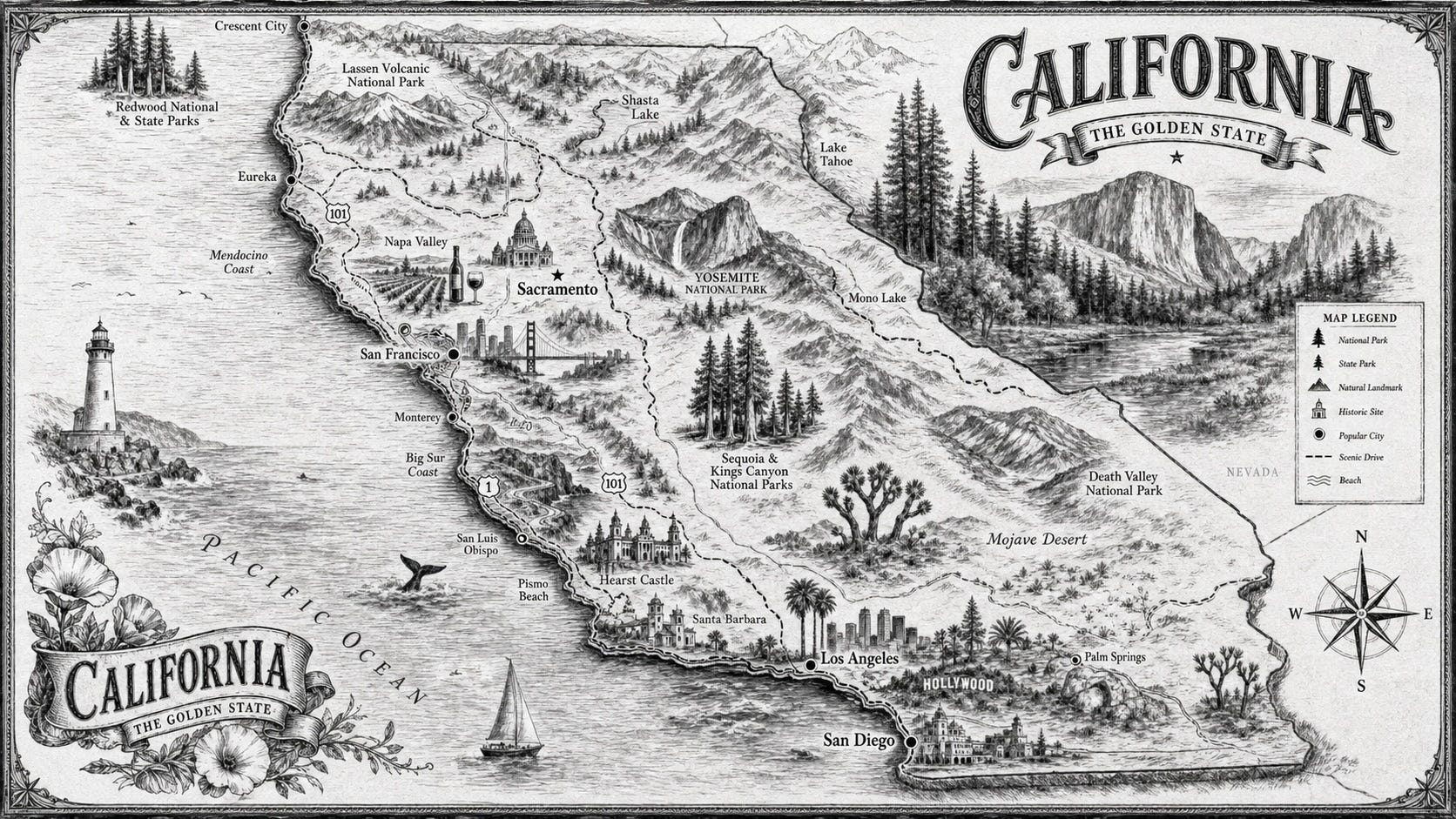
This state has more geographic and ecological diversity than most countries. You can surf in the morning and be skiing in the mountains by afternoon. You can drive through the oldest trees on earth and watch the sun set over the Mojave by evening. California produces about half of all fruits, vegetables, and nuts grown in the United States. The Central Valley alone, using fewer than 1 percent of U.S. farmland, supplies 8 percent of the nation’s agricultural output by value and produces one quarter of the country’s food, including 40 percent of the nation’s fruits, nuts, and other table foods. The wine regions of Napa and Sonoma are world-class by any standard. The ocean coastline stretches approximately 840 miles along the Pacific and includes some of the most dramatic coastal scenery in the contiguous United States.
I run along the coast. I paddleboard in waters that still stun me. I have done both for years. Back in the day I even raced motocross on some of the best tracks in the world. The fact that a person can do all of these things before noon on a Tuesday is something the rest of the world does not fully believe until they come here and see it for themselves.
Diversity as a Strength, Not a Slogan
The diversity of California is not a talking point. It is a lived reality that shows up in the food you eat, the music you hear, the businesses you patronize, the doctors who treat you, and the neighbors you know.
This state is home to the largest populations of Latinos, Asian Americans, and Pacific Islanders in the nation. It has the largest immigrant population in the country. And those communities are not struggling on the margins. They are building businesses, raising families, contributing to science and medicine and law and the arts, and making California what it is.
I have spent forty years as a trial lawyer in this state. I have sat across from families from every background imaginable, at the worst moments of their lives, and worked to get them justice. Those families have taught me more about the human capacity for resilience and love than anything I have ever read. California put those families in my life. The diversity of this state made me a better lawyer and a better person.
What We Keep Working On
Honest love tells the truth, so here it is.
Housing costs in California are a real, ongoing challenge. The state knows it, and significant legislation has been passed in recent years to increase housing production, speed up permitting, and reduce barriers to building. The progress is not fast enough for the people who need it. Work continues.
Homelessness is visible in ways that are painful to see, and it is not simple to solve. California spends more on homelessness services than any other state. The causes connect to mental health, addiction, housing costs, and economic displacement, and the solutions require sustained, coordinated effort. That effort is ongoing.
There are also real conversations to be had about the cost of doing business here, about regulatory frameworks that can create friction for small businesses, and about ensuring that the economic gains from the tech sector reach communities that have not yet felt them. These are worth having, and Californians are having them, loudly and in public. That is what a functioning democracy looks like.
The Bottom Line
Forty years of living here, working here, and paying attention have given me a perspective that no political narrative can overwrite.
California is not perfect. No place is. What California is, at its core, is a state that believes the best is still possible. It believes that protecting people and growing an economy are not competing goals. It believes that diversity makes a community stronger. It believes the planet is worth protecting. It believes that every family deserves to live in dignity, regardless of where they came from or who they love.
The data keeps backing that up. California continues to outperform every other state as the largest U.S. economy, growing its GDP faster than any of the other 49 states, year after year.
That is not a coincidence. That is what happens when a state commits to its people and stays committed through every political headwind thrown at it.
I love this place. Not because it is easy. Because it is worth it.
California has 40 million people who wake up every day and build something here, raise kids here, care for neighbors here, and fight for this place because they know what it actually is. They deserve to have their story told accurately.
Mitch Jackson, Esq.
Dear Mitch,
You just made me want to sell my cute little Cape, farmers porch, 6.5 acres, paddock w two 12x12 barns, fields, wetlands and woods to be your neighbor!! Lol.
It's very obvious you love it there.
I did two summers of small mammal fieldwork in the Chiricahua Mountains in SE Arizona, I've never felt more at peace and at home as the SW deserts, and I'm an inner city kid from Pittsburgh Pennsylvania!!! Growing up in Arizona and living your adult life in California sounds like a dream!!
😊♥️🔆
I'm so happy you wrote this article about California, I'm getting tired of our current administration bashing it and Governor Newsom. Trump lies so much!! He needs to read some facts and many books before he opens his pie hole and criticizes things he doesn't know about. Thank for clarifying how wonderful California is!!!
😊♥️🐾🌿🌎🔆🐦🦌
Judy