
How and Why Trump Will Seek a Third Term as President (and how we can stop him)
His Final Power Grab: Inside Trump’s Plan to Defy the Constitution in 2028

✨ Unlocked for the next 24 hours only. Read and share. ✨
Introduction
Donald Trump is now in the White House for a second time, and an unsettling question looms: will he try to stay for a third term? The U.S. Constitution, via the 22nd Amendment, limits presidents to two terms. No president in modern history has seriously attempted to defy that rule.
But Trump isn’t like most presidents. He has already hinted—sometimes as a “joke,” other times quite seriously—that two terms might not be enough for him. His words and actions have many Americans deeply concerned that he’ll attempt to extend his presidency beyond January 2029, shattering a fundamental principle of American democracy.
This detailed 18-page article examines why Trump is likely to seek a third term and how he and his allies might try to pull it off. It also looks at how other institutions might respond and, most importantly, what Americans can do to stop it. The goal is to break down the issues in plain language, sounding the alarm for anyone who cares about the future of our democracy.
Why Trump Will Try for a Third Term
Trump’s drive to pursue a third term would not be a mystery. It flows directly from his character and circumstances. Here are the key motivations pushing him in that direction:
- An Insatiable Thirst for Power and Adoration: Donald Trump’s narcissism and ego are legendary. He thrives on being at the center of attention and wielding power. The presidency gives him the ultimate spotlight and control.
Stepping down means giving up the crowds chanting his name, the constant media coverage, and the feeling that he alone commands the nation’s agenda. For someone who believes he is uniquely suited to lead (“I alone can fix it,” as he once proclaimed), the prospect of relinquishing power is intolerable.
Past presidents have gracefully left office after two terms, but Trump’s behavior suggests he sees himself as the exception. He’s even mused about staying longer—famously telling rally-goers in 2020 that after “four more years” he might go for “another four years.” At the time, many laughed or shrugged it off as Trump being Trump. Yet as he returns to power, those once-rhetorical asides take on a more ominous tone.
Donald Trump is thinking about pushing for a third term. It isn’t going to be some sideshow or ego trip—it’s will be a full-blown siren wailing across our democracy. His comments are the clearest sign yet that he’s willing to burn the Constitution to stay in power.
Trump’s pride paints a picture of himself as a hero who deserves an extra chapter. He has never been one to voluntarily exit the stage. The allure of a third term—of being the first to smash the two-term tradition since it was formalized—feeds directly into his self-image as a man who can break rules and “make history.” In short, Trump loves power, and if two terms leave him wanting more, he’ll be tempted to grab it.
- Fear of Losing Immunity and Facing Prosecution: Beyond ego, Trump has very practical reasons to cling to the Oval Office: staying out of jail. By 2025, he carries an unprecedented amount of legal baggage for a sitting president. Even before winning back the presidency, he was entangled in multiple criminal cases—ranging from hush-money payments to election interference and inciting the January 6th insurrection.
As president, Trump enjoys de facto immunity from federal prosecution including limited immunity granted to the presidency by SCOTUS in Trump v. United States. Additionally, the Justice Department has a long-standing policy against indicting a sitting president. This protection lasts only while he’s in office. The moment he becomes a private citizen, that shield drops, and all those legal cases can come roaring back. Trump knows this. It’s widely believed one major reason he ran for president again in 2024 was to delay or derail the prosecutions against him. And indeed, his victory bought him time: several investigations and trials were paused or slowed once he took office again.
However, that relief is temporary. The clock runs out in January 2029, when a new president is supposed to be sworn in. At that point, unless something changes, Trump could be prosecuted for any number of alleged crimes, including those that were put on hold. He might even face new investigations for actions taken during his second term.
For Trump, this isn’t abstract—this is a man who has been impeached twice and indicted multiple times; he lives with the real fear that losing power could mean courtrooms, convictions, and even prison. That fear cannot be overstated. If you were in his shoes and truly believed political office was the only thing keeping you out of jail, wouldn’t you be desperate to hold onto it? Trump certainly is. It’s a powerful motivator for him to explore every possible avenue to extend his presidency. In his mind, a third term might be the only way to ensure he never faces a jury or a jail cell. This creates a frightening incentive: he might break democracy’s biggest rule just to save himself.
- Money and Personal Gain: Power for Trump isn’t just about ego and legal safety—it’s also about money. Trump has a long history of blending his personal business interests with politics. The presidency has proven lucrative for him in indirect ways.
He’s raised hundreds of millions from fervent supporters, turning political fundraising into a personal piggy bank to pay legal bills and sustain his brand. He’s steered government and GOP business toward his private properties (from luxury hotels to golf resorts), profiting from events and visits. Foreign dignitaries and lobbyists have spent lavishly at Trump-owned venues, likely hoping to curry favor. Even the post-presidency spotlight can be monetized, but nothing compares to the grifting opportunities while actually in office.
If Trump leaves power, not only does he lose the legal shield, he also loses the attention that fuels his fundraising and the leverage that bolsters his businesses. A third term would keep the Trump money machine humming along. It’s sad to say about an American president, but we have to consider the possibility that Trump sees the Oval Office as a cash register.
His approach to politics has often been transactional—what can he get out of it? Maybe he’s behind a conglomeration trying to develop the Gaza Strip, or putting up a high-rise in downtown Moscow; it’s anyone’s guess what he has up his sleeve.
By 2028, his private empire could be financially shaky (lawsuits, debts, and declining business fortunes have plagued him). Holding onto the presidency could be his way of propping up his empire a little longer, whether through donor money or deals struck from the White House.
In short, beyond abstract ideals, Trump has personal financial incentives to remain in power. The job benefits him and his family brand in ways no private citizenship can. That monetary lure, combined with ego and fear, adds another reason he’ll be reluctant to step aside.
- A Vendetta and “Only I Can Do This” Mindset: There’s one more factor driving Trump: a deep-seated belief that he must crush his enemies and cannot trust anyone else with power. Trump’s rhetoric has increasingly cast his political opponents as not just rivals, but traitors or threats to America.
He often portrays the world in us-vs-them terms: his base versus the “corrupt elites,” “socialists,” or whomever he’s targeting. In this narrative, only Trump can deliver “justice” or restore greatness, and anyone else taking over would ruin everything. This near-messianic self-view means he likely feels a duty (or at least strongly justifies to himself) to continue leading. Handing off to a successor—even a Republican one—could be unthinkable if Trump perceives that person might not be 100% loyal to his legacy or might expose wrongdoing from his term.
Furthermore, Trump is driven by revenge as much as by ideology. He has made clear he wants to “settle scores” if given the chance: against Democrats who impeached him, officials who investigated him, even Republicans who weren’t sufficiently obedient. If he knows a third term is unconstitutional, he might rationalize an attempted power grab as necessary to prevent his enemies from “unfairly” punishing him. Remember, Trump falsely claims victimhood in almost every controversy. In his mind, staying in office might be “fighting back” against a system he insists is rigged against him. This is dangerous thinking, but it’s very much how he operates. Add it all up—narcissism, lust for power, fear of prosecution, greed, and vengeance—and you have a president extremely motivated to hold onto the presidency by any means available. The “why” is crystal clear: Trump’s self-interest and worldview both point toward an attempt to grab a prohibited third term. Now the question becomes how he might try to do it.
How Trump and His Allies Will Attempt a Third Term
If Trump decides to push for a third term in 2028, he and his loyalists will have to overcome the very explicit barrier of the U.S. Constitution. It’s not a simple task—there’s no legal way to just announce “I’m running again” without challenging the system head-on.
But one lesson we’ve learned about Trump is that he’s willing to test boundaries, exploit loopholes, and brute-force his way through norms that others respected. So how exactly could they attempt this? Let’s break down the possible strategies, from seemingly legal maneuvers to outright defiance:
1. Altering or Abolishing the Two-Term Limit: The most straightforward (though extremely difficult) approach would be to change the Constitution itself. Trump’s allies in Congress have already floated this idea. In fact, at the beginning of Trump’s new term, a congressman from Tennessee introduced a proposal to repeal or revise the 22nd Amendment’s two-term limit specifically so Trump could run again in 2028. The pitch was to allow a president to serve up to three terms as long as no more than two were consecutive—language clearly tailored to fit Trump’s unique case (having had a term, a break, and another term). This was a startling move: an open attempt to rewrite the rules for the benefit of one man.
Realistically, such an amendment has almost no chance of success. The bar is extremely high: it would need two-thirds approval in both the House and Senate, plus ratification by 38 state legislatures. That is a nearly impossible threshold in today’s divided political climate. Most Americans, regardless of party, are not eager to scrap term limits—those limits exist precisely to prevent the kind of power entrenchment Trump seeks. Even many Republicans balk at tinkering with this part of the Constitution.
However, just because a constitutional amendment is unlikely to pass doesn’t mean the attempt is harmless. By even proposing it, Trump’s backers send a signal to his base that a third term should be thinkable. It normalizes the conversation around undoing established democratic safeguards. Trump could use such proposals as propaganda: “See, people want me to stay longer!” He might claim there’s a popular demand to “let the people decide” beyond the constitutional constraint. In doing so, he tries to turn a personal power grab into a faux populist cause. So yes, changing the Constitution outright is one path they’ll discuss—mostly to fire up supporters—even if it’s an extreme long shot.
2. Exploiting Legal Loopholes and Technicalities: Leave it to Trump’s team to search for any crack in the law that might be pried open. One scheme that has been bandied about in MAGA circles is a Vice-Presidential gambit. How would this work?
The idea is essentially to get around the phrase “elected to the office of President more than twice” by having Trump not technically run for president in 2028, but still end up as president. For instance, Trump could run as a vice-presidential candidate with a trusted ally or even a placeholder as the presidential candidate. The logic goes like this: voters in 2028 would cast ballots for “Trump’s team” with Trump listed as the VP pick. If that ticket won, on Inauguration Day the obedient new president could immediately resign, making Vice President Trump ascend to the presidency via the line of succession. Presto—Trump gets a third term without ever being “elected president” that year.
Does that sound wild and far-fetched? Yes, it does. But incredibly, Trump himself has acknowledged this scenario in interviews, making clear that he’s aware of it. He once responded coyly when an interviewer brought it up, saying “there are methods” to get a third term and refusing to elaborate further. We all know what that implies: his team has thought about it.
Now, before anyone panics that this loophole could actually succeed, it’s important to note that the Constitution anticipated shenanigans like this. The 12th Amendment specifies that no one ineligible to be President can be Vice President. If you’ve served two terms, you’re ineligible to be president again—so you also cannot legally run for VP as a backdoor. In simple terms, if Trump can’t be president, he can’t use a technical trick to slide into the role from the VP slot.
Legal scholars overwhelmingly agree that this “Trump as VP” idea would not hold up in court. It’s almost certain the Supreme Court or even the electoral process would strike it down. But the key is that Trump might try it anyway. He has a pattern of testing legal boundaries, even if he eventually gets slapped back, because he loses nothing by trying. If no one stops him, great. If the courts do stop him, he’ll play victim and claim the “Deep State” is after him again. I wrote more about this “backdoor” approach here- “The Trump-as-Vice-President Backdoor Scheme: Why It Fails.”
So, expect talk of supposed loopholes—like the VP scheme or other convoluted interpretations of “not elected but serving”—to swirl around. They will sow confusion and could even force a constitutional showdown, which Trump might welcome as a spectacle. The complexity of such a plan might also be used to muddy public understanding—making it seem like maybe, just maybe, Trump has some magical path to a third term hidden in the fine print.
We should be clear: these loophole arguments are flimsy at best. But in a constitutional crisis, sometimes flimsy arguments are used as cover for power grabs. Trump’s lawyers (or TV cheerleaders) might argue, for instance, that the 22nd Amendment doesn’t explicitly say “you can’t serve three terms, only that you can’t be elected to them.” This hair-splitting could be their fig leaf as they attempt an end-run around the law. It wouldn’t convince a neutral judge, but will that matter if they can find partisan judges or officials to go along? We must be prepared for this kind of legal sophistry.
3. Manipulating Congress and the Courts: Another avenue for Trump is to essentially dare the system to stop him by brute political force. In this scenario, Trump would openly run for president again in 2028 (despite the constitutional ban) and rely on allies in power to make it possible. How could that play out?
For one, state election officials in pro-Trump states might put his name on the ballot regardless of the 22nd Amendment. Usually, states have to follow the Constitution, but what if they interpret that Trump is allowed to run because the people should decide? Some states might say, “We’ll let the voters here vote for him and let the courts sort it out later.” Meanwhile, any state or official that tries to bar him from the ballot (citing his ineligibility) could face lawsuits and political backlash. This messy situation would almost certainly wind up in the courts, and fast. Ultimately, the Supreme Court would be asked to rule on whether Trump can appear on the 2028 ballot or be sworn in if he somehow wins.
Here is where things get dicey: Trump has spent years reshaping the judiciary, including appointing three Supreme Court justices in his first term. By 2028, he may have had the chance to appoint even more judges and perhaps additional justices if vacancies arose. The current Supreme Court has a conservative majority, and while one hopes they’d uphold clear constitutional text, they have shown willingness to indulge Trump or the GOP in various disputes (for example, sometimes green-lighting dubious voting restrictions or dodging cases that might hurt Trump politically). Trump could wager that the Court won’t want to be the one to directly bar a candidate who millions of Americans support. In other words, he might bet on the justices either interpreting the law in his favor or punting the issue as a “political question” for Congress to resolve. It’s a cynical calculation: he doesn’t need a legally sound case if he has a compliant Court or Congress.
Now consider Congress’s role. The final step in electing a president is the counting of electoral votes by Congress in early January. If Trump ran and claimed victory in 2028, that count could become a flashpoint. Imagine a scenario where Trump, despite the constitutional ban, runs and the election is contested (as our elections often are). If Congress is controlled by his allies at that time, they might simply count his electors and declare him the winner, constitutional objections be damned. They could argue that it’s up to Congress to interpret the 22nd Amendment in this instance. This would be blatantly illegal, but if the Supreme Court stays out and Congress pushes it, it edges toward a constitutional collapse.
What if Congress is not entirely on Trump’s side? Suppose the House or Senate is controlled by those opposed to Trump’s third-term bid. Then we could see a true constitutional standoff: one chamber refusing to certify Trump’s electoral votes, perhaps declaring that he’s disqualified, and the other chamber (or Trump’s team) objecting. Normally, the law clearly wouldn’t allow Trump to even be a valid candidate, but if reality gets this far off the rails, legal clarity might not prevent chaos.
The point is, Trump’s strategy could be to create a situation so unprecedented and chaotic that the law becomes muddled in practice. He thrives in chaos, where he can leverage his cult-like base and bully Republican officials into submission. If he can’t formally change the Constitution, he might try to bend it by sheer political pressure—expecting Republicans in Congress and on the bench to act as accomplices or bystanders. This is why those 2026 midterm elections (which determine the makeup of the new Congress for 2027-2029) are so crucial, but we’ll get to that later.
Additionally, Trump might wield emergency powers or concoct a crisis to strengthen his hand. For example, under the guise of ensuring “election integrity” or responding to civil unrest, he could push Congress to grant him special authorities or delay the electoral process. He notoriously floated the idea of postponing the 2020 election due to the COVID-19 pandemic (which did not happen, but the mere suggestion was alarming). In 2028, if unrest or a security scare occurs, a Trump-friendly Congress might actually vote to delay the presidential election—something that has never been done in our history. Even a short “postponement” beyond January 20th would be unconstitutional (since a president’s term is fixed), but again, that might not stop him from trying if he thinks public fear will let him get away with it.
One can even imagine Trump attempting to use the Insurrection Act or declare a national emergency late in his second term, claiming the country is under threat and that changing leadership would be dangerous. It would be a pretext to hold onto power, and it would be illegal. Yet by the time courts sort it out, he might have effectively squatted in the White House beyond the expiration of his term.
These scenarios sound extreme, and they are. But none of them are out of character for someone who tried to overturn a national election once already. The bottom line is that Trump’s path to a third term, if he attempts it, likely won’t be a single straightforward plan. It will be a multi-pronged attack on the democratic system: a mix of propaganda (“the people demand I stay!”), legal maneuvering (loopholes and frivolous challenges), institutional pressure (leaning on Congress, state legislators, and judges to go along), and potentially emergency powers or brute force (declaring crises, encouraging mob pressure like we saw on Jan 6, 2021). We should not underestimate how far he and his most devoted allies might go.
Trump has a knack for finding yes-men to do what sane officials would never contemplate. If some scheme sounds too crazy—like, say, having a loyal Vice President pretend to be President for a day just to hand power back to Trump—well, remember that crazier things have been attempted (we did see a Vice President pressured to throw out actual electoral votes in 2021). To protect the two-term limit, every branch of government might be tested. Let’s examine how those institutions could respond if Trump pushes the envelope.
How Other Institutions Might Respond
A president doesn’t operate in a vacuum. Even as Trump and his inner circle plot a third-term bid, there are other players on the board: the courts, the military, state governments, and of course the American people represented by Congress. These institutions are supposed to serve as checks and balances, especially when someone oversteps their authority. If Trump moves to defy the Constitution, how might these institutions react? Will they stop him, or will they falter? Here’s a look at the key guardians of democracy and what role they could play:
- The Supreme Court: In any constitutional crisis, the Supreme Court is often seen as the arbiter of last resort. One would think that a third-term attempt by Trump would be swiftly shut down by the Court citing the 22nd Amendment’s crystal-clear text. And indeed, in a healthy democracy, that’s what should happen. If a case comes before the justices—say, a lawsuit to block Trump’s name from the ballot, or a challenge to Congress counting votes for an ineligible candidate—they ought to rule that the Constitution means what it says: two terms means two terms, period.
The question is, do we trust that the current Supreme Court would do that? It’s not a trivial concern. Trump has openly pushed the idea that the courts (especially judges he appointed) owe him loyalty. During his first term, he often complained he didn’t get enough personal favor from “his” judges, but by and large the judiciary did constrain him at times (for instance, they blocked various overreaches like certain travel bans until he revised them). However, the Supreme Court today has a conservative super-majority, and some of its members have shown sympathy to extreme executive power theories.
A few Justices might also calculate the political fallout of outright barring Trump from office. It would be an unprecedented move for the Court to say, “This candidate can’t even run or serve.” Even though it would simply be upholding the Constitution, you can imagine the firestorm—Trump would rail against the “biased liberal court” (never mind it’s mostly conservative) and possibly encourage unrest. The justices are human; they could feel intimidated or prefer to avoid getting involved if possible. On the other hand, if they shirk their duty, it would be a disaster for the rule of law. What signs do we have?
For one, consider how courts responded when Trump tried to cling to power after losing the 2020 election. Dozens of judges (including many Trump appointees) firmly rejected his frivolous fraud claims. That was heartening. It showed that when presented with absolutely no basis to overturn an election, the judiciary held the line. A third-term scenario, though, might not hinge on proving fraud—it hinges on constitutional interpretation and political will. If Trump just outright violates the rules, the Court’s backbone will truly be tested.
Imagine a scenario: a state removes Trump from the ballot because of term limits, and Trump challenges it. Will the Supreme Court take the case and rule against Trump? Or what if no state stops him, but after the election someone sues saying “Trump can’t take office again because of the 22nd Amendment”? The Court might face massive political pressure from Trump’s supporters to stand aside and let Congress handle it.
We have a bit of a preview: recently, various groups attempted to disqualify Trump from running in 2024 under the 14th Amendment (due to the Jan 6 insurrection). Some lower courts tossed those cases by saying it’s not up to states or courts to decide eligibility in that way. The Supreme Court didn’t definitively rule on that, but if they were to take a similar approach for the 22nd Amendment, they might say something like “the question of a third term is a political one, not a judicial one.” That would be a cop-out, frankly, but it’s possible.
Another factor: by 2028 Trump might further shape the Court. If any justices retire or pass away, he could appoint replacements who are even more stridently loyal to him. It’s not guaranteed; confirmations are tough fights, and a Senate might block extreme nominees. But it’s conceivable the Supreme Court in 2028 could be even more Trump-friendly than it is now. All it would take is a single justice’s shift to tip a decision. On something as charged as keeping a president in power, even one Justice wavering could decide history.
Ideally, the Court would rise above partisanship and hold Trump to the Constitution. Some justices likely would show courage. But others might seek a technical out or might quietly enable him by refusing to expedite decisions. It shouldn’t require “immense political courage,” as one expert put it, to enforce a clear constitutional rule—but in the climate Trump creates, it just might.
At the end of the day, we can hope the Supreme Court would do the right thing. But hope is not enough. Citizens must be prepared to demand that the Court uphold the law, and Congress must be ready to act if the Court falters. Which brings us to…
- Congress: The United States Congress is the body that, in theory, represents the will of the people and the states. Congress has some specific powers in this domain: it counts electoral votes, it could refuse to acknowledge an illegitimate claim to office, and it can impeach and remove a president who oversteps. If Trump attempts an illegal third term, a lot hinges on who controls the House and Senate by that time.
Let’s consider two very different scenarios: (a) Congress is dominated by Trump loyalists, or (b) Congress has a majority (even a slim one) of representatives committed to the Constitution over Trump.
In scenario (a), if both chambers are stacked with his allies, they might help rubber-stamp his power grab. They could, for example, simply ignore the 22nd Amendment by passing a resolution that “the term limit doesn’t apply in this unique circumstance” (which would be nonsense legally, but they might do it as cover). Or they could refuse to certify any other winner in 2028. Essentially, Congress could become an accomplice to a constitutional crime.
Given how many sitting members of Congress supported Trump’s false election fraud narrative in 2020 (remember, 147 Republicans still voted to reject certified state results right after the Capitol was attacked on Jan 6), it’s not far-fetched to think a similarly cowed Congress in 2029 might play along with Trump’s demands. They might justify it by saying “the people should decide” or “there were irregularities, so we’re keeping Trump.” Some might even claim that because Trump’s second term wasn’t consecutive with his first (having had Biden in between), the spirit of the law is different. It would all be rationalization for the same end: keeping Trump in power.
In scenario (b), if a majority in one or both chambers opposes Trump’s overreach, Congress becomes a fortress for the Constitution. The House or Senate (even one of them is enough to gum up Trump’s plan) could refuse to acknowledge Trump’s candidacy or win.
They might, for instance, decline to count any electoral votes cast for him, on the grounds he was never eligible. They could also hold hearings and denounce any attempt to break the term limit, rallying public support against it. And if Trump tries to simply not leave office, Congress can impeach him (again) and put tremendous pressure for his removal. Of course, impeachment would require a two-thirds Senate vote to actually remove him, which is difficult. But a unified stance by a constitutionalist Congress could sway other actors (like the courts, military, and public) to enforce the law.
It’s worth noting that even some Republicans have said they would not support a third term under Trump — a U.S. senator openly stated that changing the Constitution for one man is off the table. So there is a glimmer of bipartisan agreement on this principle. The key is electing enough of these principled individuals.
Another role of Congress: it could pass legislation clarifying procedures to handle any rogue attempt. For example, it could amend the Electoral Count Act to specify that electoral votes for an ineligible candidate must be discarded. It could also make it a criminal offense to knowingly seek the presidency in violation of term limits (though that might be mostly symbolic, as the Constitution is already clear). Such laws, if passed before 2028, would signal that Congress will not tolerate term-limit violations. However, whether such measures pass depends on the political makeup of Congress — again underscoring how much the 2026 midterm elections matter.
- State Governments and Election Officials: U.S. presidential elections are not run by the federal government; they’re run by the states. This means state governors, secretaries of state, and legislatures have significant influence over how the election of 2028 would be conducted. They could become either obstacles or accomplices to Trump’s third-term ambitions.
On one side, we have states that could act as the first line of defense for the Constitution. Some state election officials might say, “Donald Trump is ineligible for the presidency, so we will not place him on the ballot.” They have a legal leg to stand on: states generally have the power to determine ballot access, and they routinely disqualify candidates who don’t meet basic requirements (age, residency, etc.). Being term-limited could be considered a disqualifier.
If, say, California or New York (states with leaders who are no fans of Trump) took this approach, it would spark immediate legal battles, but it would also frame the issue clearly: they’d be standing up for the constitutional rule. Additionally, states could form compacts or pass state laws reaffirming their commitment to the two-term limit.
We might see some blue states announce jointly that they will refuse to recognize any attempted third term, putting pressure on Congress and the courts. We could also envision state governors mobilizing in a crisis: consider if Trump literally tried to cling to office after Jan 20, 2029 — state governors could refuse to deploy their National Guard units under any unlawful federal orders, or even coordinate with each other and with federal law enforcement to support the rightful new president.
During the tail end of Trump’s first term, there were quiet discussions among some state leaders and Pentagon officials about what to do if Trump wouldn’t accept his loss. The consensus was that states would follow the law and the certified election results, and the new president would be recognized. We might see a similar scenario play out if Trump denies the end of his second term.
On the other side, however, some states are firmly pro-Trump and controlled by Republican officials who are extremely loyal to him. Those states might do the opposite: they may hasten to change their laws to allow Trump on the ballot regardless of eligibility questions, or even instruct their electors to vote for Trump no matter what. In 2020, we saw a few states consider (though ultimately not do) appointing alternate slates of electors contrary to the vote.
By 2028, if Trump is saying “I’m running again, try and stop me,” states that are MAGA strongholds might give him whatever he asks for. They could sue any entity that attempts to block Trump. They could ignore federal court rulings they don’t like (setting up a constitutional confrontation). In the worst case, if things went truly haywire, we could imagine a divided scenario where some states recognize Trump as president and others do not.
This is verging into nightmare territory—a fragmented union politically. We absolutely want to avoid that, and the way to avoid it is by having a decisive, clear outcome and broad agreement among institutions in upholding the law. But the fact we can even conceive of such a split shows how high the stakes are. The role of states is also crucial in ensuring the election itself (if it proceeds normally) is fair and that turnout is high. Some state governments might have to resist any federal efforts to suppress votes or declare martial law locally.
During Trump’s second term, if he senses he might lose in 2028 (assuming he’s allowed to run or tries to anyway), he could lean on swing state governors to tilt the playing field. States that uphold fair elections will be critical in delivering a legitimate result and countering any false narrative from Trump about fraud (which we can fully expect if he loses).
- The Military and Law Enforcement: The United States military is traditionally apolitical and has never been used to settle a domestic electoral dispute in modern times. Yet, if Trump refuses to hand over power, it could conceivably become an issue. Military leaders have made it clear in the past that they will not intervene in elections and that their oath is to the Constitution, not to an individual president.
In 2020, the Chairman of the Joint Chiefs of Staff at the time subtly reaffirmed this, and there were reports that if Trump tried to illegally stay, the military would not back him. We would likely see the same stance in 2029. The military’s role, if any, would probably be indirect: simply recognizing the lawful commander-in-chief when the time comes. If Trump is no longer president as of noon on Jan 20, 2029, then any orders he gives after that would be unlawful. The armed forces would be expected to ignore such orders.
If a new president is properly elected and sworn in, the military would take their orders from the new president. Now, could Trump attempt to use the military to bolster a coup? He might try to invoke the Insurrection Act or use loyalists in federal law enforcement (like certain officials in the Department of Homeland Security) to cause chaos. However, I suspect the rank-and-file military would not go along with any attempt to keep Trump in office illegally.
Many of these people are dedicated to the rule of law; they are not his private army. In fact, Trump’s relationship with military leadership has been fraught — he’s purged some critical voices and surrounded himself with loyalists, but ordering troops to help him subvert an election crosses a line that I believe most soldiers, sailors, airmen, and Marines would not cross. It could create a split within the military if some fringe generals side with Trump, but the institution as a whole would likely adhere to the Constitution.
We should also mention the Secret Service and law enforcement: The Secret Service, which protects the president, would face a surreal situation if Trump simply wouldn’t leave the White House. At some point, their protectee is no longer the president, and someone else has that title. There’s been talk (half-jokingly) about Secret Service agents having to escort Trump out if he wouldn’t budge. It seems unlikely things would get exactly to that cinematic point, but it’s not impossible.
Federal law enforcement agencies like the FBI, U.S. Marshals, etc., could also be involved in enforcing court orders or upholding the lawful transition. One can imagine a scenario where, say, the Supreme Court rules Trump must vacate and if he doesn’t, a federal marshal (backed by military if needed) enforces it. That would be dramatic and dangerous, possibly inciting violence from Trump’s hardcore supporters. No one wants us to reach that point. That is why preventing the crisis in the first place is so crucial.
Lastly, consider the public and peaceful protest. Public opinion and mass response can influence institutions too. If millions of Americans take to the streets to protest an illegal power grab (peacefully exercising their First Amendment rights, as we’ve seen in movements like the Women’s March or various pro-democracy rallies), that can stiffen the resolve of officials to do the right thing.
Conversely, if armed groups of Trump supporters riot to keep him in power, that could intimidate officials into capitulating. We saw a preview on Jan 6, 2021: a mob was used in an attempt to disrupt the transition. If Trump thought it nearly worked once, he might encourage unrest again. Law enforcement agencies, from the Capitol Police to local police in cities, might then be tasked with quelling violence around an attempted coup. Their preparedness and loyalty to country over party would be vitally important.
Summing up the institutional responses: each branch and level of government has a role in stopping an unlawful third term. The Supreme Court can uphold the Constitution, Congress can refuse to go along, states can ensure a fair election and resist illegal orders, and the military and law enforcement can honor their oath to the Constitution. Many of these actors did hold firm when Trump tested them in the past. But this time, the pressure could be even greater. We cannot simply assume “someone else” will save the day. It will likely require all these pieces working together—and that only happens when we the people make our voices heard loudly that we expect our Constitution to be defended.
Why This Must Be Stopped – and How Americans Can Prevail
All of this leads to an unavoidable conclusion: an attempt by Trump to secure a third term would be an attempted authoritarian takeover, and it must be resisted by every lawful, democratic means available. This isn’t just partisan hyperbole. It’s the clear implication of everything we’ve laid out.
If an American president can override the two-term limit, then the door to dictatorship is wide open. The United States would cease to be the democratic republic it has been for over two centuries. The stakes could not be higher. Here’s why stopping Trump’s third-term effort is absolutely critical, and what we—everyday Americans—can do to stop it:
First, let’s articulate why it must be stopped in values we all understand. America is built on freedom, fairness, truth, and hope for the future. Trump clinging to power strikes at each of these values.
Freedom is endangered when one man declares himself above the voters’ verdict and the law. Fairness disappears when the rules apply to everyone except the ruler. Truth is twisted when a leader perpetuates lies (like “I really won” or “I’m entitled to extra time”) to justify illegitimate power. And the future becomes bleak when the next generation can no longer count on living in a country where they have a voice and can change their leaders through elections.
We often tell our young people that in America, anyone can be president, leadership changes hands peacefully, and no one is above the law. A Trump autogolpe (self-coup) would shatter that promise. It would send the message that our institutions are no longer stronger than an individual’s greed.
History has shown time and again—both abroad and in our own past—that democracies die when citizens become complacent or cynical. We cannot shrug and assume “oh, the system will sort itself out” or conversely throw up our hands and say “nothing we do matters.” It does matter. In fact, it matters more now than ever. The best antidote to a power grab is a populace that is alert, informed, and engaged.
So, what can we do? How can ordinary Americans, especially younger, independent, or previously disillusioned voters, make a difference in preventing this nightmare scenario?
- Use the Power of Your Vote (Especially in 2026): The single most impactful thing citizens can do is vote for representatives who will uphold democracy, and vote out those who won’t. Midterm elections often have low turnout, especially among young voters and independents. But the 2026 midterms may well decide the fate of the nation.
By electing senators, members of Congress, governors, and state legislators who will put country over party, we increase the chances that if Trump tries something drastic, he will face resistance instead of obedience. Imagine a Congress in January 2029 that has a majority of members, from either party, who say firmly “No” to any attempt to break the 22nd Amendment. That alone could deter Trump from even trying.
Conversely, if his loyalists dominate Congress, they could enable him. So your vote in 2026 is not just about local issues or which party you prefer—it’s a vote that could indirectly determine whether the presidential election of 2028 will be free and fair.
If you’re a young voter who sat out previous midterms thinking “Congress doesn’t affect me,” please rethink that. This time, Congress could affect whether you even have a meaningful vote in the future. Every race, down to state legislatures, will matter, because state officials will be on the front lines too. Check your registration, encourage your friends to do the same, and turn out in droves. The irony is that by voting in 2026, you might be saving your vote in 2028 from being rendered meaningless. Don’t let apathy be the reason we lose our democracy.
- Pressure Your Representatives Now: Voting is crucial, but we don’t have to wait until Election Day to make our voices heard. Starting right now, citizens can hold their elected officials accountable.
If you have a member of Congress (House or Senate) who is a Trump supporter, write to them and ask them to go on record that they will uphold the two-term limit. It might sound naive to ask, but putting them on the spot is important. Let them know you are watching and that you expect them to defend the Constitution regardless of personal loyalty to Trump. If they dodge or give excuses, that tells you where they stand—and you can communicate that to your fellow constituents and remember it when you vote.
If your representatives are already against Trump’s anti-democratic moves, support them vocally. They will likely face immense pressure and even threats; knowing their constituents have their back gives them courage. Public petitions, town hall questions, letters to the editor—these are small actions individually, but collectively they build a climate of expectation that even Trump’s allies have to consider. We want a chorus of American voices saying: “No third term. Not in this country.” Politicians do pay attention to the public mood when it’s overwhelming.
- Engage and Inform Others: One of the reasons Trump’s lies about elections gained traction is that many people simply didn’t know the facts or were swayed by misinformation on social media. To combat that, each of us can play a part in spreading truth and puncturing the propaganda.
Talk to your family, friends, classmates, coworkers—especially those who don’t normally vote or who feel disconnected from politics. Explain what a third term attempt would mean. You don’t have to be alarmist, just factual: “Did you know the Constitution prevents anyone from serving more than two terms? Well, I’m worried Trump might try to ignore that. We all need to be aware and make sure our leaders uphold the rules.”
Encourage people to pay attention to credible news sources as 2028 approaches, not just memes or partisan social media posts. A lot of young and independent folks tune out politics because it’s ugly or boring. But frame it like this: This is about our freedom and voice. Politics is going to directly affect whether you have any say in the future.
That’s as personal as it gets. By engaging people now, we can build a larger coalition of voters who will turn out to protect democracy. There are also non-partisan organizations dedicated to voter education and democratic norms—support them, volunteer, or at least share their materials. When more Americans are informed, Trump’s disinformation loses power.
- Peaceful Civic Action: If, as we near 2028, it becomes clear that Trump is seriously moving to violate the term limit, Americans should be prepared to peacefully protest and demonstrate en masse. Our voices in the streets, on campuses, and in community centers can show that we won’t accept an authoritarian turn.
Think of the massive demonstrations in U.S. history—from the civil rights movement to protests against the Vietnam War to more recent Women’s March and March for Our Lives. Peaceful protests can influence public opinion and signal to officials that the people will not stay silent. The key is that these actions must remain non-violent and focused on upholding democracy, not any partisan agenda. We don’t want to mirror the chaos of Trump’s mobs; we want to be the calm, determined majority that stands for the rule of law.
Alongside protests, other civic actions include court challenges (plenty of pro-democracy legal groups will be filing suits; support them if you can), and even strikes or boycotts if things get very dire (for instance, if some companies or donors back Trump’s illegal bid, public pressure could make them reconsider). Every lever of peaceful pressure should be on the table. Our democracy is worth fighting for in every legal, non-violent way.
- Defend the Truth: In the coming years, expect an onslaught of lies from Trump’s camp to justify why he should get a “special exception” or why the 2028 election (if he loses it) was “rigged.” It is essential for citizens, journalists, and officials to actively counter these lies with truth.
Trump might claim, for example, that the 22nd Amendment was never intended for non-consecutive terms (false—it absolutely applies). Or he might say something like “millions of people want me to continue, so it’s democratic to give them what they want.” That is a distortion: in a democracy we change leaders precisely to keep power in check. Whenever Trump or his spokespeople spout these arguments, they must be met with clear, simple refutations. Do not let the propaganda go unchallenged among your circles. If an acquaintance shares a misleading post on social media about Trump deserving a third term, politely correct it with facts. It might feel like a never-ending game of whack-a-mole, but it matters.
The narrative battle is one Trump is keen to fight—he wants to convince enough Americans that him staying on is somehow okay or even good. We have to win that narrative battle by emphasizing our core values: no one is above the law, the presidency is a public service not a personal throne, and America is stronger when we abide by our Constitution. Make those points over and over, wherever you can do so productively.
- Protect the Vote: In a broader sense, protecting democracy means ensuring elections remain free. Support efforts to expand voting rights and access, so that in 2028 every eligible voter can easily cast a ballot. The more people vote, the harder it is for any would-be autocrat to claim a mandate or sow doubt.
This includes opposing voter suppression measures and being aware of disinformation that tries to discourage voting (“your vote won’t count,” etc.—don’t fall for it, and counter it when you see it). If you’re able, consider being a poll worker or observer in 2028 to help uphold election integrity at the ground level. When citizens get involved in running elections, it builds trust and transparency.
It’s important to remember that we are not powerless. The Constitution provides mechanisms and our civic society provides tools to stop a lawless leader. But those mechanisms only work if engaged. Apathy or the assumption that “others will handle it” is what Trump is counting on. He benefits from people feeling disconnected and thinking their participation doesn’t matter. We have to prove him wrong by rising to the occasion.
Let’s also address directly those who may feel disillusioned or distrustful of “the system” as it stands. You might be an independent or young voter who thinks both parties are flawed, or that politics is too ugly to touch, or that your vote is just one drop in a bucket. Maybe you’re discouraged by slow progress on issues you care about and have tuned out. I hear you.
American politics can be deeply frustrating. But this moment is about something even more foundational than any single issue: it’s about whether we continue to have a democracy where we can work on those issues at all. If Trump (or anyone) can become effectively president-for-life, all our debates on policy could become moot because we won’t have the power to change anything through voting. The system might not be perfect, but it will get a whole lot worse if we let it collapse.
Think of protecting democracy as the prerequisite to everything else. If you care about climate change, or jobs, or student debt, or civil rights—none of that can be addressed if we slide into authoritarianism, because public pressure and elections will no longer shape policy; it’ll be whatever Trump decrees. So even if you’re “meh” on politics, please be *very interested* in preserving the ability to have a political voice. It’s basically self-preservation of your rights and future.
Also, consider the long term. Do we want to set a precedent that could be exploited by future presidents? If Trump somehow got away with a third term, what stops a future president (perhaps smarter and more disciplined than Trump, which could be even more dangerous) from doing the same, citing Trump as an example? It could permanently damage the peaceful transition of power that has been a hallmark of American governance. We’d be telling future generations that we dropped the ball—that when our time came to defend the republic, we didn’t step up. That cannot be our legacy. Our legacy should be that when democracy was tested, the American people passed the test.
Conclusion
Donald Trump’s apparent desire to seek a third term as President in 2028 is more than just a quirk of his ego—it is a flashing red alert for the nation.
We have explored why he is likely to attempt it: from his unquenchable hunger for power and adulation, to his fear of prosecution, to the personal profits and grudges that make him want to cling to office. We have outlined how he and his allies might scheme to make it happen: through attempts to rewrite the Constitution, exploit loopholes, bully Congress and courts, or even declare emergencies and stoke chaos. We have examined the possible responses of institutions: the Supreme Court could be a firewall or a rubber stamp; Congress could be a safeguard or a collaborator; state officials and the military could hold the line or be pushed aside. In the end, all roads lead back to us, the American people.
The United States of America is ultimately a government “of the people, by the people, for the people.” That principle is put to the ultimate test when a leader tries to place himself above the law. If Trump truly attempts to subvert the two-term limit, it will be a crisis unlike any we have seen in our lifetimes. But it will also be a moment of clarity. It will force every American to answer the question: Do we still believe in our Constitution and the values that underpin it?* I believe the overwhelming answer can and must be “Yes, we do.”
We stop Trump’s third-term aspirations by asserting, through every democratic means, that America is not a one-man show. We stop it by voting in record numbers, by electing leaders who will put country first, by peacefully resisting any unlawful power grab, and by reminding each other that patriotism isn’t about saluting a person—it’s about loyalty to the ideals of liberty and justice. We stop it by refusing to be intimidated by chaos or discouraged by cynicism.
Make no mistake: this is a crossroads for the United States. The path of allowing a third term (or the attempt at one) leads to a dark place of authoritarian rule, eroded freedoms, and likely turmoil. The path of defending the Constitution leads to renewal—renewal of our democratic promise and the principle that no one, not even a former reality TV star and convicted felon, turned president, is above the rules that bind us all.
In the coming years, you might hear arguments that “exceptional times call for exceptional measures” or that “Trump is needed to finish the job.” But America does not have kings. We don’t anoint saviors who stay in power forever. Our nation was founded precisely to escape that kind of tyranny. We have term limits to prevent a slide into autocracy, and they exist for moments exactly like this.
This is a call to action for every American who cares about preserving our republic. It doesn’t matter if you’re a Democrat, a Republican, or an independent—this is beyond party. This is about preserving the basic framework that allows us to even have parties and elections. It’s about ensuring that when you cast a vote, it truly means something, and that the torch of leadership is peacefully passed on when the time comes.
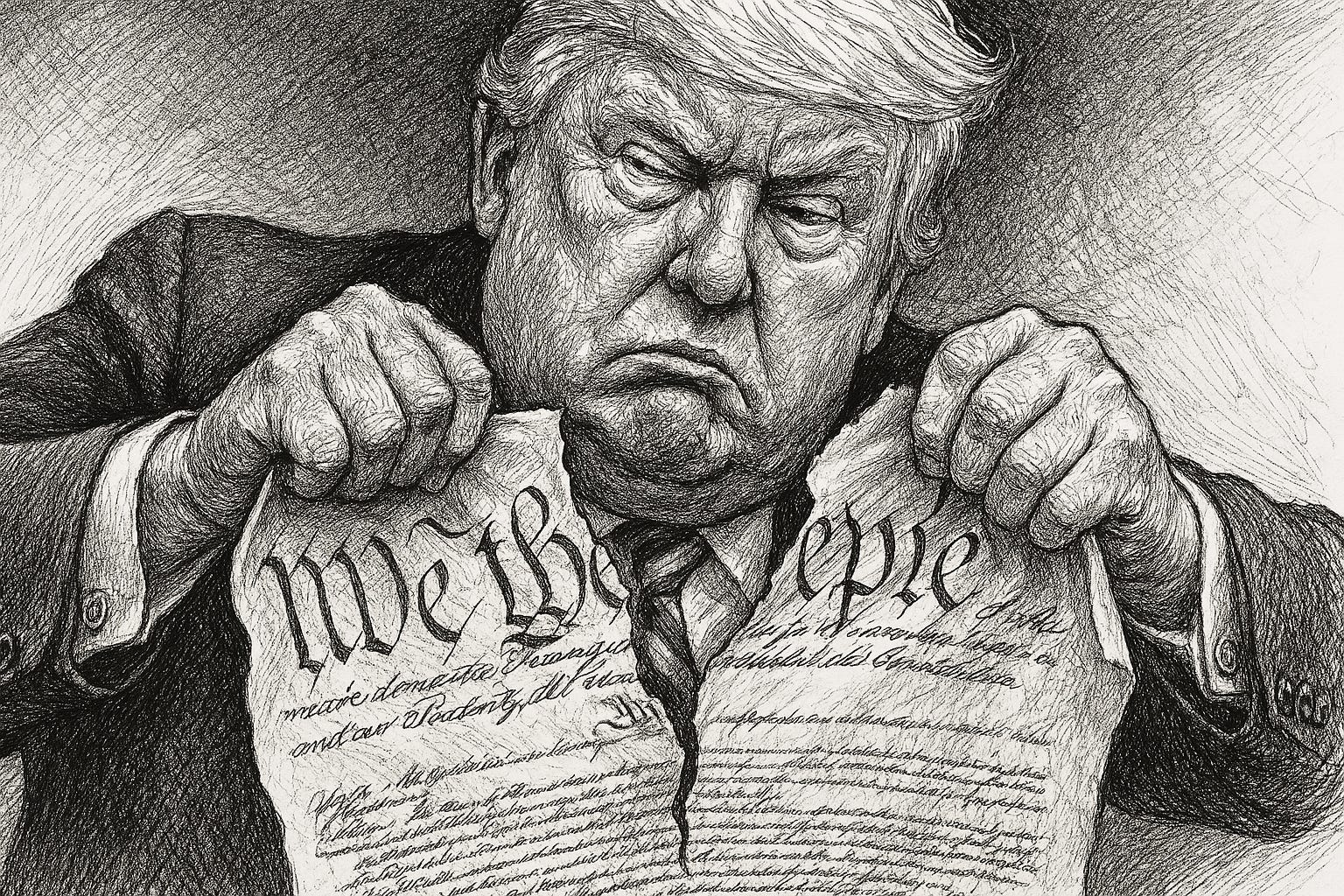
Imagine it’s January 20, 2029. In one scenario, you see Donald Trump place his hand on a Bible and take the oath for a third time, as the crowd cheers and the Constitution lies in tatters. In another scenario, you see a new president take the oath—the rightful winner of 2028—while Donald Trump watches from the sidelines, maybe scowling but ultimately yielding to the rule of law. The second scenario is the continuation of American democracy; the first is the end of it. The actions we take between now and then will decide which of those futures becomes reality.
The power to shape that future lies with us. Let’s choose freedom over fear, law over lawlessness, and “We the People” over any one person. Let’s ensure that when the history of this era is written, it will be said that Americans, young and old, rallied to defend their democracy from the brink. The battle is not in some distant battlefield—it’s here and now, in our votes, our voices, and our vigilance.
Our message to Mr. Trump should be simple: America is not yours to rule, it’s ours to govern. And we intend to keep it that way. Let’s get to work, together, to make sure that the presidency of the United States remains a position of service, not a throne. The future of our republic depends on what we do next. Let’s meet this challenge with the courage and determination that freedom requires.
Mitch Jackson, Esq. | links
Thank you for being a paid subscriber
Independent journalism only works when people like you choose to lean in—not just with attention, but with support.
For that reason, I want to thank you for your support.
I believe “Uncensored Objection” makes for a unique gift to anyone in your life who you feel might like to stay up-to-date on the breaking political news and issues.
If you agree and would like to gift a monthly or annual subscription to a family member or friend — today’s a great day to do just that.
At just $5 a month. $50 a year. It’s a small investment in something bigger than all of us.
Listen to the related podcast conversation on Substack, Apple Podcasts and Spotify.


Let's face it. He knows he's going to jail for sure sometime between 2028 and 29. The only way he can prevent that from happening is to stay in office. The world is going to be looking for retribution from Trump by 2028. It will be time to pay the piper.