

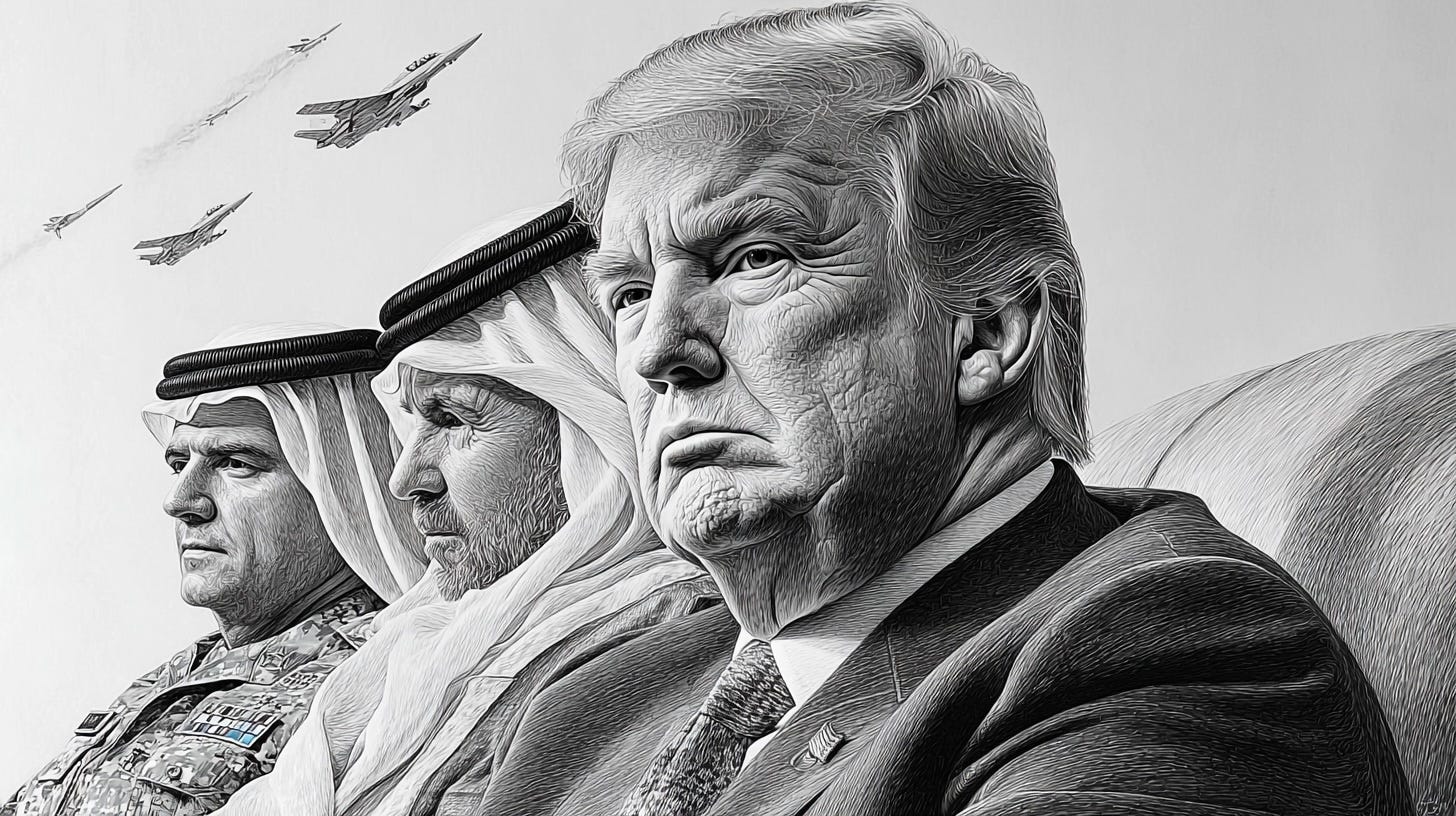
When the Trump administration announced that Qatar would pay to build a new military facility for its Air Force pilots inside Mountain Home Air Force Base in Idaho, every American should have stopped cold. This is not a routine training deal. It’s a foreign regime with a record of corruption, censorship, and repression buying access to U.S. soil under the banner of “partnership.”
You don’t hand the keys to your home to someone you don’t trust. Yet that’s exactly what this administration is doing, inviting a foreign military power into the heart of America and expecting us to believe it’s business as usual.
The Hegseth Announcement and Immediate Backlash
“Today we’re signing a letter of acceptance to build a Qatari Emiri Air Force Facility at the Mountain Home Air Base in Idaho.” -Pete Hegseth, US Secretary of Defense
On October 10, 2025, Defense Secretary Pete Hegseth publicly announced that Qatar would fund a facility on U.S. soil where Qatari pilots could train with F-15 jets, using infrastructure at Mountain Home AFB. Immediately the public negatively responded and he was forced to clarify that this would not be an actual base owned or controlled by Qatar: the facility would remain under U.S. jurisdiction.
That distinction has done little to dampen political firestorm: critics call it a foreign military presence on U.S. soil in all but name. The reaction was swift and harsh, from both sides. Even Trump’s far-right MAGA buddy, Laura Loomer, denounced what she called a “betrayal,” accusing the administration of “gifting American land to funders of Islamic terrorism.” Many other staunch Trump backers expressed shock at the optics of foreign military involvement on U.S. soil.
In response, Hegseth later backpedaled somewhat, emphasizing that control would remain with the U.S. military and that the facility is best understood as a “shared” or “enduring” location, not a sovereign Qatari base. But the damage is done: even the softened language underscores how unnatural and fraught this arrangement is.
Qatar’s Record of Silencing Critics, Oppressing Women, Funding Terrorism, Punishing LGBTQ People, and Muzzling the Press
To comprehend how radical this development is, one must examine Qatar’s record in areas that directly touch on American values, U.S. law, and international norms.
Human rights and violation of values
Qatar’s record on human rights is a series of broken promises and systemic repression. Women in Qatar live under a rigid guardianship system that denies them independent legal status, control over their own lives, or even authority over their children in many cases. They must secure permission from their male guardian to marry, travel abroad, take government scholarships, obtain some medical care, and work in numerous public-sector roles. Divorce often strips women of custody rights or financial control. In courts, women’s testimony is sometimes valued as half that of men. Inheritance laws award sons double the share of daughters. If a woman marries a non-Qatari, she cannot pass citizenship to her children. The legal and cultural architecture there treats women as permanent dependents in matters of agency and rights.
LGBTQ individuals live under constant threat. Same-sex relationships are criminalized, and both men and women can face prison sentences for consensual gay or lesbian acts. In Qatar, transgender people are sometimes arrested for “impersonating” the opposite sex. Security forces have detained LGBTQ individuals without charges, conducted abusive searches of their phones, coerced forced confessions, forced them to sign pledges renouncing their identity, and subjected them to beatings or harassment while in detention. Some are pressured to undergo conversion therapy as a condition of release.
Free speech in Qatar carries risk of arrest, censorship, or disappearance. Journalists, activists, and ordinary citizens have no true safety when they criticize the ruling powers. Migrant workers building stadiums and infrastructure routinely suffer wage theft, forced labor, dangerous working conditions, unpaid recruitment fees, and deaths shrouded in mystery. Those abuses continue even after international scrutiny.
When you invite Qatar to expand a military footprint on U.S. soil, you grant legitimacy to a regime that silences dissent, treats half its population as second-class, criminalizes identity, and tolerates abuses hidden behind political power. You send a message that these violations do not matter. You allow a foreign government with no respect for personal freedoms or basic dignity to lean on America’s strength, and you empower them to hide behind that partnership.
Terror financing, regional meddling, and ethical contradictions
Qatar long has maintained a contradictory posture: on one hand, a U.S. security partner hosting America’s largest military base in the Middle East (Al Udeid); on the other, a regime tolerated (and often accused) of harboring or funding Islamist political movements, mediating with extremist elements, and navigating between regional powers with ambiguity.
It is undeniably true that Qatar has played a mediating role in difficult conflicts, from Hamas negotiations to diplomatic outreach in the Gulf. But that role is entangled with opaque financial networks, state-linked investment vehicles, and influence operations. Analysts have long warned that Qatar’s “soft power” investments often mask deeper strategic and ideological aims.
For instance, Qatar has been accused of channeling funds to Islamist groups, sometimes straddling the line between diplomacy and concealment. That makes the United States complicit, whether knowingly or inadvertently, in legitimizing and abetting a regime that has consistently walked the boundary between statecraft and covert influence.
Corruption, money laundering, and business ties
Less often discussed, but equally relevant, is Qatar’s exposure to corruption scandals and the laundering of capital via opaque real estate, sovereign wealth, and global financial networks.
One high-profile example: In 2024, Raytheon, now part of RTX, agreed to pay over $950 million to resolve U.S. federal charges involving a bribery scheme to secure Qatari defense contracts and fraudulent overbilling of U.S. Department of Defense contracts. That case exposed how deeply corruption runs through Qatar’s defense and business circles, where influence is bought through personal favors and backroom payments instead of transparency, accountability, or respect for the rule of law, a warning to any nation that pretends this is a trustworthy partner.
Financial oversight and crime
That kind of case is emblematic of the structural risks in Qatar-U.S. defense commerce: when large sums flow through intermediaries tied to ruling-family channels, transparency and oversight are dangerously thin.
Closer to the Trump orbit, in 2025 the controversy over a $400 million Boeing 747 being offered by Qatar for use as a presidential aircraft drew intense scrutiny. Many critics called it “the definition of corruption,” because the optics of a foreign regime “gifting” a massive asset to a sitting U.S. president, with unclear quid pro quo, trigger stark questions about emoluments, conflicts of interest, and national security risk.
Qatar’s capital and investment networks are deeply embedded in global real estate, sovereign funds, and alternative assets, opening doors for money laundering, tax optimization, and hidden influence. It is no secret that opaque structures permit foreign capital to influence U.S. markets, regulators, and politics from behind the veil. When those structures intersect with defense and security, the danger is exponential.
The Elephant in the Room: Trump Family Business and Conflicts of Interest
There is a plausible, and deeply troubling, explanation why Qatar might suddenly be extended this unusual concession in U.S. domestic territory: because it has long standing business and financial entanglements with the Trump orbit.
Real estate and Qatar investments
The Trump Organization has stepped into Qatar with its first branded development in Doha: the Trump International Golf Club and Trump Villas inside the massive Simaisma coastal project north of the capital. This is not a modest footprint. The portion allocated to the Trump brand occupies nearly 790,000 square meters within the broader development, and includes a full 18-hole golf course, a golf clubhouse, and luxury villas hugging the coastline. The entire Simaisma scheme is pegged by developers at roughly $5.5 billion in value.
Qatari Diar, the project’s lead developer, is owned by the Qatari state. The Trump brand participates under license, in collaboration with Dar Global, a Saudi real estate firm. The licensing and branding arrangement is opaque: public statements mention “licensed use” of the Trump name and that the license can be terminated. The press release confirms the Trump brand is not the actual owner or developer, but the fact remains that the Trump name is now a marketed stake in state-linked Qatari infrastructure.
Eric Trump has publicly praised the venture as expansion of the Trump empire into Qatar. This happens concurrently with high-profile moves by the U.S. federal government toward deepening security and investment agreements with Qatar. In the same season, the administration accepted a $400 million luxury Boeing 747 from Qatar, which it plans to retrofit for presidential transport then ultimately transfer to a Trump library. Congresswoman Mary Gay Scanlon and other lawmakers have formally demanded legal memoranda explaining how that gift could ever comply with the Constitution’s Foreign Emoluments Clause. The DOJ and White House Counsel have been pressed for internal legal opinions justifying the arrangement.
These overlapping moves raise profound questions. When the president’s family business stands to gain from land, licensing, and revenue in a foreign state that is simultaneously receiving military, diplomatic, and economic favors from the U.S. government, you move from mere coincidence into structural conflict. The public must ask: which comes first, the national interest or the balance sheet?
None of this is speculation. The 666 Fifth Avenue “rescue” stands as one of the clearest examples of how foreign-linked money intersects with Trump family interests. In 2018, Jared Kushner’s company, Kushner Companies, was drowning in debt on the Manhattan skyscraper it had purchased for $1.8 billion in 2007, the most expensive real estate deal in U.S. history at the time. The building’s mortgage was set to come due, and no American lender wanted to refinance a failing project that was losing millions each year. Then a lifeline appeared. Brookfield Asset Management stepped in with a 99-year lease valued at about $1.29 billion, effectively bailing out Kushner Companies and wiping out the crushing debt.
At first glance, the transaction looked like any major commercial real estate deal. Then investigators learned that Brookfield’s property arm, Brookfield Property Partners, was backed by the Qatar Investment Authority, the sovereign wealth fund of the Qatari government. The QIA owned roughly nine percent of Brookfield Property Partners through its affiliate Brookfield Property Group, giving it substantial financial exposure and influence. Both Brookfield and the Qatari fund denied any coordination, and Brookfield insisted QIA had no direct involvement in the lease decision. Yet the timing raised serious questions. The deal closed just months after Qatar spent significant effort repairing its relationship with Washington following the 2017 Gulf blockade and Trump’s public siding with Saudi Arabia against Doha.
The optics were damning. A member of the president’s family received a billion-dollar bailout tied to a foreign government that had business before the White House. Ethics watchdogs and members of Congress called it a potential violation of federal conflict-of-interest and emoluments safeguards. To this day, no one outside the small circle of dealmakers knows what internal communications took place before the agreement. What is clear is that the Qatari Investment Authority’s role in Brookfield gave Qatar indirect access to one of the most politically sensitive real estate rescues in modern American history.
The Qatari development now carrying the Trump name brings that pattern full circle. It shows how Gulf wealth, political favor, and family business interests can merge into a single channel of influence that turns foreign capital into domestic leverage inside the president’s own portfolio.
Crypto ventures and stablecoins
In 2025, Congress erupted in debate over proposed arms sales to Qatar and the UAE. Key voices, led by Senator Chris Murphy, argued those deals intersected dangerously with Trump-family crypto ventures. Murphy pointed to a request the president made to the UAE: a $2 billion investment in Trump’s cryptocurrency company, specifically his stablecoin venture, World Liberty Financial. That request came right before the administration proceeded with sensitive drone and aircraft sales to Qatar and the UAE.
Critics argue that this sequence shows how foreign capital can influence U.S. foreign policy through financial entanglements. The UAE deal would deploy that $2 billion in the stablecoin USD1, a product tied to the Trump family, to fund a stake in Binance, one of the world’s largest crypto exchanges. Those moves raise real questions: is U.S. national security decision making being steered by private crypto profits?
Senators tried to block about $1.9 billion in drone sales to Qatar and $1.6 billion in rotorcraft equipment to the UAE. Those votes failed, but not before Democrats shouted that foreign states were enriching a U.S. president in exchange for defense favors. The arguments included the earlier gifts: a $400 million jet offered by Qatar, and the crypto funding offer from the UAE using the Trump-linked stablecoin.
While investigators have not definitively proven quid pro quo for every dollar, the pattern matches classic influence operations: money flowing into a private enterprise with ties to a sitting president just before defense favors flow outward. I think most rational Americans would agree that the U.S. must not be a marketplace in which national security decisions are traded for private gain.
Why This Is Not Symbolic Outrage, There’s Real Risk
The arrangement is not primarily a technical or bureaucratic curiosity. It is a genuine national security risk, a political hazard, and potentially a constitutional crisis.
Domestic national security vulnerability. Having foreign military elements on U.S. soil, even in shared facilities, weakens the firewall between domestic and foreign operations. That introduces intelligence risk, operational compromise, or even espionage pathways.
Erosion of the principle of sovereignty. The United States does not typically permit foreign powers to place military assets on its soil except under treaty-based occupation or formal alliances. This unique privileging of Qatar sends a disquieting message about who has influence in this administration.
Precedent and expansion. Once a foothold is accepted, it becomes easier to expand or replicate. Today it’s a training facility. Tomorrow, it could be forward bases, joint command posts, or co-located logistics hubs.
Corrupt influence and public trust. For the American public, this deal erodes trust in the integrity of governance. If foreign regimes can effectively purchase military concessions in the U.S., what prevents others from doing the same?
Legal and constitutional questions. The Emoluments Clause, conflict-of-interest statutes, and procurement law impose constraints on what foreign gifts or concessions public officials may accept. This deal may push the boundaries of all three.
What Must Be Asked and Done
If this deal proceeds, every American should demand answers to these questions:
Why Qatar, of all nations? We already maintain a massive U.S. presence in Qatar (e.g. Al Udeid). Why grant a reciprocal presence on U.S. soil when our strategic needs do not demand it?
What oversight, audit, and transparency mechanisms govern the funding, construction, and operation of the facility? Are U.S. inspectors, IG units, Congress, and independent monitors involved? Who holds liability?
Have conflicts of interest been fully vetted? Were Trump family businesses, Qatar investments, or crypto ventures considered or recused? Was there a blind trust? Who evaluated the emoluments risk?
What is the legal basis? Does the arrangement require congressional consent or treaty approval? Does it comply with the Constitution’s gift, foreign affairs, and appropriation clauses?
What is the end-state? Is the arrangement temporary? Will control shift over time? Is this a wedge toward broader co-location?
Finally, the public and Congress must demand full disclosure of all Qatar-linked financial flows into Trump-associated entities, and insist on full independent investigations if wrongdoing is uncovered.
Conclusion: An Absurd and Dangerous Overreach
To host a foreign military presence on American soil is not a trivial act. It is inherently a sovereign concession, one the United States has not made lightly in its history. For it to occur in the case of Qatar, a regime with suspect influence networks, corruption allegations, and deep dealings with a presidential family already under scrutiny, is not just ill-advised. It is reckless.
The audacity of the arrangement is magnified by the lack of credible strategic justification. The United States already commands vast military infrastructure in the Middle East; it does not need Qatar’s presence here. What it does need is integrity, transparency, fidelity to democratic norms, and protection from undue foreign influence.
If this deal goes through, history will not be kind. Future generations will look back and wonder how the United States, a nation built on independence and accountability, allowed a foreign regime with deep pockets and darker motives to plant its military presence inside our borders. They will ask how we let it happen under the banner of “partnership” while every warning light was flashing red.
The truth is clear. This is not about national defense, diplomacy, or mutual security. This is about the Trump family using the power of the presidency to cash in, repay favors, and protect their private fortunes while putting every American’s safety, sovereignty, and future on the line.
Mitch Jackson, Esq. | links
Related Article: Trump’s Profits and Blood Money: How Saudi Arabia and Qatar Silence and Imprison Critics, Oppress Women, Fund Terrorism, Punish LGBTQ People, and Muzzle the Press (May 14, 2025)
Free and Premium Subscription Options
You’re getting my Uncensored Objection newsletter because you’re either already part of this movement or, someone forwarded this issue to you. For that, thank you.
Your support powers independent journalism and keeps this work going strong. If you’d like to do even more, there are several ways to take the next step:
Become a monthly or annual premium supporter. Or, consider becoming a Founding Member and gain direct access to me to discuss issues and brainstorm ideas.
Gift a subscription to a friend or family member who cares about democracy, truth, and fearless commentary.
Together, we’re calling out the far-right MAGA fascism and authoritarian bullsh*t and building something bigger than all of us. Let’s keep going.

Thanks Mitch for bringing these backyard deals to light. It scares the shit out of me that our current administration is making deals bh Americans backs that are potentially very dangerous and suspect. 😊♥️. Judy Chupasko
Devil's advocate - maybe it is to show Netanyahu that he cannot randomly bomb other countries without potential repercussions. On the other hand, Qatar is unlike any other country that has a military presence in the US and should be viewed with extreme skepticism. Hegseth's attempted to walk the announcement back and recolor it as something much more benign. Somebody is lying but we knew that already.
Defense Secretary Pete Hegseth said Friday that the U.S. would be “signing a letter of acceptance to BUILD a Qatar Emiri Air Force facility at the Mountain Home Airbase in Idaho” a location that is set to host a contingent of Qatari F-15 fighter jets and pilots.
“This is largely a fake story,” Vance said. “We continue to have, with countries that we work with, we have relationships where sometimes their pilots work on our bases, sometimes that we train together, sometimes we work together in other ways. The reporting that somehow there’s going to be a Qatari base on United States soil, that’s just not true.”
He added: “We’re not going to let a foreign country have an actual base on American soil. So there’s a bit of misreporting on that, as there often is.” Right, Just Dance Vance.
https://thedispatch.com/article/do-foreign-countries-have-military-bases-in-the-united-states/
https://economictimes.indiatimes.com/news/international/us/qatar-to-establish-military-training-facility-in-idaho-which-countries-have-military-training-presence-in-the-us/articleshow/124464382.cms?from=mdr