

A Trial Lawyer Breaks Down Trump’s WSJ Defamation Case, SLAPP Suits, and What It Means When Someone Uses the Courts as a Weapon
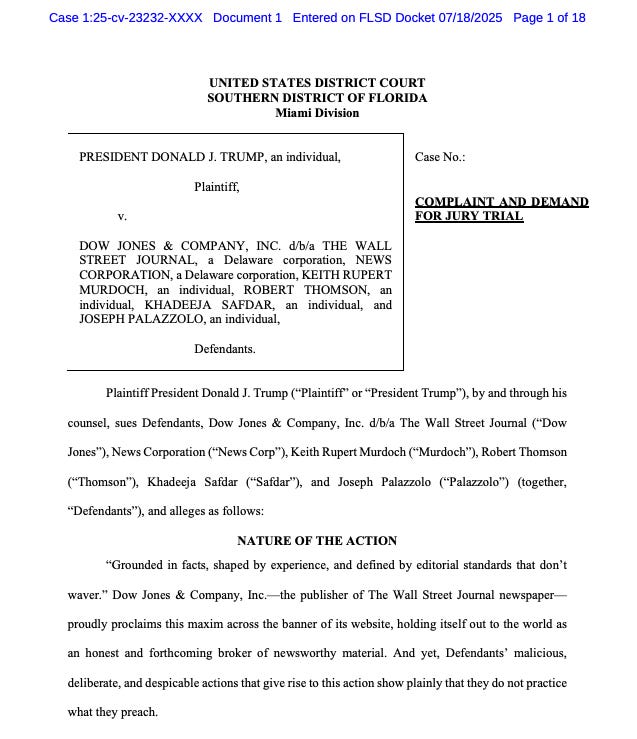
A sitting president filed a $10 billion lawsuit against a newspaper. One day after the story ran. And a federal judge threw it out, saying the complaint “comes nowhere close” to the legal standard.1
You need to understand what that means. Not for the newspaper. For you.
I’m a trial lawyer. Forty years. I’ve filed hundreds of lawsuits on behalf of clients and their businesses. That’s my job.
I’ve never had a case dismissed because it didn’t have merit.
Never.
Me personally? As an individual? Two lawsuits over the same period of time. Two. And both of those happened only because insurance companies on the other side decided to play hardball. If I’d had my way, I never would have filed either one.
I’m telling you this for a reason.
Donald Trump has been involved in more than 4,000 lawsuits over the course of his career. A comprehensive review by USA Today identified at least 4,095 lawsuits where Trump was a party. He personally started at least 1,600 of them. Former federal prosecutor James Zirin documented more than 3,500 of these cases in his book, Plaintiff in Chief. That number has only grown since.
Read that again. Over 4,000 lawsuits.
That’s not normal folks.
Lawsuits are not a last resort for this man. They are a first strike weapon. He sues journalists. He sues business partners. He sued his own wives after their divorces. He sues small companies for using the Trump name. He has publicly stated he wants to “open up” libel laws so he can sue the press more easily and “win lots of money.”
Now here’s what happened this morning. And I need you to pay close attention.
A federal judge threw out Trump’s $10 billion defamation lawsuit against the Wall Street Journal. Most lawyers I know were not surprised. Let me walk you through exactly what went down, what it means, and what you need to know about the legal tools that exist to stop people from weaponizing the courts.
What the Lawsuit Was About
On July 17, 2025, the Wall Street Journal published a story describing a letter attributed to Trump inside a birthday album created for convicted sex offender Jeffrey Epstein in 2003. According to the reporting, Ghislaine Maxwell, who was later convicted of enabling Epstein’s sexual abuse, assembled the album. The Journal reported the letter bore Trump’s signature alongside a sketch of a nude woman. The accompanying message read, “Happy Birthday, and may every day be another wonderful secret.”
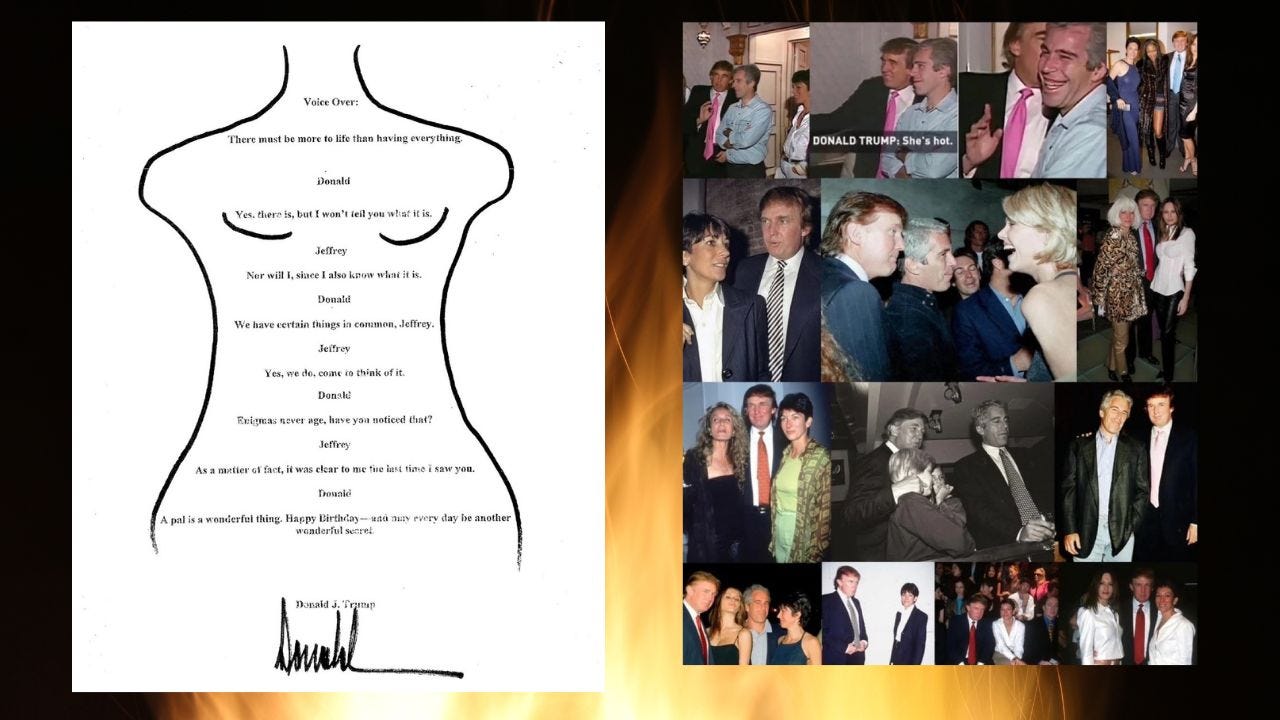
Trump denied any connection to the letter. He called the story “false, malicious, and defamatory.” He filed suit the very next day. He named News Corp, founder Rupert Murdoch, CEO Robert Thomson, Dow Jones, and two reporters as defendants. He demanded at least $10 billion in damages.
One day. No extended legal analysis. No careful review of his claims. Filed the next morning.
That timeline tells you everything you need to know about the purpose of this lawsuit.
Why the Judge Threw It Out
U.S. District Judge Darrin P. Gayles, sitting in the Southern District of Florida, dismissed the case because Trump failed to meet the legal standard required for a public figure to win a defamation claim.
Here’s what most people don’t know about defamation law in this country.
This standard comes from the landmark 1964 Supreme Court case New York Times Co. v. Sullivan. Under Sullivan, a public figure who claims defamation must prove “actual malice.” That means the plaintiff has to show the publisher either knew the information was false when they published it or acted with reckless disregard for whether it was true or false.
This is a high bar. The Supreme Court set it that way on purpose. The Court recognized that a free press sometimes gets things wrong. Honest mistakes, even careless ones, do not create liability when the subject is a public figure. You have to prove the publisher lied on purpose or flat out did not care whether the story was true.
Putting aside the simple fact that what was reported was probably true, Trump’s complaint came nowhere close.
Here’s what Judge Gayles pointed to.
The Journal contacted Trump before publication and gave him the opportunity to respond. The newspaper included his denial in the article itself. The reporters reached out to the Justice Department and the FBI for comment. These are the hallmarks of responsible journalism. This is exactly what a news organization does when it cares about getting the story right.
Judge Gayles wrote that Trump’s claims of malice were “formulaic” and that the complaint “comes nowhere close” to the court’s standards. The judge said the complaint and the article itself “confirm that Defendants attempted to investigate.”
Let me say that in plain English. Trump’s own lawsuit contained the evidence that destroyed his own case.
There’s more. After the lawsuit was filed, a copy of the birthday book described in the article was provided to the House Oversight Committee by lawyers representing Epstein’s estate. The 238 page document corroborated the Journal’s account.
The dismissal was without prejudice, meaning Trump can refile. His legal team has already said they plan to do exactly that by April 27. They called it a “powerhouse lawsuit.” Trump posted on social media that the ruling was “not a termination” and characterized it as a “suggested re-filing.”
I respect every litigant’s right to refile.
I’ll also say this. Calling a dismissed lawsuit a “powerhouse” is like calling a car with no engine a race car. You can call it whatever you want. It’s not going anywhere.
A Pattern That Keeps Repeating
Here’s what most people miss about this story. It’s not a one time event. This is a pattern. A well documented pattern of failed legal actions directed at news organizations.
His campaign’s 2020 case against CNN failed. His 2021 case against the New York Times failed. His 2023 case against journalist Bob Woodward failed. His campaign’s case against the Washington Post failed. His class action lawsuit against social media companies failed. A separate $15 billion claim against the New York Times was thrown out in September 2025, four days after it was filed. He refiled that case in October, and the parties have been ordered to pursue mediation.
He has also filed a $10 billion defamation lawsuit against the BBC. Legal experts consulted by a major news network said they could not recall any past instance of a sitting president suing a news outlet over a story.
Let that sink in.
In the entire history of the United States, no other sitting president has done what this man does routinely.
His ongoing hostility toward the press has started to create problems in other courtrooms. Judges have cited his public attacks on journalists as a factor in at least three rulings against his administration involving news organizations. In one notable decision on March 31, a federal judge struck down an executive order that would have cut funding for NPR and PBS, finding it violated the First Amendment.
What Is a SLAPP Suit and Why Should You Care
Let me introduce you to a legal concept that applies directly to what you’re seeing here.
SLAPP stands for Strategic Lawsuit Against Public Participation. The term was coined in the 1980s by two University of Denver professors, George Pring and Penelope Canan.
A SLAPP suit is a lawsuit filed not to win in court. It is filed to punish someone for speaking out. The goal is intimidation. The goal is to drain the other side’s resources. The goal is to send a message to anyone else who might consider saying something critical. If you speak up, I will bury you in legal fees.
Here’s how they work. A wealthy individual or corporation files a defamation claim, an interference claim, or some other civil action against someone who has exercised their First Amendment rights. The claim may have little or no legal merit. That doesn’t matter. The lawsuit itself is the weapon. The plaintiff doesn’t need to win. They need to make the defendant spend $50,000, $100,000, or $500,000 defending themselves. Most people and many organizations cannot afford that fight. They settle. They apologize. They stop talking.
That chilling effect is the entire point.
And I need you to understand why this matters to you personally.
Currently, 35 states and the District of Columbia have anti-SLAPP statutes designed to combat this abuse. These laws generally allow a defendant to file a motion to strike the case early, before the expensive discovery process begins. The plaintiff then has to show a probability they will prevail. If the plaintiff cannot meet that burden and the case is dismissed, many anti-SLAPP statutes require the plaintiff to pay the defendant’s attorney’s fees.
There is no federal anti-SLAPP law, though Congress has considered several proposals over the years.
I practice law in California and it has one of the strongest anti-SLAPP statutes in the country. Under California Code of Civil Procedure Section 425.16, defendants can move to strike a SLAPP suit, and if they win, the plaintiff must pay their legal fees. The plaintiff cannot escape this fee award by amending or even voluntarily dismissing their complaint once the motion has been filed.
Now here’s the question you should be asking yourself. When a sitting president files a $10 billion lawsuit against a newspaper the day after it publishes a story he doesn’t like, and the complaint is so weak a federal judge says it “comes nowhere close” to the legal standard, what is the purpose of that lawsuit? Is it designed to seek justice, or is it designed to punish speech?
Anti-SLAPP laws exist because the answer to that question matters. A free press cannot function if every critical story results in a nine figure lawsuit designed to bankrupt the publisher.
What Is a Vexatious Litigant
There’s another legal concept you should know about. It directly addresses what happens when someone uses the court system not as a tool for justice but as a weapon of harassment.
A vexatious litigant is a person who repeatedly files frivolous or meritless lawsuits, placing an undue burden on the courts and the people they sue. Courts in the United States have the power to designate someone as a vexatious litigant. That designation carries real consequences.2
In California, under Code of Civil Procedure Section 391, a person can be declared a vexatious litigant if they have filed at least five lawsuits in the preceding seven years that were either decided against them or left pending without resolution. Federal courts can also impose “pre-filing injunctions” under the All Writs Act, requiring a vexatious litigant to get permission from a judge before filing any new case.
Once you receive that designation, you lose the ability to freely file lawsuits. Every new case requires court approval. If you file without that approval, your case can be dismissed without a hearing. You may also be required to post a security bond to cover the other side’s legal costs before your case can proceed.
The threshold is intentionally high. Courts do not make this designation lightly. The right to petition the courts is fundamental to American democracy. This designation is reserved for people who demonstrate a clear pattern of abusing the system.
The logic behind vexatious litigant laws is straightforward. The courthouse doors are open to everyone. They should be. They are one of the things that make this country what it is. When someone uses those open doors not to seek justice but to harass, intimidate, and exhaust their opponents, the system has to protect itself. And protect the people being targeted.
With more than 4,000 lawsuits and a track record of defamation claims against the press that fail over and over again, the pattern speaks for itself.
Here’s What the Target of a Meritless Lawsuit Can Do About It
If you’re the Wall Street Journal and a $10 billion lawsuit lands on your desk that a federal judge later says “comes nowhere close” to the legal standard, you’re not without options. In states with strong anti-SLAPP laws like California, you can file a motion to strike the case early and force the plaintiff to prove they have a real chance of winning. If they can’t, the case gets tossed and the plaintiff pays your attorney’s fees. That’s the law working the way it should.
Some states go further. Texas, Oregon, and Washington allow defendants to recover general damages for the financial harm caused by defending a frivolous case, and in some circumstances, courts can award punitive damages designed to punish the plaintiff for abusing the legal system. The specifics vary wildly from state to state. Some states have broad anti-SLAPP protections. Others have weak ones. A handful have none at all.
Federal court is a different story. There is no federal anti-SLAPP statute. If you’re sued in federal court, your options depend on whether the court applies the anti-SLAPP law of the state where it sits. Federal circuits disagree on this. Some apply state anti-SLAPP protections. Others don’t. That means the same frivolous lawsuit might get thrown out with fees awarded in one courthouse and survive long enough to cost you a fortune in another. A defendant in federal court can still seek sanctions under Federal Rule of Civil Procedure 11, which allows a judge to penalize a party for filing claims that lack legal or factual basis. Sanctions can include paying the other side’s attorney’s fees and costs. Judges can also award fees under 28 U.S.C. Section 1927 when an attorney unreasonably multiplies litigation. These tools exist. They are underused.
Here’s what you need to take away from this. The system gives defendants options to fight back against meritless lawsuits, and those options include recovering every dollar they spent defending themselves, collecting damages for the harm the lawsuit caused to their business and reputation, and in the right case, punitive damages that send a message. The problem is these protections are a patchwork. They depend on what state you’re in, whether you’re in state or federal court, and whether the judge is willing to use the tools available. Until Congress passes a federal anti-SLAPP law with teeth, wealthy plaintiffs will keep using the courthouse as a weapon because the cost of filing a meritless lawsuit is still too low and the cost of defending one is still too high. That math has to change.
The Bigger Picture
Step back with me for a moment. Look at what is happening right now.
The President of the United States is using the civil court system to file massive defamation claims against news organizations that publish stories he does not like. These claims demand billions of dollars in damages. They name individual reporters as defendants.
And they fail. Repeatedly.
The Journal’s legal team argued the original article was accurate. They also argued that the described conduct aligned with Trump’s own established public reputation, a defense that, if accepted, would independently defeat the defamation claim. The 238 page Epstein birthday book, subsequently subpoenaed by Congress, corroborated what the Journal reported.
A spokesperson for Dow Jones responded to the ruling by affirming confidence in the Journal’s reporting standards.
Here’s what I need to be straight with you about.
I’ve tried more than 70 trials over the course of my career. I’ve won about 97% of them. I know what a strong case looks like. I know what a weak case looks like. I know the difference between a lawsuit filed to seek justice and a lawsuit filed to send a message.
When someone files a $10 billion lawsuit the day after a story is published, names individual reporters, and produces a complaint so thin a federal judge says it “comes nowhere close” to the legal standard, that tells you what the lawsuit is about. It is not about the money. It is not about the truth. It is about making the next reporter, the next editor, the next publisher think twice before running the next story.
That is the definition of a chilling effect on the press.
And that should concern you. Regardless of where you fall on the political spectrum. Regardless of who you voted for. Regardless of whether you like this president or not.
The First Amendment does not exist to protect speech you agree with. It exists to protect speech that makes the most powerful people in the country uncomfortable.
That is exactly when it matters most.
Mitch Jackson, Esq.
See Trump v. Dow Jones & Company, Inc., et al., [U.S. District Court, Southern District of Florida (Miami Division- Defamation and related claims arising from Wall Street Journal reporting, with demand for jury trial.]
Why hasn’t Trump been declared a vexatious litigant? You might be reading all of this and asking yourself the obvious question. If Trump has filed or been involved in more than 4,000 lawsuits and his defamation claims against the press keep failing, why hasn’t any court declared him a vexatious litigant? The answer comes down to how the system works and where it falls short. Vexatious litigant statutes typically require a specific number of cases filed by the same person in the same court system within a defined time window. California’s statute requires at least five lawsuits in the preceding seven years that were decided adversely or left unresolved. Trump’s cases are spread across dozens of state and federal courts all over the country. No single court has seen the concentrated volume needed to trigger the designation on its own. The pattern is massive when you look at the full picture. From any one courthouse, it stays below the threshold.
There’s another layer most people don’t see. Many of Trump’s lawsuits were filed through corporate entities, LLCs, and business organizations rather than in his personal name. Vexatious litigant statutes generally apply to individual persons. When lawsuits come through the Trump Organization, a Trump branded LLC, or a campaign entity, those filings may not count toward a personal vexatious litigant tally even though the same person is directing the litigation strategy behind every one of them. On top of that, many of these cases settle or get voluntarily dismissed before a final adverse ruling. Settlements and voluntary dismissals don’t always count as adverse outcomes under these statutes. So even when the cases lack merit, the way they resolve keeps the formal scorecard from reaching the threshold.
Then there’s the part nobody talks about. Declaring someone a vexatious litigant requires a judge or an opposing party to initiate the process. Judges are reluctant to restrict access to the courts under any circumstances because it’s such a fundamental right. Doing so against a former or sitting president would invite enormous political backlash and media scrutiny. No judge wants to be the one who triggers that firestorm, even if the legal record supports it. The legal system was designed to handle individuals who abuse one courthouse repeatedly. It was not designed to handle someone who treats the entire national court system as a revolving door. The tools exist in theory. In practice, no one has applied them to a litigant operating at this scale across this many jurisdictions. Whether that gap is a flaw in the law or a failure of will is a question every American should be asking.
The Guardian also prevailed as Trump media company drops lawsuit. TMTG dropped a defamation claim over a Guardian report that prosecutors were investigating payments received as possible money laundering. Couldn't have anything to do with the $8m in payments TMTG received from entities with ties to Vladimir Putin as possible money laundering, could it? When Trump sues the Pope for undue criticism, he should be barred from the courts forever unless he is on trial. As you said, 4,000+ lawsuits simply is not normal and Trump's actions are an outright abuse of the judicial system. Trump is not just VEXATIOUS. He is obnoxious (among many other adjectives that are both known and proven).
https://www.theguardian.com/us-news/2026/apr/13/trump-media-guardian-lawsuit