

Listen to the audio on the app

There is a section of the United States Constitution that most Americans have never read. It was ratified on February 10, 1967, less than four years after President John F. Kennedy was assassinated in Dallas. And right now, in April of 2026, with Donald Trump in his second term and the country fraying at the seams, every single American needs to understand what it says, who it involves, and how it works.
I’m talking about the 25th Amendment.
You are going to want to read every word of this article. You are going to want to share it with the people you care about. Because what is happening in this country right now, the chaos, the firings, the division, the economic instability, the attacks on democratic norms, all of it raises a question that millions of Americans are quietly asking: what happens when a president can no longer do the job?
Let me walk you through it. All of it. Names included.
Why the 25th Amendment Exists
Before 1967, the Constitution had a massive gap. If a president died, resigned, or became unable to serve, there was no clear process for transferring power. When President Woodrow Wilson suffered a devastating stroke on October 2, 1919, his wife Edith essentially managed the executive branch from his bedside for approximately 17 months, from October 1919 all the way through the end of his presidency in March 1921. She screened all matters of state, decided what information reached the bedridden president, and relayed his responses to the outside world. Nobody had the legal authority to step in. The country drifted.
After Kennedy’s assassination in November 1963, Congress got serious. What if a president survived an attack and was in a coma? What if a president suffered a severe cognitive decline? What if a president simply lost the capacity to lead and refused to admit it?
The result was the 25th Amendment, ratified on February 10, 1967. It has four sections. Each one matters.
Section 1: When the President Leaves Office
This is the simplest part. If the president dies, resigns, or is removed from office, the vice president becomes president. Not “acting president.” President. Full stop.
This is what happened when Richard Nixon resigned on August 9, 1974. Gerald Ford became president. It is what happened when Kennedy was killed on November 22, 1963, and Lyndon Johnson took the oath of office on Air Force One.
Right now, that means if Donald Trump were to leave office for any reason, JD Vance would become the 48th President of the United States.
Section 2: Filling a Vice Presidential Vacancy
If the vice presidency becomes vacant, the president nominates a new vice president, and that person must be confirmed by a majority vote in both the House of Representatives and the Senate.
This has happened twice. In 1973, when Vice President Spiro Agnew resigned, Nixon nominated Gerald Ford. Then when Ford became president after Nixon resigned, Ford nominated Nelson Rockefeller. Both were confirmed by Congress.
Today, if JD Vance were to leave the vice presidency for any reason, Donald Trump would nominate a replacement. That nominee would need approval from Speaker of the House Mike Johnson and the House, and from the Senate, currently led by Majority Leader John Thune.
Section 3: When a President Voluntarily Steps Aside
This section lets a president temporarily hand over power. The president sends a written declaration to Speaker Mike Johnson and Senate President Pro Tempore Chuck Grassley stating that he is unable to perform the duties of the office. The vice president immediately becomes acting president.
When the president is ready to resume power, he sends another written declaration to Johnson and Grassley, and he takes the job back.
This has been used several times, mostly for medical procedures. George W. Bush invoked Section 3 twice when he underwent colonoscopies, temporarily transferring power to Vice President Dick Cheney, first on June 29, 2002, and again on July 21, 2007. Joe Biden did the same on November 19, 2021, when he underwent a routine colonoscopy, making Vice President Kamala Harris the acting president for one hour and 25 minutes.
The key here is that Section 3 is voluntary. The president decides to step aside. Nobody forces him.
Section 4: The Involuntary Removal. This Is the One Everyone Needs to Understand.
Section 4 is the most powerful and most controversial part of the 25th Amendment. It is the provision that allows the removal of a sitting president against his will, without impeachment, when he is unable to discharge the powers and duties of the office.
Here is exactly how it works with today’s government officials.
Step one. The vice president and a majority of the principal officers of the executive departments, meaning the Cabinet, send a written declaration to Speaker Mike Johnson and Senate President Pro Tempore Chuck Grassley. That declaration states that the president is unable to discharge the powers and duties of his office.
The moment that declaration is transmitted, the vice president immediately becomes acting president.
Let me put real names to this so you understand the weight of it.
Vice President JD Vance would need to agree. Then a majority of the following Cabinet members, the heads of the 15 executive departments, would need to sign that declaration:
Marco Rubio, Secretary of State.
Scott Bessent, Secretary of the Treasury.
Pete Hegseth, Secretary of Defense.
Todd Blanche, Acting Attorney General, who stepped into the role after Trump fired Pam Bondi on April 2, 2026.
Doug Burgum, Secretary of the Interior.
Brooke Rollins, Secretary of Agriculture.
Howard Lutnick, Secretary of Commerce.
Lori Chavez DeRemer, Secretary of Labor.
Robert F. Kennedy Jr., Secretary of Health and Human Services.
Scott Turner, Secretary of Housing and Urban Development.
Sean Duffy, Secretary of Transportation.
Chris Wright, Secretary of Energy.
Linda McMahon, Secretary of Education.
Doug Collins, Secretary of Veterans Affairs.
Markwayne Mullin, Secretary of Homeland Security.
That is 15 department heads. A majority means at least eight of them, plus Vance, would need to sign the declaration.
Stop and think about that list for a moment. These are the people Trump personally selected. These are his loyalists. His hand picked team. And therein lies the fundamental problem with Section 4 as it applies to this administration. The very people who would need to act are the very people who owe their positions to the man they would be removing.
Step two. The president fights back. The Constitution gives the president the right to respond. He sends his own written declaration to Speaker Johnson and President Pro Tempore Grassley stating that no inability exists. And here is what most people get wrong about this step: the president immediately resumes his powers and duties as soon as that letter is transmitted. He does not have to wait. Power transfers back to him the moment the letter arrives.
Step three. The vice president and Cabinet can challenge the president’s claim. They have exactly four days from the receipt of the president’s letter to transmit a second written declaration to Johnson and Grassley reaffirming that the president is unable to serve.
If that four day window passes without a second declaration, the matter is over. The president keeps his power. End of story.
If the vice president and Cabinet do send that second declaration within four days, the fight moves to Congress.
Step four. Congress decides. Once that second declaration is transmitted, Congress must assemble within 48 hours if not already in session. Then Congress has 21 days to vote. During this period of time, the vice president serves as acting president during that entire 21 day period while Congress deliberates.
The House and the Senate each vote separately. To keep the president removed, two thirds of both chambers must vote that the president is unable to serve. That means two thirds of the House and two thirds of the Senate.
If Congress does not reach that two thirds threshold in both chambers within 21 days, the president gets his power back.
The math is staggering. In today’s Congress, two thirds of the House means roughly 290 out of 435 members. Two thirds of the Senate means 67 out of 100 senators. Getting those numbers would require massive bipartisan agreement that a president cannot do the job.
Why Section 4 Has Never Been Successfully Used
Section 4 was designed for emergencies. A president in a coma after a stroke. A president suffering from severe cognitive impairment after an assassination attempt. A president whose mental state has deteriorated to the point where the country is in danger.
It was never designed to be a political weapon. It is not a shortcut around impeachment. It is not a tool for policy disagreements or partisan warfare. It addresses capacity, not conduct.
And that distinction matters. Impeachment under Article II of the Constitution deals with “high crimes and misdemeanors,” meaning the president did something wrong. The 25th Amendment deals with the president being unable to do the job at all.
No vice president in American history has ever invoked Section 4. The political cost would be enormous. The vice president would be seen as staging a coup by the president’s supporters. The Cabinet members who signed on would be vilified by their own party. The fallout would be historic.
That is why Section 4 has remained a loaded gun in a locked cabinet. Everyone knows it is there. Nobody has been willing to pull it out.
What This Means for You Right Now
Let me be direct with you.
We are living through a second Trump term that has already produced unprecedented chaos. Trump fired his own attorney general, Pam Bondi, five days ago. He removed his homeland security secretary, Kristi Noem, last month and replaced her with Markwayne Mullin. Reports indicate that more Cabinet members may be next, including Commerce Secretary Howard Lutnick and Labor Secretary Lori Chavez DeRemer. His approval ratings are sinking. The economy is rattled by tariff wars that his own advisers have struggled to defend. The midterm elections are seven months away, and his own party is worried about a wipeout. And he’s posting messages like this:
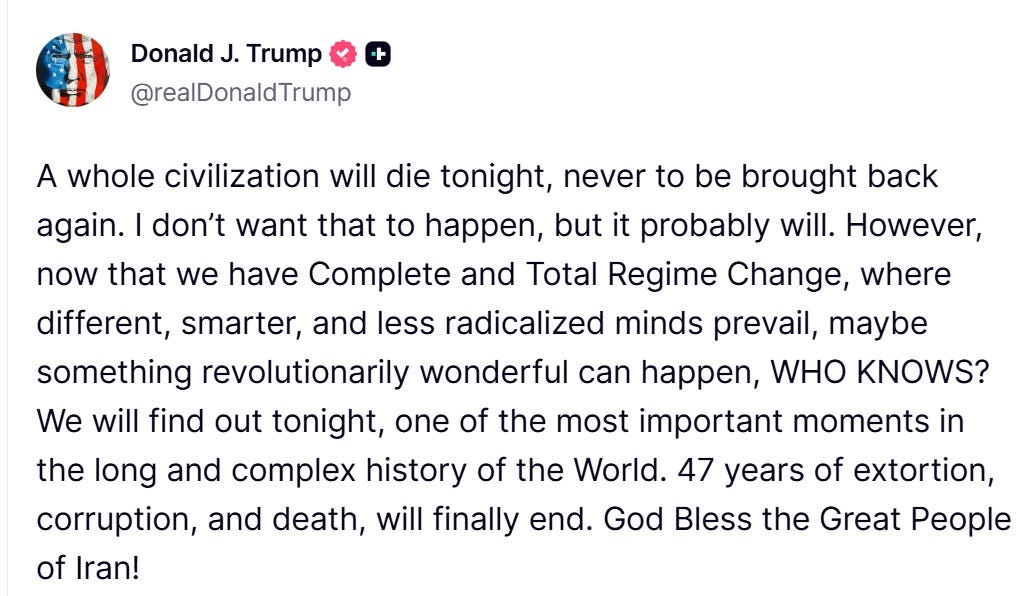

And through all of it, the constitutional mechanisms that are supposed to protect this country remain frozen because the people who would need to act are the same people who are afraid of the man they serve.
Think about that. The 25th Amendment places the power to protect the nation in the hands of the vice president and the Cabinet. The very people who were chosen specifically because of their loyalty to the president are the ones who would need to stand up and say he can no longer do the job. That is a design flaw baked into the structure of every administration, and it becomes especially dangerous when a president surrounds himself with people who prioritize personal allegiance over constitutional duty.
JD Vance would need to lead this process. The same JD Vance who, in a 2016 text message to his former law school roommate, said he went “back and forth between thinking Trump is a cynical asshole like Nixon who wouldn’t be that bad, or that he’s America’s Hitler.” That same JD Vance has spent the last year defending every controversial move this administration has made.
Do you see him invoking the 25th Amendment? Do you see Pete Hegseth, a former Fox News host who got confirmed by a single vote, with Vice President Vance himself casting the tiebreaker in a 51 to 50 vote, standing up against the man who gave him the Pentagon? Do you see Robert F. Kennedy Jr. risking his platform at HHS?
I do not.
And that is the sobering reality of where we are as a country. The constitutional guardrails exist on paper. The people who would need to activate them are either unwilling or unable to do so.
The Line of Succession
If the 25th Amendment were invoked and JD Vance became president, or if both the president and vice president were unable to serve, the presidential line of succession would kick in. Here is who stands in line today, in the order established by the Presidential Succession Act of 1947:
1. Vice President JD Vance.
2. Speaker of the House Mike Johnson.
3. Senate President Pro Tempore Chuck Grassley.
4. Secretary of State Marco Rubio.
5. Secretary of the Treasury Scott Bessent.
6. Secretary of Defense Pete Hegseth.
7. Acting Attorney General Todd Blanche.
The list goes on and on.
What You Can Do
You need to understand this because knowledge is your power. The 25th Amendment is not an abstract law school hypothetical. It is a functioning part of our Constitution, written by people who understood that the presidency is bigger than any one person.
If you believe that the current administration is damaging this country, and I do, then the answer is not to wait for the Cabinet to grow a spine. The answer is for you to do what the Constitution also empowers you to do: vote. Organize. Speak up. Show up at your local government meetings. Contact your representatives. Demand accountability from every elected official who represents you.
The midterm elections are in November 2026. Every single seat in the House of Representatives is on the ballot. One third of the Senate is up for reelection. Governors races in key states will shape policy for years to come.
This is your moment. The 25th Amendment may sit unused in its constitutional vault, waiting for Cabinet members who are too afraid to touch it. That means the real power to change the course of lives is with you by voting in elections.
Share this article. Talk about it with your family, your neighbors, your coworkers. Make sure every American you know understands how our government works. Because when people understand their Constitution, they stop being spectators and start being citizens.
And right now, this country needs citizens more than ever.
Mitch Jackson, Esq.
Great explanation. I keep telling people that Amendment XXV is a steeper climb than impeachment.
25th Amendment isn't the answer