

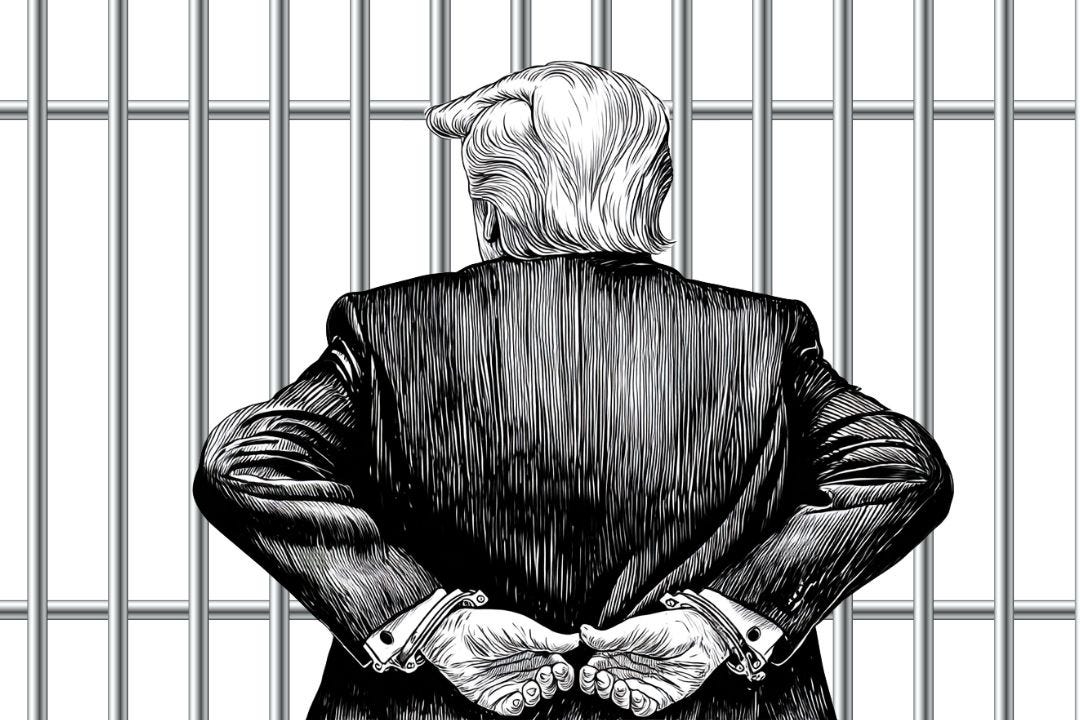
Just So We're Clear: This Is a Hypothetical. Not a Verdict.
This piece is built around a big “what if.” I’m a lawyer, and people ask me all the time: what would actually happen if the Epstein files were released and showed Donald Trump was involved in criminal activity with minors? That’s what this article is about. It’s a legal and political opinion piece based entirely on public information and explores what the fallout could look like if the unthinkable became real.
I don’t have insider info. I’m not breaking news. I have no personal knowledge of what Trump did or didn’t do. Everything here is based on a hypothetical scenario and is meant to spark conversation, raise important legal questions, and push us to think about accountability at the highest levels of power.
So before anyone loses their mind: this isn’t legal advice or an accusation. It’s not a verdict. It’s a thought exercise built on facts, law, and what we already know. Take it seriously, not literally.
The Dark Cloud
We are standing on the edge of something unimaginable. It's towards the end of 2025, and the long-hidden Jeffrey Epstein files are finally released. Inside those pages is credible evidence that years ago, President Donald J. Trump allegedly committed criminal acts with underage girls at Epstein’s homes in Florida or New York. If true, the shock wouldn’t just ripple, it would tear through the foundation of our nation, demanding a swift, unapologetic reckoning.
The Epstein story has hung over this country like a dark cloud for years, a wound that refuses to heal without the truth. In 2025, pressure for full transparency reached a boiling point. The House Oversight Committee issued subpoenas, demanding that the Department of Justice release every single page of the Epstein files. And still, the FBI pushed back, claiming the release would interfere with ongoing investigations.
Then came the kicker. The DOJ announced it found no incriminating “client list” and no “credible evidence” worth pursuing against uncharged third parties. And let’s not forget, this announcement completely disregarded credible sources reporting there are more than 100,000 Epstein-related records totaling over 300,000 pages. That’s not a typo. Three hundred thousand pages. And regarding those documents, it’s reported that Bondi assigned about 1,000 agents to look for Trump’s name in these documents. That’s an estimated 700,000 FBI and DOJ man-hours spent all paid for by your tax dollars.
And don’t even get me focused on the thousands of wire transfers and the $1 billion that moved through Epstein’s accounts. Contrary to Bondi and the DOJ, all of this deserves a full, unflinching investigation.
With all of this in mind, the DOJ statement that “there’s nothing to see here” didn’t close the case, it lit a fire. Even Trump’s most loyal supporters called it a betrayal. So if the files were actually released and showed something different? It wouldn’t be a quiet reveal. It would be a thunderclap, shattering every lie we’ve been told.
At the heart of this hypothetical is something explosive, credible evidence directly implicating the sitting President of the United States. That alone collides head-on with the Department of Justice’s current public stance. Just days ago, the DOJ, under Trump-appointed Attorney General Pam Bondi, declared that after a “thorough review” of the Epstein files, it found no credible evidence against any uncharged third parties. That’s not a vague implication. That’s an official declaration from the very institution that would be responsible for prosecuting the President, if it could.
But here’s the problem. The DOJ falls under the executive branch. Trump runs the executive branch. Bondi answers to him. And DOJ policy, shaped by an internal Office of Legal Counsel opinion, still says a sitting President can’t be indicted. That opinion isn’t law, but it governs how the DOJ operates. So now we’re staring at a deeply dangerous contradiction: the man credibly implicated in serious criminal conduct is the same man who oversees the institution that says it can’t and won’t prosecute him.
This is a flashing red warning light about how power can be used to sidestep accountability. If this hypothetical evidence ever sees daylight, it won’t come from the DOJ. It would have to break through from the outside, maybe through a federal court order, a whistleblower brave enough to defy protocol, or a leak so undeniable it can’t be buried. That’s what it would take to expose a system failure at the highest level, where justice is delayed, diluted, or denied because of who holds the keys to the courthouse.
The real question isn’t whether the law applies to the President. It does. The question is when it will, how it will, and whether our democracy is strong enough to make sure it does.
The public’s demand for the Epstein files hasn’t faded, it’s only intensified. Congressional subpoenas, mounting pressure, and growing frustration have collided head-on with the FBI’s refusal to release everything and the DOJ’s firm denial that any incriminating “client list” or credible evidence against third parties exists. That clash reveals something bigger than a document fight. This is a battle over who controls the truth and whether the American people ever get to see it.
The heart of this hypothetical is a direct contradiction of the DOJ’s public statement. If credible evidence surfaces that implicates Donald Trump or anyone else in criminal acts tied to Epstein, it won’t be because the DOJ handed it over willingly. It would require something powerful enough to break through denial and obstruction, a court order, a whistleblower, a leak too massive to suppress. That kind of reveal wouldn’t just be a headline. It would be a political earthquake.
And it would prove something we already know deep down: the road to justice doesn’t start in a press conference. It starts with a fight for the facts. Until the public has access to the full truth, real accountability isn’t possible. Information is power. And whoever controls it, controls the outcome.
Legal Reckoning: Statutes, Jurisdiction, and Presidential Accountability
Allegations of criminal activity with underage girls at Epstein’s properties would unleash a cascade of serious federal and state criminal charges.
Applicable Criminal Statutes
Federal Statutes
The federal government possesses a robust framework of laws to prosecute crimes involving the sexual exploitation of minors.
Sexual Exploitation of Children (18 U.S.C. § 2251): This statute prohibits inducing or coercing a minor to engage in sexually explicit conduct for the purpose of producing visual depictions. Given Epstein's documented collection of such materials, this statute would be directly applicable. A first time conviction carries a statutory minimum of 15 to 30 years in prison.
Sex Trafficking (18 U.S.C. §§ 1591, 22 U.S.C. § 7102): Federal law broadly criminalizes sex trafficking, particularly when it involves interstate or foreign commerce or travel. This includes recruiting, enticing, harboring, transporting, providing, obtaining, advertising, maintaining, patronizing, or soliciting individuals for commercial sex acts, especially where force, fraud, or coercion is used. Crucially, if the victim is under 18, it is considered human trafficking regardless of whether force, fraud, or coercion was used. Penalties are exceptionally severe, ranging from mandatory minimums of 15 years to life imprisonment if the victim is under 14, and 10 to 40 years if between 14 and 18.
Transportation of Minors for Illicit Sexual Activity (18 U.S.C. § 2423): This specific statute targets the transportation of minors across state or international boundaries for prostitution or other illicit sexual activity, including sex tourism. Given Epstein's known travel and network, this statute would be highly relevant. Penalties include fines up to $250,000 and prison sentences of up to 30 years, with a minimum of 10 years to life imprisonment for transporting a minor.
Conspiracy (18 U.S.C. § 371 and specific conspiracy statutes): The nature of Epstein's network strongly suggests a conspiracy. Conspiracy involves an agreement between two or more persons to commit a federal offense, coupled with an overt act in furtherance of the scheme. While general conspiracy under § 371 carries up to 5 years, conspiracies related to severe crimes like sex trafficking or child exploitation carry the same severe penalties as the underlying offenses, making this a powerful prosecutorial tool.
State Statutes (New York and Florida)
The alleged crimes would also fall under the jurisdiction of state laws in New York and Florida, both of which have stringent statutes against child sexual exploitation.
New York:
Sex Trafficking of a Child (NY Penal Law § 230.34-a): This statute applies to individuals 21 years or older who intentionally advance or profit from the prostitution of a person under 18. A critical aspect is that knowledge of the child's age is explicitly not an element of this offense, nor is it a defense. This is classified as a Class B felony, carrying potential imprisonment of 5 to 25 years.
Statutory Rape (NY Penal Law §§ 130.25, 130.30, 130.35): In New York, the age of consent for sexual relations is 17 years old. Sexual intercourse with a person under 17 is legally deemed to be without consent, even if the minor appeared to consent. Penalties vary based on the victim's age and the age difference between the parties, ranging from Class E felonies (up to 4 years) to Class B felonies (up to 25 years).
Other Article 130 Sex Crimes: New York Penal Law Article 130 encompasses a wide array of sex offenses, including sexual misconduct, criminal sexual acts, sexual abuse, and aggravated sexual abuse. These crimes also carry significant penalties, including lengthy prison terms and mandatory sex offender registration.
Florida:
Unlawful Sexual Activity with a Minor (Statutory Rape): In Florida, the age of consent is 18 years old. Any sexual activity with a minor under 18 is considered statutory rape, regardless of whether the minor willingly participated. This is a strict liability offense, meaning the defendant’s intent or knowledge of the minor’s age is irrelevant and not a defense. Penalties are severe, ranging from several years to decades in prison, and mandatory sex offender registration. Specifically, engaging in sexual activity with a 16 or 17 year old by someone 24 years of age or older is a second degree felony, punishable by up to 15 years in prison.
Sexual Exploitation of a Child (Florida Statutes): This broad category includes allowing, encouraging, or forcing a child to solicit for or engage in prostitution, or participate in a sexual performance. Charges can include third degree sexual exploitation, human trafficking, and felony second degree sexual exploitation.
Lewd and Lascivious Conduct (Florida Statute § 800.04): This involves intentionally touching a child under 16 years old in a lewd or lascivious manner, or soliciting such a child to commit a lewd act. For adults, conviction is a second degree felony, carrying a potential term of 15 years in prison or on sex offender probation, along with a maximum of $10,000 in fines.
Sexual Battery (Florida Statute § 794.011): Florida's term for rape. If the victim is under 12 years old, and the offender is 18 or older, this is a capital felony, potentially punishable by death or life imprisonment. For victims 12 years of age or older, penalties range from life felony to first or second degree felony, depending on the use of force, age differences, and other aggravating factors.
Jurisdiction
The alleged crimes tied to Epstein’s properties in Florida and New York, involving underage girls and a figure with global ties, would activate multiple layers of jurisdiction. Federal jurisdiction kicks in when sex crimes involve interstate or international commerce, like using the mail, airlines, or the internet to traffic child pornography or exploit minors. Given Epstein’s travel patterns and global network, federal charges for sex trafficking, child exploitation, and conspiracy would be well within reach.
At the same time, New York and Florida hold primary authority over any crimes committed within their state lines. Many offenses involving minors can be prosecuted by both federal and state governments. While federal prosecutors sometimes defer to the states to avoid overlapping charges, they step in for the most serious cases, especially when crimes cross state borders or involve digital infrastructure that falls under federal oversight.
Presidential Indictment While in Office
The question of whether a sitting U.S. President can be indicted for a crime remains one of the most unsettled and explosive issues in American constitutional law. For over 50 years, the Department of Justice has maintained a policy, first set in 1973 and reaffirmed in 2000, that a sitting President cannot be indicted or criminally prosecuted.
This stance isn’t based on law or a Supreme Court ruling. It’s an internal DOJ opinion rooted in the idea that prosecution would interfere with the President’s ability to lead the nation and carry out official duties. In that view, impeachment is the only constitutionally appropriate remedy for criminal conduct in office.
But the legal ground under that policy has shifted. The Supreme Court has never ruled directly on whether a sitting President can be indicted, but it has made clear that presidents are not immune from everything. In Clinton v. Jones, the Court ruled that a sitting President can be sued for unofficial acts. More recently, in Trump v. United States (2024), the Court drew a sharp line between official and unofficial conduct and stated clearly that former presidents have no immunity for unofficial criminal acts.
Now apply that to this hypothetical: credible evidence allegedly shows Trump committed criminal acts involving underage girls at Epstein’s properties before becoming president. These are deeply personal, unofficial acts before his presidency. That destroys the core of the DOJ’s “interference with official duties” argument. The only thing left holding the line is the concern that indicting a sitting President would be politically disruptive, that the stigma of an indictment alone would cripple his ability to govern. But that’s not a legal defense. That’s political self-preservation dressed up as policy.
So what does this mean in real time? It means the DOJ’s own precedent could delay prosecution, but not prevent it. The Supreme Court has opened the door. The pressure to walk through it would be enormous, especially in a case involving crimes against children. Even if a full indictment is deferred until after Trump leaves office, the political and moral cost of waiting would be staggering. The public wouldn’t tolerate silence. The victims wouldn’t wait quietly. Justice would demand a response, not later, now.
Charges After Leaving Office
If a sitting President can’t be indicted, that protection ends the moment he leaves office. The Department of Justice’s own policy makes this clear: presidential immunity from criminal prosecution is temporary. Once a President is out of office, he can be indicted and tried for crimes committed during his term. That’s not speculation, it’s backed by precedent. When Richard Nixon resigned, he accepted a pardon from President Ford to avoid exactly that outcome.
And when the crimes involve children, the law stretches even further to make sure justice can still be served. At the federal level, statutes of limitations for sex crimes involving minors have been extended or eliminated altogether. The Eliminating Limits to Justice for Child Sex Abuse Victims Act of 2022 wiped out the statute of limitations for many federal civil actions tied to human trafficking and child sex abuse. In criminal cases, the law often gives victims more time to come forward, recognizing the deep trauma, fear, and manipulation that can delay disclosure. Human trafficking crimes involving minors often have no expiration date. Conspiracy laws extend the timeline even more, since the clock doesn’t start ticking until the last overt act.
In New York, the Child Victims Act allows survivors to file civil lawsuits up until they turn 55. For criminal prosecution, the statute of limitations doesn’t even begin until the victim turns 23 or reports the crime. Some crimes, like Aggravated Sexual Abuse in the First Degree, have no time limit at all. In Florida, the law is equally clear: there’s no statute of limitations for sexual battery on children under 12. For other child sex crimes, the clock often doesn’t start until the victim turns 18 or files a report. And again, human trafficking involving minors? No time limit.
Across both state and federal law, one truth stands out. When it comes to crimes against children, the law is designed to wait. It makes room for survivors to process what happened and speak out when they’re ready. Even if presidential immunity delays justice, it doesn’t erase it. The legal system keeps the door open, sometimes for decades, to make sure these cases can still be heard. That’s not just legal evolution. That’s moral clarity. The message is unmistakable: for these crimes, there is no safe haven in time or title.
Could State Prosecutors Pursue Charges Independently
Yes, after Trump leaves office, state prosecutors have the clear authority to bring criminal charges against a former U.S. President. The President’s power to grant pardons only applies to federal crimes, it does not extend to violations of state law.
That’s a crucial distinction. While the legal debate over presidential immunity continues to evolve, especially when it comes to official acts, recent Supreme Court rulings have narrowed that immunity when it comes to unofficial conduct. In this hypothetical, the alleged crimes involving underage girls at Epstein’s properties would be classified as unofficial conduct, leaving the door wide open for prosecution.
The D.C. Circuit Court of Appeals has already affirmed that once a President leaves office, he becomes citizen Trump, subject to prosecution like any other individual. That ruling alone makes it clear that state-level prosecution is not only possible, it’s a direct path to accountability.
The American legal system is built on dual sovereignty. Federal law doesn’t cancel out state authority. And while DOJ policy may temporarily shield a sitting President from federal indictment, it holds no power over state prosecutors. Florida and New York, where the crimes allegedly occurred, both have strong laws against child sex abuse and trafficking, and their prosecutors operate independently of the federal executive branch.
This decentralized structure is not a loophole. It’s a safeguard. It ensures that even if the federal government stalls or sidesteps accountability, the states can act. That’s the power of American justice: when one avenue is blocked, another can open. State attorneys general and local district attorneys have the legal tools and the constitutional authority to step in. No title, no office, no privilege should protect someone from facing justice for crimes this serious. Not even a former President.
Seismic Shifts: Political, Institutional, and Constitutional Consequences
The emergence of credible evidence like this wouldn’t just shake Washington, it would tear through the country like an earthquake. We’d be facing an instant, full-blown political crisis. A sitting President, accused of some of the most horrific crimes imaginable, would send the nation into chaos.
Whatever trust the public still had in the system would collapse overnight. The entire machinery of government would grind to a halt as the focus shifted from governing the country to defending the President. Policy, leadership, and stability would be shoved aside. The spotlight would lock onto one thing: whether the man in the Oval Office is fit to remain there at all.
Constitutional Mechanisms
The Constitution lays out clear tools for confronting presidential misconduct, and in this scenario, every one of them would be put under a national microscope.
Impeachment would become unavoidable. The House of Representatives would face overwhelming pressure, from the public, from within its own ranks, and from the gravity of the evidence itself, to act immediately. The Constitution allows impeachment for treason, bribery, or “other high crimes and misdemeanors,” a phrase historically interpreted to include abuse of power and conduct that violates the integrity of the office. Obstruction of justice was central to Nixon’s impeachment inquiry. Perjury and obstruction were the charges against Clinton. The precedent is clear: criminal conduct, especially when it undermines the rule of law, crosses the impeachment threshold.
The House could vote to impeach with a simple majority. That would send the case to the Senate for trial, where the Chief Justice would preside. Conviction and removal would require a two-thirds vote. No President has ever been removed from office through impeachment, Nixon resigned before the vote, and Clinton was acquitted, but this situation would push Congress to prove whether its commitment to checks and balances is real or performative. This wouldn’t just be a political showdown. It would be a constitutional reckoning.
The Twenty-Fifth Amendment: Section 4 of the Twenty-Fifth Amendment offers a constitutional mechanism to remove a President deemed unable to fulfill the duties of the office. It’s rarely used and only in the most extreme circumstances, but this would be one of them. Under this provision, the Vice President and a majority of the Cabinet can declare the President unfit and transmit that decision to the Speaker of the House and the President pro tempore of the Senate.
If the President challenges it, Congress must then vote, with a two-thirds majority in both chambers, to decide whether he remains in power. While this amendment has typically been associated with physical or mental incapacitation, its language is broad. It doesn’t exclude a President overwhelmed by criminal allegations, crippled by public outrage, or stripped of moral authority. It’s a drastic, politically explosive move, but in a crisis of this scale, it would absolutely be on the table.
Congressional Oversight Hearings: Even if impeachment or the Twenty-Fifth Amendment aren’t triggered right away, Congress has another powerful tool: oversight. It can investigate. It can subpoena. It can demand answers. In a moment like this, those hearings would be swift, aggressive, and impossible to ignore. Congressional committees would dig into the allegations, examine who else may have enabled or concealed the crimes, and bring the details into full public view. The power to investigate is one of Congress’s most vital checks on presidential abuse—and in a case this serious, oversight wouldn’t just be procedural. It would be a lifeline for the truth.
Institutional Responses
Department of Justice (DOJ): The DOJ would find itself in the middle of an unprecedented firestorm, one that strikes at the heart of its credibility. Attorney General Pam Bondi, who already declared there was no credible evidence in the Epstein files against third parties, would be under intense public and political pressure.
The Department’s long-standing internal policy that a sitting President cannot be indicted would become a national flashpoint. Every decision, every hesitation, would be scrutinized. The DOJ’s recent shift away from corporate and public integrity investigations, along with its controversial grand jury probe into alleged Obama-era actions against Trump, would only fuel public skepticism. Demands for a truly independent investigation would erupt, and the appointment of a Special Counsel would be seen as the only viable path to restore even a shred of public trust.
Congress: Congress would be in turmoil. Divided, yes, but unable to ignore the sheer weight of the crisis. The House would feel overwhelming pressure to act, driven by public outrage and a moral line that can’t be blurred. Impeachment proceedings would move fast. The Senate would brace for a political and constitutional showdown. Past impeachment battles involving Nixon and Clinton would be studied, cited, and debated, but the alleged crimes in this case would transcend political spin. They would challenge even the most partisan voices, forcing members to choose between party loyalty and basic human decency.
Supreme Court: The Supreme Court would be pulled into the storm almost immediately. It would face emergency appeals on executive privilege, the limits of congressional subpoenas, and the boundaries of presidential immunity. Its recent decision in Trump v. United States, which stripped immunity for unofficial acts, would become central. The Court wouldn’t just be interpreting the law, it would be defining the future of American democracy. Every ruling would carry enormous weight, not only in determining what happens next, but in setting the long-term precedent for how far presidential power can go before the system pushes back.
Public and Party Response
Public Reaction: The public’s response would be instant and explosive. Shock would give way to outrage, and outrage would ignite a demand for swift, unflinching accountability. While some of Trump’s most loyal supporters might initially fall back on familiar cries of “witch hunt” or “political hit job,” the nature of these allegations, child sexual abuse, is a moral red line for nearly every American.
This isn't a tax charge or a procedural fight. It's the kind of crime that disgusts and enrages people across every political, religious, and cultural line. Recent polling already shows that most Americans believe former presidents should not be immune from prosecution for crimes committed in office. That belief would harden into urgent demand if the crimes involved children. The pressure wouldn’t just be political. It would be deeply human.
Trump’s Party: The Republican Party would be thrust into a moment of reckoning unlike anything it’s faced before. Up until now, many in the party have circled the wagons, dismissing Trump’s legal troubles as partisan attacks and casting doubt on the justice system itself. That defense would collapse under the weight of these allegations.
Crimes against children are a moral line few are willing to cross. The party would fracture. Some would rush to distance themselves, while others, driven by loyalty, fear, or calculation, might double down. But the cost of defending the indefensible would be high. Internally, the GOP would face brutal infighting, public defections, and a crisis of identity. The usual political calculus, defend Trump to hold the base, would crumble when placed next to the horror of these accusations.
The System Under Stress: If this scenario became reality, it wouldn’t just be about Trump. It would be the ultimate test of the American system. Every constitutional safeguard, impeachment, the Twenty-Fifth Amendment, the potential for prosecution, would be activated at once.
The Department of Justice would be caught between its internal policy against indicting a sitting president and a tidal wave of public outrage demanding justice. Congress would be forced to act swiftly. The courts would be dragged into urgent rulings on immunity, subpoenas, and executive privilege. Each branch of government would be pushed to its breaking point.
And in that chaos, one question would loom over the country: can our democracy hold the line? This wouldn’t just be a scandal. It would be a defining moment in American history. A moment where the rule of law, the moral clarity of the people, and the backbone of our institutions would be tested in full view of the world. The outcome would define more than the fate of one man, it would reveal who we are as a nation and whether we still have the courage to choose justice over power.
International Implications
The global fallout would be immediate and unforgiving. Allegations of child sexual abuse against a sitting U.S. President would send shockwaves through the international community, triggering widespread condemnation and deep disillusionment. America's credibility as a global leader in the fight against human trafficking and child exploitation would be shattered.
For decades, the United States has positioned itself as a defender of human rights, a country that champions justice for the most vulnerable. If its own President were credibly implicated in such heinous crimes, that image would collapse under the weight of hypocrisy.
International pressure would be relentless. Allies would demand accountability. Human rights organizations would raise alarms. And America’s long-standing opposition to the International Criminal Court (ICC) would come under renewed scrutiny. While the U.S. has resisted ICC jurisdiction over its nationals, the court operates on the principle of complementarity, it only steps in when national systems fail.
If the U.S. appeared unwilling or unable to hold its own leader accountable, global calls for international intervention would surge. The damage wouldn’t just fall on the President, it would stain America’s moral standing, weaken its diplomatic influence, and undermine its ability to lead on the world stage. This wouldn’t be viewed as a personal scandal. It would be seen as a collapse of American integrity.
Moral Imperative: Upholding Democracy and Justice
Accountability is not optional, it’s the cornerstone of justice. In a democracy, no one, no matter how powerful or politically protected, stands above the law. The rule of law is not a talking point or a partisan tool. It’s the foundation of everything we claim to believe in. And when we allow it to bend for one person, we risk breaking it for everyone. If we trade integrity for loyalty, or justice for political survival, we lose the soul of this republic.
Allegations involving the exploitation of children by a sitting President aren’t just criminal, they are a direct assault on public trust. A President takes an oath to protect the vulnerable, not prey upon them. To even be credibly linked to such abuse is to betray the very purpose of public service. It violates the deepest values we hold as a society and demands a response that is clear, forceful, and unwavering.
How we respond to this kind of crisis is who we are. This is not the moment for hesitation or spin. It’s the moment for every institution, every citizen, to stand up and say: our principles matter. Truth matters. Justice matters. Yes, the path forward may be painful. Yes, it may divide us. But ignoring it will destroy us. Accountability is the only way through this moment. It’s how we restore faith in our institutions. It’s how we show the world that our democracy has a spine.
Silence is complicity. Loyalty to power over principle is a moral failure. Now is the time to speak, act, and demand the truth. Demand accountability—fully, immediately, and without exception. We owe it to the victims. We owe it to each other. And we owe it to the future of this country. Because the truth is simple and immovable: no one, not even the President of the United States, is above the law.
Mitch Jackson, Esq. | links | audio version |
If this hits home, subscribe for free and share it. Want to pitch in with a paid subscription? Amazing. But it’s never expected. Because facts shouldn’t be gated—they should be loud, clear, and accessible to all.

Since major news outlets are not highlighting this story, I will...
New Epstein emails show Trump knew what was happening.
In a message obtained by Congress and released today, the convicted sex offender Jeffrey Epstein wrote that Donald J. Trump spent hours at his house with one of Epstein’s victims.
Here’s a gift access link to the New York Times article.
https://www.nytimes.com/2025/11/12/us/politics/trump-epstein-emails.html?unlocked_article_code=1.0k8.Twf8.om7D8LI7uxz_&smid=url-share