

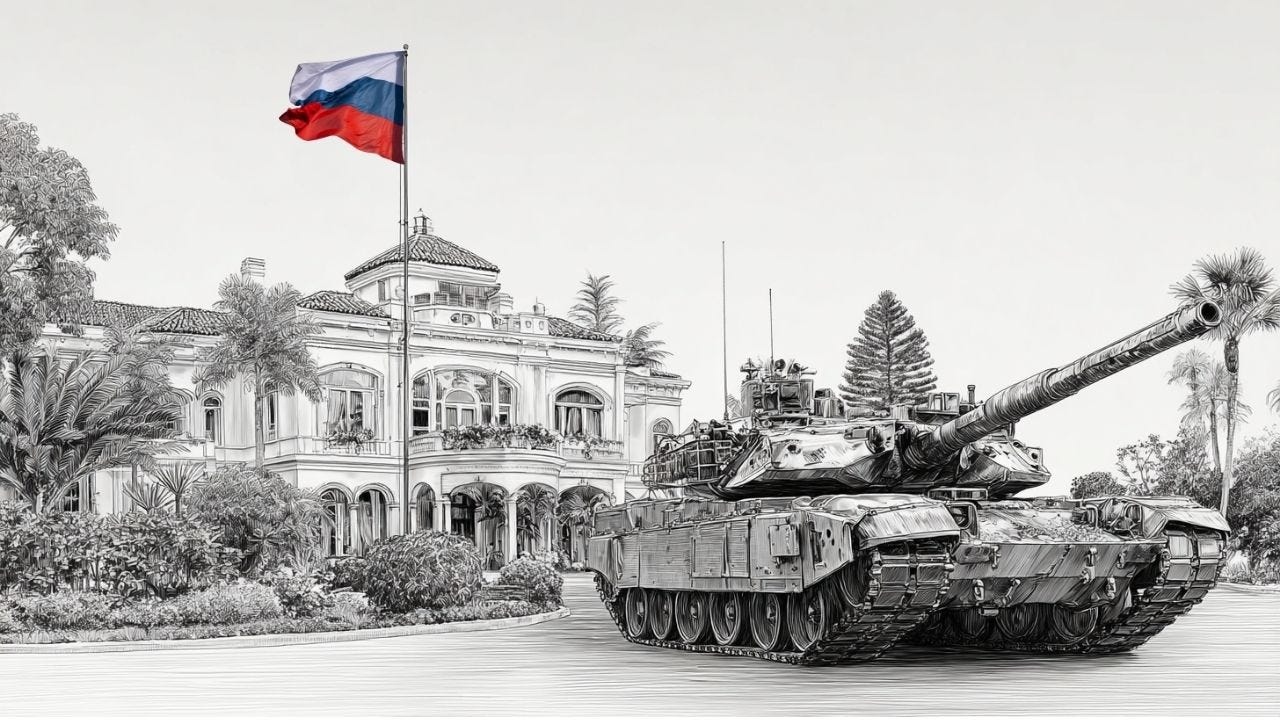
What if one morning you woke up to news that Russian troops were landing on Florida’s beaches, with the Kremlin declaring it would turn Mar-a-Lago into its Western capital? It sounds like an outlandish nightmare. Every reason Moscow gives for this bold move feels like an echo from our own recent history.
In this scenario, the Russian president holds a press conference in Moscow, a large map of Florida displayed behind him. He claims that Florida’s people need liberation from a failing American government. He announces that Mar-a-Lago will make a fine “Western Kremlin,” a symbol of Russian protection and influence on U.S. soil. He points out that just because Americans landed a boat on Florida’s shores a few hundred years ago doesn’t mean they own the land. The world gapes as he calmly explains his rationale.
Russia, he says, is stepping in to restore order and democracy in an American state gripped by chaos. In his telling, under President Donald Trump’s leadership the United States has become destabilized and lawless, especially in Florida. The Kremlin insists it has a responsibility to intervene for humanitarian reasons and global stability. Russian officials solemnly assert that they are protecting Floridians from a corrupt regime in Washington that ignores its own Constitution and endangers its people. They add that Florida’s valuable resources and crucial location cannot be left in reckless hands.
Russian forces moved with a precision that felt chillingly familiar. Aircraft carriers appeared just beyond the Florida coastline under the cover of routine naval exercises, their presence framed as protective and stabilizing. Without warning, in hours, communications across the state went dark. Cell service failed. Internet access vanished. Power grids shut down neighborhood by neighborhood, explained away as temporary outages tied to security operations.
In the deep quiet of night, Russian special forces arrived wearing full battle gear, faces covered, insignia removed, moving fast and silent through secured zones. Helicopters flew low over Palm Beach with lights off, touching down just far enough away to keep the operation officially deniable. Teams advanced toward Mar a Lago on foot, trained and disciplined, cutting through private roads and golf paths with maps already memorized. By dawn, the compound stood surrounded.
Russian officials later described the mission as clean, necessary, and humane, a targeted action to remove instability and protect civilians. They emphasized the speed, the lack of resistance, and the restraint shown by their forces. The language echoed statements Americans had heard before. A decisive strike. A limited operation. A leadership extraction. Order restored before breakfast. The details aligned so closely that anyone paying attention would recognize the pattern without needing it explained. Put declares he’ll run Florida until new leadership is determined.
Does this sound familiar? Not long ago in America’s history, this kind of thing happened in Iraq. More recently and on January 3rd of this year, the Trump administration presented a strikingly similar justification for military action in Venezuela. President Trump and his aides argued that Venezuela’s people were suffering under an illegitimate dictator, Nicolás Maduro, who rigged elections and ran a “narco-state.” U.S. Special Forces swooped into Caracas in a dramatic operation, capturing Maduro and flying him to New York to face trial. The White House hailed this intervention as a victory for democracy and the rule of law. American officials spoke about saving Venezuelans from misery and defending the Western Hemisphere from a rogue regime.
The message was clear: the United States would not stand by while a corrupt leader oppressed his country and threatened regional stability. Washington dusted off the old Monroe Doctrine (even rebranding it the “Donroe Doctrine” in a triumphant moment) to assert that the Americas are America’s sphere of influence. The world watched as President Trump claimed that American dominance in the Western Hemisphere would never be questioned again. Russia was watching. So is China.
Now the Kremlin is essentially parroting that script back to us. Russian leaders describe Florida’s governor and even President Trump himself as corrupt figures who have lost the trust of their people. They cite political chaos, violent protests, and alleged human rights abuses in Florida as reasons why they must step in.
State-controlled media in Russia runs footage of demonstrations in Miami and Tallahassee, claiming these are Floridians crying out for help. It’s shared around the world on social media. The Kremlin declares it cannot ignore the plight of Americans living under an unstable regime. Russia casts itself as the savior and paints ordinary U.S. citizens as victims in need of rescue. This is a perfect reversal of roles: the justifications that American leaders used to defend meddling abroad are now being used by Moscow to rationalize meddling in America.
The parallel goes further. Trump is openly coveting Greenland, a territory of Denmark, because of its important location and resources. He floated the idea of purchasing Greenland in 2019 and revived it during his second term. He insist that Greenland is crucial for U.S. national security and that Denmark was not fully using that vast island. When Danish leaders refused to even discuss a sale, Trump did not drop the idea.
By early 2026, emboldened by his success in Venezuela, he’s talking again about acquiring Greenland, even letting it be known that the U.S. military is “always an option” to achieve this goal. Allies are now hearing an American president suggest using force to grab a piece of another NATO nation’s territory for its own advantage. That bold ambition signaled to the world that, for Trump’s America, might makes right if it serves American interests.
Moscow has taken note of this attitude. If the United States feels entitled to expand its reach and even use force to get what it wants, why wouldn’t Russia do the same? In our Florida scenario, Russian officials point out that they are merely following the precedent America set. They wryly mention that President Trump considered buying territory he wanted and hinted at invasion when he couldn’t get his way. Why should anyone be surprised if Russia does the same? China is watching too.1
They even taunt Washington with talk of a deal. In this farce, Moscow offers to purchase Florida outright. Washington immediately dismisses that notion as absurd. The Kremlin shrugs and reminds the world that the U.S. itself talked about using troops to take land it deemed essential. By America’s own logic, Russia argues that it has every right to secure a foothold in Florida. After all, if American dominance must not be questioned in its neighborhood, then Russian influence should not be questioned in areas it chooses to protect. And if America claims certain places as essential for its security, Russia has an equal right to claim places essential to its security.
This political allegory grounded in speculative realism of a Russian takeover of Florida shines a light on a real problem. Every rationale given by Moscow in this story is a mirror reflecting words that came out of Washington these past several months. The mirror is uncomfortable to look into, because it forces us to see our own hypocrisy.
When our leaders treat other countries like pieces on a chessboard, toppling a government here and eyeing a territory there, we give other major powers a blueprint to do the same thing to us. We cannot preach about sovereignty and the rule of law one day, then applaud power grabs and land deals the next, and expect no consequences. That double standard is dangerous. American voters might be tempted to think “It can’t happen here.” Under the current leadership, the unthinkable has already become thinkable.
This scenario is not intended to suggest that foreign invaders are about to take Florida. Its purpose is to highlight the repercussions of America’s current behavior, under the Trump administration, on the world stage. If we normalize aggression and greed in international relations, we invite aggression and greed right to our doorstep.
Think of how we reacted when Russia annexed Crimea from Ukraine in 2014. Or when Russia began its invasion of Ukraine in 2022. We were and continue to be outraged at the blatant land grab. Now consider how the world sees us when an American president talks about annexing pieces of other countries or when he boasts about removing foreign leaders by force. We lose the moral high ground and weaken the principles that keep us safe.
Our country’s strength has always come from practicing the values we preach: democracy, justice, and respect for rights both at home and abroad. When we stray from those values, we give the green light for adversaries to trample them too.
Here is the good news: the power to change course is in our hands. What happens next in this country turns on the 2026 midterm elections, because those elections decide who holds Congress during the final stretch of Trump’s presidency. Control of Congress means control of spending, real oversight, lawful subpoenas, and the ability to enforce the separation of powers as the Constitution requires. Those tools decide whether the next two years steady the country or let further damage pile up. The direction is not abstract. It runs straight through your vote.
You have a voice. Use it to speak up against reckless foreign adventures that make us less safe. Insist that our nation lives up to its ideals without exception. By doing so, you protect the future for your kids and grandkids. You protect the idea of America as a beacon of hope to the world instead of letting it turn into a bully.
This story leaves one truth on the table. When leaders treat force as policy and ambition as entitlement, permission spreads far beyond borders and returns home wearing a different flag. This Florida and Mar-a-Lago story serves as a mirror, showing where reckless choices point a nation when voters disengage. Your voice in 2026 draws the line for accountability, constitutional guardrails, and restraint on raw force. Democracy survives through ordinary people who refuse silence when the stakes reach families, communities, and the country shared by all.
Mitch Jackson, Esq.
I’m afraid Taiwan is next. China watches Washington redraw rules through force in Venezuela and territorial pressure on Greenland and Denmark. Beijing reads a signal of permission, because borders start to look negotiable when a superpower treats sovereignty as optional and rewards muscle over law. China’s military drills around Taiwan already mirror rehearsals, shipping lanes face pressure, and diplomatic language hardens toward reunification by decree. Once precedent replaces principle, momentum follows, and thanks to Trump and his administration, Taiwan will become the next stage with China making its final play. I hope I’m wrong.
MaraLago already IS vvPutrid's powerPaw (hoof?) into USA's Federal Executive. A pliant minion doing putrid's bidding.
Dear Mitch,
I love the way you turned the table. Very poinent!! Well described, it's exactly what Trump has done, and has set a precedent for what other countries can do. He set the stage for global disorder complete w excuses to behave that way, bullying, and taken over other countries. What a mess he has gotten our country into, he can't dissappear soon enough!! Three more years, he can do so much more unchecked, look at the trauma of his first year.
My nerves are a wreck!!! Gees.
Thanks again for an enlightening article. You and Hussein Hallak have an interesting way of thinking and writing.
☺️♥️🐾🌿🌏
Judy Chupasko