

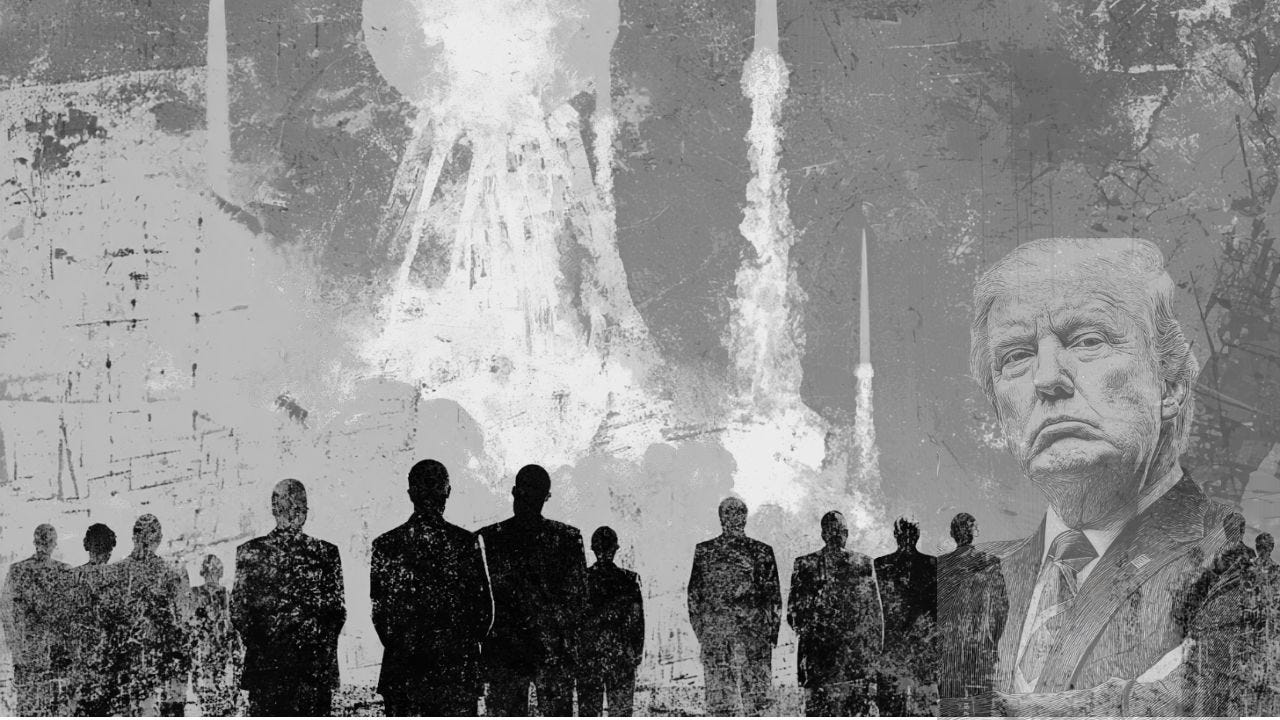
As of today, February 28, 2026, the United States military is conducting major combat operations, with Israel, in Iran. Strikes are hitting Tehran and cities across the country.
Iran if fighting back. This is not a hypothetical. This is not a drill. American forces are at war.
The word “war” was used by Trump in the video he released.
So here’s what every single American needs to understand: the Constitution could not be clearer about who gets to make this decision about starting a war or sending American military forces into war.
Pursuant to Article I, Section 8 of the U.S. Constitution, and The War Powers Resolution’s stated policy (Section 2(c), codified at 50 U.S.C. § 1541(c)):
“The constitutional powers of the President as Commander-in-Chief to introduce United States Armed Forces into hostilities, or into situations where imminent involvement in hostilities is clearly indicated by the circumstances, are exercised only pursuant to (1) a declaration of war, (2) specific statutory authorization, or (3) a national emergency created by attack upon the United States, its territories or possessions, or its armed forces.”
The founders were very intentional about this. They did NOT give the President the unilateral power to start a war. That power belongs to Congress. It’s right there in Article I, Section 8 of the Constitution and as codified above.
This becomes even more troubling when you look at the billions of dollars this war has already cost American taxpayers, with billions more projected in the months ahead. We ran the numbers through our law firm’s AI due diligence system, and in the footnote I laid out the full scope of the staggering financial impact it identified ($40M to $150M per day over the next year.).1
So what CAN a President do as Commander-in-Chief?
As mentioned above, The War Powers Resolution states that the President’s power to introduce U.S. forces into hostilities is exercised only pursuant to (1) a declaration of war, (2) specific statutory authorization, or (3) a national emergency created by an attack upon the United States, its territories or possessions, or its armed forces.
That’s it. Three scenarios. Not “I feel like it.” Not “it seems like a good idea.” Not “they’ve been disrupting the world for decades so I decided to do this.” Three.
And here’s the part most people miss, there’s a built-in timer.
Under Section 4(a) of the Resolution, the moment a President introduces forces into hostilities, they must report to Congress in writing within 48 hours. And here’s the critical piece: a 60-day clock starts running from the date that report is submitted, or required to be submitted, whichever comes first. That means a President can’t dodge the clock by simply not filing the report.
When those 60 days are up, the President must terminate the military action UNLESS Congress has taken one of three steps: declared war or passed a specific authorization for the use of force, extended the 60-day period by law, or, and this one matters, Congress is physically unable to meet because of an armed attack on the United States.
There is ONE narrow extension. The President can extend the deadline by up to 30 additional days, but ONLY by certifying to Congress in writing that unavoidable military necessity for the safety of our troops requires it, and only in the course of bringing them home. It’s a withdrawal extension, not a “keep fighting” extension.
Think of it as a two-lock system. The President holds one key. Congress holds the other. You need both to stay at war.
Why does this matter? Because this system exists to prevent any single person from dragging an entire nation into war without Congress, the people’s elected representatives, having a say. It’s not a technicality. It’s the democratic guardrail that separates our system from one where a single leader can wage war on a whim.
Mitch Jackson, Esq.
Executive Summary: This memo estimates U.S. taxpayer costs tied to the Iran war using the most reliable public operating-cost benchmarks and unit-cost anchors available, with assumptions stated where official totals and exact expenditure counts have not yet been released. A reasonable estimate is $0.45B to $1.05B for the month-long pre-hostilities buildup and $0.25B to $1.50B+ for the first ~48 hours, with the largest swing factor being high-cost missile defense interceptors and standoff munitions. If current tempo persists, projected annual spending ranges from $14.6B to $54.8B, translating to roughly $1.67M to $6.25M per hour and $40M to $150M per day over the next year.
To: Mitch Jackson
From: J&W AI
Date: March 1, 2026
Re: Estimated U.S. taxpayer cost of the Iran conflict: pre hostilities buildup, first 48 hours, and projected one year burn rate
This memorandum provides a current, best available estimate of U.S. taxpayer spending tied to the Iran conflict, broken into (1) the month-long buildup, (2) the first ~48 hours of combat operations, and (3) a one-year projection if the current operational tempo continues. Because the U.S. government has not yet released a consolidated, audited running total for these periods, the figures below are derived from publicly available operating-cost benchmarks and published unit-cost anchors for major munitions and flight-hour rates, with assumptions stated where counts and force composition are not yet public. For the month prior to the first strikes (approximately late January through February 27, 2026), the dominant costs are force posture and sustainment: forward deployment and daily operation of naval strike groups, increased flight operations for carrier and land-based aircraft, ISR, aerial refueling, logistics lift, spare parts, maintenance acceleration, base support, and personnel tempo. Using conservative “posture-day” modeling for an elevated regional force package, a reasonable month-long buildup range is $0.45B to $1.05B (roughly $15M to $35M per day over 30 days), reflecting one-to-two major naval strike packages and their supporting air, ISR, tanker, and logistics architecture, plus associated sustainment.
For the first ~48 hours of combat operations (Feb 28 through Mar 1, 2026), costs split into two buckets: (A) operations tempo and sustainment and (B) weapons and interceptors expended. Operations tempo excluding weapons is reasonably estimated at $60M to $160M over two days (approximately $30M to $80M per day), reflecting elevated sorties, refueling, ISR, maritime operations, maintenance, and logistics under combat conditions. Weapons expenditure is the major swing factor because the exact number of missiles, bombs, drones, and defensive interceptors fired is not yet reliably public. Using unit-cost anchors commonly cited in defense reporting and procurement materials, a plausible two-day weapons spend band includes: Tomahawk cruise missiles at roughly $1.3M to $2.5M each (illustrative two-day spend $65M to $375M if 50 to 150 are used), JDAM guidance kits roughly $25K to $84K each (about $5M to $50M if 200 to 600 kits are used), JASSM-class standoff missiles roughly $1.2M to $1.5M each (about $24M to $90M if 20 to 60 are used), and low-cost one-way drones around $35K each (about $7M to $35M if 200 to 1,000 are used).
The largest uncertainty is air and missile defense interceptors: a high-volume defense fight can add hundreds of millions to multiple billions in short order depending on interceptor type and quantity (many modern interceptors are priced in the millions per round). Combining operating tempo plus munitions, a reasonable all-in estimate for the first ~48 hours is $0.25B to $0.50B for lower-intensity strike levels, and $1.0B to $1.5B+ if missile defense interceptor expenditure is heavy and sustained. Looking forward, if operations continue at roughly the current trajectory, a one-year U.S. taxpayer cost is best expressed as a daily burn-rate model that includes posture, sortie generation, sustainment, and a continuing flow of munitions and interceptors: Low scenario $40M/day ($14.6B/year), Mid scenario $75M/day ($27.4B/year), High scenario $150M/day ($54.8B/year). Translated into time-based costs over the next year, these equate to: Low = $1.67M/hour, $40M/day, $280M/week, $1.22B/month average; Mid = $3.13M/hour, $75M/day, $525M/week, $2.28B/month average; High = $6.25M/hour, $150M/day, $1.05B/week, $4.56B/month average.
Israel’s participation may shift operational burden across missions, but it does not eliminate U.S. taxpayer exposure for regional basing, naval and air defense, ISR, refueling, replenishment, resupply, and replacement procurement as inventories are consumed; the single biggest cost lever across all scenarios remains the pace of interceptor and standoff-munition expenditure and the speed at which the United States must replenish those stocks.
Another reason to remove this regime now. Another distraction. Release the Epstein files--all one terabyte plus, unredacted. Prepare for takeover of our mid-term vote.
Congress MUST STOP RUMP's ABJECT MADNESS: Stand-down the War Posture! Approve Sen. Tim Kaine's (D-Va.) war powers resolution.
Says Senator Kaine: "The Senate should immediately return to session and vote on my War Powers Resolution to block the use of U.S. forces in hostilities against Iran. Every single Senator needs to go on the record about this dangerous, unnecessary, and idiotic action.”