

By the time Friday rolls around, I have published a lot across two Substacks, and readers keep telling me in the replies that the week moved fast and they missed pieces of it. This Friday morning post fixes that. What follows is my end of week walk through the most important things I wrote and talked about on Uncensored Objection and Privacy in America, oldest first, with the point of each story stated plain.
Uncensored Objection Substack
Breaking political news put on the stand, cross-examined, and handed to you as a verdict. 40 years. 70+ jury trials
“The Renee Good Wrongful Death Lawsuits” opened the week. The family of Renee Good filed two federal lawsuits over her killing by an ICE officer in Minneapolis, one against the United States under the Federal Tort Claims Act and one against the officer and senior officials under the Ku Klux Klan Act of 1871. I read all 181 pages of the two complaints. My bottom line: the FTCA case, tried to a judge with no jury, is where this family wins, because the government’s own use of force rules read like the family’s witness list.
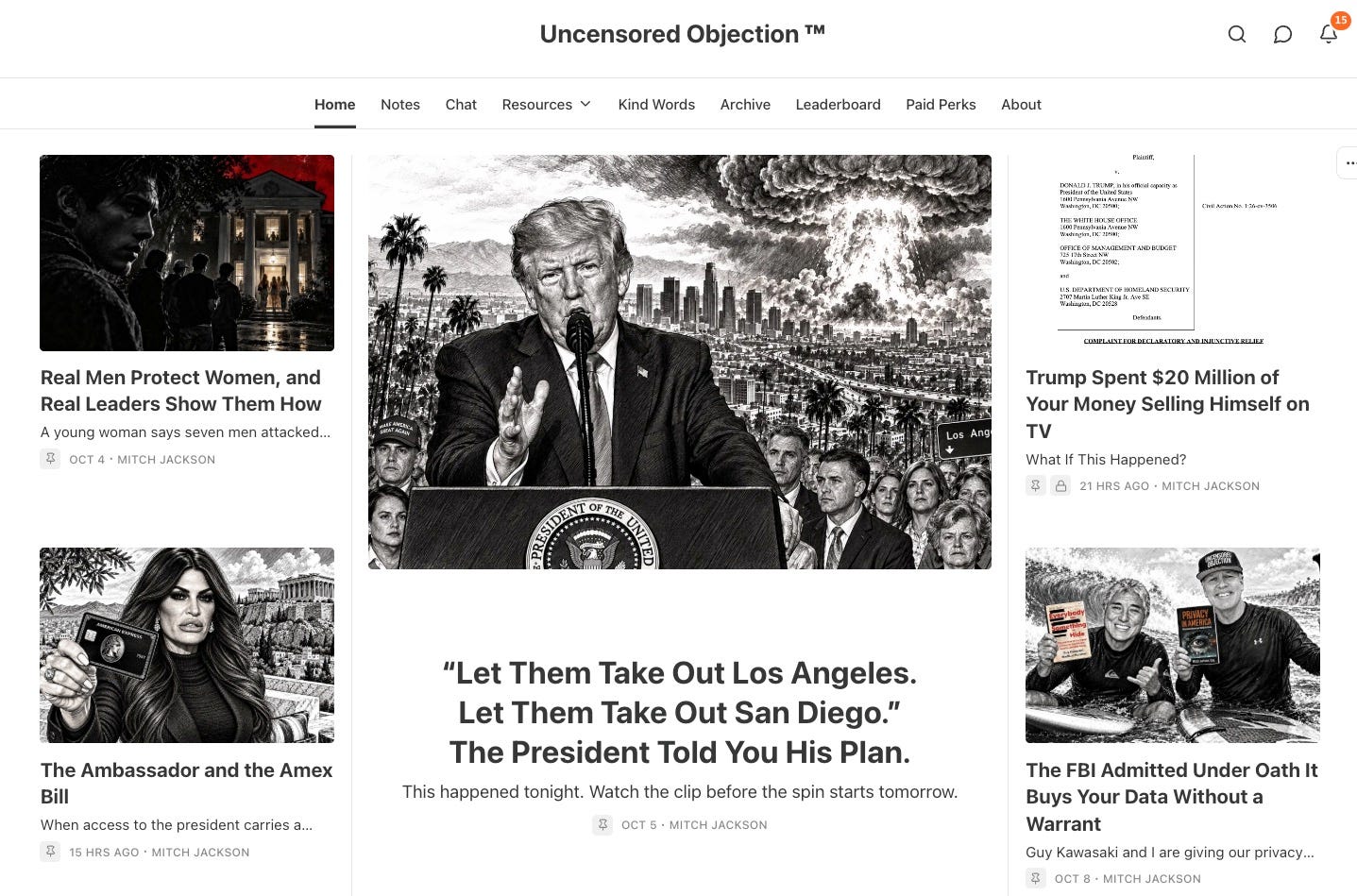
Sunday brought “Real Men Protect Women, and Real Leaders Show Them How.” A young woman at Cornell alleges seven men attacked her, and the civilly adjudicated sexual abuser in the Oval Office answered with sympathy for the accused. I wrote about the message every boy, young man and man in America takes from that moment, and I set the president’s comments next to the record in the Carroll cases, where Judge Kaplan found the evidence supported the jury’s verdicts. Leaders teach. Boys repeat. Trump fails. [I also shared the video of Megyn Kelly’s disgusting comments body shamming the victim in my notes]
Monday I published “If Trump Declares Martial Law Before the Midterms, Here’s Exactly What Happens Next” (paid). The piece walks through the actual law on martial law, national emergencies, and federal elections, and the answer lowers the temperature in the room. A president holds no power to take over a federal election or postpone it. I close with five specific moves that protect your vote on November 3.
Monday night I wrote “Let Them Take Out Los Angeles. Let Them Take Out San Diego. The President Told You His Plan.” At a Nebraska rally that evening, the president talked about Iran striking Los Angeles and San Diego, to cheers (it’s a cult). Sixteen million people live in those two metro areas, including the families of the Pacific Fleet. A president said these cities rank as acceptable losses, out loud, four weeks before a midterm election. Reckless word salad, planting ideas or maybe even setting things up for a false flag? Read the piece and you tell me.
Tuesday took the map to Siberia with “A Plague Lab Worker Is Dead. Russia Calls It Pneumonia.” A 28 year old technician at the antiplague institute near Irkutsk died after a reported lab accident, contacts landed in hospitals for observation across the region, and Moscow settled on pneumonia as the explanation. I sorted the story into confirmed facts, likely facts, and unconfirmed claims, and the scale of the official response does the talking: about 197 contacts traced, 189 people hospitalized, and whole hospital wards under quarantine. My read stays measured: one case points to a lab accident, wider outbreak risk stays low, and risk to Americans stays tiny. The piece names the signals that change the assessment, and I told readers to circle October 9, today, for the second case watch.
Wednesday I went live with Guy Kawasaki: “Live: Guy Kawasaki and Mitch Jackson.” Guy is a Silicon Valley legend who worked with Steve Jobs to evangelize the Macintosh. My background? I have been litigating cases for four decades and look at today’s issues through the eyes of an experienced trial lawyer. So, for this conversation, the two of us combined our expertise and spent 53 minutes on Silicon Valley then and now, privacy, security in the age of AI, and questions from a live audience. The recording sits on Uncensored Objection for anybody who missed it. The two of us also gave subscribers free PDF copies of our respective books, Everybody Has Something to Hide and Privacy in America. Get the links here.
Thursday continued with “Trump Spent $20 Million of Your Money Selling Himself on TV” (paid). Customs and Border Protection moved $20 million out of a commemorative events budget line, tracked spending passed $12 million on television ads praising the president, and the Democratic National Committee filed suit in federal court in Washington on October 7. The claims rest on the appropriations limits Congress wrote long before this White House: public money funds public information, and the Purpose Statute and Antideficiency Act carry the rest of the argument. A promise on October 5 said a political committee would pay going forward; government paid spots aired after the promise anyway, and the piece tracks at least $100,000 in public spending after the announcement.
Thursday afternoon closed the publication week with “The Ambassador and the Amex Bill.” Ambassador nominee Kimberly Guilfoyle stands accused of texting a donor and asking him to wire $100,000 to her personal American Express account six days before her Senate confirmation hearing. Federal bribery law, 18 U.S.C. § 201, treats the demand itself as the completed crime, and the McDonnell decision supplies the defense side of the argument. A separate exposure runs through the false statements statute, and the limitations clock on this fact pattern reaches into 2030.
Privacy in America
Privacy in America: Your data privacy and security rights through a trial lawyer’s eyes
“Your Kids Are Being Watched: The School Surveillance and Data Privacy Crisis Every Parent Needs to Know” opened the publication week last Friday morning. GoGuardian alone tracks 27 million students, school software follows the laptop home, and one industry count puts 72,000 data points on the average child by age 13. The legal door opened through FERPA rewrites in 2008 and 2011, and the one penalty in the statute, loss of all federal funding, has never been used in fifty years. My fixes stay concrete. Turn the school device off after homework. Freeze your child’s credit too; children get targeted for identity theft at rates adults never see. Then put your district’s vendor list on the record at a public meeting.
“A Judge Just Called the Flock Camera on Your Street ‘Mass Surveillance.’ Your Privacy Won in Court.” Judge Sara Hill in Oklahoma ruled against the camera network in the Kyle case, and the post explains the ruling through Carpenter and Chatrie. Flock reports over 20 billion vehicle scans a month across more than 5,000 communities in 49 states, and every scan writes down where a car sleeps at night and where it worships on Sunday. Your car keeps a diary. My action item sits at city hall: ask your city, on the record, which data leaves town and who reads it.
“Your House Is a 24/7 Recording Studio: The Smart Home Surveillance No Privacy Law Stops.” Your speaker listens at the counter, and your television reports what you watch through automatic content recognition. Vizio’s own numbers explain the model: $57.3 million from data and $25.6 million from devices in the figures I cite. The post ends with fixes for tonight: microphone settings, camera settings, television data sharing, and the router you forgot you owned.
“Meta Muse and the Case for the Battle-Tested Player” closed the week on Thursday. My argument runs against the grain: an AI agent earns trust through enforcement scars, and Meta carries the deepest set in the industry after a $5 billion FTC order, a €1.2 billion GDPR fine, and an $8 billion forced rebuild. Grok left roughly 370,000 shared chats indexed in Google search, and the episode shows the cost of learning privacy in public. I close with the question a privacy lawyer asks before any agent touches an inbox or a calendar.
That closes the week: nine stories on Uncensored Objection and five on Privacy in America, with Guy Kawasaki in the middle of it. Bring your questions to the comments, tell me which story earned a second read at your house, and share this recap with one person who skipped the reading this week. The courtrooms, the cameras, and the campaign ads all keep moving next week, and I intend to keep reading the fine print out loud for you.
Mitch Jackson, Esq. [recommendations]
Please subscribe, share and if you can, upgrade to paid to support. Thanks!