


Overview: Trump’s Trade War 2.0—A Self-Inflicted Economic Disaster
Here we go again. Donald Trump has decided to tax everyday Americans into oblivion under the guise of “punishing” Mexico, Canada, and China. As of March 4, 2025, his reckless 25% blanket tariffs on imports from our closest trade partners—plus a tariff double-whammy on Chinese goods—have officially taken effect. The result? A direct economic assault on American families, businesses, and workers.
Let’s be crystal clear: tariffs are taxes. And no, Mexico, Canada, or China won’t be paying them—you will. From skyrocketing grocery bills to pricier cars, electronics, and household goods, the pain will land squarely on the wallets of American consumers. Meanwhile, businesses that rely on cross-border supply chains are scrambling to survive, jobs are at risk, and industries from farming to manufacturing are already feeling the squeeze.
Search AI: The best insights come from asking the right questions. This article is already set up on our Perplexity AI page—just click, explore, and dig deeper. Research every angle, challenge assumptions, and follow your curiosity wherever it leads.
This article cuts through the nonsense to expose how Trump’s tariff tantrum is wreaking havoc on the U.S. economy. I’ll break down the historical lessons Trump ignored, the immediate damage unfolding right now, and the long-term catastrophe waiting if this trade war drags on. Expect some brutal honesty, a dash of sarcasm, and zero sugarcoating as we dissect the absurdity of “winning” a trade war by making Americans poorer.
Finally, while we can’t undo Trump’s economic malpractice, I’ll share practical steps to help everyday Americans navigate this disaster—from stretching household budgets to business strategies for dodging the worst of the tariff fallout. Because if there’s one thing we know for sure, it’s that Trump won’t be footing the bill—you will.
DISCLAIMER: This is an investigative opinion piece and does not provide legal, financial, tax or investment advice. Always do your own due diligence and consult with an experienced professional in your state, region or country.
Historical Context
What Are Tariffs, Really? Tariffs are tariffs – a fancy word for taxes on imported goods. When a tariff is imposed, foreign exporters don’t simply write a check to the U.S. Treasury. Instead, the duty gets paid by the importer (usually a U.S. company) when the goods enter the country. Importers then face a choice: absorb the cost (hurting their profit) or pass it on to consumers via higher prices. Spoiler alert: most of the time, American businesses and consumers end up paying.
In effect, tariffs operate like a sales tax on foreign-made products – one ultimately paid at the cash register by you and me. So when President Trump insists that China or Mexico will pay for the tariffs, that’s about as accurate as claiming Mexico would pay for a certain border wall. The economic reality is simple: tariffs are a tax on Americans, plain and simple.
Tariffs in Action – Who Paid Last Time? We’ve seen this movie before. During Trump’s first term (2018–2019), he unleashed a wave of tariffs on steel, aluminum, and $360+ billion of Chinese imports. The result? Multiple independent studies confirmed that American consumers bore almost the entire cost of those tariffs through higher prices. Foreign exporters did not significantly slash their prices; instead, U.S. import prices jumped. For example, after tariffs on washing machines in 2018, the price of laundry appliances shot up around 12% – and that extra cost (roughly $80-$100 per washer) came out of Americans’ pockets. So much for making others pay.
“Easy to Win” Trade Wars – A Reality Check: Trump famously tweeted that “trade wars are good, and easy to win.” The aftermath of his first tariff offensive suggests otherwise. Yes, a handful of industries protected by tariffs (like domestic steel) saw a temporary uptick in jobs or profits, but at an exorbitant cost to consumers and downstream industries. One analysis found that each U.S. steel job saved by the 2018 steel tariffs cost consumers over $900,000 in higher prices – an absurdly inefficient way to create jobs (we could have just written six-figure checks to those workers and been better off!). Meanwhile, industries that rely on steel – auto manufacturing, machinery, construction – lost far more jobs due to higher input costs than steel mills gained. In fact, by 2019, U.S. manufacturing activity had slumped into a mild recession, as tariff uncertainty and rising costs hit investment and exports. So if “winning” means fewer jobs and pricier goods, then sure, that trade war was a resounding victory (pardon the sarcasm).
Retaliation and the Domino Effect: Another lesson from history: when the U.S. slaps tariffs on others, they hit back. During Trump’s first-term trade spats, Canada, Mexico, China, and the EU all retaliated with tariffs of their own on American exports. U.S. farmers were among the hardest hit. China, previously a top buyer of American soybeans, imposed heavy tariffs on U.S. agriculture, causing those exports to plunge. By the end of 2019, American farmers had **lost an estimated $27 billion in sales due to retaliatory tariffs – a crushing blow to the heartland. China’s retaliatory tariffs alone accounted for the vast majority of U.S. agricultural export losses in 2018–2019 (tens of billions of dollars, amounting to roughly a 50–70% drop in exports of key crops like soybeans). Other countries’ counter-tariffs (Canada, Mexico, the EU, etc.) also chipped away at U.S. exports, from pork to whiskey. In short, past trade wars left American exporters piled high with unsold goods and bruised balance sheets. The federal government had to step in with over $28 billion in bailout payments to farmers to somewhat offset these losses – effectively forcing U.S. taxpayers to pay for the damage from our own tariff policies. It’s a bit of dark irony: tariffs meant to help American industries led to giant subsidy checks just to keep those industries afloat.
Historical Precedent – A Cautionary Tale: The concept of using big tariffs to protect the economy isn’t new – and history isn’t kind to it. The Smoot-Hawley Tariff Act of 1930 infamously raised U.S. tariffs on hundreds of imports, aiming to shield American producers during the Great Depression. The result was a global trade war that deepened the depression worldwide as other nations retaliated and global trade collapsed. While 2025 isn’t 1930, the lesson remains: broad tariff walls tend to backfire, harming more economic sectors than they help.
Fast-forward to Trump’s trade wars: they didn’t magically erase trade deficits or revive manufacturing glory days. Instead, the U.S. trade deficit in goods actually hit record highs during the Trump years, as tariffs shifted import sourcing without bringing back lost production. By the end of Trump’s first term, American consumers were paying higher prices, farmers were dependent on government aid, supply chains were strained – and yet the underlying issues (like China’s trade practices) remained largely unresolved. It’s against this backdrop that we evaluate the new 2025 tariffs. If past is prologue, America is once again loading the economic gun and aiming at its own foot.
Current Landscape
As of March 4, 2025, Trump’s new tariffs have kicked in, and their shockwaves are starting to be felt across the U.S. economy. Let’s break down the immediate effects on various fronts – from the checkout aisle to the factory floor – focusing on how they impact everyday Americans.
Sticker Shock for Consumers: Get ready to pay more for just about everything. A 25% import tax on goods from Canada and Mexico covers a vast array of products Americans use daily – think produce, meat, cars, auto parts, appliances, furniture, electronics, you name it. Likewise, higher tariffs on Chinese imports will make many consumer tech gadgets, clothing, and household items more expensive. The math is simple: retailers and importers now face significantly higher costs, and those increases are trickling down to price tags. For example:
• Grocery Bills: Shoppers will notice higher prices on fruits and vegetables that are out of season in the U.S. (many of which are imported from Mexico). That bargain on avocados and tomatoes? Kiss it goodbye as tariffs drive up produce costs. A family filling their cart is effectively paying an extra 25% tax on any food coming from across our northern or southern border – which is a lot of food, given Mexico and Canada are key agricultural suppliers.
• Electronics and Appliances: Many smartphones, TVs, laptops, and appliances are manufactured in China or use Chinese components. With tariffs doubling on these, an item that cost $500 could easily run $550-$600 now. Companies like Apple or Dell face tough choices: raise prices (making consumers fork over more) or swallow the cost (hurting their profits and potentially jobs). Don’t be surprised if the next phone upgrade or washer/dryer replacement dents your wallet more than expected – courtesy of the tariff surcharge.
• Cars and Trucks: The auto sector is one of the most integrated industries in North America. American-made cars often contain a large percentage of parts from Mexico or Canada (engines, transmissions, electronics, etc.), and many popular models are assembled just across the borders. A blanket 25% tariff on these imports is a game-changer. Automakers have warned that new car prices will jump. If a $30,000 car relies on $10,000 worth of imported parts, that’s potentially an extra $2,500 cost due to tariffs – much of which will be passed to consumers. Even used car prices could rise as demand spikes from people avoiding pricier new models. For everyday Americans, that means new car shopping just got a lot more painful, and even holding onto your old clunker might become more expensive as imported replacement parts now cost more.
Squeeze on Household Budgets: All told, economists estimate the average U.S. household will incur hundreds of dollars in additional costs per year due to these tariffs – with some analyses projecting over $1,000 per household in extra expenses if the tariffs persist. For context, that easily wipes out the benefit of any tax cut or wage growth many families might have enjoyed. In effect, Washington has raised your cost of living via a policy change, even as it insists it’s punishing other countries (which it’s not). Working-class and middle-class families, who spend a large share of their income on goods, will feel this acutely. It’s a highly regressive hit, meaning it hurts lower-income Americans the most. To put it bluntly, “America First” trade policy is putting America’s families last in line – behind the government’s need to appear tough on trade.
Chaos in Supply Chains: The immediate fallout isn’t just higher prices – it’s also major disruptions to how products get to shelves and factories. Companies have spent decades building supply chains optimized under free trade with Canada, Mexico, and low tariffs on China. Overnight, those calculations changed. Importers scrambled in late February to rush shipments before the tariff hammer fell; now that the duties are in place, many firms are re-evaluating their logistics:
• Manufacturing Delays: U.S. factories that rely on cross-border supply chains (common in automotive, aerospace, machinery, and electronics) are facing delays and bottlenecks. For instance, an auto assembly plant in Ohio might depend on engines from Mexico and steel from Canada. Suddenly, those parts are 25% more expensive, and in some cases shipments are held up as everyone adjusts to new customs procedures and pricing disputes. Some manufacturers report having to slow or temporarily halt production because critical components became cost-prohibitive or stuck in transit. Just-in-time delivery systems don’t work well when a tariff is slapped mid-stream; the result is parts shortages on assembly lines.
• Small Business Struggles: Smaller import-reliant businesses are in crisis mode. Consider a Minnesota sheet-metal fabricator who buys aluminum from Canada. With a 25% tariff, her raw material cost just jumped dramatically. She can either jack up prices for her customers (and risk losing business), or eat the cost (and risk going out of business). As one small manufacturer lamented, these tariffs make it “extremely difficult for small businesses like mine to grow” – uncertainty and higher costs are a one-two punch that punishes entrepreneurs and Main Street. Many small firms lack the cushion to absorb such shocks. We’re already hearing about businesses postponing investments, hiring freezes, or even layoffs because their input costs spiked overnight.
• Retail and Inventory Turmoil: Retailers large and small are reeling as well. Big-box chains that import massive volumes from China, Mexico, and Canada are hastily working out how much prices must rise and which products to possibly discontinue if they become unprofitable. Some may try to source from alternative countries not yet tariffed – for example, shifting orders from China to Vietnam or India – but switching suppliers takes time and often results in higher costs anyway. In the short term, many retailers will simply pass costs to consumers and hope they’ll grin and bear it. Inventory already in stock (brought in before March 4) might hold prices steady for a brief period, but as new shipments with tariffs arrive, expect noticeable price hikes on store shelves over the coming weeks and months.
Job Market Jitters: The tariffs’ damage isn’t limited to prices; they also threaten American jobs. When costs rise and sales fall, employers react – often by cutting expenses elsewhere, which can include jobs. Here are some areas of concern:
• Export Industries: Retaliation from China and Canada is already targeting key U.S. industries. China’s response to Trump’s move was swift – they slapped tariffs on American products like U.S. oil, natural gas, coal, and farm goods (e.g. corn, wheat, pork), and even launched an antitrust probe into a major U.S. tech company. Canada, for its part, has announced it will impose equivalent tariffs on U.S. goods (everything from agricultural products to manufactured goods) to match the blow. The upshot: American companies that rely on exporting to these markets suddenly see their products becoming 10-25% more expensive overseas, undercutting their competitiveness.
A Midwestern farmer, a whiskey distiller in Kentucky, or a heavy equipment maker like Caterpillar could all see overseas orders dry up as their products are priced out by retaliatory tariffs. Fewer orders = less revenue, which often = layoffs or reduced hours for workers. We saw this in 2018–2019: U.S. soybean exports to China collapsed, grain prices fell, and farm incomes plunged, forcing painful decisions down on the farm. Similar pain is likely now across multiple sectors as foreign markets shrink for U.S. exporters. Thousands of jobs in agriculture and manufacturing that depend on exports are at risk if these tariffs stick and retaliation expands.
• Industries Using Imported Inputs: Companies that import parts or materials (which is most manufacturing firms) face margin pressure. Some will try to automate or streamline to cut costs, potentially reducing labor needs. Others might relocate some production abroad to get around tariffs (ironically shifting jobs out of the U.S. to avoid “America First” tariffs).
In 2018, for instance, iconic American motorcycle maker Harley-Davidson announced it would move some production overseas after the EU retaliated with tariffs on U.S.-made bikes. We could see a repeat: businesses moving operations or sourcing outside the U.S. (or outside tariffed countries) to dodge the tariff bullet, which translates to fewer jobs or hours in the U.S. For workers in affected industries, there’s a growing cloud of uncertainty – raises might be postponed, hiring plans shelved, and job security diminished.
• Inflation and Interest Rates: Another indirect hit to Americans: these tariffs are effectively pushing inflation higher at a time when prices were already a concern. By adding fuel to the inflation fire, they could prompt the Federal Reserve to keep interest rates higher for longer to contain those price pressures. Higher interest rates, in turn, slow down business investment and hiring and make borrowing (for homes, cars, education) more expensive for everyday people. So the tariffs could inadvertently nudge the economy toward slower growth or even recession – which, needless to say, is not good news for the job market or anyone’s paycheck.
Financial Markets and Investor Sentiment: The U.S. stock market and investors worldwide are not amused by this trade turmoil. Markets hate uncertainty, and Trump’s tariff gambit has injected a heavy dose of it into the outlook. Yesterday (below) the market took a huge hit and it started off this morning continuing to decline.
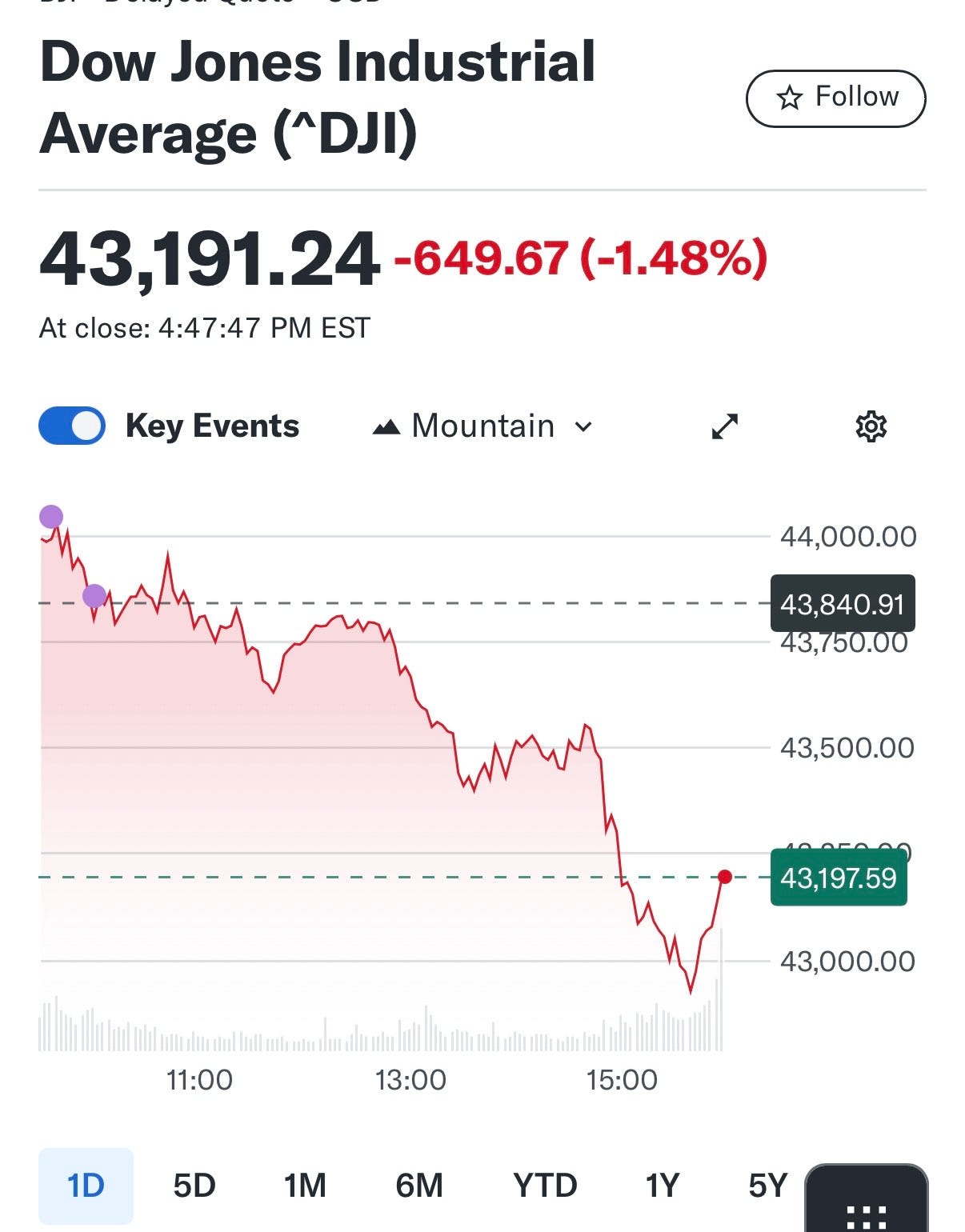
In the days surrounding the tariff announcements, stock indices swung wildly, with export-sensitive stocks (think companies like Boeing, Caterpillar, automakers, tech firms reliant on Chinese sales) taking a hit. Analysts warn that an escalating trade war could derail the economic recovery and corporate earnings. If businesses start reporting weaker profits due to tariffs or cutting guidance for 2025, we can expect a market downturn that will dent Americans’ 401(k)s and retirement savings.
Even the seemingly unrelated sectors feel the ripple effects – for instance, if a trade war slows global growth, oil demand might drop and energy sector jobs could suffer, or a weaker Chinese economy could affect demand for American luxury goods and services. In short, the tariffs are casting a pall over the economic mood. Consumer confidence could also erode as people experience rising prices and hear talk of trade war – if folks get nervous about the economy, they might pull back on spending, creating a negative feedback loop.
To sum up the current landscape: American consumers are facing higher prices, businesses are facing chaos and tough choices, and workers are facing growing insecurity. The tariff tax has arrived, and it’s hitting home. What’s worse, this pain is utterly predictable – a self-own in economic terms. While Trump insists these measures will force Mexico, Canada, and China to capitulate to U.S. demands (whatever those may be, from stopping fentanyl to balancing trade), the immediate effect is indisputable: Americans are feeling the hurt right now.
Future Projections
If these tariffs remain in place for the long haul (or, heaven forbid, escalate further), the consequences for the U.S. economy could become even more severe. Here’s a forward-looking analysis of what might loom ahead:
Prolonged Pain for Consumers: In the long term, a 25% across-the-board tariff on two of our largest trading partners (Canada and Mexico) and higher tariffs on China would bake higher costs into almost every supply chain. This isn’t a one-time blip – prices of many goods could settle at permanently higher levels.
Over time, some supply chains might adjust (e.g. retailers finding new sourcing countries), but those adjustments themselves are costly and often less efficient. Economists project that if the tariffs persist, annual inflation could run roughly 0.5-1 percentage point higher than it otherwise would. That means everything from groceries to gadgets would consistently cost more year after year. Middle-class real incomes (already strained by recent inflation) would stagnate or decline as the cost of living climbs. It’s essentially an erosion of Americans’ purchasing power. No doubt, creative accountants in Washington might continue to call tariffs “taxing China,” but American families will notice the truth in their monthly budgets.
Economic Growth Hits and Recession Risks: Tariffs act like sand in the gears of the economy. By raising costs and reducing efficiency, they tend to drag down GDP growth over time. Estimates from economic models suggest these new tariffs, if sustained, could shave off a significant chunk of U.S. economic growth in the coming years.
We could see business investment slow sharply – why build that new factory or expansion if supply chains are in flux and costs are unpredictable? Trade-dependent industries would likely scale back. Some forecasts indicate the tariff regime could directly reduce U.S. GDP by a few tenths of a percent (which is huge in a $22 trillion economy) and even more when you factor in retaliation. Combine that with tighter monetary conditions (as discussed, tariffs can push the Fed to keep interest rates high), and the risk of tipping into a recession increases. If consumers pull back spending due to higher prices and businesses freeze hiring, the economy could stall. A full-blown trade war, especially if it expands to involve Europe or other regions, would amplify this risk dramatically.
The scenario isn’t hard to imagine: today it’s China, Canada, Mexico; tomorrow, perhaps Trump targets imports from the EU or Japan (he has threatened tariffs on European cars before). Each escalation would provoke further retaliation against U.S. exports. The result could be a cascading global trade shutdown reminiscent of – or even worse than – the 2018-2019 episode. In a worst-case scenario, we could see a global recession triggered by these trade hostilities, with the U.S. at its center. Even in a milder scenario, expect slower growth, higher unemployment, and a general economic malaise hanging over the remainder of Trump’s term if nothing changes.
Trade Realignment – U.S. Isolated?: Another long-run effect is the potential realignment of global trade networks away from the United States. Countries burned by U.S. tariffs might deepen their trading ties with each other, leaving U.S. exporters in the cold. We’re already seeing signs of this: China is courting other suppliers and markets (e.g. buying more grain from Brazil or beef from Argentina instead of the USA).
Canada and Mexico, historically close U.S. partners, might accelerate trade deals with Europe or Asia to reduce dependence on a capricious United States. If the U.S. keeps walling itself off with tariffs, foreign companies may invest elsewhere (why build that new auto plant in the U.S. when you could do it in Canada and avoid U.S. tariffs?), and American companies may also expand overseas to get around trade barriers. The long-term danger is an America less integrated in global trade, which could mean lost access to markets for our exporters and higher costs for our importers indefinitely.
We could also lose our leadership role in setting trade norms – after all, it’s hard to champion free trade or rally allies against China’s unfair practices when we ourselves are slapping tariffs on allies like Canada for unrelated reasons.
Endless Tit-for-Tat or Resolution? If Trump doubles down, other countries will keep punching back. We could enter a tit-for-tat loop: e.g., the U.S. raises tariffs further (there’s already talk in Trump’s circle of “universal baseline tariffs” on all countries if they don’t bend – essentially taxing every import globally). In response, partners would broaden their retaliations (perhaps targeting iconic American industries like aerospace, tech, or entertainment). The cycle would continue until either economies are too battered to continue or political leadership changes course. It’s essentially Trade War 2.0 on steroids. However, there are a few off-ramps:
• Domestic pressure might force Trump to ease up. If U.S. businesses and consumers scream loudly enough (through lobbying, public protests, or, importantly, at the ballot box in the 2026 midterms), the administration could find a face-saving way to roll back some tariffs. We saw this in 2019 when faced with an outcry, Trump lifted steel tariffs on Canada and Mexico to push through the USMCA trade deal. History might repeat if the pain becomes politically untenable. My recent post, “How to Make Your Voice Heard: The Ultimate Guide to Getting Politicians to Listen to YOU and Take Action” shows you exactly how to do this quickly and easily.
• Legal or legislative challenges could also intervene. Trump invoked a national emergency law (IEEPA) to justify these tariffs (citing things like the fentanyl crisis). There will likely be court challenges and congressional pushback on this unprecedented use of emergency powers for tariffs. If courts rule against the tariffs or Congress steps in (for example, via legislation reasserting their authority over trade), the tariffs might not last.
• A change in administration in 2029 (or a policy shift if, say, Trump were not to complete the term) could reverse course. A new president could quickly dismantle these tariffs, as they are executive actions. Even before then, if the 2028 election looms and the economy is in rough shape, both parties’ candidates might campaign on ending the trade war to relieve voters.
Global Economic Fallout: It’s worth noting the wider global effects too. A drawn-out trade war between the U.S. and major economies like China, Canada, and potentially others could slow global growth significantly. Emerging markets could suffer as global supply chains reorient and demand softens.
Allies might lose trust in the U.S. as a reliable economic partner, potentially creating a vacuum that China (ironically) could fill by championing multilateral trade agreements that exclude the U.S. In essence, the U.S. risks ceding economic leadership and goodwill. That has strategic implications beyond just economics – countries that feel bullied by U.S. tariffs may be less inclined to cooperate on other issues (security, diplomacy) down the line. The tariffs, meant to project strength, could actually weaken America’s hand globally.
In summary, if the current tariff path isn’t corrected, we’re looking at a future of persistently higher prices, slower growth, damaged relationships, and a risk of broader economic decline. The “America First” trade strategy could ironically leave America behind. It’s a bit like cutting off your nose to spite your face – it might feel like a bold move at first, but in the long run you’re the one disfigured by it.
Case Studies & Examples
The abstract talk of tariffs and percentages can obscure the real human impact. Let’s spotlight a few concrete examples and stories that illustrate how Trump’s tariff barrage is already affecting individuals, businesses, and industries across America:
• Middle-Class Family at the Grocery Store: Meet the Garcias, a family of four in California. They keep a careful budget, but since the new tariffs kicked in, they’re finding it harder to make ends meet. At the supermarket, prices for produce like avocados, berries, and tomatoes (much of which is imported from Mexico) have jumped noticeably. Sandra Garcia jokes bitterly that she might have to ration her kids’ avocado toast – except it’s not really a joke when avocados cost 30% more than last month. Even orange juice is pricier (some oranges come from Mexico when Florida’s harvest is down). The family’s weekly grocery bill has spiked by about $20-$30, which adds up to over $1,000 a year – essentially a “tariff tax” equal to a couple months’ worth of utility bills. The Garcias also needed a new washing machine; when they went shopping, they saw prices were higher than a year ago, in part due to tariffs on imported appliances. They ended up postponing that purchase, hoping prices might fall or a tariff exemption might come (or maybe they’ll scour Craigslist for a used machine). For families like this, there’s a mix of frustration and anxiety – they hear politicians saying the economy is great, but all they see is their dollar not stretching as far. As Mr. Garcia quipped, “I didn’t sign up to pay for a trade war in my grocery tab.”
• Small Manufacturing Business in Minnesota: Traci Tapani co-owns a small sheet-metal fabrication company in Minnesota that produces custom parts for larger manufacturers. Her company relies on raw aluminum from Canada, which historically was affordable and high-quality. With the 25% tariff on Canadian aluminum now in effect, Traci’s cost for that key input has soared. Immediately, she faces awful choices: either raise prices on her customers (and risk them sourcing from elsewhere or just cancelling orders) or absorb the costs (which would wipe out her thin profit margins). She’s already had clients push back on new quotes reflecting the higher costs. Expansion plans are on hold, and she’s worried she might have to lay off a couple of workers if business slows. “We were poised to grow and hire this year,” Traci says, “but these tariffs have thrown a wrench in our plans. It’s hard to invest when you don’t know how high costs will go or if your supply chain will get hit next by a tweet.” This small business example shows how tariffs can stifle entrepreneurship and job creation on Main Street. Instead of buying a new machine or adding an employee, Traci is spending her time figuring out how to survive an unpredictable trade policy. Multiply her story by thousands of small manufacturers around the country, and you see how tariff-induced uncertainty and cost spikes are undercutting the very people who are supposed to be building up the economy.
• Midwestern Soybean Farmer: John is a third-generation soybean farmer in Iowa. He barely made it through the last trade war when China slapped tariffs on U.S. soybeans and essentially stopped buying from American farmers. Back then, soybean prices plummeted and he watched soy harvests rot in silos until the government issued emergency aid to keep farmers like him afloat. Now, with Trump doubling tariffs on China and Beijing retaliating again, John is reliving that nightmare. China has already scaled up purchases from Brazil and Argentina, leaving U.S. soybeans with nowhere to go (at least not at a fair price). The local grain elevator is offering rock-bottom prices for soy because of the glut and lack of export demand. “It’s Déjà vu,” John says. “We worked so hard to rebuild relationships with buyers after the last tariff fight, and it’s all gone up in smoke again.” He’s calculating how much of the USDA tariff relief payments he saved last time might need to be used just to pay his loans this year. He worries about his farm’s survival if this continues, and it angers him that farmers are once more the tip of the spear in trade retaliation. “We’re patriots, but it feels like we’re being sacrificed,” he says, noting that rural communities are already struggling and can’t handle another blow. John’s story represents thousands of farmers across the country – from soybean fields in Iowa to pork producers in North Carolina and dairy farmers in Wisconsin – who are collateral damage in the trade war. Many of them supported tough talk on trade initially, but watching foreign markets shut them out again is testing their faith. As one farm advocate put it, “Farmers don’t want handouts, we want trade. These tariffs are killing our markets.”
• Kentucky Bourbon Distillery: Bourbon whiskey is a quintessential American product, deeply tied to Kentucky’s economy and heritage. A few years ago, bourbon makers unexpectedly got caught in a trade crossfire when the EU and Canada slapped tariffs on American whiskey in retaliation for Trump’s metal tariffs. Exports of Kentucky bourbon took a nosedive, and some distilleries put expansion plans on hold. Fast forward to 2025: with new U.S. tariffs on Canada, Ottawa has retaliated by reimposing tariffs on American whiskey (among other goods). For a distillery in Kentucky, this is grim news. One small bourbon producer that had been gaining a foothold in the Canadian market now finds their product suddenly 25% more expensive there, virtually shutting them out. The CEO of the Kentucky Distillers’ Association noted that when bourbon faced tariffs last round, the industry lost nearly $600 million in sales and many craft distillers suffered. “These policies have real consequences,” she warns, “and we’re looking at difficult times ahead again.” In a broader sense, this example shows how retaliation zeroes in on emblematic American industries – not just bourbon, but also products like Harley-Davidson motorcycles, Florida orange juice, or Washington apples, depending on the trading partner. Trading partners know hitting these industries gets media attention and political pressure. So, America’s proud export products and the workers who make them are once again in the crosshairs of counter-tariffs. The bourbon makers, who invested years aging their whiskey to perfection, now have to worry more about geopolitics than the art of distilling.
• Tech Industry Employee: Not all impacts are in traditional sectors; even the tech world is feeling the squeeze. Consider a California tech firm that imports components from China – say, advanced batteries or circuit boards – to build electric scooters or high-end computers in the U.S. The tariff spike on Chinese goods raises their production costs significantly. The company’s product prices are already high in a competitive market, so passing costs to customers could kill demand. Instead, management is looking at cutting other expenses. Sarah, who works in the firm’s R&D department, notices budgets are being slashed. “Projects are getting delayed or axed,” she says, “because the money’s being eaten up by these tariffs. It’s crazy – we’re literally paying a tax that goes to the U.S. government for the privilege of buying parts we need.” Sarah fears that layoffs may be around the corner if the financial pressure continues. Moreover, China’s retaliation isn’t just tariffs – Chinese regulators have retaliated by opening investigations into U.S. tech giants and by encouraging Chinese consumers to favor domestic tech products over American ones. If that atmosphere grows, big players like Apple, Google, or Tesla could see sales in China suffer, which might lead to cost-cutting back home (again, potentially jobs or investment cuts in the U.S.). While Sarah’s company is smaller, the ripple effect from the giants could hit the whole tech ecosystem. The innovation economy thrives on global supply chains and markets – tariffs and trade barriers throw sand in that engine, possibly slowing the pace of innovation and job creation in one of America’s most dynamic sectors.
These case studies paint a clear picture: the pain from Trump’s tariffs isn’t theoretical – it’s happening now, to real people. Families are paying more for necessities. Small businesses are facing gut-wrenching decisions. Farmers and producers see years of hard work in building markets undone overnight. Iconic American industries are losing sales and scrapping growth plans. And workers across various sectors are staring at an uncertain future. The tariffs were pitched as a way to help the American economy, but on the ground, they feel like a gut punch to Americans who can least afford it.
Actionable Insights
Facing this tariff-induced economic turbulence, what can everyday Americans and businesses do? While we can’t single-handedly change national trade policy, we can take practical steps to mitigate the damage. Here are some actionable insights and recommendations to navigate the fallout:
• Brace Your Budget: Households should proactively adjust their budgets anticipating higher prices. Plan for your grocery and shopping bills to increase for the foreseeable future. It might be wise to set aside a little extra each month as a “tariff buffer” fund to cover the rising cost of food, gas, clothing, and other essentials. Awareness is key – knowing that a price hike isn’t a random fluke but a likely outcome of tariffs can help you mentally prepare and avoid nasty surprises.
• Shop Smart and Strategically: Be a savvy consumer in this environment. Compare prices more than ever – you may find that some retailers or brands are absorbing tariffs better than others, leading to price differences. Consider switching to generic or locally produced alternatives for products that have become too pricey. For example, if imported cheese or produce has spiked in cost, look for domestic producers or farmers’ markets. When it comes to big-ticket items (appliances, electronics, cars), shop around aggressively. Some dealers or stores may offer discounts to offset tariffs, especially if demand slackens. If you’ve been eyeing a major purchase and can’t delay it, it might be better to buy sooner rather than later – before supply runs tighter or more price increases kick in. Conversely, for certain products you might wait it out in hopes of policy changes; use your judgment on a case-by-case basis.
• Support Local and Domestic Businesses: One silver lining is that domestic producers not reliant on imports might be more competitive price-wise now. By buying American-made goods or sourcing locally, you not only potentially avoid some tariff costs, you also support businesses that employ Americans. For instance, if imported furniture or apparel costs jump, check out local craftsmen or “Made in USA” clothing brands. They might still be pricier than pre-tariff imports were, but the gap has narrowed. Plus, keeping your dollars in the domestic economy can help cushion the broader impact. A note of caution: domestic producers might raise prices too (since they have cover to do so when imports are costlier), but at least you’re funding U.S. jobs.
• For Businesses – Adapt Your Supply Chain: Companies, especially small and mid-size ones, need to be nimble. Explore alternative suppliers or materials that aren’t subject to tariffs. This might mean seeking suppliers in countries not hit by the new tariffs (though given Trump’s all-encompassing tariff threats, one has to choose carefully). It could also mean finding domestic sources for certain inputs – even if they cost more initially, it might be better than a 25% tariff plus uncertainty. Engage with your supply chain partners and negotiate: some foreign suppliers might be willing to offer discounts to keep your business, sharing some pain of the tariff. Also consider increasing inventory of critical items before further tariff escalations occur (stockpiling non-perishables or parts now could save money if tariffs go even higher later). In short, have a Plan B (and C) for sourcing, because relying on the status quo is risky now.
• Advocate and Stay Informed: Don’t underestimate the power of your voice. Businesses and consumers alike should speak up about how these tariffs are harming them. This can mean contacting your representatives in Congress to urge them to push back against the tariffs or support legislation to limit the President’s tariff powers. Many industry associations (Chamber of Commerce, Farm Bureaus, Retail Federations) are lobbying hard to end the trade war – lend them your stories and support. Grassroots pressure can help shape political outcomes. On an individual level, staying informed is also crucial: tariffs and trade policies can change rapidly with this administration. Keep an eye on the news and be ready to adjust plans if, say, a tariff gets lifted or if a new one is announced. Knowing, for example, that an additional round of tariffs might hit European goods could inform your business import strategy or even personal buying decisions (maybe you’d buy that imported car now before a possible tariff). In this volatile situation, information is power – use it to stay a step ahead.
• Personal Financial Planning: Economic uncertainty is back in a big way. It’s prudent to strengthen your personal financial safety net. This means, if possible, bulking up your emergency savings in case the tariffs contribute to a broader downturn or job loss in your industry. Avoid taking on new high-interest debt if you can, since rates may rise. If you’re in an industry likely to be affected (manufacturing, agriculture, export-related sectors), consider upskilling or having a contingency plan for employment – just in case. It’s not about panicking; it’s about being prepared. The trade war is a risk factor much like a pandemic or a financial crisis – something largely out of individual control but potentially disruptive. So control what you can: your readiness for tough times.
• Business Strategy – Innovate and Cut Costs (Wisely): Companies should use this challenge as an impetus to streamline operations (without simply axing workers). Look for efficiency gains that can offset some added costs – maybe investing in energy-saving equipment, software that improves logistics, or training that raises worker productivity. While it’s hard to invest under cost pressure, remember that competitors are all facing the same tariffs; those who innovate will come out ahead. However, be careful about knee-jerk reactions like outsourcing jobs abroad solely to save on tariffs – that can hurt morale and reputation (and if tariffs ever end, you’ve disrupted your workforce for nothing). Instead, focus on temporary measures: reduced overtime, negotiating shorter-term labor adjustments, etc., as you ride out the storm. Also, keep open communication with employees – if people understand the company is facing higher costs because of tariffs, they might be more receptive to interim belt-tightening measures. Team up within your industry: sometimes competitors can join forces in lobbying or share strategies to cope with tariffs (non-sensitive areas) – there’s strength in numbers.
• Look for Government Relief Programs: It’s a sad reality, but if the trade war persists, there may be relief funds or government assistance programs (as we saw with farmers last time). Keep an eye out for any aid targeted to your industry. Farmers, for example, should stay in close touch with the USDA and Farm Service Agency for announcements of tariff compensation programs. Small businesses can watch for Small Business Administration (SBA) initiatives or emergency loans to help with tariff impacts. While everyone would prefer to just trade freely rather than need aid, if the aid is available it can be a lifeline. Just be cautious not to rely on it until it’s actually in hand – plan as if you’re on your own, and treat any relief as a bonus.
Conclusion: Trump’s Tariffs Are an Economic Disaster—And You’re Paying the Price
Let’s not sugarcoat it: Donald Trump has single-handedly unleashed an economic disaster on the American people. His reckless, ill-conceived tariff policies are nothing more than a self-inflicted tax on hardworking Americans, designed to score political points while gutting household budgets, suffocating businesses, and destabilizing entire industries. He promised that Mexico, Canada, and China would pay—but instead, it’s you footing the bill at the grocery store, the car dealership, and every checkout line across the country. Jobs are already disappearing, manufacturers are slamming the brakes on expansion, farmers are once again staring at financial ruin, and small businesses are drowning in uncertainty—all because Trump decided to play economic arsonist.
And let’s be clear: this was entirely avoidable. These tariffs were not some unfortunate necessity—they were a deliberate choice. Trump didn’t have to wage another trade war, but he did. He didn’t have to disrupt supply chains and send prices soaring, but he did. He didn’t have to ignore the economic fallout of his last tariff debacle, but he did. And now, everyday Americans are left to clean up his mess while he brags about “winning.”
So, what now? While we can’t undo Trump’s damage overnight, there are steps to mitigate the financial pain:
• Brace for rising costs—because they’re coming whether you like it or not. Adjust your budget, shop strategically, and cut back where possible.
• Support local businesses that aren’t getting crushed by these tariffs, and consider domestic alternatives where feasible.
• For businesses, rethink supply chains—diversify sourcing, negotiate with suppliers, and prepare for higher operating costs.
• Make your voice heard. Contact lawmakers, support trade groups fighting these policies, and demand an end to Trump’s economic malpractice.
• Stay informed and plan ahead. These tariffs could escalate further—so financial caution is more important than ever.
The sad truth is, we’ve seen this nightmare before—and now, Trump has doubled down on the very same failed policies that crushed farmers, hurt manufacturers, and bled American consumers dry. The only way out of this disaster is to push back, stay resilient, and ensure that his reckless economic vandalism doesn’t go unchecked. Until then, tighten your belts (literally, if your grocery bill forces you to) and prepare for more financial pain—all thanks to Trump’s obsession with playing trade war tough guy, while the rest of America suffers.
Mitch Jackson, Esq. | links
This post is free.
But free doesn’t build the future.
Independent journalism only works when people like you choose to lean in—not just with attention, but with support.
If this work matters to you, today’s a great day to take the leap.
$5 a month. $50 a year. For you or gift to a friend.
A small investment in something bigger than all of us.

Everything he does/says/touches, is screwing over Americans, & the rest of the world!😒🙄😒🤪🎃🤡👻💩💀