
Trump’s Golf Grift: $144 Million in Taxpayer Money Wasted on His Luxury Getaways

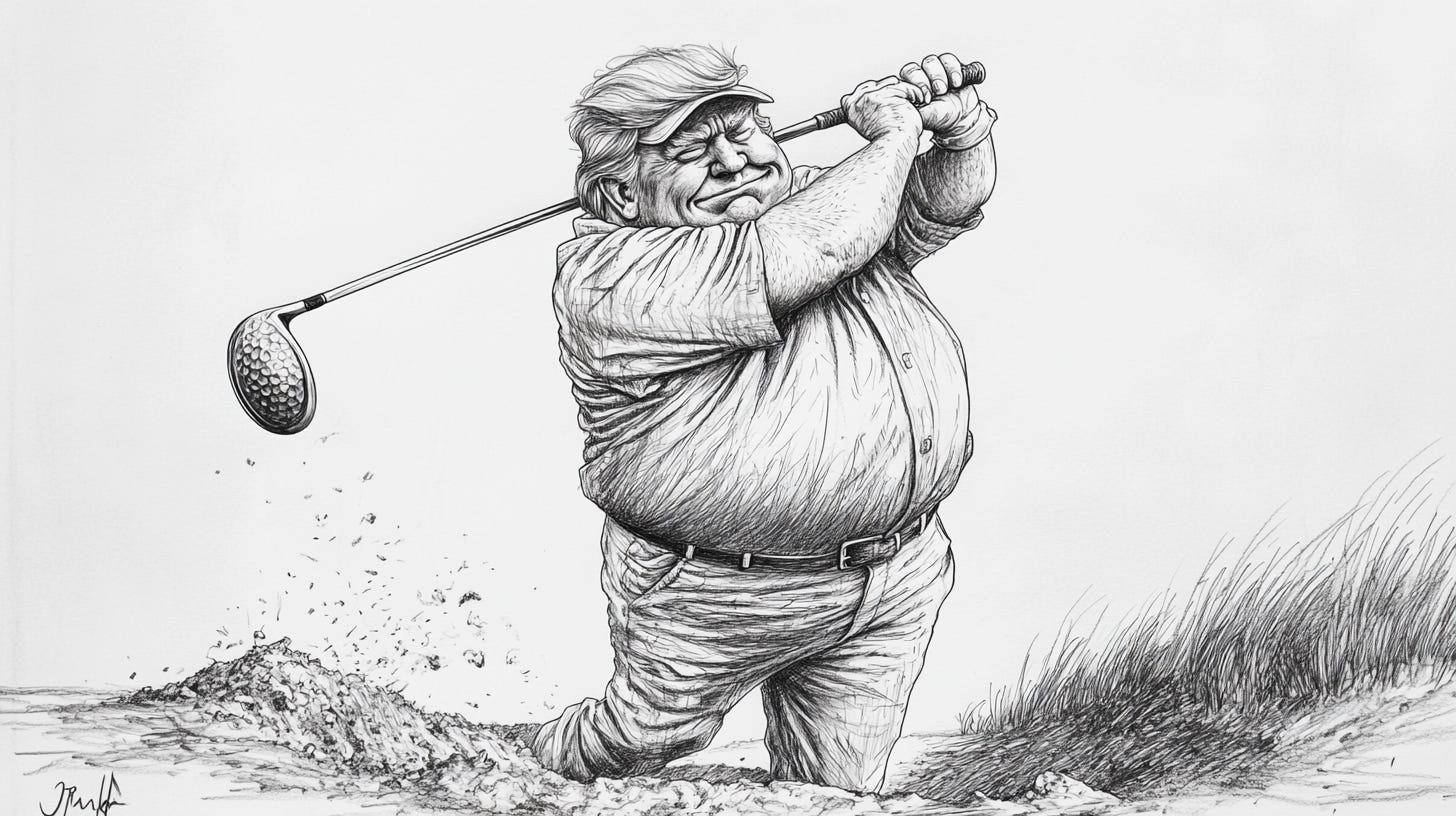
Summary
Donald Trump’s love for golf came with an eye-watering price tag for American taxpayers – well over $144 million during his first term alone. That number is expected to grow by an additional $155 million in his second term.
His frequent weekend trips to his private resorts, especially Mar-a-Lago and Bedminster, cost significantly more than the travel expenses of past presidents, largely because Trump chose distant locations requiring Air Force One, extensive security, and government-paid stays at his own properties.
Unlike his predecessors, who largely used Camp David or stayed in non-commercial accommodations, Trump’s travel funneled millions of taxpayer dollars directly into his own businesses. The legal framework allowed him to take these trips without reimbursement, exposing glaring gaps in presidential spending oversight. Without new policies to curb such self-serving expenses, future presidents – regardless of party – could exploit the same loopholes, forcing taxpayers to foot the bill for personal indulgences.
Introduction
Donald Trump’s penchant for frequent golf outings and leisure trips during his presidency came at a steep cost to American taxpayers. This report provides a critical, data-driven analysis of the taxpayer money spent on Trump’s recreational travel in office, examining the total expenses incurred, comparisons with past presidents, the legal framework allowing such spending, and public responses. While every U.S. president incurs travel expenses, Trump’s expenditures – particularly trips to his own luxury resorts – were unprecedented in scale and have raised serious questions about fiscal responsibility and ethics.
DISCLAIMER: This is an investigative opinion piece and does not provide legal, financial, tax or investment advice. Always do your own due diligence and consult with an experienced professional in your state, region or country.
1. Total Travel Costs
During his term in office (2017–2021), President Trump traveled frequently to his private resorts for weekends and vacations, primarily Mar-a-Lago in Florida (dubbed the “Winter White House”) and the Trump National Golf Club in Bedminster, New Jersey. These trips required the use of Air Force One or other government aircraft, motorcades, and extensive Secret Service protection – all funded by taxpayers. Key findings on these costs include:
• Mar-a-Lago Trips (Florida): Trump visited his Mar-a-Lago club often, especially in winter months. Each round-trip from Washington, D.C. to Palm Beach was enormously expensive. A Government Accountability Office (GAO) audit of four early Mar-a-Lago trips in 2017 found an average cost of $3.4 million per trip . These costs include operating Air Force One and military support aircraft, Coast Guard patrol boats, and the lodging, meals, and overtime pay for personnel. By mid-2019, Trump had made roughly two dozen Florida trips, costing about $81 million in total . Over his presidency he continued to visit Mar-a-Lago (with around 30 trips in four years), pushing the cumulative Florida travel bill toward the $100 million mark. In short, shuttling the President to his Palm Beach resort on weekends consumed a nine-figure sum of taxpayer funds.
• Bedminster Trips (New Jersey): In the summers, Trump often spent time at his golf club in Bedminster. These trips, while shorter in distance, still required Air Force One flights and security logistics. As of mid-2019 he had taken about 15 trips to Bedminster, tallying an estimated $17 million in costs . By the end of his term, the number of Bedminster visits grew (approximately ~20 trips in four years), with total costs likely around $20–25 million for these New Jersey getaways. Notably, Trump sometimes treated these as “working vacations,” but they overwhelmingly centered around golf and personal time.
• Other Golf-Related Travel: President Trump’s recreational travel wasn’t limited to Florida and New Jersey. He also visited other golf properties he owns:
• Trump National Los Angeles: On one occasion, he flew to his golf club near Los Angeles; that side trip cost roughly $1 million in taxpayer-funded travel , despite being a short stay.
• International Golf Resorts: Trump even mixed personal leisure into official overseas trips. In 2018, he made a two-day stop at his Trump Turnberry golf resort in Scotland (during a trip to Europe for a NATO summit), where he played golf. The total cost for that detour exceeded $1.1 million for the U.S. government . This included nearly $1 million just in Secret Service expenses (such as $466,000 on rental cars to accommodate the remote location), plus State Department and military transport costs. Similarly, during a 2019 visit to Ireland, Trump stayed at his Doonbeg golf resort; this added significantly to the expense of the trip (exact figures for Doonbeg were not publicly reported, but would include trans-Atlantic flight costs comparable to the Scotland visit).
• Security and Ancillary Costs: Each presidential golf trip triggers a wide array of support costs beyond plane fuel. For example, local law enforcement in Palm Beach County racked up $3.4 million in overtime in the first months of Trump’s presidency due to Mar-a-Lago visits, an amount later reimbursed by the federal government. The U.S. Coast Guard also had to station cutters and patrol boats whenever Trump stayed at Mar-a-Lago on the coast; in the early weeks, the Coast Guard alone spent nearly $20 million to protect the Mar-a-Lago area. Additionally, the Secret Service had to rent rooms, golf carts, and facilities at Trump’s properties to carry out their protective mission – effectively paying the President’s own businesses for space. Records show the Secret Service spent almost $2 million at Trump-owned properties over Trump’s term for guarding him and his family. This means taxpayer money was being paid directly into Trump’s resorts and clubs as a byproduct of his travel.
Cumulative Expense: Combining all these trips, the total taxpayer cost of President Trump’s golf and leisure travel is estimated at around $130–150 million for his four-year tenure. One watchdog analysis put Trump’s known travel tab at about $144 million as of late 2020 . To put this in perspective, Trump’s frequent weekend trips consumed an amount over 355 times the annual presidential salary (which Trump famously declined to take) – an irony given that he claimed to be saving taxpayer money by not drawing the $400,000 salary. In effect, any savings from his forgoing the salary were dwarfed hundreds of times over by the extra travel and security expenditures incurred by his golf habits.
It’s also important to note the frequency of Trump’s leisure travel, which contributed to these high costs. He visited his own properties on nearly 550 days of his presidency  – roughly one day out of every four was spent at a Trump-branded property, usually golfing. Every one of those outings required motorcades, Secret Service details, and often flight support if outside Washington. By comparison, presidents have the option of working from the White House or Camp David (the government-owned presidential retreat in Maryland) at essentially no added cost; Trump opted instead for commercial resorts that required flying him and his entourage south or north on many weekends. This unprecedented level of personal travel set the stage for equally unprecedented costs borne by the public.
It’s also notable that Trump’s travel uniquely monetized the presidency in ways previous presidents avoided. Neither Obama, Bush, nor Clinton owned personal vacation properties that could charge the government. Trump not only spent more, but much of that spending flowed back into his own businesses (something no prior president has done on such a scale). This self-dealing aspect – effectively having the Secret Service and Defense Department pay resort fees and expenses directly to the President’s company – sets Trump apart from his predecessors, who generally stayed at either public facilities (Camp David) or the homes of friends/family while on break.
In summary, Trump’s golf and leisure travel spending was significantly higher than that of past presidents, both in absolute dollars and in concentration over time. He managed to accumulate a taxpayer-funded travel bill in four years that exceeds what two-term presidents before him spent in eight years. The high frequency of his golf trips, the choice of distant private resorts, and the redirection of government resources to his own properties all contributed to this outsized level of expenditure.
2. Legal and Policy Aspects of Presidential Recreational Travel
Authority for Taxpayer-Funded Travel
Under U.S. law and longstanding practice, the sitting President is entitled to transportation and security provided by the government at all times – including during personal or recreational travel. The logic is that the President of the United States must be protected 24/7 and must remain in secure communication with national security staff, regardless of location. This means when the President travels, he must do so on military aircraft with Secret Service protection. Trump, like his predecessors, flew on Air Force One or Marine One (the presidential helicopter) for virtually all trips, official or personal. These aircraft are operated by the U.S. Air Force under orders from the Commander-in-Chief. The use of Air Force One and the accompanying support (such as cargo planes carrying the presidential motorcade, advance teams, etc.) is an established privilege of the office. No explicit additional “permission” is needed for a president to take a vacation or play golf – it is left to the President’s discretion. In essence, the authority for a president to use taxpayer funds for travel is inherent in the office, backed by various statutes that fund the Executive Office, Secret Service, and military transport for presidential use.
Several specific laws and regulations underpin this arrangement. 18 U.S.C. §3056 authorizes the Secret Service to protect the President and immediate family, which in practice obligates the Service to spend whatever is necessary to safeguard the President wherever he goes. The Department of Defense similarly has internal regulations (and congressional authorizations) to provide air transport (Air Force One and support aircraft) for the President. There is no law requiring a President to stay put in Washington – if the President decides to travel for leisure, the agencies must follow. In Trump’s case, if he wanted to spend every weekend at his Florida club, the government had to make it happen, budget allowing.
One informal limitation is that if a trip is purely political (such as attending a campaign rally or fundraising event), federal law (and regulations of the Federal Election Commission) requires the campaign or political party to reimburse the government for part of the cost. For example, during election season, when Trump traveled to campaign events, the Trump campaign had to pay what a commercial charter flight would have cost for those passengers. However, these reimbursement rules often cover only a fraction of the true expense. They do not apply to personal or leisure travel – only to political (campaign-related) travel. Thus, when Trump flew to Mar-a-Lago for a golf weekend that was not a campaign event, there was no requirement to reimburse any costs; the full expense was borne by taxpayers. In practice, presidents can blend some official purpose into personal trips (for instance, Trump occasionally hosted foreign leaders or held meetings at Mar-a-Lago) to classify the travel as official, but even fully personal trips are still paid for by public funds because the President cannot realistically travel without the trappings of office.
Restrictions and Oversight Measures
Despite the broad latitude given to presidents in using government resources for travel, there are a few oversight mechanisms and guidelines in place. Notably, the Presidential Protection Assistance Act of 1976 (enacted after concerns about excessive costs to support former President Nixon’s private residences) requires transparency about the costs of protecting the President. Under this law (as amended), agencies involved in presidential protection must submit semiannual reports to Congress detailing the expenses for protecting the President and other protectees. This includes the Secret Service, Department of Defense, and others incurring travel-related costs. In theory, this reporting requirement is a check on excessive spending – Congress and the public are supposed to be informed of how much is spent on presidential travel every six months.
In practice, however, compliance has been spotty. A GAO investigation found that several agencies failed to file the required expense reports during 2016–2017 . The Secret Service, for instance, had not submitted the mandated reports on protective travel costs for several consecutive periods . This lapse meant that as Trump’s expensive travel ramped up, Congress was not automatically getting the detailed breakdown it should have by law. GAO recommended that the Secret Service and DOD improve compliance with reporting requirements . While reporting lapses are being addressed, the key point is that current law relies on after-the-fact transparency rather than upfront limits: agencies must report what was spent, but there’s no specific cap on what they can spend.
Apart from reporting requirements, there are few hard restrictions on a president’s use of taxpayer-funded travel for leisure. The President controls the schedule and destination; traditionally, political pressures and norms served as the main constraint. For example, presidents have been wary of appearing to waste taxpayer money on too much vacation, which in the past kept their travel frequency in check. Trump largely disregarded this norm, traveling far more often than previous presidents despite the costs. Because it is a security imperative that the President be protected and reachable, agencies like the Secret Service effectively have blank-check authority (within their budgets) to cover whatever travel the President undertakes.
One practical limitation is budgetary: if a president’s travel demands are so high that agencies risk running out of funds, Congress might intervene. In fact, during Trump’s first year, the Secret Service faced severe strain on its personnel budget – over 1,000 agents hit their annual salary and overtime caps by August 2017 due to the intense travel and large number of protectees (Trump’s adult children also required Secret Service details as they traveled frequently) . This unprecedented situation required special congressional approval to raise the overtime cap, highlighting how Trump’s travel pushed the envelope of what the Secret Service’s budget was designed to handle. While not a formal restriction, this incident shows that if presidential travel is excessive, the funding can become a problem that draws congressional scrutiny.
Legally, the President also cannot personally profit from the office beyond his fixed compensation, under the Constitution’s Domestic Emoluments Clause. This clause says the President shall receive a salary and no other emolument (payment) from the federal government or the states during his term. Trump’s decision to travel to his own resorts created a gray area: his businesses received payments from the federal government for lodging, space, and services during those trips. Ethicists argued this could violate the spirit of the Domestic Emoluments Clause, since taxpayer money flowed to the President’s private company beyond his salary. Trump’s defense was that these were legitimate reimbursements for expenses, not personal gifts, and he pointed out that he didn’t take a salary. Regardless, this self-dealing aspect was unprecedented in modern presidencies and revealed a gap in ethics rules – no law explicitly forbids the government from doing business with a president’s private company to support travel, because previous presidents never attempted it. Thus, existing restrictions failed to anticipate a situation like Trump’s, where official travel and personal financial interest intertwined.
In summary, the current legal framework gave President Trump wide freedom to use taxpayer funds for golf trips and personal travel. He was fully within his authority to travel as often as he did, and agencies were obligated to spend what was necessary for his security and transport. With no set limits and only post-hoc reporting as oversight, the onus was on the President to self-regulate his usage of public resources – which, in Trump’s case, did not result in restraint. This has led many to conclude that the laws and policies governing presidential travel need reform to prevent potential abuse.
3. Public Reaction and Policy Recommendations
Public Reaction and Criticism
Trump’s heavy spending on golf and leisure travel drew significant public scrutiny and criticism, especially given his prior statements and the ethical questions involved. Public opinion was divided largely along partisan lines: Trump’s supporters often downplayed the issue or accepted his assertion that he was always working, whereas critics accused him of behaving like a “part-time president” on the taxpayer’s dime. Media coverage was unrelenting in highlighting the contrast between Trump’s words and actions – as a candidate, he lambasted President Obama’s golfing and promised he “wouldn’t have time for golf” if elected , yet as President, Trump visited golf courses over 280 times. News outlets and watchdog organizations regularly tallied the growing costs. Headlines about “$100+ million taxpayer bill for Trump’s golf” became commonplace by 2019 , and by the end of his term the figure had risen to well over $130 million. This narrative of apparent hypocrisy (criticizing Obama, then exceeding Obama’s golf time and expenses) hurt Trump’s credibility with moderates and was seized upon by late-night comedians and political opponents.
Beyond politics, many Americans expressed frustration at the idea of public funds being spent at the President’s private resorts. Ethically, it appeared to many as if Trump was using the presidency to subsidize his businesses – an impression reinforced each time records showed the government paying Mar-a-Lago or Bedminster for services. Watchdog groups like Citizens for Responsibility and Ethics in Washington (CREW) and Judicial Watch (typically on opposite ends of the political spectrum) both raised red flags. CREW documented how “American taxpayers foot the bill, paying well over $100 million to shuttle him to his properties” , and noted that at least $1 million of public funds flowed directly into Trump-owned businesses in the form of payments for accommodations and services . This kind of self-enrichment via travel was widely seen as an abuse of power, even prompting some Republican lawmakers to quietly voice discomfort.
Local communities affected by Trump’s frequent visits also had mixed reactions. In Palm Beach, residents and businesses initially welcomed the prestige of the “Winter White House,” but that enthusiasm waned as airport closures, roadblocks, and Coast Guard restrictions recurred daily during Trump’s stays, disrupting commerce and daily life. The county incurred hefty security-related expenses (ultimately reimbursed federally) and had to make special arrangements each time Air Force One arrived. Similar fatigue was reported around Bedminster, NJ, where summers brought repeated no-fly zones and motorcade disruptions. These local impacts kept the issue in the news and reinforced the perception of high cost for the President’s personal convenience.
There was indeed pushback and debate. In town halls and online forums, citizens questioned why the President couldn’t work from the White House or Camp David more often to save money. Editorial boards ran pieces arguing that Trump’s travel spending was an affront to taxpayers, especially during times of national crises. For instance, during a 35-day government shutdown in early 2019, Trump pointedly stayed in Washington (foregoing his usual Mar-a-Lago vacation) – and later remarked how much he “missed being at Mar-a-Lago” . This statement drew ire from furloughed federal workers who felt he was pining for taxpayer-funded leisure while they went without pay. Similarly, during the COVID-19 pandemic in 2020, Trump’s decision to visit his golf course was met with public criticism that he was prioritizing recreation amid a crisis.
In essence, many Americans (outside of Trump’s core base) saw his excessive leisure travel as wasteful, tone-deaf, and even corrupt. While presidents are certainly allowed downtime, the scale of Trump’s golfing – and the bill attached – became a symbol, for his critics, of a President who treated the Treasury like a personal expense account. Polls consistently showed low approval ratings for Trump’s handling of ethical issues, and his travel habits were a contributing factor. The issue also likely had a lasting effect on his brand: a portion of the public was angered enough to boycott Trump hotels and golf courses, perceiving them as being unfairly subsidized by their tax dollars.
Calls for Reform and Policy Recommendations
Trump’s presidency has sparked renewed discussion about setting clearer limits or rules on taxpayer-funded presidential travel. Good governance advocates and some lawmakers argue that what is considered a “norm” (self-restraint by the President) should perhaps be codified into law to prevent future abuse. Several proposals have emerged to rein in costs and increase accountability:
• Reimbursement for Personal Trips (SWAMP Act): Very early in Trump’s term, legislators introduced bills aimed at forcing the President to personally bear the cost of purely recreational travel – especially trips to properties from which he might profit. One notable proposal was the Stop Waste And Misuse by the President Act (SWAMP Act), originally put forward by Rep. Ted Lieu and Sen. Sheldon Whitehouse in 2017 . The SWAMP Act explicitly called for any trip to a President’s own commercial property (e.g. a resort or hotel they own) to be treated as a campaign expenditure, requiring reimbursement to the Treasury. The logic was that taxpayers should not subsidize the President’s private business promotion. If enacted, this would mean Trump (or any future president in similar circumstances) would have to pay back the government for the costs of, say, a weekend golf trip to his own resort. Although these bills did not advance in a Republican-controlled Congress, they signaled strong concern about the issue. The idea of requiring partial or full reimbursement for non-official travel continues to gain traction. Proponents compare it to corporate practice: CEOs often must reimburse personal use of corporate jets – here the “corporation” is the U.S. government and the jet is Air Force One.
• Capping Travel Budgets: Another suggested reform is to impose a formal budget cap on presidential leisure travel. For example, Congress could appropriate a certain annual sum for presidential personal travel, and if the President exceeds it, he would need to seek additional approval or use campaign/personal funds. This would function somewhat like a travel budget in other parts of government (or even in corporations). While presidents have very broad use of funds, Congress does hold the power of the purse and could direct that “not more than $X may be used for non-official presidential travel in a fiscal year.” Such a cap would be unprecedented – previously it was assumed no president would approach a threshold high enough to warrant a cap – but Trump’s $30+ million per year tab has changed minds. A cap might discourage frivolous trips and encourage more use of remote meeting technology or closer locations. Some analysts propose a cap tied to the President’s salary (for instance, no more than 10 times the presidential salary can be spent on purely recreational travel annually, which would be ~$4 million) to provide a reference point for reasonableness.
• Ban on Self-Dealing and Conflicts: Lawmakers and ethics experts have also urged rules to prohibit official spending at a president’s personal businesses. One simple fix would be a law stating that federal agencies cannot disburse funds to businesses owned by the President (or immediate family) for travel or accommodations. This would effectively force future presidents with private holdings to use public facilities (Camp David, government guest houses) or third-party venues when they travel, eliminating at least the profit motive. In Trump’s case, such a rule would have barred the Secret Service from renting golf carts from Trump’s club or rooms at Mar-a-Lago – they would have had to arrange alternate logistics, likely reducing the President’s incentive to go there so often. This kind of conflict-of-interest safeguard could be part of a broader ethics reform to close the loopholes Trump exposed.
• Enhanced Transparency and Accountability: Even without outright reimbursement or caps, improving transparency is a widely agreed step. This includes enforcing the 1976 reporting law strictly – ensuring Congress and the public get detailed, timely reports on how much each presidential trip costs and where the money went. Additionally, some propose real-time disclosure: for instance, requiring the White House to publish the estimated cost of each personal trip whenever the President travels for non-official purposes. If the public sees a price tag (“This weekend’s trip to X will cost an estimated $3 million”), it could pressure the White House to justify the trip. Oversight committees in Congress could hold hearings on particularly egregious expenses, further shining a light. The goal of transparency measures is to make the President think twice before incurring excessive costs, knowing it will be scrutinized.
• Utilizing Alternatives: A softer recommendation (outside of legislation) is that presidents should make more use of cost-saving alternatives for downtime. For example, Camp David is a secure retreat already maintained by the government; increased use of Camp David or nearby federal facilities for weekends would save money versus flying to distant locales. Even within the White House, there are ample recreation facilities (movie theater, gym, bowling, etc.), and past presidents have taken “staycations” during sensitive times. Setting an expectation that the President will limit far-flung leisure trips, perhaps through internal policies or public commitments, could curtail expenses. While this relies on voluntary compliance, a president who campaigned on fiscal responsibility might pledge to minimize personal travel costs (a pledge many wish Trump had honored).
• Bipartisan Standards: Importantly, any reforms would apply to presidents of both parties. The Trump experience demonstrated a need for rules not because the issue is partisan, but because norms can be broken. Moving forward, one proposal is for a bipartisan commission to establish standards for presidential travel – defining what is “official” versus “personal,” recommending best practices for mixing work and play, and perhaps setting guidelines on acceptable frequency of purely recreational trips. This could help depoliticize the issue: whether the President is Democrat or Republican, all would be expected to adhere to similar limits, so the public doesn’t feel one standard is used to attack one president and not others.
Public sentiment has shown an appetite for these kinds of changes. The idea that “the President should pay for his own golf vacations” resonates with many taxpayers, especially when budgets are tight or when ordinary Americans are asked to sacrifice. While the President does carry the burdens of office 24/7 and legitimately needs downtime, the consensus among reformers is that clear rules can ensure that future presidents enjoy personal travel responsibly – without sticking taxpayers with exorbitant bills or creating the appearance of profiting from office.
In the wake of Trump’s term, several members of Congress vowed to reintroduce travel reimbursement bills if similar patterns recur. With the 2024 election and beyond, if a President (Trump or otherwise) were to resume heavy leisure travel at public expense, we can expect renewed pressure to enact some of these policy fixes. Even absent new laws, the spotlight on Trump’s spending has likely set a cautionary example. Future presidents may think twice about excessive golf trips, knowing they will be compared to the costly precedent Trump set. At the very least, Trump’s case has jump-started a conversation about the balance between affording the President personal freedom and protecting the taxpayers’ purse – a conversation that is likely to shape norms and policies in the years ahead.
Conclusion
Donald Trump’s golf and recreational travel as President came with an extraordinary price tag funded by American taxpayers. The data shows a pattern of spending far beyond that of prior administrations, driven by frequent trips to his own luxury resorts. Legally, he operated within a system that grants the President broad privilege to travel, but his use (and some would say abuse) of that privilege has exposed flaws in oversight. Public reaction has been sharply critical, fueling demands for reforms such as requiring reimbursement for personal trips or capping travel expenditures. Going forward, implementing stricter guidelines or laws could ensure that no President – of any party – can so freely use public money for private leisure without accountability. The presidency may come with unique perks, but ultimately those perks are funded by the public and should be exercised with prudence and transparency.
Mitch Jackson, Esq. | links
This post is free.
But free doesn’t build the future.
Independent journalism only works when people like you choose to lean in—not just with attention, but with support.
If this work matters to you, today’s a great day to take the leap.
$5 a month. $50 a year. For you or gift to a friend.
A small investment in something bigger than all of us.

Can you do me a favor and contact Egberto Willies @ Politics Done Right.
Makes me wish you'd get an interview about this golf grift. Worth hearing.