
Trump’s First 60 Days: Is He Governing for America…or Putin?
Two Months of Chaos, Capitulation, and Kremlin Wins

Curiosity isn’t passive—it’s the engine of insight. This article is already queued up on our Perplexity AI page, waiting for you to dive in. Click. Question. Explore. No rabbit hole too deep, no angle off-limits. Go.
I Had to Share Because Seriously, Who’s He Working For?
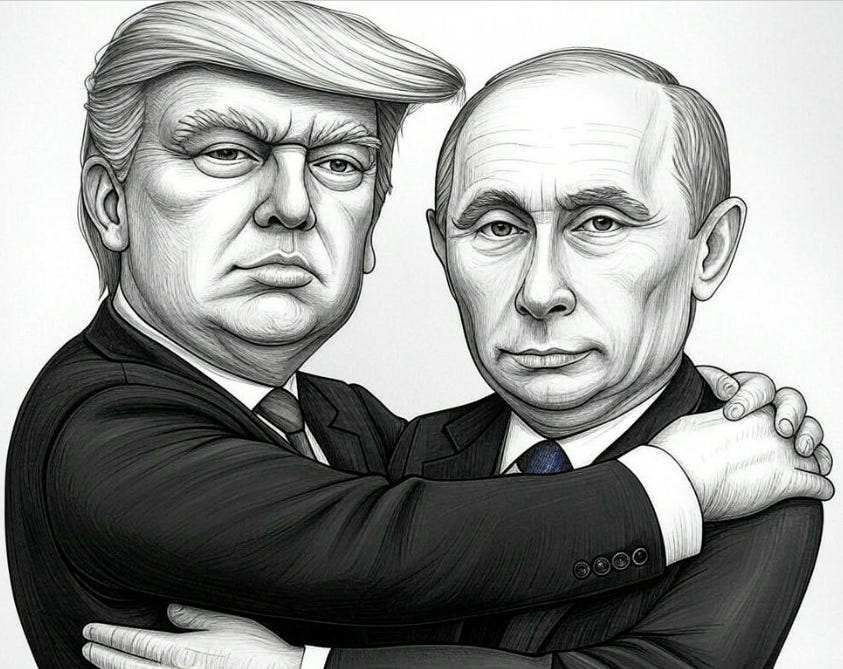
If Vladimir Putin penned the script for an American president’s first 60 days, it would look eerily like Donald Trump’s opening act in 2025. In just two months back in office, Trump has unleashed a blitz of executive moves, policy pivots, personnel picks, and pronouncements that weaken the United States at home and abroad – all while handing Moscow one strategic gift after another.
Call me old-fashioned, but when Russia applauds your foreign policy, you’re clearly doing something wrong.
While reading this article, I want you to ask yourself:
What did America get in return for all the concessions Trump gave up these past several weeks?
As I write below, the fact of the matter is that Trump:
(1) gave up supporting Ukraine when he called it’s President a dictator and claimed Russia didn’t start the war;
(2) sabotaged NATO and alienated our allies;
(3) suspended military aid to Ukraine on Monday;
(4) excluded Ukraine from peace talks;
(5) halted cyber operations against Russia also on Monday;
(6) is taking steps to release frozen Russian funds and beginning new financial, transportation and aluminum deals with Russia;
(7) undermining U.S. intelligence and security operations; and
(8) installing loyalist who echo Russian talking points.
For what?
The answer is basically nothing of substance.
Zero. Zip.
No matter how you look at it, there’s no art in this deal.
America’s alliances are fraying, its global credibility is crumbling, and its own institutions are under siege from within. Meanwhile, in the Kremlin, Putin must be smiling at his good fortune. “America First,” indeed – but it’s starting to feel like Russia First in practice.
Below I break down the major issues and policy areas where just over the last few weeks, Trump’s decisions have thrilled Putin and undermined U.S. interests, from NATO and Ukraine to sanctions, intelligence agencies, and beyond.
The pattern is as unmistakable as it is alarming (not to mention darkly ironic): President Trump is courting chaos in the West and comfort for the Kremlin. Let’s examine how, issue by issue.
Sabotaging NATO and Alienating America’s Allies
Trump wasted no time reviving his long-held grudge against NATO. In his first weeks, he signaled that U.S. commitment to the alliance is now highly conditional and transactional. Forget the old tenet of collective defense – Trump’s message to European allies is essentially “pay up big or lose our support.” During the 2024 campaign, he’d already mused that NATO expansion was a “mistake” and even blamed it as the reason Russia invaded Ukraine. Now in office, he’s acting on that worldview.
Administration insiders talk of a “radical reorientation” of NATO where Washington takes a back seat. In practice, that means the U.S. pulling back troops and letting Europe fend for itself, while America cherry-picks when (and if) to show up in a crisis. Trump hasn’t formally ditched NATO (yet), but he’s dangling that prospect as leverage – and effectively holding the alliance hostage to his demands.
European officials are understandably on edge. Trump’s threats to quit NATO outright might be on pause, but his new ultimatum – drastic spending hikes and a two-tier alliance or else – isn’t much more reassuring. Allies hear the undertone loud and clear: the U.S. might not have your back. Trump and his surrogates have even floated letting Russia have a say in NATO’s future expansion.
According to reports, Trump has considered cutting a deal with Putin over NATO – potentially barring countries like Ukraine or Georgia from ever joining, to appease Moscow. It’s the kind of offer Kremlin strategists dream about: NATO’s door slammed shut, not by Russia’s hand, but by an American president’s. Little wonder that Eastern European and Baltic states – who rely on NATO for their very survival – are alarmed at Trump’s cavalier approach. Officials from the region have bluntly described Trump’s negotiation gambit as “a push for Ukraine’s capitulation” and a perilous sign for Europe’s security.
Rather than reassure our closest friends, Trump has chosen to antagonize and belittle them. He still complains that NATO allies “rip us off” on defense spending and has shown “as little love for Ukraine as he does for NATO,” as one account put it. In a June conversation with congressional leaders, Trump scoffed that Ukraine will “never be there for us” and argued the money would be better spent on U.S. troops than helping Kyiv fight Russia. That sentiment – essentially “why bother helping them?” – undermines the core premise of NATO’s collective defense: that standing together serves America’s own security. By questioning the value of allies and warping burden-sharing into shakedown tactics, Trump is driving a wedge into the Western alliance.
This delights Putin, who has long sought to fracture NATO. Indeed, NATO’s new Secretary General, Mark Rutte, has the unenviable task of coaxing Trump back into a cooperative mindset. In a recent BBC interview, Rutte gently urged that it’s “important that President Zelensky finds a way to restore his relationship with the American president” after a recent spat  – diplomatic code for “please, Mr. Trump, stop treating our friends like foes.” When the head of NATO is effectively pleading for the U.S. President to play nice with an ally under attack, you know something has gone terribly wrong in the alliance. And in Moscow, you can bet they’re savoring every moment of this allied discord.
Suspending Military Aid to Ukraine
In yet another jaw-dropping move favoring Moscow, Trump announced late Monday evening the suspension of all military aid to Ukraine. Citing vague concerns about accountability and "reevaluation of strategic interests," Trump has effectively handed Putin a colossal advantage on the battlefield.
This decision cripples Ukraine’s capacity to defend itself precisely when Kyiv’s counteroffensive desperately needs U.S. military supplies. Ukrainian officials are understandably livid, calling this act "a betrayal of democratic values" and a direct invitation for Russia to intensify its aggression.
America's European allies are equally stunned, perceiving Trump’s maneuver as not only irresponsible but downright reckless. Moscow, meanwhile, is undoubtedly relishing the spectacle—U.S. commitment falters yet again, granting Putin strategic breathing room and emboldening his violent ambitions. This decision isn't diplomacy; it's outright surrender masquerading as statesmanship.
It’s worth noting that in response, the European Union swiftly stepped in today, announcing billions in new military assistance, economic support, and infrastructure investments for Kyiv. European leaders emphasized their unwavering support for Ukraine, promising to fill the gap left by Washington's abrupt withdrawal.
The EU’s commitment includes not only vital funding and military hardware but also expanded efforts to deploy planes, tanks, and even training personnel directly to Ukrainian forces. European officials described their decision as essential to preventing a strategic catastrophe, one caused solely by Trump's retreat.
Remarkably, Europe's response was partially funded by reallocating assets seized from Russian oligarchs—a poetic twist that Putin surely finds bitterly ironic. Europe's move underscores just how isolated Trump's America has become, forced into the humiliating role of bystander while allies pick up the slack.
Abandoning Ukraine, Rewarding Kremlin Aggression and Excluding Ukraine from Peace Negotiations
If undermining NATO weren’t bad enough, Trump’s approach to the Russia-Ukraine war has been an even bigger boon for Putin. On the campaign trail, Trump crowed that he would end the war in 24 hours – “before I even arrive at the Oval Office.” Well, he’s now in the Oval Office, and his strategy to end the war has become clear: force Ukraine to swallow a bitter peace on Russia’s terms. Within weeks of inauguration, Trump moved to sideline Kyiv and our European partners and cut a “deal” directly with Vladimir Putin.
The administration has begun bilateral negotiations with Moscow, largely excluding Ukraine from the table – a stunning betrayal of the very nation under attack. Reports indicate Trump is prepared to sacrifice key Ukrainian interests – even Ukraine’s own territory – in order to satisfy Putin and declare the war over. Incredibly, one of Trump’s first acts was to freeze U.S. military aid and arms deliveries pending these talks (a page from his old playbook of leveraging aid for personal agendas, now scaled up to grand strategy). The message to Kyiv was unmistakable: Don’t expect the arsenal of democracy to keep fueling your fight – Uncle Sam is packing up his guns and going home.
Trump’s hand-picked officials have wasted no time reinforcing this stance. His new Secretary of Defense, Fox News alum Pete Hegseth, announced that Ukraine must let go of its dreams of victory. In a Feb. 12 speech, Hegseth declared it “unrealistic” for Ukraine to ever restore its pre-2014 borders – essentially telling Ukrainians to accept that Crimea and parts of the Donbas are gone for good. Piling on, Hegseth dismissed Ukraine’s hopes of NATO membership as “not a realistic outcome” and insisted no U.S. troops would ever help guarantee Ukraine’s security.
This is music to Moscow’s ears: an American Defense Secretary publicly shooting down Ukraine’s territorial claims and NATO aspirations before peace talks even begin. Ukrainian and European officials were aghast – warning that Hegseth’s preemptive concession undermined Ukraine’s leverage and all but invited Putin to dig in. Indeed, Kyiv’s allies called the comments “stunning” and accused Washington of undercutting Ukraine “behind their backs.” From Putin’s perspective, having the Pentagon chief himself lower Ukraine’s ambitions is a dream come true – why compromise when your opponent’s patron is doing it for you?
Then there’s Trump’s new “special envoy” for the war, retired General Keith Kellogg – a man who now wears two hats, as envoy to both Ukraine and Russia. (Yes, you read that right: the same envoy for the victim and the aggressor, which tells you a lot about the administration’s priorities.) At the Munich Security Conference, Kellogg glibly asserted that both Ukraine and Russia “will have to make concessions” for peace. In case it wasn’t clear, he spelled it out on Fox News: “There will be a certain agreement on the potential loss of territory” by Ukraine, he said, though the U.S. might *“formalize” those Russian land-grabs without officially “recognizing” them. In other words: Ukraine should surrender territory on paper while we wink and say it’s only temporary.
This breathtaking suggestion – effectively codifying Putin’s conquests, then shrugging – drew outrage. Officials likened it to the Cold War era when the U.S. refused to “recognize” the Soviet occupation of the Baltic states but lived with it anyway. For Ukrainians, being told to accept a similar fate is beyond insulting; for Putin, it’s an unexpected victory. Trump’s envoy is signaling that Moscow can keep chunks of Ukraine as long as there’s a fig leaf of non-recognition. To Ukraine’s supporters in Eastern Europe, this feels like capitulation in all but name – a sellout of a democratic ally. Little wonder Baltic and Polish officials reacted with fury, calling Trump’s rush to negotiate “highly alarming” and warning that any pause in fighting now would just give Putin time to reload for future aggression.
All of this adds up to a stark reversal of U.S. policy. Under President Biden, America’s stance was clear: support Ukraine’s right to self-defense and insist Russia’s aggression not be rewarded. Under Trump 2.0, the new mantra is “Peace at any price – to be paid by Ukraine.” Military aid that was flowing at unprecedented speed has been drastically cut off. Instead of helping Ukraine win, Trump is pressuring Kyiv to yield “significant territory” to appease Putin.
The consequences are as predictable as they are dangerous. If Ukraine is forced to capitulate on Trump’s terms, Putin will have gotten exactly what he wanted – land, leverage, and a weakened, nonaligned Ukraine – without ever facing real defeat. Russia will emerge emboldened, its illegal annexations effectively validated by U.S. inaction. And every dictator watching (looking at you, Beijing) will learn that armed aggression can pay off if you just wait for America to elect a friendly deal-maker. As one aghast European diplomat put it, Trump isn’t achieving “peace through strength,” he’s pursuing peace through Ukrainian surrender. The only party strengthened by that outcome is the Kremlin.
Halting Offensive Cyber Operations Against Russia
In his latest concession to Moscow, Trump announced on Monday that the U.S. is halting all offensive cyber operations against Russia. Claiming this move will "reduce tensions" and foster "more cooperative dialogue," Trump is effectively removing a key American deterrent at a moment when Russian cyber-attacks on U.S. allies remain rampant.
Cyber experts immediately slammed this decision, warning it gives Putin a free pass to escalate cyber aggression with minimal repercussions. By dismantling America's cyber-defense posture, Trump sends yet another reassuring signal to the Kremlin that the U.S. will look the other way as Russia wreaks digital havoc.
Putin’s hackers must be celebrating—America’s cyber shields are down, and Moscow’s digital saboteurs now have a clearer runway than ever. With America voluntarily stepping off the digital battlefield, critical infrastructure, election systems, and even private sector businesses are now dangerously vulnerable. Allies who have depended on U.S. cyber capabilities are left exposed and uncertain about America's commitment to collective cyber-defense. Putin, already adept at exploiting weakness, is undoubtedly viewing this as an open invitation to escalate, confident in Trump's reluctance to respond meaningfully.
Embracing Moscow: From Tough Talk to Big “Deals”
It’s often said that Trump’s rhetoric is tough but his actions tell the real story. Nowhere is that more evident than in his schizophrenic approach to Russia in these first 60 days. Initially, Trump tried to cloak himself in a bit of Reagan-esque bluster – threatening Putin with “high” sanctions and tariffs if Moscow didn’t come to the bargaining table immediately. Just two days after taking office, Trump took to social media to warn that if a peace deal isn’t reached soon, he’d slap levies on “anything being sold by Russia to the United States.” “Settle now, and STOP this ridiculous war!” he thundered on Truth Social. It was vintage Trump bravado, and it certainly got attention. But it turned out to be mostly sound and fury, signifying nothing – or at least nothing consistent.
Fast-forward a few weeks, and Trump’s tone toward Putin shifted from saber-rattling to saccharine. After some behind-closed-doors calls, the president suddenly began breaking out the carrots for Moscow. The White House started floating the idea of a “grand economic rapprochement” with Russia – essentially dangling sanctions relief and lucrative trade opportunities as incentives for Putin to sign a deal. In an astonishing turnaround, Trump went from threatening to break Russia’s economic back to promising major economic “transactions” with Moscow. He even gushed that a peace agreement could unlock “incredible opportunities” for U.S.-Russia business ties, a line that made seasoned Russia-watchers do a double take.
So which is it? Is Trump the hard-nosed negotiator squeezing Putin with potential “high tariffs”? Or is he the eager self serving deal-maker ready to welcome Russia back into the global economy with open arms? The answer seems obvious now: the tough talk was a fleeting posture, while the real inclination is to let Russia off the hook.
Those “vast array” of sanctions on Russia for its 2022 invasion – the painstakingly coordinated economic pressure by the U.S. and allies – are now just bargaining chips for Trump. By late February, experts noted with alarm that Trump appeared “sadly familiar with waving the white flag” to America’s adversaries. Indeed, offering a premature reprieve to Putin – effectively rewarding him for holding out – is nothing short of a preemptive surrender in economic terms.
While Ukraine is being told to surrender on the battlefield, Trump is signaling the U.S. will surrender the economic fight as well, in exchange for a cosmetic peace. It’s the polar opposite of Reagan’s “trust but verify”. Trump is willing to trust Putin (who has violated every agreement so far) and drop the very leverage that brought Russia to talks – all without verified withdrawals or justice for Ukraine. Putin must be pinching himself to make sure he’s not dreaming.
Consider how this looks to the rest of the world. Washington’s allies spent the last three years tightening sanctions noose on Moscow – cutting Russia off from finance, technology, and markets – in hopes of curbing Putin’s war machine. Now, Trump is ready to loosen that noose in exchange for a piece of paper. He even has his Secretary of State (Florida’s Russia-hawk-turned-dove Marco Rubio) talking about joint economic projects with Moscow as if Putin’s atrocities never happened.
The Kremlin couldn’t have scripted a better outcome: sanctions relief, international legitimacy, and maybe even investment deals, all while Russia likely keeps a chunk of Ukraine in its pocket. This undercuts U.S. credibility terribly. When America threatens “severe consequences” for aggression, who will believe it now? Already, commentators are slamming Trump’s rapprochement idea as “wrongheaded” – noting that Russia’s economy remains fragile and heavily dependent on oil, making any rushed partnership a one-sided boon for Putin.
The only “upside” here is for Russian oligarchs and state industries, who are chomping at the bit to have sanctions lifted and doors reopened. In short, Trump’s Russia policy has lurched from chest-thumping to chest-bumping with Putin. The end result is that Moscow stands to regain strength – economic and political – just as the pressure was starting to bite. Chalk up another win for Putin’s patience and another self-inflicted wound to U.S. leadership.
Undermining U.S. Intelligence and Security Institutions
On the home front, Trump’s first 60 days have looked less like a smooth running government and more like a scorched-earth purge of the federal workforce. While this might fulfill a MAGA campaign slogan, it has dire implications for America’s ability to counter foreign threats – and Moscow is undoubtedly delighted to see the turmoil.
In early February, the Trump administration commenced mass firings across multiple agencies, sweeping out thousands of federal employees in the name of efficiency. Career officials at the Departments of Veterans Affairs, Education, the Consumer Financial Protection Bureau, and even the Forest Service got pink slips overnight. In a surreal twist, Trump appointed billionaire Elon Musk to spearhead this government purge   – giving an unelected tech mogul extraordinary influence over federal operations.
Musk’s team even marched into the IRS to hunt for cuts, and U.S. embassies abroad were told to brace for staff reductions. The goal, according to Trump, is to slash “waste” and streamline government. The reality is a mass exodus of expertise that leaves America less prepared to face security challenges. When you fire seasoned staff en masse (often in agencies dealing with everything from veterans’ cybersecurity to diplomatic security), you create gaps that adversaries can exploit. It’s hard to focus on countering Russian hackers or spies when your own house is on fire and half your team just got sacked.
Trump’s war on the so-called “Deep State” also squarely targets the intelligence and law enforcement agencies – a longstanding grievance of his. Within days of taking power, he forced out or marginalized officials at the FBI, CIA, and NSA deemed insufficiently loyal. By design or effect, this has muzzled the very institutions that keep tabs on Russian malign activities. Remember, these agencies unanimously assessed that Russia interfered in the 2016 U.S. election – something Trump still calls a hoax. Now, he’s ensuring those voices are silent or gone.
The FBI, for instance, finds itself under heavy political pressure; agents who investigate Russian cyber operations or oligarchs’ money flows might wonder if doing their job too well will put a target on their back. In public, Trump continues to deride U.S. intelligence findings that conflict with his personal narrative. (We saw this movie before – Helsinki 2018 comes to mind – when Trump openly sided with Putin’s denials over his own intelligence community’s conclusions.)
In 2025, it’s déjà vu but on steroids: the White House has reportedly cut intel briefings on Russian activities to a bare minimum, and analysts are being redirected to focus on China or domestic issues instead. The subtle signal internally is that probing Russian threats is not a career-enhancing move under this administration.
Meanwhile, Trump’s Justice Department seems more interested in chasing his domestic political enemies than prosecuting Russian spies or hackers. The new Attorney General – a Trump loyalist – has ordered reviews of the Russia investigation origins (again) and hinted at pardons or dropped charges for figures in the Russia probe who were convicted in Trump’s first term. This climate of impunity is undoubtedly emboldening the Kremlin’s agents. Why fear meddling in American affairs when the president himself is undermining or distracting the agencies that would stop you?
The broader effect of Trump’s purge and politicization campaign is a weaker, more chaotic American national security apparatus. Seasoned diplomats are gone (one of the first orders of business was recalling U.S. ambassadors en masse for “re-evaluation”), and intelligence professionals are keeping their heads down. Even military-to-military cooperation with allies has suffered as Trump focuses the Pentagon on rooting out “woke” policies rather than Russian submarines. It’s an internal meltdown at the very moment the U.S. needs to project unity and vigilance.
For Putin, a dysfunctional U.S. government riddled with vacancies and infighting is a strategic jackpot. The KGB old-timer in him knows that a nation divided against itself – or gutting its own security organs – is ripe for influence and manipulation. Trump may brag he’s saving America from a “deep state,” but in doing so he’s hollowing out the defenses that shield us from the likes of Putin. Once again, the Kremlin benefits while America bleeds capacity.
Installing Loyalists Who Echo the Kremlin Line
Personnel is policy, as the saying goes – and Trump’s personnel choices in these 60 days show a penchant for loyalty over competence and ideology over expertise. The end result is a U.S. government staffed at the highest levels by individuals whose views often align conveniently with Moscow’s interests or who lack the backbone to challenge Trump’s pro-Putin instincts. Start at the top: Trump’s vice president, JD Vance, rose to prominence questioning U.S. support for Ukraine and arguing against confronting Russia. Now as VP, Vance has been an unsurprising cheerleader for Trump’s Ukraine-isn’t-our-problem approach.
During the Munich conference, it was notable that VP Vance – not exactly a seasoned foreign policy hand – met with President Zelensky only to reinforce Trump’s “goal to end the war” quickly. One can imagine how that conversation went, likely with more stick (pressure to deal) than carrot. Then there’s Secretary of State Marco Rubio, a man who once lambasted Putin but has apparently discovered “incredible opportunities” in making nice with Russia. Critics have been stunned to watch Rubio, formerly hawkish on Moscow, now parroting the administration’s line about economic partnership with Russia. It seems even prominent figures will contort themselves to fit Trump’s agenda – an agenda that, intentionally or not, favors Putin’s worldview.
Over at the Pentagon, the appointment of Pete Hegseth as Secretary of Defense was a loud alarm bell. Hegseth, a television personality with minimal military strategic experience, has quickly proven to be exactly what Trump wanted: a yes-man willing to publicly downplay Ukraine’s chances and talk up European “peacekeeping” in lieu of American leadership. That’s precisely the Kremlin-friendly message we detailed earlier.
And who has Trump put in charge of negotiating with Russia? Keith Kellogg, whose recent statements could easily have been scripted by the Russian foreign ministry – urging “concessions from both sides” and rationalizing Russia’s oil-smuggling “shadow fleet” as a key target while glossing over Putin’s maximalist demands. Even the National Security Council is populated by figures from Trump’s ideological echo chamber. Reports suggest Trump tapped retired General Michael Flynn for an advisory role (yes, the same Flynn who dined with Putin in 2015 and was convicted for lying about his Russia contacts – a pardon recipient now back in the fold). Whether formal or informal, Flynn’s counsel surely reinforces Trump’s distrust of U.S. intel and his affinity for Moscow.
The through-line in these appointments is unmistakable: pick people who will never contradict Trump’s rosy view of Putin or his dismissive attitude toward allies. The State Department’s ranks are being purged of traditional diplomats and filled with ideologues from outfits like the Heritage Foundation’s Project 2025 playbook (which explicitly calls for scaling back support to democracy abroad). The Pentagon’s advisory boards are reportedly being stacked with Trump loyalists who see China as the only threat worth talking about, giving Russia a relative pass.
In sum, Trump has surrounded himself with a team that is either overtly sympathetic to Russia’s positions or too timid to push back against policies that favor Russia. This echo chamber ensures that when Putin demands X, Trump’s inner circle says “sure, why not?” instead of “hold on, that harms U.S. interests.” Never mind that some of these appointees lack the experience or credibility to stand up to America’s adversaries – what matters is they’re on the Trump train, wherever it leads. And right now it’s leading straight toward concessions and accommodations to Moscow.
Even former hardliners have been co-opted. We are witnessing a purge not just of bureaucrats but of dissenting views within policy circles. The Pentagon’s top ranks, the State Department, the intelligence community – all are being realigned to Trump’s narrative, which often overlaps neatly with Putin’s narrative. When the president asks, “Why do we even need to defend Ukraine or NATO?” there’s no James Mattis-type around anymore to tell him, “because it’s in our national interest, sir.” Instead, he’s flanked by enablers nodding along. It’s a yes-man chorus – and Putin is hearing his own talking points echoed back in that chorus. Personnel is policy, indeed, and in this case the policy is to see the world a lot more the way Moscow sees it.
The Oval Office Fiasco: Bowing to Putin, Browbeating Zelensky and Ukraine
The clearest illustration of this administration’s tilt toward Russia came during Trump’s recent Oval Office meeting with Ukrainian President Volodymyr Zelensky. What should have been a reaffirmation of solidarity turned into a diplomatic train wreck – one that signaled just how far Trump is willing to go to humiliate an ally in order to please the Kremlin.
By all accounts, the March 1 meeting was a tense, heated confrontation. Witnesses described a “heated exchange” as Zelensky, a wartime leader fighting for his country’s survival, pushed back against Trump’s one-sided peace diktats . Trump reportedly pressed Zelensky to “be realistic” and agree to a deal – code for giving Putin what he wants. Zelensky in turn pleaded for continued U.S. support and respect for Ukraine’s sovereignty. The meeting devolved into raised voices.
At one point, sources say Trump berated Zelensky for “begging Europe for help” and suggested Ukraine should just “sue for peace and be done,” which drew an emotional rebuttal from Zelensky. In the end, the Oval Office discussion ended with no joint statement, no smiles for the cameras – only frayed relations. One Ukrainian official bluntly called it a “fiasco” and accused Trump of trying to bully Zelensky into capitulation (fittingly, a Kyiv Independent op-ed termed it a “calculated setup to humiliate Ukraine and undermine democracy” ). I shared my thoughts right after the incident in this post, A Humiliating Oval Office Showdown: America Turns Its Back on Ukraine.
The fallout has been telling. Instead of reaffirming ties with Kyiv, Trump’s team virtually scolded the victim. In an extraordinary public admonishment, the new NATO Secretary General Mark Rutte implored Zelensky to patch things up with Trump, emphasizing how “important” it is to “restore his relationship” with the U.S. president . Think about that: the head of NATO urging Ukraine’s leader – whose nation was invaded and brutally attacked – to cater to the ego of the American president who is withholding help. It was a stark sign of how upside-down things have become.
Usually, the U.S. pressures aggressors to relent; now NATO is pressuring the victim to appease the fickle U.S. leader. European allies, for their part, looked on in dismay and adjusted to a new reality. Zelensky immediately flew to London to confer with Britain and other European partners, essentially seeking support where he can still find it . Meanwhile, pro-Kremlin politicians in Europe openly applauded Trump’s tough treatment of Zelensky.
Figures like Hungary’s Viktor Orbán and others on the far-right heaped praise on Trump for “standing up” to Ukraine – a propaganda victory Moscow will surely exploit to divide Europe. Even on U.S. soil, there was backlash: members of Congress from both parties expressed disgust that an American president would talk to Zelensky “like a pawn” rather than an ally. Senators on the Armed Services Committee ominously warned that Trump’s behavior was driving Ukraine into a corner and emboldening Putin to demand even more. And in Ukraine, the response was fiery. When asked about Trump’s stance, one Ukrainian soldier on the front lines spat, “Trump can go to hell”   – a raw sentiment echoing across a nation that feels betrayed by its erstwhile champion.
This Oval Office clash confirmed what many had feared: Trump’s sympathies lie not with the courageous defender but with the aggressor’s agenda. He showed scant empathy for Ukraine’s suffering, instead fixating on what Putin wanted out of a deal. The optics alone – an American president browbeating the leader of a smaller ally at war – sent a chill through every U.S. partner around the globe. If Trump will treat Zelensky this way, who’s next?
It signaled that under Trump, U.S. support is conditional, fickle, and even hostile if an ally’s fight inconveniences Putin. The incident also underscored how isolated Washington has become in its stance. People and leaders from around the world expressed their disgust with some taking to social media to support Zelensky after the meeting, urging the world not to abandon Ukraine. When your policy drives a majority of people from around the world to publicly take the side of a foreign president against our own, you might want to reconsider your approach. The Biden administration had painstakingly rebuilt U.S.-Ukraine relations and Western unity; Trump has shattered it in two months.
In the final analysis, Trump’s meeting with Zelensky sent exactly the signal Putin hoped for. It advertised to the world that the United States – formerly the arsenal of democracy – is now an unreliable partner who might scold you in the Oval Office and cut a deal with your enemy behind your back. It told Putin that his strategy of waiting out Western resolve is paying off: Washington’s will has cracked, and even Ukraine is being told to fall in line with Moscow’s wishes.
For America’s national security, this is a devastating development. Our moral standing has taken a hit; our commitments are in doubt. The only beneficiary is Vladimir Putin, who likely raised a glass of vodka to toast the Oval Office fiasco. After 60 days of Trump’s second term, the ledger of winners and losers is clear. Losers: U.S. global leadership, NATO unity, Ukrainian sovereignty, and American credibility. Winner: Vladimir Putin and the Russian Federation.
It didn’t have to be this way – but this is the path Trump has chosen. With each action and pronouncement, he seems bent on eroding the pillars of American strength that have kept Putin in check for years. The sarcastic irony is painful: Trump claims to be making America great, yet he’s empowering Moscow at every turn and undermining the very greatness – our alliances, our values, our institutions – that truly sustains American power.
If the first 60 days are a sign of things to come, the damage to U.S. security and stature will be incalculable. And as America’s light flickers, Russia’s shadow looms larger. In the end, perhaps the only person happier than Donald Trump about Trump’s policies is Vladimir Putin himself.
Mitch Jackson, Esq. | links
Stay ahead and better informed with real-world insights on political breaking news. Subscribe now for sharp commentary, critical analysis, and key updates—straight to your inbox!
