

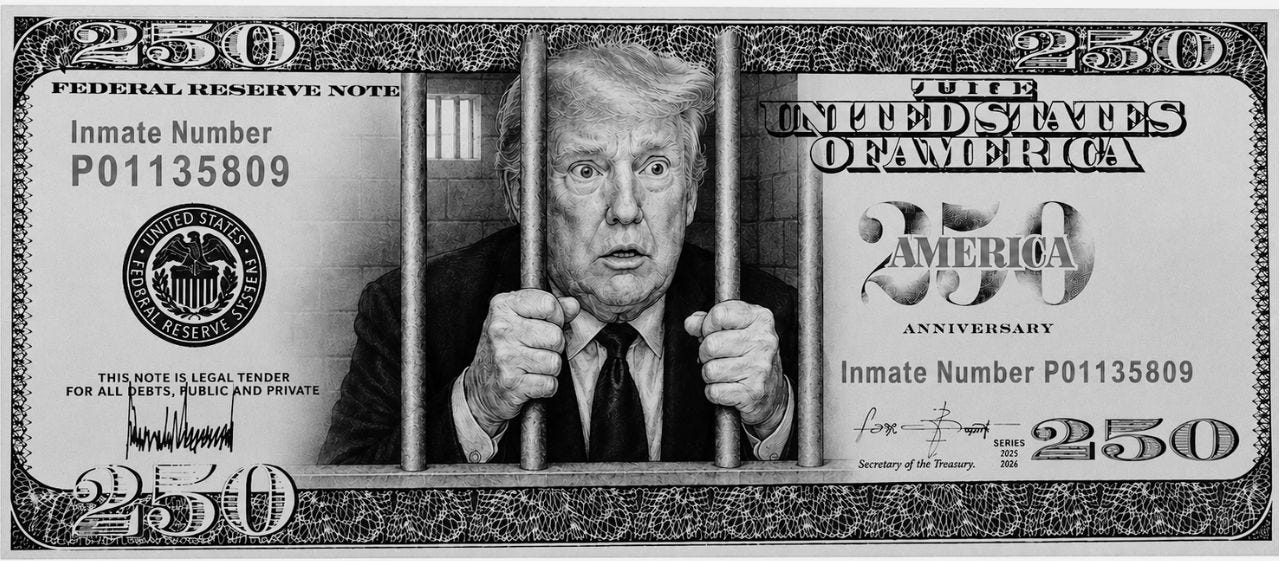
It’s too bad Trump’s $250 bill will never happen, because with his bad economic policies and gas hitting record highs, we’ll all need it just to fill the tank.
Treasury Secretary Scott Bessent stood in the White House briefing room on May 28, 2026, held up a draft design for a $250 bill with Donald Trump’s face on it, and said the part that matters. “It’s all in the hands of Capitol Hill. We will stick to the law.”
That sentence tells you everything. The administration prints designs, preps the engraving office, and applies pressure. The law still says no. Here is where this stands, what the law demands, and why the math makes this a long shot.
The Legal Barrier
Federal law has barred living persons from U.S. currency since 1866. The story starts four years earlier. Treasury Secretary Salmon P. Chase put his own portrait on the $1 bill in 1862. The move drew so much criticism that Congress banned the practice outright in 1866. No living American has appeared on U.S. currency in the 160 years since.
The Current Proposal
Representative Joe Wilson, a South Carolina Republican, introduced the Donald J. Trump $250 Bill Act on February 27, 2025. The bill carries the number H.R. 1761 in the 119th Congress and now lists 15 cosponsors. Wilson built it around the 2026 Semiquincentennial, the nation’s 250th anniversary. It creates a denomination that has never existed in U.S. history, features Trump’s portrait and the phrase “250 AMERICA,” and amends federal law to let former presidents appear on currency.
The Congressional Approval Process
The bill went to the House Financial Services Committee the day Wilson introduced it and has stayed there since, with no formal action recorded. The committee floor is quiet. The lobbying is not. Wilson’s office confirms the congressman has pressed Financial Services Committee Chair French Hill multiple times to move the legislation, and that both Bessent and Trump have told Wilson they support it.
To become law, the bill must clear three gates. Committee approval. A full House floor vote. A Senate floor vote. Then Trump signs it.
Step 1: House Financial Services Committee
The bill sits in the House Financial Services Committee, chaired by French Hill of Arkansas. The committee holds a markup, debates the bill, and votes to advance it. A simple majority moves it to the full House floor. Republicans hold the committee majority, so this gate passes along party lines the moment leadership decides to act.
Step 2: Full House Floor Vote
The House margin runs razor thin. Recent counts put Republicans at 218 seats and Democrats at 215, with one vacant seat as of late April 2026. Those numbers shift with pending special elections, so the exact tally moves week to week. The principle holds. A simple majority of members present and voting passes the bill, and Republicans can spare almost no votes. Two or three defections sink it. Some moderate Republicans in swing districts will balk at putting a living president on currency for the first time in 160 years. That hesitation is a real vulnerability.
Step 3: The Senate, Where It Almost Certainly Dies
This is the decisive obstacle. The Senate requires 60 votes to end debate and advance legislation to a final vote. That number is the filibuster threshold. Once 60 senators vote for cloture, a simple majority carries final passage.
That threshold means Republicans cannot rely on their own senators alone. The chamber breaks down 53 Republicans to 47 Democrats. To pass this bill, Republicans need at least seven Democrats to cross the aisle. Given the symbolism of putting a sitting president on currency for the first time since 1862, seven Democratic defections rank as extremely unlikely. Senator Mark Warner, a senior member of the Banking Committee, has already attacked the proposal.
Could Republicans Eliminate the Filibuster?
In theory, yes. Senate Republicans could change the chamber’s rules by simple majority and declare the filibuster dead. That maneuver carries the nickname “the nuclear option.” In practice, it stays a dead end.
Senate Majority Leader John Thune has stated repeatedly that his support for the legislative filibuster remains unchanged. His leadership team has ruled out going nuclear. James Lankford called it an absolute no. John Cornyn called it a nonstarter. The vote count buries the idea too. Republicans hold 53 seats and could lose only three votes to force the change with all Democrats opposed, and far more than three Republicans have already gone on record against it.
Bottom Line
The bill clears the House. Possible, given the slim margin, never certain. The bill clears the Senate. Highly unlikely. Here is the plain math.
Republicans hold 53 Senate seats. They need 60 votes to break a filibuster. That leaves them hunting seven Democratic votes. No path to those seven votes exists on a bill this charged.
If the bill fails, it expires at the end of the 119th Congress on January 3, 2027.
Can the Administration Do It Without Congress?
No, not lawfully. The 1866 statute controls. Short of a constitutional crisis, the administration has no unilateral path to put Trump’s portrait on a bill. Two narrow workarounds sit on adjacent ground.
The Circulating Collectible Coin Redesign Act of 2020 authorizes the Treasury Secretary to issue $1 coins with designs tied to the Semiquincentennial. Treasury says it is working on a $1 coin featuring the president’s image for the anniversary. Whether that 2020 authority stretches to cover a Trump coin is a legal reading, not settled law, so treat it as analysis rather than a guarantee.
Treasury has also announced that Trump’s signature will appear on paper currency. A signature differs from a portrait and falls outside the living-persons ban, which makes it a separate question from the $250 bill.
The chances of this bill becoming law in the current Congress sit in the single digits. The House math runs tight. The Senate math runs nearly impossible without killing the filibuster. Republican Senate leadership shows no appetite for going nuclear over a currency bill. Absent a dramatic shift in the Senate’s procedural posture, I’m happy to report that Trump’s face on the $250 bill is never going to happen.
Mitch Jackson, Esq.
Some things will never happen, like Trump’s face on a $250 bill, and some things you can count on, like Uncensored Objection showing up in your inbox with the facts and the fine print on every story that matters. Grab the free subscription right now, or step up to premium and get the full investigations, the complete archive, and full access for the people who go all in.
Thanks Mitch. Most commentary this week centers on the "outrageousness" of the proposal. True to form, you give us the fact-anchored analysis. I enjoy your writing.
As a pragmatic addendum let me ask, who in the world would be willing to ACCEPT this bill? On the occasions that I use cash at a store, $100 and $50 bills garner close scrutiny, and often enough even $20's get a swipe with the magic pen. What merchant is going to be comfortable that its cashiers can judge the validity of a large, unfamiliar bill? Accepting a $250 bill for a twenty dollar bottle of wine seems pretty risky. Even Mobsters will inspect every greenback in the suitcase.
"No, not lawfully."
And therein lies the rub. Will the Mango Mussolini destroy the 250 year old democracy we are supposed to be celebrating in order to appease his own childish ego.
He's never felt that laws apply to him so why should this one be any different?
I do know this: I, personally, will never TOUCH that bill if it is created and we will be rejecting at our store as "funny money."