

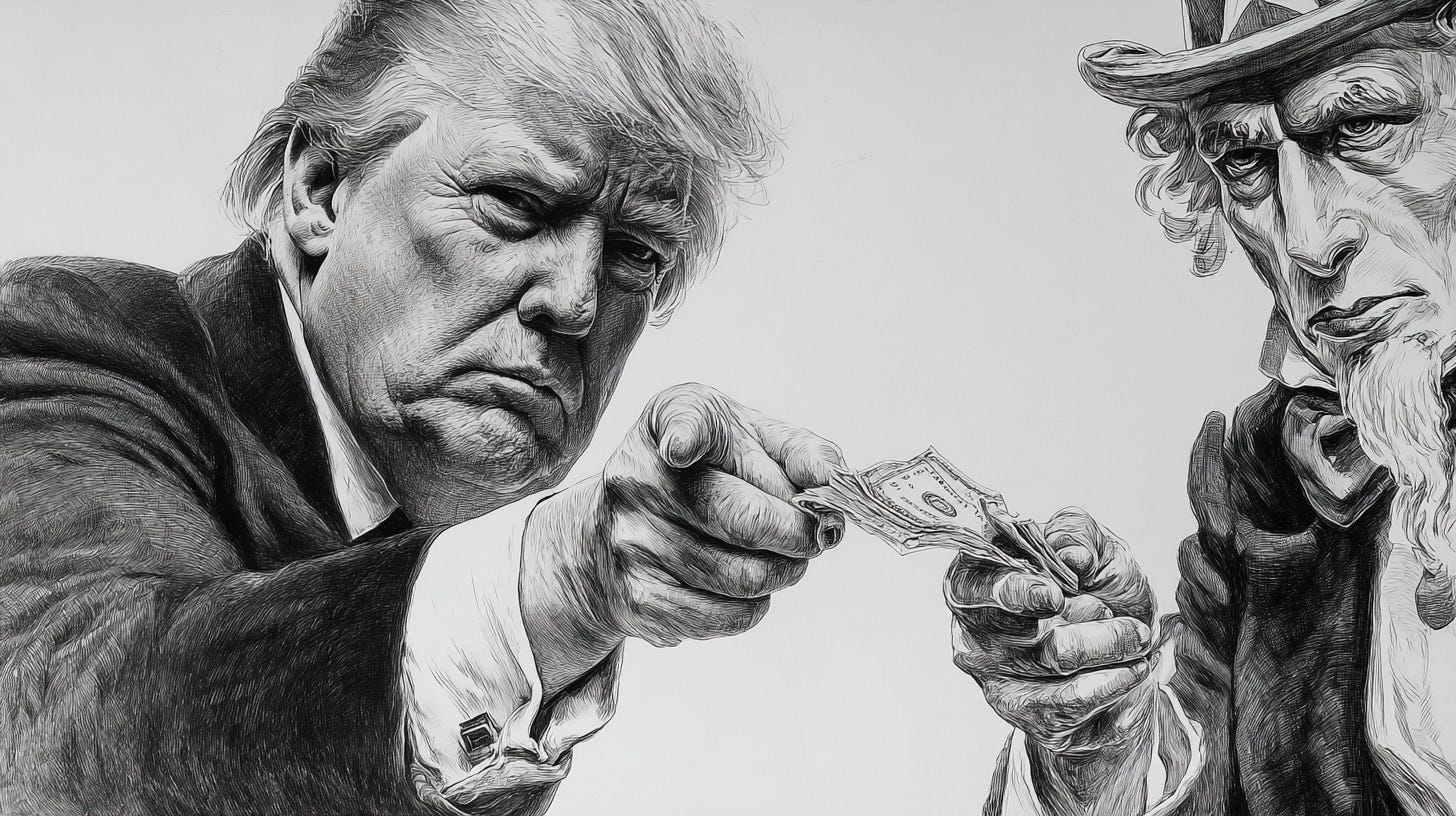
The convicted felon in the Oval Office, found guilty on 34 counts, has submitted claims to the Department of Justice seeking roughly $230 million from U.S. taxpayers.
He filed two separate administrative claims. One claim, lodged in late 2023, seeks damages linked to the investigation into his 2016 presidential campaign’s ties with Russia and the subsequent probe. The other claim, filed in mid-2024, targets the August 2022 FBI search of his Mar-a-Lago estate and the broader classified-documents case against him.
Both claims are baseless. The man asking for the payout is the President of the United States. The government expected to write the check is the one he commands. The people who would sign off on the payment include his own former defense lawyer, now sitting as Deputy Attorney General. Every part of this reeks of corruption and self-dealing.
How The Process Normally Works
When someone believes a federal agency has wronged them, they file Form 95 (a Standard Form) to initiate an administrative claim. The agency examines the claim and may either settle, reject it, or let the person proceed to court. Statistically there is a very high rate of these claims being declined or denied. If the claim is rejected or ignored the claimant may sue in federal court.
The key features of this process: the claimant is separate from the decision-maker; the deciding officials have no personal stake in the outcome; any damage award comes from appropriated funds under public decision-making; the claimant typically cannot also control the process. The purpose is simple: accountability, impartiality, transparency.
Instead…
Here’s what is happening instead: The claimant is the President of the United States. The defendant is his own government. The officials who may approve the payout are his appointees, one of whom is a former lawyer for the President in his criminal trials.
The President says that he will review and approve any agreement. He claimed “I’m the one that makes the decision… it’s awfully strange to make a decision where I’m paying myself.” He filed the claims before he took office again, yet now holds the power to influence their outcome. The system of neutral review has been flipped into a self-review. Taxpayer money would move from the Treasury into the hands of the President via processes controlled by his own team. That is self-dealing.
Trump’s Claims Are Frivolous
The first claim targets the investigation into possible coordination between the 2016 campaign of President Trump and Russia. While the actual criminal proceedings did not end in a conviction of Trump on those coordination or interference issues, the investigation driven by the former special counsel Robert Mueller revealed numerous contacts and suspicious links between his associates and Russian officials, as documented in the Mueller Report and other records.
As noted in Volume II, page 8 of the report:
“If we had confidence after a thorough investigation of the facts that the President clearly did not commit obstruction of justice, we would so state.”
Mueller also reinforced this publicly when he said in his May 29, 2019 statement:
“If we had had confidence that the President clearly did not commit a crime, we would have said so.”
These words were Mueller’s careful but unmistakable message: his team found substantial evidence of obstruction, but he deferred judgment to Congress and future prosecutors rather than declaring the President criminally responsible while in office.
The second claim centers on the search of the former president’s Florida residence at Mar‑a‑Lago in August 2022 that was authorized by a federal warrant. The warrant was approved by a magistrate judge and executed by the Federal Bureau of Investigation while investigating the alleged improper retention of classified government documents. The property receipt and affidavit show that the search uncovered government records marked “TOP SECRET” and “SECRET” among other classification levels.
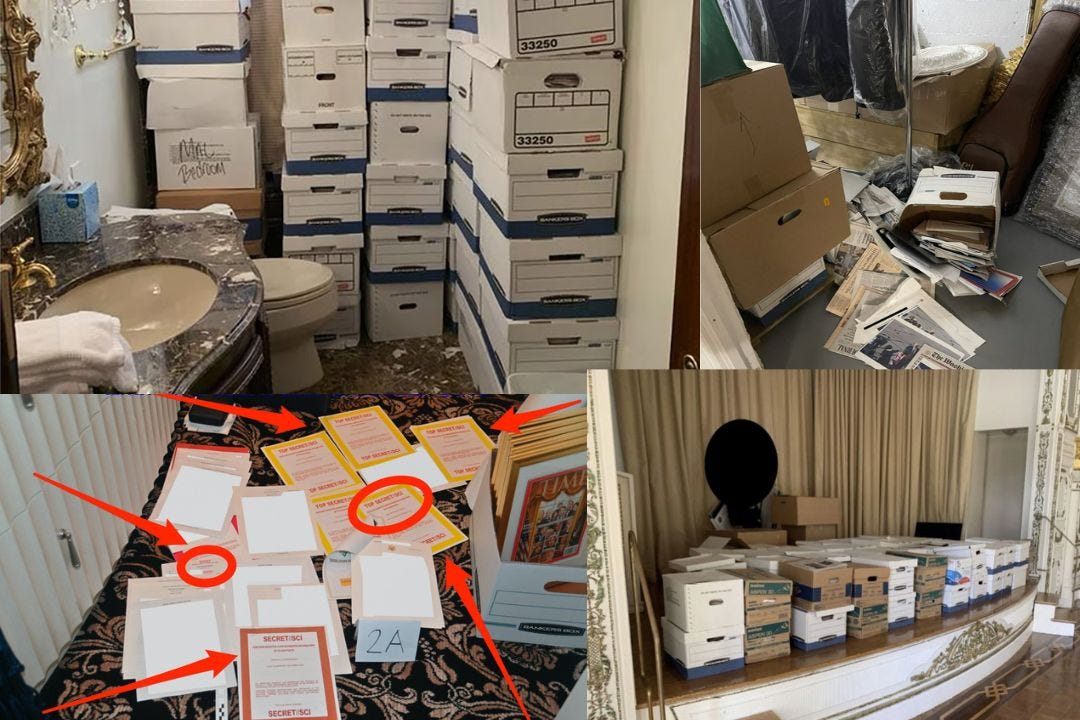
The case resulted in a federal indictment of Trump in June 2023 on counts regarding the retention of national defense information and obstruction of justice; the government set out the factual basis for pursuing those charges. The claim now filed by Trump frames these investigations as violations of his constitutional rights and asks for compensation on that basis.
Both of these claims paint a victim narrative ignoring that Trump was the subject of investigations (about important things he was probably guilty of), not a neutral party. Then Trump turns around and asks for a payout exactly from the body he challenged. The request assumes wrongdoing on the part of the investigators, yet those investigators were performing legally authorized functions. That makes the claim frivolous from a legal standpoint.
A Few Other Concerns
First: The investigations did not result in a conviction of Trump. He was indicted in the classified-documents case and in the special-counsel Russian-ties investigation, but he never went to prison because the prosecutions were placed on hold after he was reelected. Investigations and indictments do not equal legally compensable wrongful conduct under the law.
To win a settlement or later lawsuit a claimant must show actual error, causation and quantifiable harm. Trump’s claim says the investigations themselves caused him damage. That argument is weak. Federal law gives very narrow paths for paying someone damages for wrongful governmental action. The President is not a private citizen in this regard.
Secondly: There is no independent decision-maker. The Deputy Attorney General, Todd Blanche (also the guy who defended Trump on his 34-felony convictions and also the guy who met with convicted child set trafficker, Ghislaine Maxwell), must sign off on any settlement above $4 million. And let’s not kid ourselves. That’s a done deal after Todd gives the matter about 3 seconds of thought.
Other senior officials, like the head of the civil division, represented Trump’s aides in the very cases at issue. That means the people who argued for Trump are now deciding whether his government pays him. That undermines the integrity of the entire process.
Third: The structure risks violating constitutional restrictions. If a President receives payments from the government outside his salary then constitutional issues like the emoluments clauses arise. Legal experts warn that a payoff from the government to the President for claims he initiated risks being a direct violation.
The Conflict of Interest is Suffocating
Imagine you’re caught on video robbing a bank. The evidence is clear, and the police launch an investigation. Then you run for mayor, somehow win, and suddenly you’re in charge of the same city whose police department investigated you. You appoint your old defense lawyer to oversee city finances, and then you demand that taxpayers pay you $230 million for the “damage” done to your reputation.
That’s what this situation looks like. The person accused of wrongdoing is now sitting in the big chair, signing off on his own payday, and using public money to do it.
The President demands a settlement against the Justice Department. The Justice Department officers reviewing the settlement were his lawyers. Approving a bullsh*t payment to the President means taxpayer money flows outward at his discretion. That creates a direct clash between public duty and personal interest. The standard safeguards of recusal, independent review, and public transparency are either absent or ignored.
What This Means For Our Democracy
This is not a technical dispute about legal forms. This is a raw challenge to the idea that no person, even the President, is above the law and the process. It sends a message that power allows you to convert investigatory scrutiny into taxpayer compensation. It signals that justice is negotiable and the system is pliable if you hold the reins.
For you, the everyday American voter, this should alarm you because you expect the law to apply evenly not be reshaped for one individual. You expect public money to be spent with oversight not routed through a personal funnel. Our democracy depends on checks and balances not the consolidation of self-authorizing power.
What You Should Do
Stay awake. Ask your Representatives to demand full transparency. Demand that any claim filing, review, recusal documentation, payment decision be made public. Push for an independent special counsel or inspector general to review this matter. Talk to friends, family, colleagues. Use your voice so this does not drift into silence. If this proceeds unchecked you and your children will inherit a government that sees public money as personal.
Let’s be clear: Trump’s demand is reckless, improper and destructive. He is asking his government to pay him for investigations that targeted him when he was subject to law enforcement. He is using his office to benefit himself. The process is broken. The precedent is dangerous. The time to act is now.
You matter. Your voice matters. Speak out. Share this article. Comment. Demand accountability.
Mitch Jackson, Esq. (on LinkedIn)
Subscribe (free and premium)
When a sitting president tries to turn justice into his personal ATM, every American deserves to know. Stories that expose abuse of power and demand accountability belong to the people, not behind a closed door.
If honest reporting about corruption and self-dealing matters to you, subscribe for free and help more readers see it. If you can support this work with a paid subscription, that support keeps it independent and fearless. Either way, the truth stays free. Because democracy depends on all of us seeing what power wants to hide.

It’s difficult to watch the events unfolding around Trump’s demand for $230 million from the Justice Department without feeling a profound sense of alarm. The very idea that a sitting president could direct his own government to financially compensate him for past investigations—reviewed by officials who once served as his defense attorneys—strikes at the heart of impartial governance and legal integrity.
America’s credibility in the eyes of the world rests not on wealth or might, but on integrity—on the idea that no one, not even the president, is above the law. To see that principle threatened so openly is to witness a slow dismantling of common sense, institutional integrity, and the respect that once defined the American example.
I see this as just another nail in the coffin of what used to be one of the greatest countries in the world. Trump's promise to "Make America Great Again" is clearly a long forgotten idea.