

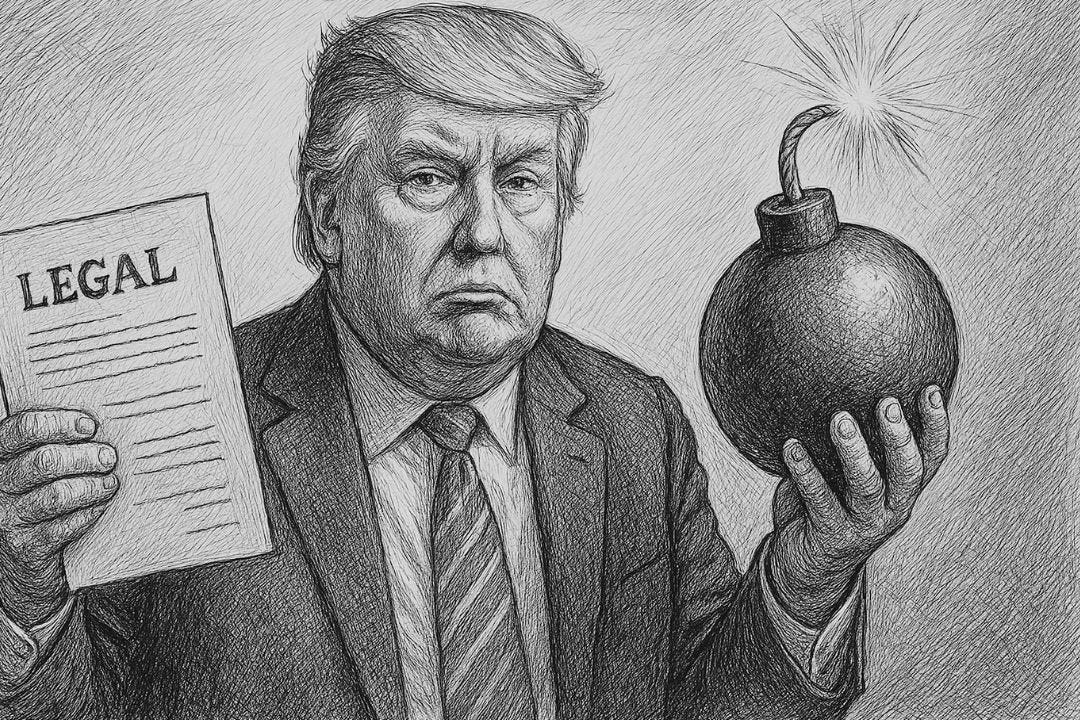
This isn’t a lawsuit, it’s a headline heist to stall for time while he quietly expands his crypto grift and locks down more power behind the scenes.
Executive Summary
Donald Trump’s latest legal stunt is not a serious case. It is a loud distraction. He filed a $15 billion defamation lawsuit against The New York Times, four of its reporters, and Penguin Random House.
Nothing in the lawsuit points to new facts, new issues or newly uncovered evidence. Instead it takes the same stories that have already been litigated in public debate and earlier lawsuits and tries to dress them up as a new $15 billion claim. This pattern, waiting, then suing over well-known reporting from the past, fits with his long history of using lawsuits to punish critics and keep old controversies alive as political weapons rather than responding to any new factual development.
As you’ll see in this post, the real purpose behind this garbage lawsuit is not justice. It is another attempt to pull your attention away from his crypto money schemes, his relentless power grab, and his failure to release the full Epstein files that his own administration keeps buried. This lawsuit is designed to confuse, delay, and dominate the news cycle while he keeps working behind the scenes to tighten his grip on power.
What Trump Claims
Trump filed his case in the U.S. District Court for the Middle District of Florida. He demands at least $15 billion in damages. He says a series of Times articles and a related book called Lucky Loser were written with actual malice to hurt his reputation, wreck his business, and damage his 2024 campaign. You can read the lawsuit here.
He points to a Times editorial that endorsed Kamala Harris, an article adapted from Lucky Loser about how producers of The Apprentice boosted his fame, an October 2024 article by Peter Baker listing accusations of wrongdoing, and another October 2024 piece by Michael Schmidt quoting former Chief of Staff John Kelly. Kelly warned that Trump might rule like a dictator and confirmed reports that Trump called fallen soldiers suckers and losers. Trump claims these stories were timed to cause maximum harm to his reelection effort and cost him enormous sums of money.
The Lawsuit Has No Merit
In General
This lawsuit is a recycling of old attacks on the press dressed up with a new dollar sign. Trump is a public figure and a sitting president. To win, he must prove that the reporters knowingly lied or recklessly ignored the truth. That is a legal wall built to protect free speech and political reporting. The statements he complains about are drawn from documented sources, direct quotes, or opinion pieces like the Times endorsement.
Courts have already thrown out similar suits he brought against the Times and other outlets. He lost those cases because opinion, fair comment, and accurate reporting are protected speech. He also owes legal fees from earlier failed cases.
The complaint is full of broad claims about economic harm and personal insult but short on provable false statements. It waves around a giant damage figure without showing a clear link between the reporting and any real financial loss.
It attacks timing as if election season coverage is evidence of malice. It treats criticism and commentary as defamation. These are the hallmarks of a lawsuit meant to scare journalists and rally supporters, not to win in a courtroom.
Specifically (through the eyes of a trial lawyer)
High Legal Bar: First let’s start with this: Truth is a defense. Furthermore, as a public figure and presidential candidate, Trump must prove the defendants published false statements and did so with “actual malice”—knowledge of falsity or reckless disregard for the truth. This is a demanding standard designed to protect robust political reporting. The complaint lacks this critical element.
Opinion and Fair-Report Protections: Much of the challenged content involves quotations, documented sources, or opinion (e.g., editorials, characterizations of his business history). Such material is typically shielded by the First Amendment. I believe it’s because of the sourcing, most or all of the complaint will eventually be dismissed and Trump and his lawyers sanctioned.
Prior Failures: Trump has repeatedly lost similar defamation suits against The Times and other outlets, suggesting this case faces significant hurdles. History leaves clues. This history and clues are going to slap Trump and his attorneys upside the head.
This lawsuit is another salvo in Trump’s long-running conflict with the press. While it seeks massive damages and highlights alleged economic harm, the combination of constitutional protections, prior court rulings, and the public-figure standard make a successful outcome for Trump legally improbable.
Here’s What The Public Needs to Know
Legal Standards for Defamation by a Public Figure
To succeed, Donald Trump, as a public figure, must satisfy:
False statement of fact- the defendant must have made a statement that is false (or that is purported as fact and is untrue).
Published to a third party- the statement was published or broadcast.
Defamatory meaning- the statement must harm reputation.
Fault by the defendant- for public figures, the standard is actual malice (i.e. knowing falsity or reckless disregard for truth).
Damages- actual harm to reputation, business, or similar (though some statements can qualify for presumed damages under certain circumstances).
Key Weaknesses / Issues in the Complaint
Based on what’s reported, here are several features that shows the complaint has serious weak points, which are the sort of things courts typically pick apart in early motions (e.g., motions to dismiss, summary judgment):
Actual Malice Is Hard to Prove
Public figure defamation law (from New York Times Co. v. Sullivan and its progeny) requires showing defendants either knew statements were false or acted with reckless disregard. That is a high bar.
Many allegations seem to be based on interpretation, opinion, or controversies (e.g. whether certain anecdotes are accurate or whether certain characterizations are fair). Courts often shield opinion and non-verifiable statements.
Vague or General Accusations
The complaint uses sweeping language such as “pattern of falsehoods,” “baseless hatred,” “deranged” editorial endorsement, etc. These tend to be opinion, rhetoric, hyperbole, which are often nonactionable.
If specific defamatory factual errors are not clearly identified with reference to why they are false, that makes proof more difficult. My review of the complaint tells me it is “short on any allegations of specific false statements of fact” meeting the standard.
Timing and Political Context
The complaint asserts timing (election season publications) intended to inflict electoral damage. That is relevant to motive, but proving timing was motivated by malice rather than editorial or political judgment is challenging, especially protected speech about political figures.
Despite what Attorney General Pam Bondi said last week, criticism of political figures is heavily protected under First Amendment jurisprudence. Editorial endorsements, commentary, warnings, etc., are almost always treated as free speech, unless there is a clear, provable false statement of fact.
Opinion, Editorial, and Fairly Held Disputes
Much of what is challenged is focused on commentary, or statements of warning (e.g. “may rule like a dictator,” “suckers” and “losers” quote), or books that include interpretations or critiques. Unless there is a provably false attribution, opinion or editorial content is protected.
Also, many alleged statements are disputed in the public record, for example, whether Trump said certain things (e.g. “losers,” “suckers”), such disputes are common in media reporting, and courts often require very specific proof (e.g. testimony, recordings).
Damages and Causation
Trump claims “enormous economic losses” and harm to business/brand value. To survive a motion to dismiss or summary judgment, he must show a causal connection between the allegedly defamatory statements and economic harm. Otherwise the claim may fail (or damages be significantly reduced).
Also, $15 billion is extremely large; such claims are often viewed skeptically unless backed by strong, specific damages evidence.
Prior Similar Lawsuits and Dismissals
As I mentioned earlier, Trump has brought similar suits before against The New York Times and other outlets, which have been dismissed. Courts often consider precedent: what was rejected before may indicate what arguments are likely to fail again.
The Bigger Play
Trump’s real strategy is to dominate headlines and drain his opponents’ resources. Every time he sues a reporter or a publisher he sends a warning to anyone who dares to expose his deals, his authoritarian moves, or his shady finances.
He wants the press to hesitate before publishing hard truths. He wants you to think the facts are up for debate. Meanwhile his crypto ventures continue to raise red flags (see yesterday’s New York Times article?), his administration keeps ducking accountability on the Epstein files, and his policies push America deeper into division and economic danger. He uses lawsuits like smoke bombs to keep you from focusing on what really matters.
How You Can Help
You deserve the truth without intimidation. This lawsuit is not about protecting reputation. It is about controlling the conversation.
Trump wants to keep you distracted while he chips away at democratic safeguards and hides the financial games he plays with foreign allies and secret donors. Do not let a flashy complaint and a giant dollar figure fool you.
Watch the pattern. Call it out. Demand transparency on the crypto deals. Demand the release of the Epstein files. Demand a government that answers to the people instead of bullying the press.
Your voice and actions today, and your vote next year in the 2026 midterms, are the antidotes to this pathetic and dangerous circus.
Mitch Jackson, Esq. | links
While Trump throws smoke bombs to distract and divide, Uncensored Objection cuts through the haze. Subscribe today for clear, unfiltered reporting and analysis that exposes the power plays he and others want you to miss.

BREAKING: Federal Judge Steven Merryday just told Trump and his lawyers they're out of their league. He tossed Trump’s latest lawsuit in the trash. In a blistering order, the Bush-appointed judge said the filing read more like a campaign speech than a serious legal complaint. Trump has 28 days to try again, this time with a strict 40-page limit. Translation: stop grandstanding and start following the law.