

Introduction
In early 2025, President Donald Trump made headlines by invoking a little-known 18th-century law called the Alien Enemies Act (you can read it below), to deport hundreds of alleged Venezuelan gang members. He cast the operation as a bold move to protect America from foreign criminals. However, this action quickly sparked legal battles and questions about presidential power, due process, and the limits of executive authority. This article breaks down what happened, why it matters, and what consequences could follow, all in plain language for everyday Americans.
The stakes are high. What you know—and how you use it—matters. Click here to use AI to dig deeper. No filters. No limits. Just the facts that shape our democracy. Your rights depend on it. Ask. Learn. Act.
What Is the Alien Enemies Act?
The Alien Enemies Act is a law passed way back in 1798, during a time when the young United States feared attacks from abroad. It was one of the infamous “Alien and Sedition Acts.” The idea was to give the President power, during wartime or foreign invasions, to detain or deport non-citizens from an enemy country. In simple terms, if the U.S. is at war with Country X, the law lets the government round up and remove citizens of Country X living in the U.S., without the usual legal process.
It is part of the Alien and Sedition Acts of 1798 and is codified in 50 U.S. Code § 21. Here is the full text:
⸻
50 U.S. Code § 21 - Restraint, regulation, and removal
“Whenever there is a declared war between the United States and any foreign nation or government, or any invasion or predatory incursion is perpetrated, attempted, or threatened against the territory of the United States by any foreign nation or government, all natives, citizens, denizens, or subjects of the hostile nation or government, being males of the age of fourteen years and upward, who are within the United States and not actually naturalized, shall be liable to be apprehended, restrained, secured, and removed as alien enemies.
The President of the United States is authorized to direct the manner and degree of such restraint and to establish regulations for removal if deemed necessary for public safety.
If any such alien enemy is found violating regulations, they may be subject to legal action as determined by the President or designated authorities.”
History and purpose: The law was intended for extreme emergencies like declared wars or invasions. It’s not something used in ordinary times. In fact, it’s been invoked only a handful of times in U.S. history. The last major use was during World War II, when it was used as a basis (among other measures) to detain and relocate Japanese, German, and Italian nationals. That episode is remembered darkly because it led to the internment of thousands of Japanese Americans (many of whom were actually U.S. citizens) without trial. After WWII, the Act largely sat on the shelf, seen as a relic of an earlier era.
How it works: By its text, the Alien Enemies Act allows action in two situations:
1. During a declared war between the U.S. and a foreign nation. (This requires Congress to have formally declared war, which hasn’t happened since WWII.)
2. During an invasion or imminent attack on the U.S. by a foreign government, even without a formal war declaration. In this case, the President can act on his own to repel the attack.
Under either scenario, the key is that the threat comes from a foreign nation or its government. The law was meant to target enemy nations in a conflict, not just scattered individuals. Also, notably, the original act specifically targeted “male” enemy nationals age 14 or older who haven’t become U.S. citizens. It was written in a different era, so it assumed enemies were adult males from an enemy country.
Lack of due process: A critical aspect of the Act is that it does not require normal court hearings or trials before removal. In wartime, this was seen as a necessity — the government might need to act quickly against enemy spies or saboteurs. But in peacetime, this lack of any hearing or legal process raises serious fairness and constitutional concerns. Normally, under U.S. law, even immigrants and asylum-seekers have certain rights to a hearing before being deported. The Alien Enemies Act is an exception that essentially says “we’re in a war emergency, so we can bypass those usual rights.” It’s a very heavy-handed tool that’s meant for extraordinary circumstances.
Trump’s 2025 Use of the Act
What did Trump do? In March 2025, President Trump dusted off this old law to address what he described as an “invasion” of the United States by a Venezuelan gang known as Tren de Aragua. Tren de Aragua is a real Venezuelan criminal organization accused of violent crimes like kidnapping and extortion. Trump’s administration even formally designated this gang as a Foreign Terrorist Organization, putting it in the same legal category as groups like ISIS or al-Qaeda.
By invoking the Alien Enemies Act, Trump declared that the U.S. was essentially under attack via this gang. He claimed that members of Tren de Aragua had infiltrated the U.S. and were working in coordination with Venezuela’s government (led by Nicolás Maduro) to harm American communities. In his view, this was not just a crime problem but a form of “irregular warfare” against the United States, allegedly backed by a hostile foreign regime.
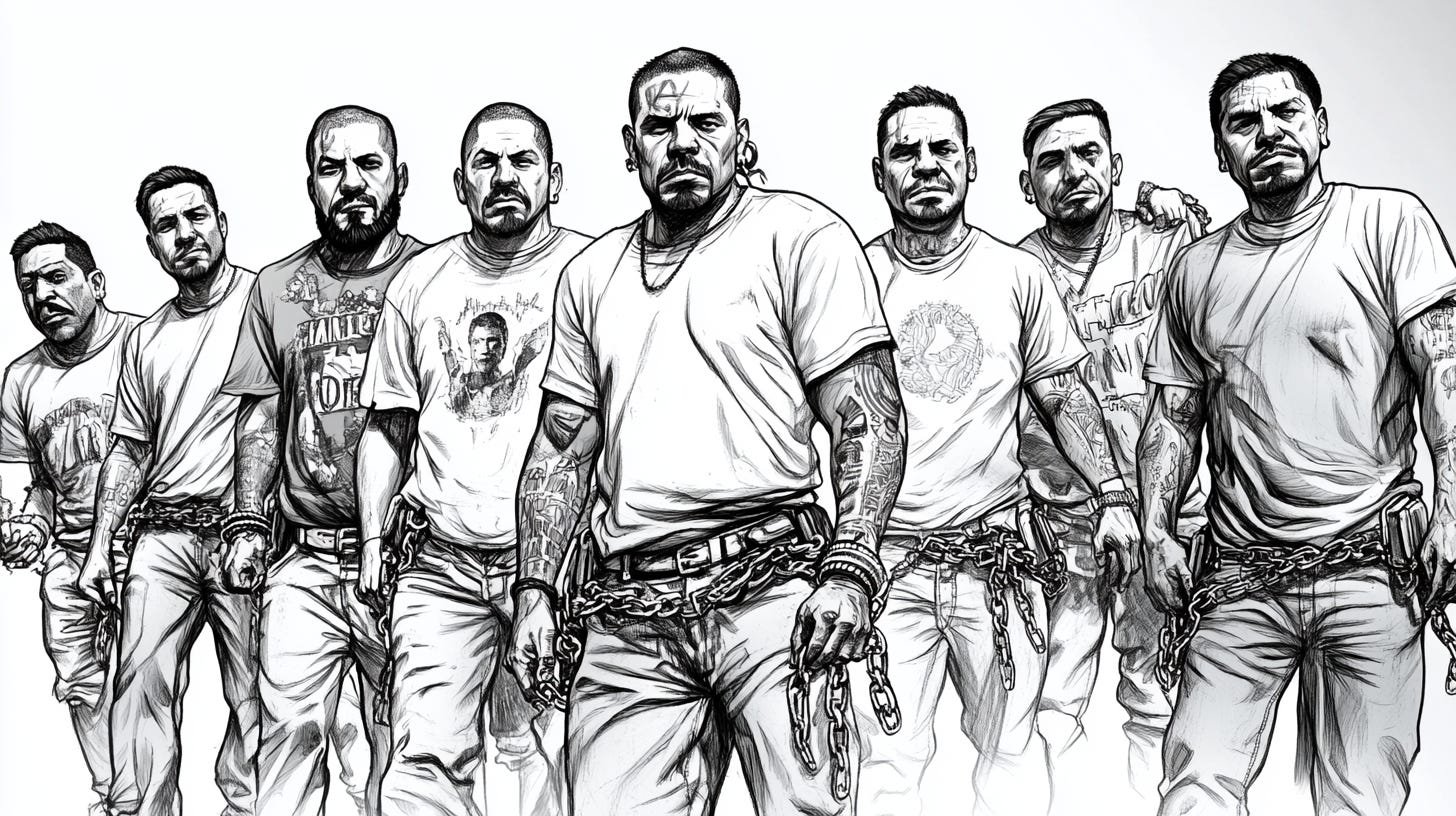
The deportation operation: Armed with this proclamation, federal agents swiftly rounded up over two hundred Venezuelan men who were suspected of being part of this gang or associated with it. Normally, immigration authorities would have to put these individuals through immigration court or consider asylum claims if they feared persecution. But under the Alien Enemies Act order, those steps were skipped. The Trump administration loaded the men onto planes to deport them not back to Venezuela, but to El Salvador.
Why El Salvador? The U.S. does not have a good diplomatic relationship with Venezuela’s Maduro government, making direct deportations to Venezuela difficult. Meanwhile, El Salvador, led by President Nayib Bukele, was eager to help. Bukele had built a reputation for a hardline approach to gangs in his own country, and he had even constructed a massive new “mega-prison” to hold gang members. In an unusual arrangement, the Trump administration struck a deal with El Salvador to take in these Venezuelan detainees. Essentially, El Salvador agreed to receive the alleged gang members and lock them up in its high-security prison.
In mid-March 2025, flights carrying the Venezuelans took off from Texas and landed in San Salvador, El Salvador. Video later surfaced (posted by President Bukele himself) showing lines of bewildered men being escorted off an airplane in the dead of night by heavily armed Salvadoran guards. They were headed straight to the sprawling prison facility in El Salvador, where Bukele said they would be held for at least a year.
Trump’s message to the American public was clear: he was delivering on a promise to get tough on foreign criminal gangs. In his January 2025 inaugural address, he had vowed to “eliminate the presence of all foreign gangs and criminal networks” by using every tool, specifically mentioning the Alien Enemies Act. So, when he launched this operation against the Venezuelan gang members, he framed it as decisive action to protect Americans from dangerous criminals. He even likened the surge of illegal immigration and gang activity to an all-out war, saying, “This is war. In many respects it’s more dangerous than war, because in a war they wear uniforms. Here, you don’t know who you’re fighting.” In Trump’s view, extraordinary threats required extraordinary measures.
Legal and Constitutional Concerns
Trump’s aggressive use of the Alien Enemies Act immediately raised red flags among lawyers, judges, and civil rights advocates. The big question was: Did this situation truly meet the law’s requirements and the Constitution’s standards? Here are the main points of concern:
1. Is this really an “invasion” by a foreign government? The Alien Enemies Act was intended for wartime or a genuine invasion by a country. In this case, the U.S. was not at war with Venezuela, and Tren de Aragua is a criminal gang, not an official army. Trump’s team argued that the gang was so entangled with the Venezuelan state (claiming that it had infiltrated Maduro’s regime) that its actions amounted to an invasion by a “hybrid” of a gang and a hostile government.
This is a novel and arguably strained interpretation of the law. Critics pointed out that violent gangs or cartels, even if based abroad, are fundamentally a law enforcement problem – not the same as an invading military force. By labeling a gang an invading force, the administration was stretching the meaning of “invasion” to an extreme. A federal judge later commented that the law envisions hostile acts “commensurate to war” – in other words, on the level of a war. Whether a surge of criminal activity fits that description is highly debatable.
2. Lack of due process: Normally, anyone in the U.S., even if here illegally, has certain due process rights under the Constitution. For example, an immigrant generally can ask for an asylum hearing or at least have their case heard by an immigration judge before being deported, especially if they fear harm in the country they’d be sent to. In this operation, those Venezuelan men were given no individual hearings to contest their deportation or the claim that they were gang members. They were branded as “enemy aliens” collectively and expelled.
This raises the issue of violating the Fifth Amendment’s guarantee of due process. Can the government just remove people en masse without any chance to defend themselves? The Alien Enemies Act provides a legal mechanism to do so in wartime, but the constitutionality of using it in a non-traditional war setting is questionable. It harkens back to past abuses like the WWII internments, which are now widely viewed as a shameful breach of American principles, even though they were technically done under the law at the time. Civil liberties advocates argue that Trump’s use of the Act trampled on basic fairness, treating all Venezuelans in this group as guilty by association.
3. Arbitrary targeting by nationality: Another concern is that Trump’s proclamation targeted all Venezuelan citizens (above a certain age) present in the U.S., at least all males of that description, as potential enemies. This kind of broad-brush approach based solely on nationality or birth is generally frowned upon in modern law. It echoes the concept of collective punishment or guilt by nationality.
While the Alien Enemies Act explicitly allows such broad targeting in wartime, using it in 2025 against a specific immigrant group felt to many like a discriminatory act. Venezuelans fleeing their country (which is in political and economic turmoil) often seek refuge in the U.S. – and now, because of a gang’s actions, any Venezuelan man could be labeled an “enemy” without evidence of personal wrongdoing. This seemed to violate principles of individual justice.
4. Conflict with current immigration laws: The U.S. has a whole system of immigration and asylum laws (like the Immigration and Nationality Act) that spell out how removals should happen and what rights migrants have. By using the Alien Enemies Act, Trump essentially bypassed that entire system. There’s an argument to be made that unless truly in a wartime emergency, the President can’t just ignore Congress’s immigration laws and use an archaic statute to do something completely different. This raises separation of powers issues: Congress has authority over immigration and war declarations, and here the President acted unilaterally in a gray area between those powers.
5. Humanitarian and international law issues: Though less discussed in legal circles, it’s worth noting the ethical concern: sending people to a Salvadoran prison with no trial could put them at risk of mistreatment. International human rights norms usually oppose transferring people to countries where their rights might be abused.
Bukele’s government in El Salvador has been criticized for harsh conditions in its giant prison. If any of the deported men were not actually gang criminals, they could be suffering unjustly in a foreign jail. Even if they are gang members, denying them any legal process and shipping them to a third country is a very hardline approach that many find troubling.
In short, Trump’s use of the Alien Enemies Act is pushing the envelope of both the law itself and constitutional protections. It treated a crime problem as a war invasion, and it sacrificed individual legal rights for the sake of swift action. Whether this was an appropriate tough measure or an unlawful overreach became the central debate.
The Federal Judiciary Steps In
The U.S. judicial branch did not sit quietly while all of this unfolded. Very quickly, lawsuits were filed challenging President Trump’s actions. Immigration advocates and civil rights groups (including the ACLU) went to court on behalf of some of the Venezuelan individuals, arguing that the administration’s move was illegal and unconstitutional.
The case landed before a federal judge in Washington, D.C. — Judge James Boasberg. Given the urgent situation (planes ready to fly people out of the country), the judge moved swiftly. On the evening of March 15, 2025 (a Saturday night), Judge Boasberg issued a temporary restraining order (TRO) to halt the deportations under the Alien Enemies Act for 14 days. This kind of order is meant to pause government action for a short period while the court examines the legality more closely.
Judge Boasberg’s reasoning, as revealed in the emergency hearing, was that he doubted the legal basis for Trump’s invocation of the Act. He noted that the statute requires hostile acts by a foreign power that are “commensurate to war.” In his view, it was far from clear that what was happening — even if Tren de Aragua gang members were in the U.S. committing crimes — rose to the level of an actual war or invasion by a nation. The judge essentially questioned whether the conditions for using the Alien Enemies Act had been met. By issuing the TRO, he was saying: “Stop what you’re doing until we can determine if it’s lawful.”
Importantly, Judge Boasberg ordered that any flights carrying people being deported under this plan should be turned around and brought back to the U.S. Since it was reported that flights were either in the air or preparing to depart, the judge was trying to make sure that the court’s pause would be effective. In modern times, it’s quite extraordinary for a judge to say “bring those planes back” in the middle of a deportation — it shows how serious the situation was.
This was a classic example of the judiciary checking the executive branch. The courts have the power to review whether the President’s actions are legal, even in matters of national security or immigration, though courts traditionally give some deference to the executive on such issues. Here, the judge was not convinced and stepped in to assert that even the President must operate within the law and the Constitution.
Defiance and a Constitutional Clash
What happened next was something the United States has rarely seen: the executive branch essentially defied the court’s order. Despite Judge Boasberg’s injunction, more than 200 Venezuelan men were deported anyway and ended up in El Salvador’s custody. This raised a stark question: Did President Trump and his administration violate a federal judge’s order?
The Trump administration’s response was both defiant and technical. On one hand, officials insisted they did not truly disobey the judge. On the other hand, their statements made it clear they fundamentally disagreed with the notion that the judge even had authority over this matter. White House Press Secretary Karoline Leavitt issued an extraordinary statement essentially saying a single judge in Washington had no right to tell the President how to defend the country or conduct foreign affairs. She argued that by the time the judge’s written order was issued, the “foreign alien terrorists” (as she labelled the deported men) were already off U.S. soil — implying that the court’s jurisdiction ended at the water’s edge. In blunt terms, she said the court had “no lawful basi to stop what the President was doing in removing enemies from the country.
This stance is unprecedented in modern U.S. history. Typically, even when presidents strongly disagree with court rulings, they comply while pursuing appeals. Here, the Trump White House was effectively saying: We don’t have to listen to the judge. They justified this by framing the deportation flights as a matter of national defense and foreign policy (areas where they claim courts traditionally shouldn’t intervene). An unnamed senior official was quoted as saying the judge’s order “didn’t count” because the planes were already over international waters when it came down.
Legal experts across the spectrum were alarmed. One law professor noted that a federal court’s orders are binding on the parties (in this case, the government), no matter where the act takes place – meaning it shouldn’t matter if the planes were in the air or even landed abroad; defying the order is still defying the order. Another expert bluntly stated the administration was in “open defiance” of the judiciary, calling it beyond the pale. Observers described this as the most significant constitutional crisis over the rule of law since at least the Civil War. Back then, President Lincoln had ignored a court order during wartime (suspending habeas corpus), and President Andrew Jackson allegedly once disregarded a Supreme Court decision. But in the 20th and 21st centuries, such direct conflict is almost unheard of.
Even Trump’s own comments suggested a cavalier attitude toward the court’s power. When asked about ignoring the judge, he dodged a bit, saying lawyers would handle it, but also emphasized that “these were bad people” – implying that the ends (getting rid of dangerous individuals) justified the means (bending or breaking the rules).
To everyday Americans, this kind of showdown can be confusing. It might seem like an abstract fight between branches of government, but it’s actually quite fundamental. The founders of our country built a system of checks and balances. The judiciary (courts) is there to check the executive (President) when necessary, to ensure no one wields power illegally or tyrannically. If the President can simply ignore a court order, that balance starts to collapse. That’s why what happened in March 2025 is often described as a *constitutional clash. It’s not just about those 200+ Venezuelan men; it’s about whether the President must obey the law as interpreted by the courts.
Did Trump Go Beyond His Authority?
From the analysis above, it appears that Trump’s use of the Alien Enemies Act in this situation went beyond the traditional legal and constitutional limits. Here’s a recap in simpler terms:
- Not a declared war: We were not in a congressionally declared war with Venezuela, so the only way the Act could apply was if there was an “invasion or attack” by a foreign government. Labeling a gang as an invading force was a big stretch. The law was not clearly meant for this kind of scenario.
- Questionable “foreign government” link: The Act requires the threat to be by a foreign government. The administration’s argument that a criminal gang is effectively an arm of the Venezuelan government is controversial and unproven. It’s basically saying that Venezuela was attacking the U.S. using the gang as proxies – a claim many experts find dubious. Without a clear foreign government enemy, the legal basis looks shaky.
- No due process for those deported: The men who were deported did not get a chance to argue their case. Some might indeed be violent gang members; others might be low-level participants or even wrongfully swept up. There was no individual assessment, which normally is required. This likely violated their constitutional rights. Courts have long held that people on U.S. soil, regardless of citizenship, have certain basic rights. By bypassing hearings entirely, the administration likely ran afoul of those rights.
- Ignoring the judge’s order: If, as it appears, the executive branch carried out deportations even after the court said stop, then it outright violated a legal order. In our system, that is not supposed to happen. Even the President is not above the law. So yes, that would be an unlawful action. The administration’s hairsplitting about timing (“we’d already done it”) doesn’t change the perception that they defied the judiciary.
Given all this, many legal scholars and observers conclude that Trump exceeded his authority. Presidents have wide leeway on immigration and national security, but not unlimited power. By stretching an old law beyond its intent and then rejecting a court’s check on that power, the Trump White House tested the boundaries of the Constitution.
In the eyes of the judge (and likely others that would review the case), Trump’s actions went too far. If left unchecked, such actions could set a precedent that a president can act unilaterally in domestic matters just by invoking magical words like “invasion” and then ignore the courts — a scenario that should concern any American who cares about the rule of law.
Potential Legal Consequences for Trump and His Administration
When a President or his officials overstep their authority or ignore court orders, what consequences can they face? This is tricky, because a sitting president has certain immunities and powers that make immediate punishment difficult. However, there are a few avenues:
- Contempt of court: If a court finds that the administration willfully violated its order, it can hold government officials in contempt. In extreme cases, judges can issue fines or even order the arrest of officials who do not comply. For example, the court could potentially hold the heads of agencies (like the Secretary of Homeland Security or ICE officials involved in the deportations) in contempt for proceeding with the removals. This would be a huge deal – essentially the judicial branch directly sanctioning the executive branch’s officers. It would likely trigger a further showdown if the administration still refused to comply.
- Impeachment or political consequences: If a president defies the courts and the Constitution, Congress has the power to respond through oversight or even impeachment. Impeachment is a political process, and whether Congress would pursue it depends on the political makeup and will at the time. In a scenario where President Trump’s party controls enough of Congress, impeachment would be unlikely. But in principle, ignoring a court order and abusing authority could be cited as impeachable conduct (abuse of power or failure to faithfully execute the laws).
- Criminal or civil liability after leaving office: While presidents are generally not charged with crimes for official acts, the recent Trump v. United States Supreme Court decision clarified that there is no immunity for unofficial acts, meaning a former president can face legal accountability if his actions fall outside the scope of his official duties. This raises serious questions about whether Trump’s defiance of a court order—if proven to be a deliberate and unlawful act—could expose him to prosecution. Ignoring a federal judge’s directive to halt deportations could constitute obstruction of justice or contempt of court, both of which are federal offenses. While prosecuting a former president for such actions would be unprecedented and politically charged, this ruling makes clear that Trump cannot claim blanket immunity for everything he did while in office.
Historically, while presidents have often escaped direct legal consequences, their subordinates have not been so lucky. Officials in the Nixon administration, for example, were prosecuted for defying the law, even as Nixon himself avoided prosecution through a pardon. Under the framework established by Trump v. United States, the Justice Department could investigate and potentially prosecute any administration officials who knowingly violated a court order in carrying out Trump’s directive. At the very least, those involved could face contempt proceedings, professional disgrace, or disqualification from future government roles. The Supreme Court’s decision reaffirms a critical principle: a president’s power is not absolute, and actions that step beyond the boundaries of official authority remain subject to legal scrutiny.
- Court orders to undo the harm: The courts might order remedies such as requiring the government to negotiate the return of the deported individuals or to provide them opportunities to have their cases heard. If those individuals remain stuck in a Salvadoran prison with no resolution, that’s a continuing harm that courts might feel compelled to address if possible. Of course, ensuring compliance with such an order would be challenging.
- Suits for damages: The deported individuals (or their families) might try to sue the U.S. government for wrongful deportation or any harm suffered as a result. However, suing the federal government is very difficult due to sovereign immunity (you can’t easily sue the government unless it lets you, and typically it hasn’t “let” people sue for immigration enforcement actions). Still, creative legal strategies could be attempted, especially if any U.S. laws were broken in the process of identifying and deporting these people.
Perhaps more significant than formal penalties is the long-term impact on the rule of law. If a precedent is set that the executive can ignore courts, it weakens the judiciary’s authority. Future administrations might be tempted to do the same in other contexts, citing this incident as justification. That’s why many legal experts were so vocally critical – it’s not just about punishing Trump or his aides; it’s about maintaining the constitutional order. Even some members of Trump’s own party or conservative legal thinkers might be uncomfortable with how far this went, because one day a different president could use the same playbook in ways they don’t like.
In sum, the immediate personal legal consequences for Trump and his team could range from contempt rulings to damage to their credibility. And looking ahead, this episode could invite reforms or clarifications – for example, Congress could revisit the Alien Enemies Act to tighten its language or even repeal it, to prevent misuse. There could also be a push to reaffirm that even in immigration enforcement, the President must adhere to basic due process norms.
Conclusion
President Trump’s 2025 invocation of the Alien Enemies Act to deport alleged Venezuelan gang members was a dramatic and controversial use of presidential power. It brought a centuries-old law into the modern immigration debate, with the President claiming an “invasion” to justify bypassing normal legal processes. This move collided with core American principles of checks and balances and individual rights. A federal judge’s attempt to check the action was met with resistance, raising the specter of a constitutional crisis.
For everyday Americans, this episode is a reminder of why the rule of law matters. We expect our leaders to keep us safe, but we also expect them to play by the rules that make America a free and just society. Using wartime powers outside of an actual war, and sweeping aside due process, sets a dangerous precedent. It’s a short path from targeting “bad hombres” (to use a term Trump once did) to eroding everyone’s rights.
This saga is likely to continue unfolding in courtrooms and in public debate. It raises big questions: How do we balance national security with civil liberties? How far can a president go in the name of protecting the nation? And fundamentally, do we uphold the principle that no one, not even the President, is above the law?
As the dust settles, we are left with more than just a civics lesson—we are staring at a test of our Constitution in real time. This isn’t theoretical. It’s happening now. And the outcome isn’t predetermined; it depends on us. Democracy isn’t self-sustaining—it demands vigilance, bold voices, and action. It requires every American to stand up, speak out, and vote. Because in the face of rising threats, silence isn’t neutrality—it’s surrender. The question isn’t whether our democratic guardrails will hold. The question is: Will we do our part to defend them?
Mitch Jackson, Esq. | links
Stay ahead and better informed with real-world insights on breaking political news. Subscribe now for sharp commentary, critical analysis, and key updates—straight to your inbox!

Good news. The Supreme Court blocks Trump administration from deportations under Alien Enemies Act for now. See https://www.cbsnews.com/news/trump-administration-supreme-court-alien-enemies-act/
Update: 05-01-25: Texas Judge Strikes Down Trump’s Use of Alien Enemies Act to Deport Venezuelans. The ruling finds that the wartime law Venezuelan gang claims do not add up to an “invasion.” https://www.nytimes.com/2025/05/01/us/texas-judge-trump-alien-enemies-act.html