

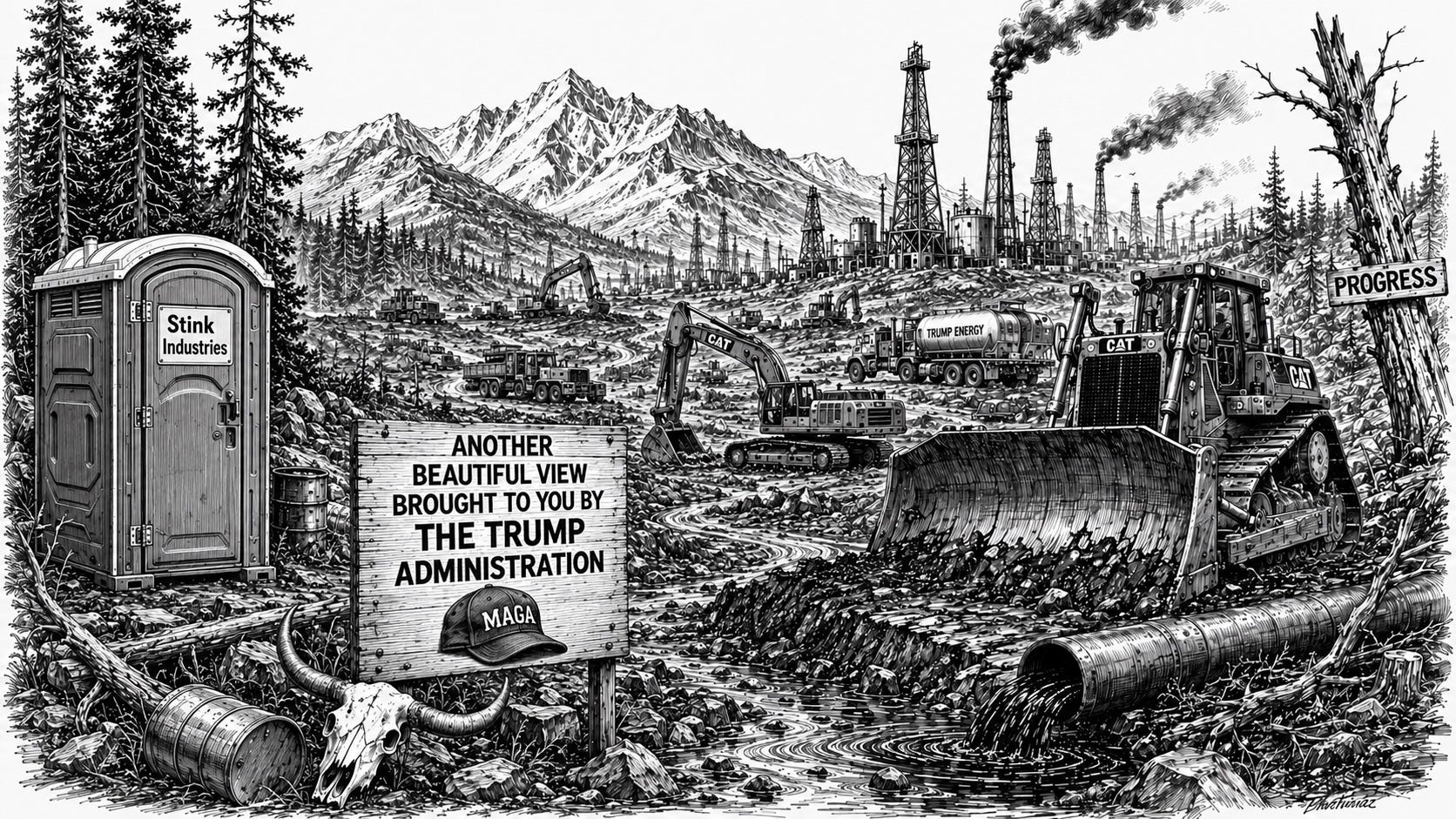
Trump erased the rules that forced the government to study the damage and listen to you before breaking ground near your home, and the people living closest to the pollution lost their protection first.
What if the most important environmental law in America just got hollowed out, and almost nobody told you? You have lived your whole life under a quiet promise. Before the federal government lets a highway, a pipeline, a refinery, or a chemical plant break ground near your home, somebody in charge has to stop, study the damage, look at safer options, and let you speak. That promise has a name. The National Environmental Policy Act.
For more than half a century it forced agencies to think before they wrecked the ground under your feet. In the span of a single year, the Trump administration took the rules that gave that promise teeth and threw them out. The binding rulebook is gone. The studies are shrinking. The public hearings are vanishing. And the people who live closest to the pollution just lost the federal programs that were supposed to have their backs. Here is exactly what happened, why it lands on your family, and what you can still do about it.
The Law That Made Government Think Before It Wrecked Things
Start with what the National Environmental Policy Act actually does, because the people dismantling it are counting on you not knowing.
Congress passed it in 1969 and Richard Nixon signed it on the first day of 1970. Lawyers call it the Magna Carta of environmental law. The idea behind it is simple enough to explain at a kitchen table. When the federal government plans something big, a dam, a freeway, a drilling lease, a federal permit for a factory, it has to do three things first. Study how the project will hurt the air, the water, and the land. Consider alternatives that do less harm. Tell the public and listen to what the public says.
That third part is the part they want you to forget. NEPA gave you a legal right to read the analysis, attend the hearing, and put your objection on the record before the bulldozers showed up. A mother living next to a planned warehouse hub could stand up and say her kids already have asthma. A tribe could say a pipeline runs through sacred ground. A neighborhood could force the government to look at a route that spared their water supply. None of that stopped every bad project. It slowed the worst ones down and dragged the consequences into the daylight.
For decades, one office made the whole system work the same way across the entire federal government. The White House Council on Environmental Quality wrote the binding rulebook that every agency followed, a rulebook that ran from 1978 all the way to 2025. That rulebook is what gave NEPA its operational teeth.
How They Erased the Rulebook in One Year
On his first day back in office, January 20, 2025, Donald Trump signed an executive order called Unleashing American Energy. Buried inside that order sat a direction to the Council on Environmental Quality. Get rid of your NEPA regulations.
The Council moved fast. In February 2025 it published a rule stripping all of its NEPA regulations out of the Code of Federal Regulations, the official lawbook of the United States. That rule took effect in April 2025. On January 8, 2026, the Council finalized the move for good. The binding national rulebook that governed environmental review for nearly half a century no longer exists. The Council’s own chairman, Katherine Scarlett, celebrated the moment by declaring that NEPA’s regulatory reign of terror had ended. Think about that word choice. The legal right of an American family to be warned before pollution arrives next door got branded as terror.
The Council did not stop there. In April 2026 it rewrote the guidance on something called categorical exclusions. A categorical exclusion is a label an agency can slap on a type of project to declare that it normally causes no significant harm, which means no full environmental study and no public review. Under the new guidance, an agency can borrow another agency’s exclusions, lean on old paperwork instead of fresh analysis, and skip the public comment step that used to be expected before any of this happened. The shortcuts multiplied. The studies shrank. The public got cut out.
Then the individual agencies fell in line. The Department of the Interior, which controls drilling and mining on hundreds of millions of acres of public land, rescinded most of its own NEPA regulations on February 24, 2026. Energy, Transportation, Agriculture, the Army Corps of Engineers, and the Federal Energy Regulatory Commission all moved their environmental review requirements out of binding rules and into soft guidance that carries far less legal weight. Most of them kept their emergency procedures and their categorical exclusions on the books, the exact tools that let projects skip review entirely, and shoved everything else into the territory where it can be ignored.
Eighteen state attorneys general wrote to these agencies warning that the rollbacks break the law. So far those warnings have changed nothing on the ground.
The Foundation Underneath It All Got Pulled Out Too
While the Council gutted the review process, the Environmental Protection Agency went after the scientific bedrock of federal climate protection itself.
In 2007 the Supreme Court ruled in Massachusetts versus EPA that greenhouse gases count as air pollution under the Clean Air Act. In 2009, after years of scientific study, the EPA made what became known as the endangerment finding. It concluded that greenhouse gas pollution endangers human health and welfare. Under the Clean Air Act, that finding triggered a legal duty. Once the government determines a pollutant endangers you, the government has to regulate it. For seventeen years that single determination served as the legal spine holding up federal limits on pollution from cars, trucks, power plants, and industrial sites.
On February 12, 2026, the EPA finalized the repeal of the endangerment finding. The agency declared it simply lacks the authority to regulate greenhouse gases at all. It called this the single largest deregulatory action in United States history and claimed it would save Americans roughly one point three trillion dollars. Independent analysts ran the other side of the ledger and found the repeal could cost the country up to one point five trillion dollars in lost health and economic benefits, wiping out any claimed savings. With the finding erased, the legal duty to limit that pollution evaporated. Around the same time, the United States withdrew from the United Nations climate framework, leaving this country as the only nation on earth refusing to take part in global climate talks.
Stack these moves on top of one another and the shape of the plan comes into focus. The review process that forced thought before damage got dismantled. The scientific finding that required action got deleted. The public hearings that gave you a voice got quietly written out of the process.
The People They Stopped Listening To First
Now follow the harm to the doorsteps where it lands hardest, because this is where the cruelty becomes specific.
For years the federal government ran a set of programs under the banner of environmental justice. The phrase sounds bureaucratic. The reality is concrete. Across America, the families breathing the dirtiest air and drinking the most contaminated water are disproportionately low income families and families of color living in the shadow of refineries, alongside truck choked highways, and downwind from industrial plants. Environmental justice programs existed to find those communities, measure the pollution piling up on them, and send help.
On January 20, 2025, Trump signed an executive order directing every federal agency to terminate, to the maximum extent allowed by law, all environmental justice offices and positions. EPA Administrator Lee Zeldin carried out the order with speed. In February 2025 the agency placed the entire staff of its Office of Environmental Justice and External Civil Rights on administrative leave, around 168 people. On March 11, 2025, Zeldin ordered that office shut down for good, along with the environmental justice divisions inside all ten EPA regional offices. The agency briefly reassigned some of those workers, then came back with a deeper round of cuts. Roughly fifty more headquarters environmental justice staff received termination notices with an August 25, 2025 end date, and more layoffs followed into 2026. The expertise walked out the door.
The money disappeared along with the people. Through an executive order issued on day one, Trump directed agencies to stop disbursing Inflation Reduction Act funds and to terminate equity-related grants. The EPA then killed the Environmental and Climate Justice Block Grant Program, a roughly three billion dollar program that Congress created under the Clean Air Act to fund pollution cleanup and climate resilience in around 350 communities nationwide. These were not abstract line items. PUSH Buffalo, a community group in New York, had been awarded twenty million dollars in December 2024 to build community resilience hubs in under-resourced neighborhoods, places stocked with backup power and supplies so families could survive a winter blackout. The group hired staff and lined up subcontractors. On May 2, 2025, before a single dollar reached them, the EPA terminated the grant.
The cancellations reached far beyond that one program. In a separate environmental justice grant, the North Carolina nonprofit CleanAIRE NC had received five hundred thousand dollars in 2024 to install air quality sensors across four communities in Mecklenburg County, neighborhoods where pollution exposure runs far higher than in the wealthier areas nearby. That grant got terminated too. Hundreds of organizations across the country had spent years building these projects to fight pollution that was already making their kids sick.
The courts have been wrestling with all of it. In a case over the block grant program, a federal district judge initially sided with grant recipients, then the Fourth Circuit Court of Appeals overturned that decision in January 2026. A separate appeal is still moving through the D.C. Circuit. Then, in June 2026, U.S. District Judge Richard Gergel in South Carolina ruled that the EPA’s cancellation of the entire program was illegal and voided the action. That ruling matters. Its reach is limited. The judge stopped short of ordering the program restarted, because the administration had already fired the staff who ran it, which made a full restart impractical. Congress compounded the damage in the July 2025 budget bill by rescinding all the unspent money in the program, so even a court order to revive it runs into empty accounts. The agency also stripped environmental justice resources off its own website, so the data families relied on to understand the risks around them simply went dark.
What This Costs You and Your Kids
Picture a specific family, because that is who all of this is really about.
A family lives three blocks from a planned expansion of an industrial facility. Under the old system, the federal government had to study the air pollution that expansion would add, weigh a cleaner alternative, and hold a hearing where that family could show up and be heard. A nearby air sensor, funded by one of those now canceled grants, would have told them in real time when the air turned dangerous. A regional environmental justice office would have flagged that this neighborhood already carries more than its share of pollution.
Erase all of it. The study shrinks to a categorical exclusion. The hearing never happens. The sensor never gets installed. The office that would have raised the alarm no longer exists. The family finds out about the pollution the way families always found out before these protections existed. Their children start coughing. The emergency room visits start adding up. The asthma inhaler becomes a permanent fixture in a backpack.
This is the machinery of how inequality deepens. The health gap between rich neighborhoods and poor ones widens. The families with the least power lose the one tool that let them push back, their voice in the process. Trust in government erodes, because the government openly decided their suffering was not worth measuring. Democracy itself takes the hit, because democracy runs on the belief that showing up and speaking out actually changes something. When the hearings vanish and the data goes dark, that belief breaks.
The damage does not stay in those neighborhoods. Dirtier air drifts. Higher healthcare costs ripple through insurance markets everyone pays into. A government that learns it can silence the least powerful Americans does not stop with the least powerful Americans. It learns the habit.
What You Do Now
You have read the facts. The review process got gutted. The science got deleted. The communities got silenced. The question that remains is the only one that matters. What do you do with what you now know.
You vote like your air depends on it, because it does. This year’s elections decide who holds the power to rebuild what got torn down. Courts have already ruled some of these actions illegal, which proves the law still has force when people fight for it. Elections decide who appoints the people who run these agencies, who write the rules, who restore the offices, who refill the accounts.
You speak. Tell your neighbors what happened to NEPA, because the people who erased it are betting on your silence. Tell them an American family’s legal right to be warned before pollution arrives got branded as terror by the people in charge. Tell them about the air sensors that never got installed and the hearings that will never happen.
You share this. You comment. You show up at the town halls and the city council meetings where state and local leaders still have power to protect you. State authority to fight pollution did not disappear, and some states are stepping up. Your state representatives need to hear from you.
The people who took apart these protections worked in quiet for more than a decade, waiting for the moment nobody was watching. Your job is to make sure somebody is watching. Your voice still matters. Your vote still matters. The future your kids and grandkids breathe into depends on what you do right now.
Speak. Share. Vote. The silence they are counting on is the only thing standing between this damage and the people with the power to reverse it. That power is you.
Mitch Jackson, Esq.
You found Uncensored Objection for a reason.
This is what happens when the people elect a corrupt real estate developer as POTUS.
I will never understand a man that doesnt care about the beauty of the earth 🌎. He's all about wanting to do things to make himself look like a good guy. But no. If it means money out of the budget, he's about spending it elsewhere for him or his buddies. What about how he looks to his family, his grandchildren?
He'll get his someday. I believe we pay for our sins !