

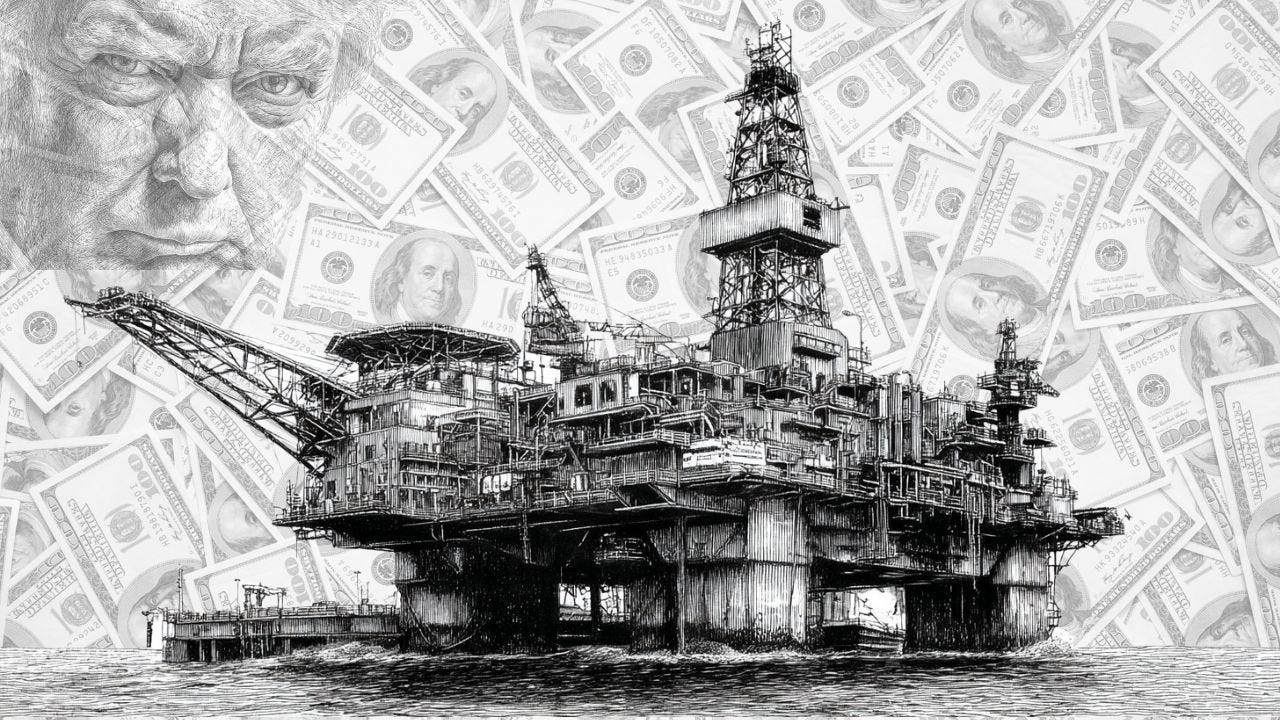
If the United States is already producing more oil than any nation in history, why is the Trump administration greenlighting two of the most reckless oil projects this country has ever seen?
That is the question no one in this administration wants you asking. I’m upset and am going to walk you through exactly why these two decisions should send a chill down your spine. This is a story about politics. It’s also a story about money, power, environmental destruction, and the ugly truth that history is about to repeat itself because the people in charge of protecting you have decided to look the other way.
On March 13 and 14, the Trump administration approved two staggering oil projects within 24 hours. One in the Gulf of Mexico. One off the California coast. Together, they represent the most aggressive expansion of offshore oil production in a generation. And they come with a track record of catastrophe that should disqualify both of them from ever moving forward.
Hang on, because what you are about to read is going to make you angry.
The Gulf of Mexico Just Got a Lot More Dangerous
The Trump administration approved BP’s Kaskida deepwater project in the Gulf of Mexico. This is a five billion dollar investment to drill for oil approximately 250 miles off the coast of Louisiana, with production slated to begin in 2029. BP expects the project to produce around 80,000 barrels of oil per day from six wells, tapping a section of the seafloor estimated to hold as much as 10 billion barrels of crude.1
Here is what they are not telling you.
Kaskida is BP’s first completely new oilfield in the Gulf of Mexico since the Deepwater Horizon disaster in 2010. If that name does not stop you in your tracks, it should. The Deepwater Horizon explosion killed 11 workers and unleashed more than 3 million barrels of oil into the Gulf over 87 agonizing days. It was the worst oil spill in United States history.
More than 1,000 miles of coastline across six states were coated in crude. Over 40,000 square miles of the Gulf were contaminated. An estimated 8.3 billion oysters were destroyed. Hundreds of dolphins, sea turtles, and marine mammals were killed. Gulf Coast economies collapsed. The tourism industry alone suffered losses estimated at 22.7 billion dollars over three years. Home values along the Gulf dropped between four and eight percent, wiping out billions in household wealth.
BP ultimately paid more than 69 billion dollars in response costs, cleanup, economic claims, settlements, and government payments. The company pled guilty to 14 felony counts. The federal court approved the largest environmental damage settlement in United States history at 20.8 billion dollars.
Let all of that sink in. That is the company the Trump administration just handed the keys to. Again.
And this time, BP wants to drill in even deeper water. Kaskida would operate at depths reaching over 6,000 feet, significantly deeper than the Deepwater Horizon rig. According to environmental groups and regulatory filings, ultra deepwater projects like Kaskida are at least six times more likely to experience a loss of well control incident than standard offshore drilling. That is the same type of incident that triggered the Deepwater Horizon explosion.
BP’s own proposal reveals that in a worst case scenario, Kaskida could spill up to 4.5 million barrels of oil into the Gulf. That exceeds the entire Deepwater Horizon disaster. The company acknowledges it would take 90 to 100 days to cap a blowout at Kaskida, compared to the 87 days it took to stop the Deepwater Horizon leak. Members of Congress sent a letter to the Bureau of Ocean Energy Management pointing out that BP failed to demonstrate in its proposal that it possesses the equipment to contain a high pressure blowout at these depths. BP’s emergency response plan for Kaskida essentially mirrors what it did 16 years ago, using chemical dispersants to break oil into tiny droplets and push it underwater.
So let me be direct with you. We are talking about a company that caused the worst environmental disaster in American history, drilling in deeper and more dangerous waters, with an emergency plan that is nearly identical to the one that failed last time, and an admission that a blowout could be even worse than before. The Trump administration approved all of this over the objections of Democratic lawmakers, tens of thousands of public comments opposing the project, and environmental organizations who warned this was an unacceptable threat to Gulf communities, ecosystems, and the climate.
This is reckless. This is irresponsible. And this should never have been approved.
California’s Coastline Is Under Attack
While BP was getting its green light in the Gulf, something even more aggressive was happening off the coast of California. On March 13, the Trump administration invoked the Defense Production Act, a Cold War era law historically reserved for genuine national security emergencies, to force the restart of the Santa Ynez offshore oil platform and pipeline system along the Santa Barbara County coast.
This pipeline has been shut down since May 2015. It was shut down for a reason. That year, the pipeline ruptured and released approximately 142,000 gallons of crude oil along the Gaviota Coast, contaminating Refugio State Beach and triggering one of the worst California coastal oil spills in decades. The cause of the rupture was systemic external corrosion.
The oil spread along seven miles of coastline. It reached four marine protected areas of ecological and cultural significance. An estimated 559 birds, 156 sea lions, and 76 dolphins were killed. 136 square miles of coastline were shut down. Fisheries closed. State parks and campgrounds closed. Fishermen lost their livelihoods. Beaches were covered in crude.
The cleanup cost the pipeline operator 96 million dollars, and overall expenses including legal settlements reached approximately 257 million dollars. After a jury found that negligent practices contributed to the spill, the operator paid 60 million dollars in penalties and damages.
That is the pipeline system the Trump administration wants back in operation. Right now. Today.
Houston based Sable Offshore Corp. purchased the entire Santa Ynez system from ExxonMobil in 2024, financing the deal with a 622 million dollar loan from ExxonMobil itself. Since the purchase, Sable has been aggressively pushing to restart operations.
Along the way, Sable has accumulated a series of state law violations and criminal charges. The California Coastal Commission cited Sable for unlawful work in sensitive coastal habitat. The California Attorney General and Santa Barbara District Attorney sued Sable for legal violations tied to unlawful discharge into creeks and waterways. The State Fire Marshal found in October 2025 that Sable had not completed enough repair work on the corroded pipeline to authorize a restart. A Santa Barbara County Superior Court judge ruled as recently as last month that Sable must comply with state requirements before any restart.
None of that mattered to this administration. The Department of Justice issued a sweeping 22 page legal opinion on March 3 asserting that the Defense Production Act could preempt California state law, override existing court injunctions, and supersede a 2020 federal consent decree requiring California State Fire Marshal approval before the pipeline could restart. On March 14, Energy Secretary Chris Wright directed Sable to immediately restore operations. Sable announced on March 16 that it has already restarted oil production at Platform Harmony in the Santa Barbara Channel and is transporting oil through its pipeline system.
One day. It took one day after the federal order for oil to start flowing through a pipeline that ruptured from corrosion, whose operator faces criminal charges, and whose restart was blocked by multiple court orders.
On Saturday, California State Parks rejected Sable’s application for an easement and ordered the company to immediately remove the four mile section of pipeline running through Gaviota State Park. That easement expired in 2016. Without it, the pipeline cannot legally operate across state parkland.
Governor Newsom has vowed to sue, calling this an attempt to illegally restart a pipeline whose operators are facing criminal charges and are prohibited by multiple court orders from restarting. The Governor put it plainly. Donald Trump started a war, admitted it would spike gas prices nationwide, and told Americans it was a small price to pay. Now he is using this crisis of his own making to attempt what he has wanted to do for years: open California’s coast for his oil industry friends so they can poison our beaches.
The Defense Production Act has never before been used to compel an oil company to resume production from idled infrastructure and override pending state requirements. This is heading to court and potentially to the Supreme Court on the question of whether a Cold War era law can preempt California’s regulatory authority. That is a novel and consequential legal question with massive implications for every state in the country.
The Biggest Oil Producer on Earth Does Not Need This
Here is the part that really needs your attention.
The Trump administration’s own Department of Energy boasts that the United States is already the biggest oil producer on the planet. Crude oil production hit record highs of 13.6 million barrels per day in 2025. The U.S. produces more oil than Russia and Saudi Arabia combined at 24.2 million barrels per day in total oil and liquid fuels production. Trump himself posted on Truth Social that the United States is the largest oil producer in the world, by far, so when oil prices go up, we make a lot of money.
Read that again. The President of the United States publicly celebrated rising oil prices as a financial windfall for the country while American families are paying over five dollars a gallon at the pump.
If we are already producing more oil than anyone in history, why do we need to greenlight a project in the Gulf of Mexico that could cause a spill worse than Deepwater Horizon? Why do we need to invoke emergency Cold War powers to force a corroded pipeline back into operation along the California coast?
The answer is not energy security. The answer is profit. The Sable pipeline would contribute just 0.05 percent of total global crude oil production. It represents less than 0.3 percent of the petroleum products trapped in the Persian Gulf because of the Iran conflict. As one environmental attorney put it, this oil is not going to bring the price of oil down, not by one cent. Trump is using a war that he started to increase profits for his friends in the oil business.
And we know exactly who those friends are, because they left a paper trail.
In April 2024, Trump held a dinner at Mar a Lago with about 20 oil and gas executives and made a brazen pitch. He asked the industry to raise one billion dollars for his campaign and told them it would be a deal because of the taxes and regulations they would avoid under his presidency. He reportedly promised to fast track drilling permits, eliminate tailpipe emission standards, expand offshore drilling, and unfreeze permits for liquefied natural gas terminals. All he needed was their money. The oil and gas industry delivered.
According to analysis from the Brennan Center for Justice, fossil fuel interests gave at least 75 million dollars to Trump’s campaign and affiliated super PACs, making them one of the top corporate backers of his reelection. Yale Climate Connections calculated the total oil and gas industry spending to influence the 2024 election at 219 million dollars, with 88 percent of it going to Republicans. After the election, fossil fuel companies poured another 19 million dollars into Trump’s inaugural fund. Chevron led the way with 2 million dollars. ExxonMobil, ConocoPhillips, and Occidental Petroleum each contributed 1 million dollars. Individual oil tycoons went even further. Kelcy Warren, executive chair of Energy Transfer Partners, gave 5 million dollars to a pro Trump super PAC. Harold Hamm, chairman of Continental Resources, donated 1 million dollars and personally organized fundraising efforts within the fossil fuel sector. George Bishop, CEO of GeoSouthern Energy, gave 1 million dollars, with his wife adding another 500,000 dollars. The top 15 fossil fuel industry billionaires saw their combined personal wealth rise by over 40 billion dollars between April 2024 and January 2025 alone.
Now look at who is signing the orders. Energy Secretary Chris Wright, the man who personally directed Sable to restart its corroded pipeline, is the former CEO and chairman of Liberty Energy, the second largest hydraulic fracturing company in North America. Wright donated 228,390 dollars to Trump’s joint fundraising committee in 2024. He attended the same Mar a Lago dinner where Trump asked the oil industry for a billion dollars. When he left Liberty Energy to join the cabinet, ethics rules required him to sell his energy holdings, a divestiture that netted him over 50 million dollars. Wright has publicly stated there is no climate crisis and has called the net zero 2050 goal a colossal train wreck. This is the man deciding whether a corroded, criminally charged pipeline should bypass California state law and start pumping oil immediately.
Then there is Sable Offshore itself. The company spent more than 300,000 dollars lobbying the federal government in 2025, including 20,000 dollars paid to the firm Holland and Knight during the fourth quarter specifically to lobby the White House on project authorizations for offshore oil and gas development. Sable reported zero federal lobbying activity before 2025. Sable purchased its entire pipeline system from ExxonMobil in 2024 with a 622 million dollar loan from ExxonMobil. So a company bankrolled by one of the largest oil corporations on the planet, a company that gave 1 million dollars to Trump’s inaugural fund, is now getting a Cold War era emergency order tailored to its specific request to override state law and restart a pipeline that multiple courts have blocked.
The financial windfall from all of this is staggering. Investment bank Jefferies estimates that American oil producers generated an extra 5 billion dollars in cash flow in March alone from elevated crude prices. Research firm Rystad projects that if oil prices average 100 dollars a barrel for the year, the industry will pocket an additional 63.4 billion dollars from production alone. Oil Change International calculated that at roughly 14 million barrels per day of U.S. crude production, elevated prices generate approximately 280 million dollars in additional revenue for American oil producers every single day. ExxonMobil, Chevron, and a string of other U.S. oil producers and refiners saw their market capitalizations surge to all time highs this month. Refiners like Valero, Marathon, and Phillips 66 all crossed market caps above 70 billion dollars, all at record levels. Every cent of that windfall comes straight from your wallet at the gas pump.
Trump told America the quiet part out loud when he posted on Truth Social that the United States makes a lot of money when oil prices go up. He is right about who makes the money. It is not you.
Meanwhile, energy analysts across the board have pointed out that even with elevated prices from the Iran conflict, the American oil industry is not going to rush to dramatically increase production. Companies have prioritized stock buybacks and strong balance sheets over new exploration. Trump’s own steel tariffs have increased the cost of drilling new wells and building pipelines. The Kaskida project will not produce a drop of oil until 2029. None of this is solving the gas price crisis you are feeling at the pump right now.
The Clean Energy Future That Was Stolen From You
All of this is happening while the Trump administration systematically dismantles every clean energy investment and protection that was put in place before his second term.
The administration signed legislation that eliminates federal tax credits for new solar and wind projects that begin construction after July 2026. Tax credits for electric vehicles were killed months ahead of schedule. The administration ordered a blanket pause on offshore wind projects. The EPA proposed rescinding its Endangerment Finding, the foundational legal authority requiring the government to protect people from climate changing pollution.
The Department of Energy banned words like climate change, green, emissions, and decarbonization from official communications. The Interior Department issued a policy requiring wind and solar projects on federal land to match the energy output per acre of fossil fuels, effectively disqualifying many renewable projects from receiving permits. Repealing the Inflation Reduction Act incentives alone would increase household electricity costs by more than 110 dollars in 2026, threaten more than 500 billion in planned economic investment, and lead to one million fewer jobs by 2030.
Every dollar being poured into reckless deepwater drilling and corroded pipeline restarts is a dollar not going toward clean energy that would make the United States independent of the very geopolitical crises that drive oil prices through the roof. Every regulation rolled back is a protection removed from your family, your community, and the coastlines and waterways that sustain your quality of life. This administration is choosing fossil fuel profits over the future you were building toward.
That is not energy dominance. That is short sighted greed dressed up in a hard hat.
This Is About Your Future.
I have spent more than 40 years in courtrooms fighting for people against institutions that put profit ahead of safety. I have seen what happens when corporations cut corners and regulators look the other way. I have seen the devastation that follows. And I am telling you right now that what is happening with the Kaskida project and the Sable pipeline restart is the setup for the next environmental catastrophe.
BP caused 69 billion dollars in damages the last time it drilled in the Gulf. Sable’s pipeline ruptured from corrosion and devastated the Santa Barbara coast. Neither company has demonstrated that this time will be different. The Trump administration has given them both a green light anyway, while stripping away the regulations, the state authority, and the clean energy future that would actually protect you.
You need to pay attention. You need to share this with everyone you know. You need to contact your elected officials, your state representatives, and your members of Congress and tell them you will not stand for this. You need to show up at the midterms in 2026 and vote for people who will protect your coastlines, your economy, your health, and your children’s future.
This is not a drill. This is the moment you decide whether your voice matters. Make it count.
Mitch Jackson, Esq.
Related
New E Book: Donald Trump Is Destroying Our Environment
If this story made your blood boil, share it with someone who needs to read it and subscribe to Uncensored Objection so you never miss the facts and the fight that the mainstream media glosses over. Your voice and your vote in 2026 are the only things standing between corporate greed and the coastlines, communities, and future your family deserves.
BP is a British multinational oil and gas company headquartered in London, England. It is one of the largest oil companies in the world, often grouped among the “supermajors” alongside ExxonMobil, Chevron, Shell, TotalEnergies, and ConocoPhillips.
The company was originally known as British Petroleum. It rebranded to just “BP” in 2000 as part of a marketing campaign that included the tagline “Beyond Petroleum,” which was meant to signal a shift toward cleaner energy. That rebrand has been widely criticized as greenwashing, especially after the Deepwater Horizon disaster in 2010.
BP operates in nearly 80 countries, produces roughly 1.2 million barrels of oil per day, and reported reserves of about 6.2 billion barrels of oil equivalent at the end of 2024. The company is one of the largest producers in the Gulf of Mexico, which is directly relevant to the Kaskida project in your article.