

It started with a ping.
At exactly 2:06 a.m. Eastern, a flurry of encrypted messages lit up a Signal group chat titled “The Core”. Inside: Vice President J.D. Vance, National Security Adviser Mike Waltz, Defense Secretary Pete Hegseth, Secretary of State Marco Rubio, and a handful of top-level aides and military liaisons. These weren’t junior staffers blowing off steam. This was the brain trust—America’s war council—sharing real-time war plans in a chat app no more secure than a well-guarded diary left on a park bench.
They weren’t just talking strategy.
They were naming targets. Assigning strike windows. Reviewing launch sequences. And debating whether to include RAF Typhoons from Cyprus in the second wave of attacks. A U.S. Navy destroyer commander even sent a thumbs-up emoji when Vice President Vance gave the green light to hit a suspected missile depot near Al Hudaydah.
By 3:40 a.m., the orders were confirmed.
At 4:00 a.m., everything fell apart.
⸻
Here’s what happened:
Unbeknownst to those in the chat, Signal had been compromised. Not because the app itself was flawed. No—the breach came from a modified Android device used by one of the participants. A secure communications protocol known as NSA-approved Type 1 encryption was required for a conversation like this. Instead, they used something built for activists, not architects of war.
Signal, while end-to-end encrypted, is not designed to handle classified national defense information. It lacks hardened physical protections. It doesn’t interface with DoD Secure Voice (DSV) networks. It doesn’t meet Classified Message Incident Handling (CMIH) standards. And its messages, if captured on a rooted or compromised phone, can be read like text on a napkin.
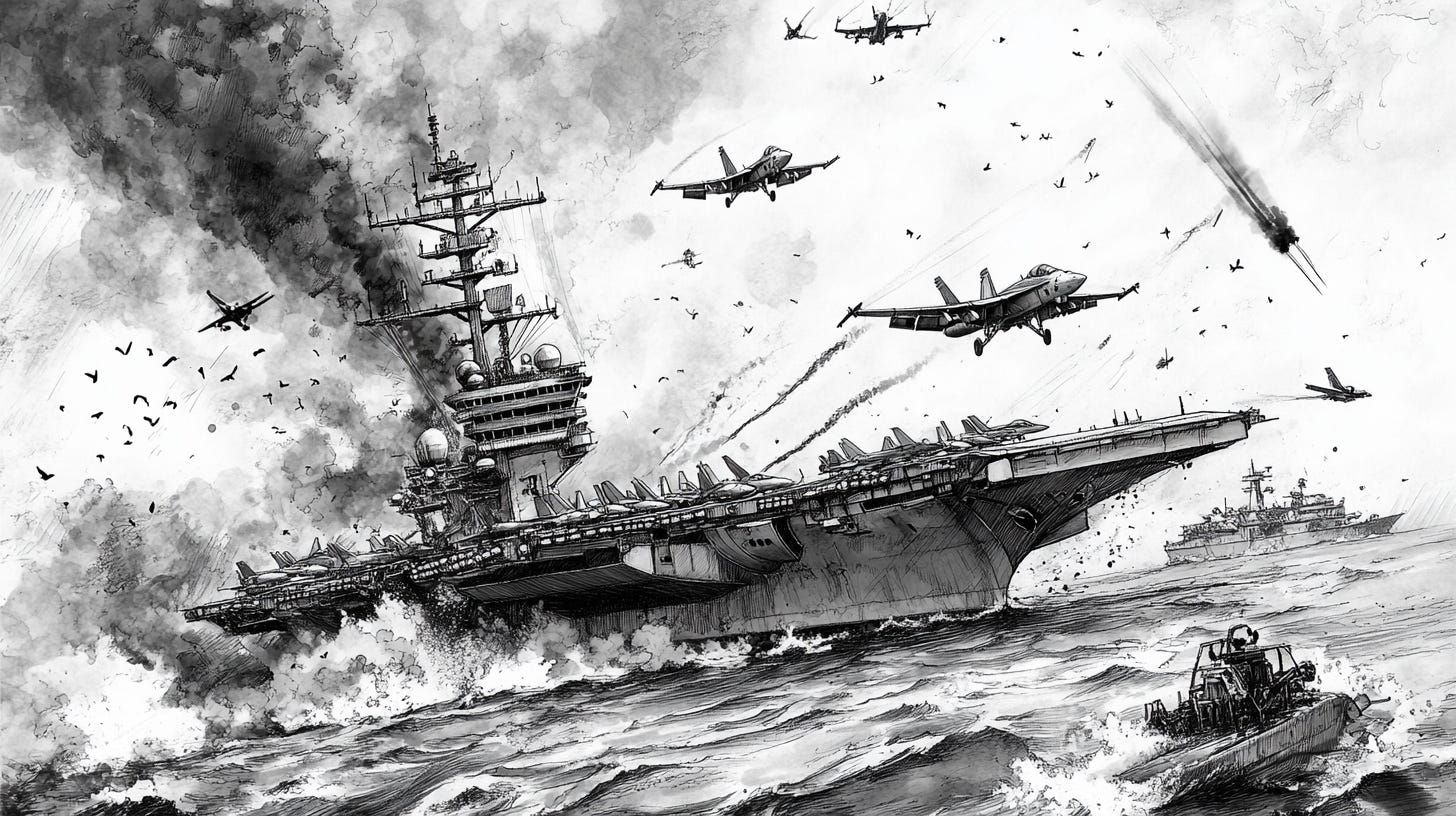
Two hours before the first F/A-18 Super Hornet launched from the USS Eisenhower, that Signal chat was already in enemy hands.
⸻
The Houthis—and their backers—had time.
Time to reposition mobile SAMs (Surface-to-Air Missiles).
Time to camouflage launch sites.
Time to redirect Iranian surveillance drones.
Time to alert naval allies in the Red Sea, including stealth craft hiding just beneath radar thresholds.
Time to set the trap.
When the operation began just after sunrise, American and allied forces walked straight into it.
⸻
It was a massacre.
Two U.S. Navy destroyers—USS Gravely and USS Carney—took direct missile hits. One of the forward radar systems was blinded.
Three B-1B bombers, flown in from Diego Garcia, were ambushed mid-air by enemy MiG-29s flown from a Syrian airstrip—yes, they knew the flight paths ahead of time.
Twelve U.S. service members died in the Red Sea alone.
Three more pilots were lost when their jets were forced to eject over Houthi-controlled territory. Their remains were recovered days later.
The United Kingdom lost two RAF pilots and a Typhoon.
France’s frigate Languedoc, monitoring from the Red Sea, was hit by a swarm of armed drones—six sailors killed.
Japan, a mostly defensive partner in the coalition, lost a destroyer-based helicopter and its crew of five.
And the missile depot near Al Hudaydah? Empty. Vacated. Swept clean.
⸻
In Washington, the fallout came fast.
Once the breach was confirmed, the Department of Defense launched a COMSEC (Communications Security) review.
The findings were devastating.
The group chat had been conducted on unauthorized devices. No SKL (Simple Key Loaders) or STE (Secure Terminal Equipment) were used. No SIPRNet coordination. No JSOC approval protocols were followed. Signal was never cleared for operations involving Weapons Release Authority or joint combat coordination.
By the end of the week:
• Mike Waltz was removed from his post and charged under 18 U.S. Code § 1924 (Unauthorized removal and retention of classified documents).
• Pete Hegseth resigned and is now under investigation for gross negligence under the UCMJ.
• J.D. Vance was stripped of all war powers coordination duties.
• Marco Rubio was censured by the Senate and is being investigated by a select committee.
They called it “a glitch,” just as former President Trump brushed it off in a Florida press conference.
But no, this wasn’t a glitch.
This was a failure.
A preventable, arrogant, sloppy failure.
And people died.
⸻
We have rules for a reason.
Every cabinet member, every general, every analyst is required to use secure government-issued devices—phones hardened with NSA-grade encryption, capable of housing classified apps like ZIA (Zero Trust Identity Access) and DISN-approved tools.
Top secret communications must go through SIPRNet, not iMessage.
Coordinated war plans must be transmitted via JWICS (Joint Worldwide Intelligence Communications System), not some encrypted group chat.
And when even one person thinks they’re too important to follow the protocols?
This is what happens.
⸻
The cost isn’t just a broken mission.
It’s broken families.
It’s body bags draped in flags.
It’s global humiliation.
And it’s a chilling reminder: national security is not about apps. It’s about trust.
⸻
America can survive many things.
But what it cannot survive is leadership that forgets what it’s guarding—and who it’s supposed to be guarding it for.
We should all be angry.
Not because technology failed us.
But because people did.
And we all paid the price.
⸻
Thank God this didn’t happen.
But the fact that it could have? That alone should rattle us.
Because when lives hang in the balance, what did happen—
the shortcuts, the sloppiness, the Signal chat—
isn’t just a footnote.
It’s a red flag. And it’s not OK.
⸻
Mitch Jackson, Esq. | links
This post is free.
But free doesn’t build the future.
Independent journalism only works when people like you choose to lean in—not just with attention, but with support.
If this work matters to you, today’s a great day to take the leap.
$5 a month. $50 a year.
A small investment in something bigger than all of us.

I like the way this particular story ends. In fact, this is exactly how it should have been dealt with, regardless of whether the US lost any equipment or men.