

The Problem
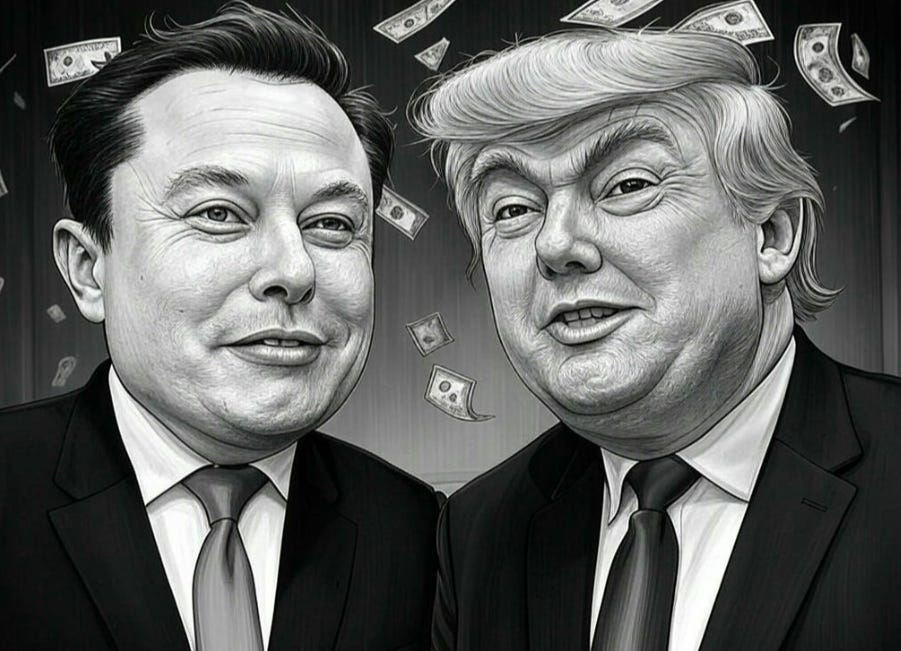
Conflicts of interest at the highest levels of power are not just technical fouls—they strike at the heart of public trust. Since January 20, 2025, two larger-than-life figures, Elon Musk and Donald Trump, have become emblematic of how personal business entanglements can collide with the public interest.
Both men have blurred the lines between their private financial ambitions and their official roles, setting off alarm bells among ethics experts and average citizens alike. As we watch these high-profile sagas unfold, we must ask: Who is the government working for—its people, or a select few with the means to bend the rules?
This topic is big. Important. A little messy. Curious? Dive in with our special Perplexity AI page—your backstage pass to exploration. Click, ask, uncover. No limits. No off-limits. Just insight, straight up.
Elon Musk
Elon Musk’s new role in the federal government is a prime example of the fox guarding the henhouse. Musk poured a fortune into helping Donald Trump return to the White House, and in return he was appointed to lead a so-called “Department of Government Efficiency” tasked with slashing government bureaucracy.
In theory, that might sound like putting a brilliant innovator to work trimming waste. In practice, it means Musk now has a hand in reshaping or even dismantling agencies that oversee his own businesses. He has kept control of his vast empire—electric cars, rockets, satellites, social media, and more—even as he sits on the inside of the government as a special advisor. This unprecedented dual role has opened the door to glaring conflicts of interest that should concern every American.
Consider Musk’s influence over the Federal Aviation Administration (FAA). The FAA is supposed to impartially manage the nation’s airspace and contract out technology upgrades to the best providers. Yet Musk, wearing his government hat, reportedly leaned on the FAA to pull the plug on a multi-billion dollar deal with a company that competes against Starlink, his satellite internet service. Shortly after, the FAA began adopting Starlink for critical air traffic control communications—a decision that could enrich Musk’s company at the expense of a fair bidding process. Please see my earlier post Corruption in Plain Sight: How Elon Musk’s FAA Deal Flouts Conflict-of-Interest Law.
It’s as if the referee of a game decided to give one team (his own) a special advantage. That’s not just unfair to other businesses; it ultimately hurts taxpayers and travelers, who might end up paying more or getting less innovation when competition is sidelined.
Musk’s influence doesn’t stop at the FAA. As part of his “efficiency” mandate, he has been involved in plans to shrink or abolish certain watchdog agencies. One reported target is the Consumer Financial Protection Bureau, which, among other things, watches over car loans and consumer lending.
Why does that matter? Musk’s car company, Tesla, offers financing to its customers. If he helps eliminate or weaken an agency policing lending abuses, Tesla stands to benefit from laxer oversight. Likewise, with Musk’s expanding ventures in artificial intelligence and internet services, he stands to gain if he can sway policies in those areas too.
All the while, Musk now has access to sensitive government information and policymaking influence, even as his companies court investors and deals worldwide. It’s a textbook conflict of interest: a public official making decisions that can boost his own bottom line. Normally, rules would require such an official to step back or recuse himself from matters where he has a financial stake. But so far there’s little evidence Musk has done so. And who’s going to make him? His benefactor in the Oval Office seems in no rush to rein him in.
Donald Trump
Donald Trump, for his part, is entangled in financial conflicts on multiple fronts. Even as he took the oath of office again in 2025, the Trump family was unveiling new business ventures that invite people to effectively put money in the president’s pocket. The most eyebrow-raising may be the Trump-branded cryptocurrency tokens—yes, actual digital coins named after Trump and his wife, rolled out just before he assumed power.
These coins attracted billions in speculative dollars within weeks. Why such enthusiasm? Partly because Trump-affiliated companies quietly kept an enormous share of the tokens for themselves. If demand (fueled by Trump’s political clout) drives the price up, the Trump family reaps a windfall. I wrote about his in an earlier post, The $TRUMP and $MELANIA Crypto Scandal: How a Presidential Meme Coin Cost Investors Billions.
Watchdogs warn that this setup offers a new avenue for influence-peddling: anyone, including foreign interests, can curry favor with the president by helping drive up the value of “Trump coins.” It’s a modern twist on an old problem—like buying stock in the boss’s company to get on his good side, except here the “boss” is the president of the United States.
The conflicts don’t end with crypto. The Trump business empire is still very much in play during his presidency. Before re-entering the White House, Trump said he handed day-to-day control of his businesses to his children again, just as he did in his first term. But let’s be clear: that arrangement did little to resolve conflicts of interest then, and it does little now.
Trump still profits from his hotels, golf courses, and branding deals. Already, Mar-a-Lago, his Florida resort, has been buzzing with political events and fundraisers, all of which funnel money directly into his pocket. Read my post, Trump’s Golf Grift: $144 Million in Taxpayer Money Wasted on His Luxury Getaways.
His company is pursuing real estate projects overseas—in places like the Middle East—even as those regions’ leaders may seek favor from the U.S. on matters of foreign policy.
It doesn’t take a constitutional scholar to see the potential for conflicted loyalties. When a president’s family business stands to make millions from partners abroad, can we be sure decisions on war and peace or trade deals are made purely in the national interest? Even if Trump believes he can separate the two, the appearance of impropriety is inescapable.
Trump’s recent actions also raise the alarming prospect of officials bending policy to favor the boss’s personal ventures. His administration has adopted a much friendlier stance toward the cryptocurrency industry—hardly a surprise, given both the First Family’s stake in it. In fact, federal regulators abruptly pumped the brakes on a fraud case against a wealthy crypto mogul who had poured tens of millions into Trump’s new digital coin project.
In plain terms, a big investor in the Trumps’ private venture saw a government investigation into his alleged wrongdoing put on hold. That’s a jaw-dropping intersection of public power and private interest. It telegraphs that those who financially support the president’s projects might get a free pass if they run afoul of the law.
At the same time, Trump’s new Commerce Secretary—an old business associate with deep ties to the crypto world—has been out front promoting cryptocurrency in his official capacity. He’s pushing policies that boost crypto markets, which conveniently aligns with his own industry background and the president’s financial interests. Ethically, he ought to recuse himself from anything that overlaps with his former business, but no law forces him to do so. When top officials start looking like they’re using public office as an extension of their investment portfolio, something is deeply wrong.
All of this paints a troubling picture: the nation’s highest office and its corridors of power being leveraged for personal gain. The safeguards that are supposed to protect the public interest seem to be failing—if not outright sabotaged.
Normally, internal watchdogs (Inspectors General) and the Office of Government Ethics would raise red flags when officials blur public duty with private interest. But in recent weeks, several of these independent officials have reportedly been fired or sidelined. Those who questioned Musk’s dual role or probed the Trump family’s ventures have found themselves abruptly shown the door. This purge sends a clear signal to everyone left in government: don’t challenge the conflicts of the people at the top. I invite you to read, The 2025 Republican Budget: Tax Cuts for the Rich, Pain for You—And They’re Hoping You Won’t Notice.
Oversight committees in Congress can hold hearings and write stern letters (and indeed some lawmakers are trying), but real accountability is hard to come by if the ruling party shields its own and longstanding norms are tossed aside. And let’s not forget, the conflict-of-interest laws that do exist have gaping loopholes.
Believe it or not, the President and Vice President are largely exempt from many of the rules that bind other federal officials. Those laws never envisioned a billionaire president who openly mingles official duties with business deals. As for someone like Musk, who technically isn’t a Cabinet secretary but a “special” advisor, enforcing ethics on him falls into a gray zone. Our system has always counted on leaders’ good faith—trusting that they wouldn’t exploit their positions for personal gain. When that good faith is absent, it turns out our tools to restrain self-dealing are distressingly feeble.
Solutions
What can be done to stop this from becoming the new normal? For starters, we need stronger laws and stricter boundaries between public service and private interest. No public servant, not even the president, should be above the conflict-of-interest principles that keep government honest.
One reform idea is to require top officials to divest from major business holdings and put their assets in a true blind trust (where they have no knowledge or control over how their money is managed) while in office. Had that been mandatory, Trump could not have simply left his company in his children’s hands without real oversight—he would have had to genuinely separate himself from his empire.
Likewise, if Musk wanted a government job, he would need to step away from the helm of companies that receive government contracts or are subject to U.S. regulation. Public officials should have one loyalty: the public. If they aren’t willing to detach from their private interests, they shouldn’t be entrusted with immense public power in the first place.
We also need to empower the watchdogs. Congress should protect Inspectors General from being fired in retaliation for doing their jobs. These independent investigators must be free to follow the facts without fear of politically motivated ouster.
Strengthening the independence of agencies like the Office of Government Ethics is equally critical. That office should be more than an advisory body—it should have the authority to initiate investigations or refer egregious violations for prosecution. Imagine if defying ethics rules brought real penalties, not just bad press. Officials might think twice about putting their wallets before their duty.
Greater transparency is another part of the solution. When we know exactly where our leaders’ money comes from and whom they’re doing business with, it’s harder for conflicts to hide in the shadows. This means more rigorous financial disclosures for officeholders and their immediate family.
If a president’s son-in-law is running an investment fund fueled by, say, Saudi or Chinese money, the public should know. If the president himself launches a new line of business while in office, we deserve a full accounting of how it works and who is investing in it. Sunlight won’t solve every problem, but it certainly makes it easier to spot the most glaring abuses and apply pressure to fix them.
Ultimately, ethics in government depends on the people we elect and the standards we demand. Stronger laws will help, but no law can anticipate every trick or loophole a determined official might exploit. It falls to voters and honest representatives to insist that public office not be used for private enrichment.
That might mean passing new anti-corruption measures, but it also means enforcing the norms we thought were understood. For example, it may be time to explicitly bar high-ranking officials from running side businesses like personal crypto coins or private media platforms while in office. At minimum, any such ventures should be subject to intense scrutiny and ethics review. And when it comes to appointing family or big donors to powerful positions, the default should be skepticism and strict vetting, not automatic trust.
None of these changes will happen unless the public cares and speaks out. The outrage over these conflicts of interest needs to translate into political pressure. If lawmakers feel heat from voters to clean up Washington, they will be more likely to act. This isn’t a partisan issue in the end—Democrats, Republicans, and independents all lose when officials betray the public trust. We all want a government that works for us, not for the officials’ bank accounts.
In the end, a democracy cannot thrive if people believe their leaders are in it for themselves. The saga unfolding with Elon Musk and Donald Trump in 2025 is a cautionary tale. It shows what happens when the lines between public service and personal business are erased. We risk normalizing a culture where the rich and powerful play by their own rules and laugh all the way to the bank.
It’s not too late to reverse course. By shoring up our ethics laws, demanding accountability, and voting with these issues in mind, we can reassert that government is a public trust, not a private enterprise. The average American might not follow every twist and turn of these scandals, but they feel the consequences when Washington prioritizes the wealth of a few over the well-being of all.
It’s time to restore trust by holding our leaders to the highest standards of integrity. The American people deserve nothing less. They work for you, not the other way around.
Mitch Jackson, Esq. | links
This post is free.
But free doesn’t build the future.
Independent journalism only works when people like you choose to lean in—not just with attention, but with support.
If this work matters to you, today’s a great day to take the leap.
$5 a month. $50 a year. For you or gift to a friend.
A small investment in something bigger than all of us.
