

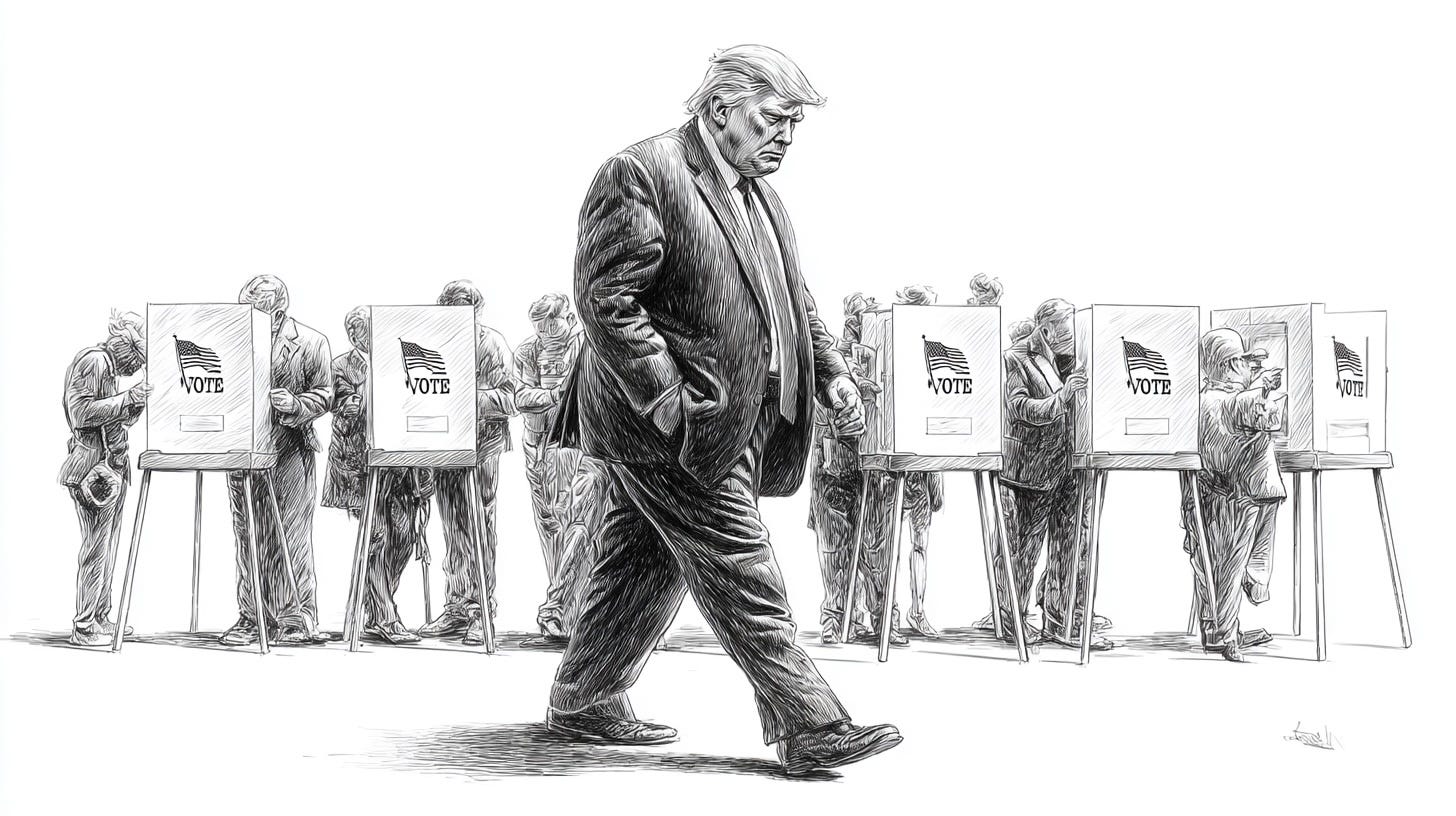
I know what you are thinking. You want to know what’s his plan and if it will work.
I have an answer. And I have the legal reasoning to back it up. Stay with me to the end of this article, and I will give you both.
Here is what I need you to understand right now. What is happening is not speculation. It is not a theory. The executive order exists. Trump signed it on March 31, 2026, in the Oval Office. It is Executive Order No. 14399, titled “Ensuring Citizenship Verification and Integrity in Federal Elections.” It was published in the Federal Register on April 3, 2026. And it is the most aggressive attempt by a sitting president to seize control of American elections in modern history.
Let me walk you through his playbook. Step by step. Because once you see it, you cannot unsee it.
The Executive Order
The order directs the Department of Homeland Security, working alongside the Social Security Administration, to compile a “State Citizenship List” of confirmed U.S. citizens eligible to vote in every state. DHS will build these lists from federal citizenship and naturalization records, Social Security Administration data, and the SAVE database, a citizenship verification system with a documented history of errors.
The order then directs the Postmaster General to initiate rulemaking within 60 days. The proposed rules would require the United States Postal Service to deliver mail ballots only to voters on a “State-specific Mail-in and Absentee Participation List.” Under the order’s language, USPS “shall not transmit mail-in or absentee ballots from any individual” not enrolled on that list.
Read that last line again. The president of the United States is directing the creation of rules that would give the post office the power to decide which Americans receive a ballot and which ones do not.
The order also directs the attorney general to prioritize the investigation and prosecution of state and local election officials who distribute ballots to voters the federal government has not pre-approved. It threatens to withhold federal funding from states and localities that do not comply.
On the same day Trump signed the order, he told reporters it was “foolproof.” He repeated his debunked claims about mail-in voting fraud. He called the cheating “legendary.” He said this would “help a lot with elections.”
Two days later, on April 2, Trump fired Attorney General Pam Bondi, the official the order had tasked with leading those investigations and prosecutions. Deputy Attorney General Todd Blanche, Trump’s former personal criminal defense lawyer, now serves as acting attorney general. The administration has not named a permanent replacement.
Here is the part Trump left out of his Oval Office remarks. Nearly one-third of all voters in the 2024 general election cast their ballots by mail. Eight states and Washington, D.C., send mail ballots automatically to all registered voters. Trump himself voted by mail in a Florida special election on March 24, 2026, one week before signing this order. When asked about the contradiction, he told reporters during a Cabinet meeting: “Because I’m president of the United States.” The day before he voted by mail, he told an audience in Memphis that “mail-in voting means mail-in cheating.”
The Democrat in that Florida race, Emily Gregory, won, flipping the state House seat that includes Trump’s Mar-a-Lago residence.
The Manufactured Crisis
Every con requires a setup. The con artist needs you to believe the threat is real before you accept the solution.
Trump has spent years building this setup. He has repeated, without any supporting evidence, that mail-in voting opens the door to mass fraud by noncitizens. No credible investigation has ever validated this claim. Federal and state systems already verify citizenship during voter registration. Noncitizen voting is already a federal crime carrying severe penalties. Study after study confirms it is virtually nonexistent.
The Brennan Center for Justice, the Bipartisan Policy Center, and multiple nonpartisan research organizations have reached the same conclusion. There is no widespread mail-in voting fraud in America. The infrastructure to prevent it already exists. The guardrails are in place.
None of that matters to this administration. What matters is creating enough fear and confusion that millions of eligible American voters question their own right to cast a ballot.
This is the second time Trump has tried this approach. In March 2025, he signed his first election-related executive order seeking sweeping changes to how states handle elections, including a requirement that voters show a passport or other citizenship document to register. Three separate federal courts found key provisions of that order unconstitutional. One court permanently blocked the citizenship-document requirement, ruling that the president lacks the authority to unilaterally alter election procedures. The executive order you are reading about today is the sequel. Same playbook. Higher stakes. Seven months before the midterms.
The manufactured crisis feeds the executive order. The executive order feeds the chaos. The chaos suppresses voter turnout. And suppressed turnout is the entire point.
Here is who gets hurt, what is coming next, and exactly what you need to do about it before November.
Who Gets Hurt
Think about who this executive order targets.
Think about the single parent working two jobs who does not have time to navigate a new federal verification system and confirm her name appears on a government database she never knew existed. Think about the 72-year-old retiree who has voted by mail in every election for 20 years and suddenly receives nothing in her mailbox. Think about the naturalized citizen who earned his citizenship a decade ago and now fears that a flawed federal database will flag him as ineligible.
That last concern is not hypothetical. The SAVE database that DHS uses to verify citizenship and immigration status has a documented history of producing flawed results. A WR Immigration analysis of the order noted that federal systems “have had a higher level of errors related to naturalized citizens as opposed to other immigration statuses.” With an estimated 52 million naturalized and foreign-born U.S. citizens eligible to vote, even small data inaccuracies create meaningful barriers.
The Brennan Center for Justice described the combination of incomplete citizenship lists and USPS restrictions this way: “Our government’s citizenship lists are incomplete and inaccurate. The United States Postal Service is overburdened and inadequate. This combines a car crash with a train wreck.”
Now consider the timeline. The order requires citizenship lists to be updated and transmitted to state election officials no fewer than 60 days before a federal election. States would need to notify USPS 90 days before the election if they intend to use mail ballots. Any voter not on that list does not receive a mail ballot. Any error in the federal database means a legitimate voter gets shut out. And the entire system must be built, tested, and deployed before November 2026, with primaries already underway across the country.
Rick Hasen, one of the country’s leading election law scholars at UCLA, wrote that the order is likely unconstitutional and that implementing it in time for November’s elections is “virtually impossible.” He added that even if it were not blocked by courts, it “seems highly unlikely any of this could be implemented for 2026.”
Impossible to implement. Perfectly designed to create confusion.
The Litigation Flood
Within 72 hours of Trump signing the order, lawsuits started hitting federal courthouses across the country.
A coalition of 23 attorneys general, including the District of Columbia, joined by Pennsylvania Governor Josh Shapiro, filed suit in the U.S. District Court for the District of Massachusetts. The coalition, co-led by California Attorney General Rob Bonta, called the order “a shocking and unprecedented power grab.” The lawsuit argues that the president violated the Constitution by usurping the states’ power to administer their own elections.
The Democratic National Committee and Democratic Governors Association filed a separate challenge in the U.S. District Court for the District of Columbia. The NAACP, Common Cause, and the Black Voters Matter Fund filed their own lawsuit. The League of United Latin American Citizens, the Secure Families Initiative, and the Arizona Students’ Association also sued in D.C. federal court. At least five federal lawsuits now challenge the order.
The legal argument is straightforward. The Constitution delegates authority over election administration to the states and to Congress. The president has no role in setting election rules. Article I gives Congress the power to alter state election regulations. The executive branch does not have that authority.
David Becker, former Justice Department lawyer and executive director of the Center for Election Innovation and Research, put it plainly: the president has no power over elections in the states. He added that the president has no authority to tell the Postal Service what mail it can and cannot deliver. He called the order “clearly unconstitutional.”
The precedent already exists. Three federal courts found key provisions of Trump’s March 2025 election executive order unconstitutional. One court permanently blocked the provision requiring documentary proof of citizenship to register using the national voter registration form, finding that the president lacks authority to unilaterally alter election procedures. Two of those lower court decisions remain on appeal.
This is not new territory. The courts have already spoken on this question. And the answer keeps coming back the same way.
The Real Strategy
Here is where you need to pay close attention. The lawsuits are part of the strategy, not a flaw in it.
Trump’s team knows the executive order will face legal challenges. They watched courts block the first one. They expect the same outcome here. The legal battles serve a different purpose entirely.
Every lawsuit creates a headline. Every headline creates uncertainty. Every moment of uncertainty makes a voter somewhere in America wonder whether their registration is valid, whether their mail ballot will arrive, whether showing up to vote is worth the hassle.
As Michigan Secretary of State Jocelyn Benson put it: “This Executive Order is illegal. It was designed to create confusion and chaos. If left unchecked, it will block millions of eligible American citizens from exercising their fundamental right to vote.”
Nevada’s Secretary of State Francisco Aguilar said Trump “has spent years attempting to manufacture a crisis around mail voting when there is none” and that his actions “create chaos and confusion for voters in the middle of an election year.”
The executive order does not need to survive in court to accomplish its mission. It needs to survive long enough to create doubt. Doubt suppresses turnout. And in a midterm election where a handful of seats will determine control of Congress, even a small drop in voter participation changes the outcome.
This is voter suppression wearing a suit and holding a pen.
The Two Scenarios
The 2026 midterm elections will go one of two ways.
Scenario one. Republicans maintain their majority in Congress. Everything continues as it has since January 2025. Project 2025 keeps rolling. ICE. More trade wars. Greenland. Panama. The Iran War. Bottom line, the executive branch keeps expanding its reach into areas the Constitution never intended. Congress looks the other way because the majority has no incentive to check the power of a president from their own party.
Scenario two. Voters show up. In massive numbers. Despite the executive order. Despite the confusion. Despite the lawsuits and the headlines and the uncertainty. A wave of voters overwhelms the suppression effort and puts Democrats back in the majority in the House and potentially the Senate.
If scenario two happens, watch what comes next. Trump will demand that Republican allies in Congress take action to delay the certification of election results. He knows that the new majority’s power with oversight, issuing subpoenas, controlling the power of the purse and enforcing the separation of powers will make him a lame duck president for his remaining two years in office.
He will point to his own executive order as evidence that the election was compromised. He will claim the very chaos his order created as proof that the results cannot be trusted.
This is the playbook. Create the problem. Blame the problem on your opponents. Use the problem as justification to override the outcome.
We watched this playbook run in 2020. The difference this time is that Trump is the sitting president with the full power of the executive branch behind every move.
What the Numbers Tell Us
Here is what Trump does not want you to see.
The backlash is already building. According to the election analysis publication The Downballot, Democrats have improved upon their 2024 presidential election margins by an average of 11 percentage points in special elections throughout 2026. That number rises to approximately 13 points when you include all special elections since the start of 2025.
In the Wisconsin Supreme Court race on April 8, 2026, liberal candidate Chris Taylor defeated conservative candidate Maria Lazar by approximately 20 points, expanding the court’s liberal majority from 4-3 to 5-2. Trump carried Wisconsin by less than a point in 2024.
In the special election for Marjorie Taylor Greene’s former 14th Congressional District in Georgia, also on April 8, Republican Clay Fuller won a district Trump carried by 37 points in 2024. The margin of victory for Fuller dropped to less than 12 points. A swing of more than 25 points toward Democrats in one of the reddest districts in the country.
In Texas, a record 2.3 million votes were cast in the March 2026 Democratic primary. More people voted in the Democratic statewide primary in North Carolina than in the Republican one. Mississippi saw a nearly 80 percent increase in Democratic primary turnout compared to the last Senate primary in 2018.
Since Trump returned to the White House in January 2025, Democrats have flipped 30 state legislative seats in special elections. Republicans have flipped zero.
On Polymarket, the prediction market platform, traders price a Democratic wave in the 2026 midterms at 87.5 percent implied probability as of early April 2026. Multiple polling averages show Democrats holding a lead of 3 to 6 points on the generic congressional ballot. Forecasters at Cook Political Report and Sabato’s Crystal Ball have been shifting competitive House races toward Democrats.
Trump’s own approval rating tells the story. The RealClearPolitics average sits at approximately 41 percent approval against 56 percent disapproval. Major polls released April 1 puts his economic approval at a career-low 31 percent. His net approval in the Silver Bulletin average hit a second-term low of negative 17.5 points in recent days. The UMass Lowell/YouGov national poll released this week shows his approval at 39 percent, with 57 percent of respondents saying their lives have become more difficult over the past six months and 67 percent saying the country is on the wrong track.
The Iran war. Gas prices above four dollars a gallon after the closure of the Strait of Hormuz. Tariffs squeezing American consumers. ICE operations splitting families and terrorizing communities. The Epstein files and the administration’s refusal to pursue full accountability, a debacle so damaging that it cost Bondi her job. The Greenland provocation. The daily hostility directed at half the American population.
The UMass Lowell poll found that 65 percent of respondents say the cost of the Iran war is too great. In the same poll, 87 percent support pursuing criminal investigations of American individuals named in the Epstein files, and 65 percent believe Trump has a personal interest in withholding the release of those files.
Voters are paying attention. And they are angry.
My Prediction
You stayed with me. Here is my answer.
I do not think Trump’s plan to steal the 2026 midterms will work.
Here is why.
The courts will find, either before or after the November elections, that Executive Order 14399 lacks a factual or legal basis and exceeds the president’s constitutional authority over state-run elections. This is not a prediction based on hope. It is a prediction based on precedent.
Three federal courts have already blocked key provisions of Trump’s first election executive order from March 2025. One court permanently enjoined the citizenship-document requirement, ruling the president lacks authority to alter election procedures unilaterally. The constitutional framework on this question is settled. The president does not control elections. States do. Congress can make laws governing elections. The president cannot.
The litigation will continue (thank God for good lawyers and honest judges). Injunctions will likely freeze key provisions of the order before November. And even if portions survive long enough to create confusion, the courts will ultimately find the order unconstitutional. Five separate federal lawsuits, filed by 23 attorneys general, the Democratic National Committee, the NAACP, the League of United Latin American Citizens, and other civil rights organizations, all make the same core argument. They are right on the law.
I also believe we will witness a historic turnout of Democratic voters in the 2026 midterms. Not despite the executive order. Because of it.
Every attempt to suppress the vote energizes the people targeted. Every attack on mail-in voting makes another voter determined to show up in person. Every threat against election officials makes another community organize and mobilize. We saw this in 2018 when Democrats gained 40 House seats. We saw it in the 2025 off-year elections when Democrats swept all 13 statewide races, won commanding victories in the New Jersey and Virginia governor’s races, and flipped 13 House of Delegates seats in Virginia alone. We saw it again in the April 8, 2026, elections in Wisconsin and Georgia, where Democrats posted their largest overperformance margins of the entire cycle.
I see Democrats taking back a majority in the House. I see a competitive fight for the Senate that puts Democratic control within reach. The Democrats need to gain four Senate seats to take the majority. Seats in Ohio, Maine, North Carolina, and Alaska are in play. I see an electorate that has watched tariffs raise the cost of everything, an unnecessary war in Iran spike gas prices to crisis levels, immigration enforcement terrorize families, and an administration treat congressional oversight as an inconvenience to be ignored.
Here is the most important part. When the dust settles, the votes will tell the same story they told in 2020.
Remember what happened after the 2020 election. Trump and his allies filed 62 lawsuits challenging the results in nine states and the District of Columbia. Sixty-one of those 62 lawsuits failed. Courts dismissed them for lack of evidence or lack of standing. Thirty of those cases involved hearings on the merits, meaning judges looked at the evidence and found nothing. The one case Trump won involved a narrow procedural question in Pennsylvania about the deadline for voters to provide identification for mail-in ballots. It did not affect the outcome. Biden still won Pennsylvania by more than 80,000 votes.
No court, no investigation, no audit found evidence of fraud at any level that would have affected the outcome of the 2020 election.
And notice what happened in 2024. Trump won. No fraud allegations. No lawsuits. No claims of a rigged system. No demands for recounts. No accusations of noncitizen voting. Silence. He only cries foul when he loses.
The 2026 midterms will follow the same path. Regardless of the executive order. Regardless of the court battles. Regardless of congressional Republicans refusing to perform their constitutional duty. When every legal challenge is resolved and every vote is counted, the results will stand. Because the votes will be legitimate. Because the system, despite every attempt to break it, will hold.
What a Democratic Majority Means
Let me tell you what changes when Democrats take back Congress.
The power of subpoena returns. Congressional committees regain the authority to investigate, to compel testimony, to demand documents. The oversight function that the Constitution requires and that the current majority has abandoned gets restored. Committees can investigate the Iran war, the Epstein files, the politicization of the Justice Department, the misuse of executive orders, and the dozens of agencies that have been gutted without accountability.
The power of the purse returns. Article I of the Constitution gives Congress control over federal spending. A Democratic majority can fund the programs this administration has dismantled. It can protect Social Security, Medicare, and Medicaid from further cuts. It can block funding for executive overreach and force the administration to justify every dollar it spends. It can defund the enforcement mechanisms of unconstitutional executive orders and redirect resources toward programs that serve the public interest.
The separation of powers gets reestablished. The founders designed three co-equal branches of government for a reason. They understood that unchecked executive power corrodes democratic governance. A Democratic majority in Congress restores the legislative branch as a meaningful check on the presidency. It restores the balance that has been systematically dismantled since January 2025.
This is not about partisan politics. This is about constitutional governance. This is about whether the system the founders built can survive a president who treats every institution as an obstacle and every election he loses as a crime.
What You Need to Do Right Now
Verify your voter registration today. Do not wait. Go to vote.org or your state secretary of state’s website and confirm that your registration is active and your information is current.
If you vote by mail, request your ballot early. Do not rely on automatic systems that this executive order seeks to disrupt. Contact your local election office directly. Confirm your status. Get a plan in place now, seven months before election day.
Talk to five people in your life who might sit this one out. Share this article. Share the facts. Make sure they understand what is at stake.
The executive order wants you to feel overwhelmed. It wants you to feel like your vote does not matter. It wants you to give up before the fight even starts.
Do not give them what they want.
Your vote is your power. Use it.
Mitch Jackson, Esq.
Belts-&-*suspenders: concerned governors should alert their National Guards(wo)men that they may be deployed to protect against election fraud.💡
When the drumpf-bunch show up, the governor says, "Mr President, not to worry, we have mobilized [if not deployed] our guards(wo)men to do just what you you want us to do."🫱🏻🫲🏽
Then, on election day, protect the polling places from I.C.E. thugs intimidating voters.🖕
I would also set up mail-in ballot pick-ups so they can be transported to polling places and counted there as votes cast; this initiative would have to be transparent and squaky clean.🗽
Thank you for all your hard work. I always look forward to reading your articles. You have a wonderful gift of simplifying the complex.
Keep up the amazing job.