

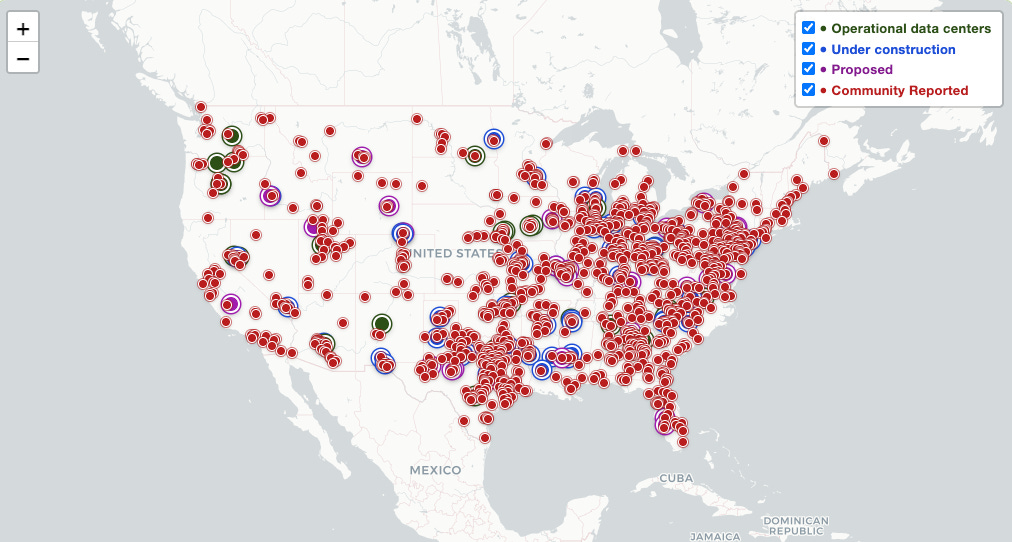
[Credit: Brockovich AI Data Center Reporting]
You wake up, pour your coffee, and notice trucks rolling down the county road outside your house. Big ones. Day after day. You ask around. A neighbor heard something about a tech project. Another heard it was a warehouse. Nobody knows for sure. Then the digging starts, and within months a structure rises out of what used to be farmland, and you learn the deal was signed before you ever heard the word.
This is happening right now, in real American towns, to real American families. The loudest complaint coming out of these communities is not noise, not water, not even the cost. It is one word.
Transparency.
You deserve to know what is being built next to your home, what it will do to your air and water and power bill, and who decided all of this without asking you. So let me walk you through it, plainly, the way I would explain it to a jury. By the end, you will understand more about these projects than most of the officials who approved them.
How Many Are Out There, and How Big Are We Talking
The United States already runs somewhere between roughly four thousand and five thousand four hundred data centers, depending on who counts and what they count. Many went up years ago, long before the artificial intelligence boom, sitting quietly in industrial parks where almost nobody noticed them.
That era is over.
A new kind of facility is going up now, and the scale of it will stop you cold. In Richland Parish in northeast Louisiana, Meta is building a four million square foot campus called Hyperion on roughly twenty two hundred acres, with hundreds more acres reportedly bought for a second phase. That parcel covers about a quarter the area of Manhattan. Mark Zuckerberg has described the eventual build, scaled to five gigawatts of power over years, as large enough to cover a big chunk of Manhattan, and President Trump held up a graphic of that comparison at the White House. At its first two gigawatt stage, industry analysts project the campus will burn through about three times the annual electricity of New Orleans, and far more as it grows.
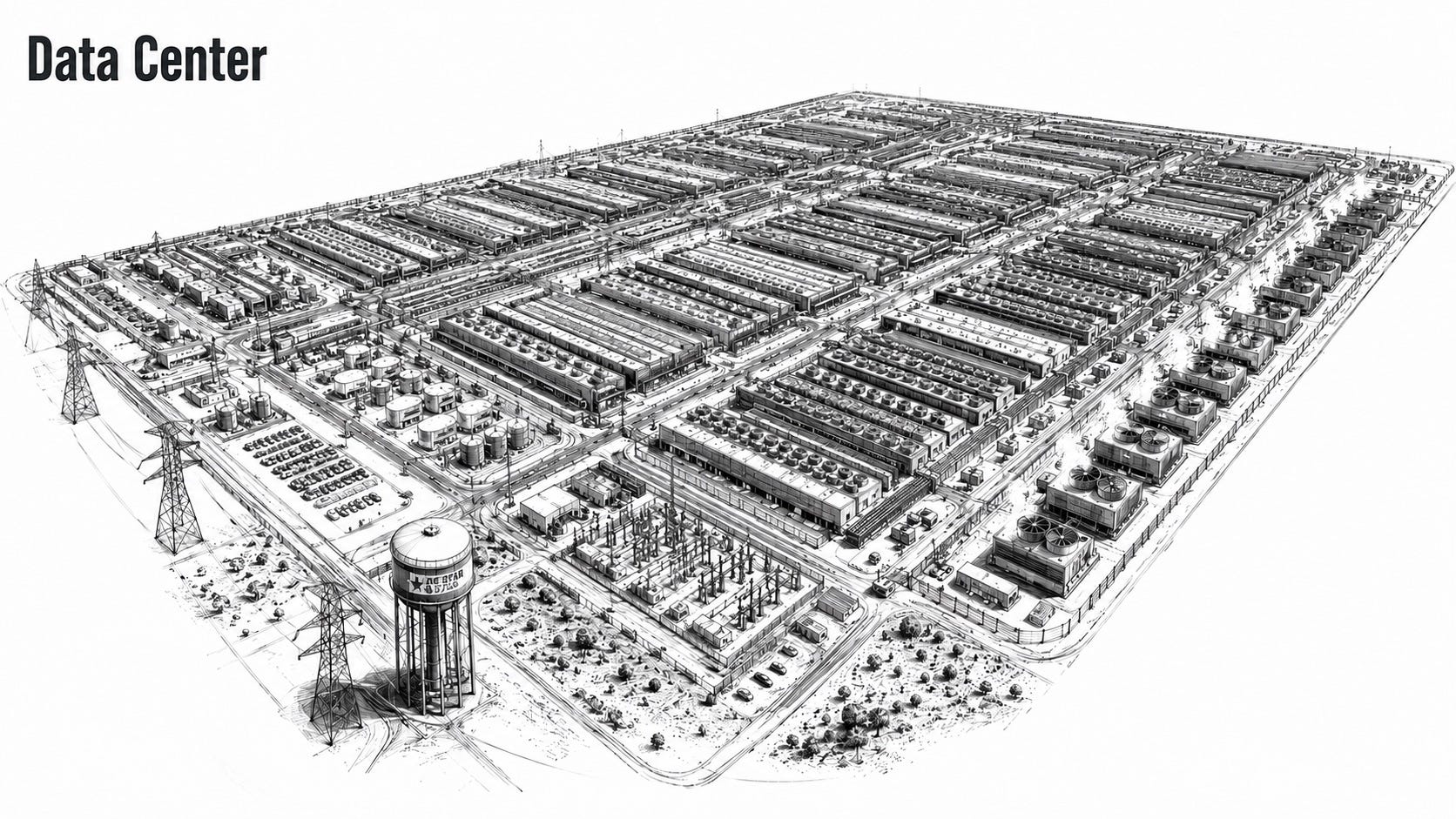
In West Memphis, Arkansas, Google has broken ground on what state officials call the largest private capital investment in Arkansas history, a multibillion dollar campus across roughly eleven hundred acres, with the announced first phase running four billion dollars through 2027 and reports of the full project climbing far higher. In rural Indiana, Amazon turned twelve hundred acres of farmland into an eleven billion dollar facility. In Wisconsin, Microsoft has poured more than seven billion dollars into a single county.
Texas alone runs hundreds of these centers, with hundreds more on the way. Virginia, the world capital of this construction, packs counties so densely that data centers already eat around a quarter of the entire state’s electricity.
Thousands exist. Thousands more are planned. The biggest facilities span thousands of acres and draw power measured against major cities, and they are landing in towns of fewer than twenty thousand residents.
Who Is Pushing All of This
Follow the money and the picture sharpens fast.
The companies building these centers are the largest corporations on earth. Meta. Amazon. Google’s parent Alphabet. Microsoft. Elon Musk’s xAI. Firms with hundreds of billions in spending power, racing each other to build computing capacity faster than anyone has built anything like it.
Behind them sits a well funded political operation built to smooth the path. A Washington trade association called NetChoice, whose members include Amazon, Google, and Meta, runs campaigns with friendly names like “Data Centers Help Local Communities.” You may have seen the ads. The messaging hammers jobs, tax revenue, and broadband. It stays silent on community consent, on environmental damage, on your right to know what is coming before the permits are signed. Another group, the Data Center Coalition, includes those same giants and fights any rule that would force these facilities to curb their power use during grid emergencies.
These are not neutral research groups. They are lobbies funded by the companies that profit from the construction. When an ad tells you a data center is good for your town, ask who paid for that message and what they are selling.
How Local Officials Keep You in the Dark
Here is the part that should make every American voter sit up straight.
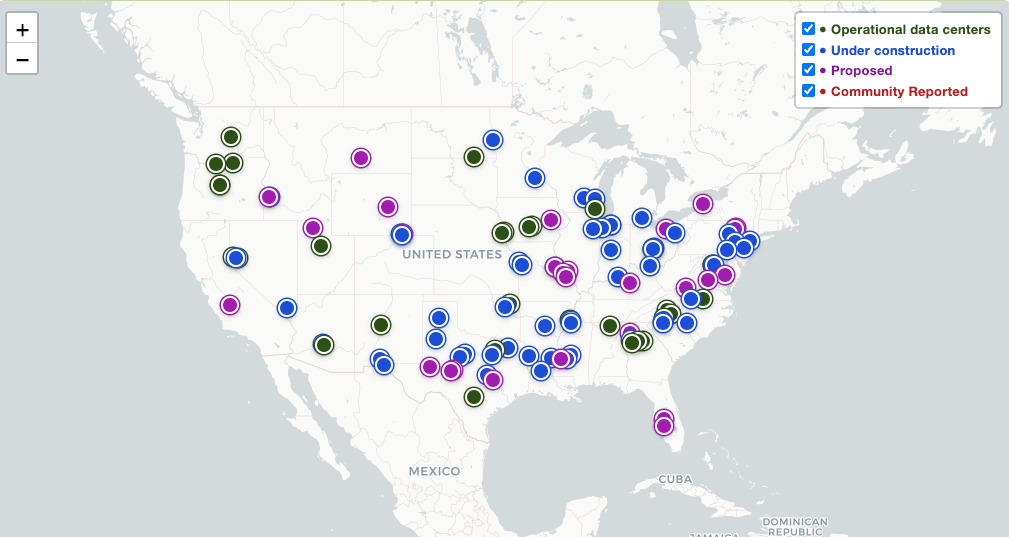
In community after community, residents discover these projects only after the decisions are final. Erin Brockovich (Brockovich AI Data Center Reporting), the consumer advocate you know from the movie about toxic water in California, put out a simple request in late April. She asked people to report concerns about AI data centers near them. She expected a handful of responses. Within a month, by late May 2026, her public map filled with more than twenty seven hundred pins from nearly four thousand resident reports across forty nine states.
Diane Cobb in Richland Parish, Louisiana found out about the Meta facility the same way everyone else did. When they started digging. There was supposedly a community meeting, she said, and nobody she knew heard a word about it.
In rural Montana, a mother named Kassi Solberg stood up at a town hall and asked one direct question. Had anyone on the council signed a nondisclosure agreement with the developer that would keep them silent. The mayor answered that the council was not obligated to address the public’s questions, based on what the town’s lawyer told him. Solberg put it bluntly to a reporter. These companies count on country people being too slow to push back, she said, and by the time you figure out their plans, the data center is already built.
That is the playbook. Nondisclosure agreements signed by your elected officials. Deals locked in before public comment. Planning meetings staged after the real choices were made behind closed doors. Permits secured quietly, so by the time you notice the trucks, your voice no longer counts.
Your local government works for you. When it signs a secrecy agreement with a corporation over a project that will reshape your community, it has stopped working for you and started working for them.
What This Does to Your Electricity
Now to the power bill that lands in your mailbox.
Data centers consumed roughly four to five percent of all electricity generated in the United States as recently as 2023. The Electric Power Research Institute, a respected research organization, now projects that figure could hit nine to seventeen percent by 2030. More than double current use in a few short years, and their new estimate runs sixty percent higher than what the same group predicted only two years ago. The growth outruns the experts updating their own forecasts.
A single hyperscale data center can use as much electricity as fifty thousand homes.
You are already paying for this in parts of the country. In the regional grid called PJM, which serves about sixty seven million people across thirteen states from Virginia to Illinois, an independent market monitor found data centers responsible for sixty three percent of a recent capacity price increase. That meant roughly nine billion dollars in extra costs passed to customers in one year. In Washington D.C., Pepco residential customers watched their bills climb by an average of twenty one dollars a month, and consumer advocates traced about half of that increase to these capacity spikes. Analysts now warn the typical PJM family could face around seventy dollars more per month by 2028, with cumulative costs topping one hundred billion dollars through 2033.
Honesty requires one clarification. Energy economists do not all agree on how much of your rising bill traces to data centers versus other forces like coal plant retirements, volatile natural gas prices, and the design of these power markets. Some pin much of the blame on market structure, with data center demand acting as a powerful accelerant rather than the sole cause. The point that survives the debate is the one that hits your wallet. Utilities build the infrastructure to serve these enormous new customers, and the public repays it through rates. Harvard Law School’s electricity experts have documented exactly that pattern. The corporation gets the computing power. You help cover the bill.
Grid reliability is now a live concern too. PJM has warned that starting in the summer of 2026 it will have barely enough power to keep the lights on, and the region could fall below reliability standards as early as 2027. Some communities near these facilities already report electricity cutting out for days at a time.
The Construction Problems Nobody Mentions
Building something the size of a small city does not happen gently.
These projects clear hundreds or thousands of acres of farmland, forest, and open ground. The grading churns up enormous quantities of dirt. Heavy trucks pound rural roads never built to carry them. The work often runs around the clock, with lighting and noise that never stops. At the Louisiana site, around five thousand temporary construction workers flooded into an area with only about twenty thousand permanent residents, and locals complained about traffic, noise, light pollution from the all night schedule, and shifting water tables that hit the neighbors who depend on well water.
Then there is power. Many facilities cannot wait for the grid to catch up, so the companies arrange their own generation. In Louisiana, the utility Entergy is building new gas turbine plants largely to serve the Meta campus. In Mississippi, Musk’s xAI built what amounts to a private power plant of gas turbines next to homes, schools, and churches to feed its Colossus data centers across the state line in Memphis. That brings us to the health questions.
The Health Issues
Here it stops being about megawatts and starts being about your lungs and your children’s lungs.
In the Memphis area, xAI installed and ran dozens of natural gas turbines to power its computing facilities. According to the lawsuit the NAACP filed in April 2026, represented by the Southern Environmental Law Center and Earthjustice, the company ran twenty seven turbines in Southaven, Mississippi and operated them before securing the proper air permit. Mississippi regulators granted a permit for those turbines in March 2026, and the legal fight centers on running them before that approval and on whether adequate pollution controls were ever in place. At its earlier Memphis site, xAI used as many as thirty five turbines. By spring 2026, reporting put the count at the Southaven facility past forty. The civil rights organization alleges these turbines could make that facility the single largest industrial source of smog forming nitrogen oxides in the entire eleven county Memphis region.
Gas turbines emit fine particulate matter, smog forming pollution, and hazardous chemicals including formaldehyde. Health experts tie these pollutants to asthma, respiratory disease, heart problems, and certain cancers. Memphis already carried some of the worst air quality in its region and earned the title of an asthma capital of the nation in 2024. Now residents nearby breathe the output of an industrial power plant that, according to the civil rights organization suing over it, expanded without adequate notice to the community.
The NAACP framed the stakes in language no parent can ignore. A data center, they said, should not become a death sentence for a community’s health, and homes and churches and playgrounds should not become sacrifice zones for the convenience of big technology companies.
Families around these sites report something simpler and harder to measure. Everyone seems to have gotten sicker since the construction arrived. They cannot always prove the connection. They should not have to fight alone to find out.
How the Environment and Wildlife Get Harmed
The damage reaches well past the property line.
Clearing thousands of acres destroys the habitat wildlife depends on. The Louisiana site sits in flatlands known for soybean fields and stands of rivercane, a native plant woven into the region’s ecology and cultural history. Turning that into a sprawling industrial campus leaves the surrounding ecosystem changed.
Air pollution from on site power generation settles into the soil and water around these facilities. The noise runs constantly, scrambling the patterns animals rely on. Residents near the Louisiana project report finding sick animals they cannot explain. These accounts do not amount to courtroom proof on their own, and they form a pattern honest oversight would investigate rather than ignore.
Heat Spikes and What They Mean
Here is a problem most people have never heard of.
These facilities throw off staggering amounts of heat, twenty four hours a day, every day of the year. Thousands of computer chips packed into a building run hot, and all that heat has to go somewhere. Much of it pushes out into the surrounding air and into the water used for cooling.
Concentrate that much waste heat in one place and you create localized temperature increases. The ground around these facilities warms. The water released back into local sources comes back hotter than it left. Warmer water holds less oxygen, and aquatic life, fish, amphibians, the small creatures at the base of the food chain, suffers when oxygen drops. Higher local temperatures stress wildlife, stress crops, and pile onto communities that already endure brutal summers. The cooling demand itself peaks in hot weather, so these facilities pull the most water and power precisely when the surrounding community needs those resources most.
Water Availability and Contamination
Now to the resource we cannot live without for more than three days.
A typical data center can use around three hundred thousand gallons of water a day, roughly what a thousand households use. A large hyperscale facility can consume up to five million gallons a day, equal to the needs of a town of fifty thousand people. Up to eighty five percent of that water evaporates during cooling and never returns to the local supply.
American data centers directly consumed an estimated seventeen point four billion gallons of water in 2023, with projections climbing to as much as seventy three billion gallons a year by 2028. In Texas, where prolonged drought already strains supplies, researchers estimate data centers will use forty nine billion gallons in 2025 and as much as three hundred ninety nine billion by 2030. State analysts say Texas needs at least one hundred seventy four billion dollars over the next fifty years to dodge a major water crisis, and these facilities are pouring in at exactly the wrong moment.
In northern Virginia, data centers consumed close to two billion gallons of water in 2023, a sixty three percent jump from four years earlier. Loudoun County’s water authority has leaned on treated drinking water to supply these facilities instead of recycled water.
Contamination follows the consumption. The water that does return often carries higher concentrations of dissolved solids and heavier mineral loads, fouling drinking water, crops, and the creatures living downstream. Residents near the Louisiana facility have asked a question that deserves a real answer. Why does their water sometimes run brown.
Who Has Actually Done the Homework
You might assume projects this large get rigorous independent review before they break ground. The honest answer is that serious analysis is finally arriving, and much of it comes from outside the companies doing the building.
The Electric Power Research Institute has built detailed state by state projections of electricity demand. The Lawrence Berkeley National Laboratory has studied the energy and water draw. Harvard Law School’s electricity experts have documented how the public ends up funding the power infrastructure these private facilities require. The International Energy Agency has modeled the global energy picture. Consumer advocates like the Citizens Utility Board and the Natural Resources Defense Council have measured the hit to household bills. Environmental groups across the Midwest and the South have hauled these companies into court over air and water violations.
The work is real and credible. The trouble is the timing. Much of this analysis catches up only after the deals are signed and the concrete is poured. The companies move at the speed of a gold rush. The oversight moves at the speed of a research paper. Communities fall into the gap.
The Question That Cuts Through Everything
Erin Brockovich and her co author Suzanne Boothby asked it directly, and it organizes this entire issue.
If data centers are such a tremendous benefit to communities, why are so many built without meaningful community input.
Sit with that. When something genuinely helps your town, the people behind it hold public meetings, answer questions, and welcome scrutiny. They do not demand that your elected officials sign nondisclosure agreements. They do not lock in permits before you hear a word. They do not run lobbying campaigns to kill the rules that would force them to tell you the truth.
Secrecy is not the behavior of a project confident in its own benefits. Secrecy is the behavior of an operation that has calculated, correctly in too many cases, that informed residents would say no.
We Could Have Powered Most of This With the Sun and the Wind, and We Still Can
Here is the part the gas turbine salesmen do not want you to sit with. The cheapest, fastest, cleanest power in America right now is solar, wind, and batteries, and the numbers prove it. In 2026, solar, wind, and battery storage are set to make up roughly ninety nine percent of all new electricity generating capacity added to the United States grid, according to federal Energy Information Administration data. Wind has reclaimed its spot as the cheapest source of new electricity in the country, beating gas for the first time since 2023, because the rush of data centers doubled the cost of gas turbines in just two years and pushed combined cycle turbine prices to record highs.
Gas turbines are effectively sold out until at least 2029, with order to grid waits stretching five to seven years. A battery storage project averages under two years from start to finish. On site solar paired with battery storage can power a large share of a data center in roughly eighteen months, and co located solar and four hour battery systems already meet real data center demand at a lower cost than gas in places like Texas and California. The honest conclusion writes itself. Clean energy is no longer the slow, expensive, idealistic choice. It is the fast, cheap, available one, and the companies bolting dirty gas turbines next to your kids’ schools are choosing them out of habit and lobbying muscle, not necessity.
I want to be straight with you, because the truth here is stronger than any exaggeration. Solar panels and wind turbines alone do not solve this, and anyone who tells you otherwise is handing the gas industry an easy way to laugh off the whole idea. These data centers run flat out, twenty four hours a day, three hundred sixty five days a year. The sun sets. The wind drops. The data center’s appetite never does. Closing that gap takes firm clean power on top of solar and wind: longer duration battery storage that improves and gets cheaper every year, geothermal, hydro, and nuclear.
These same companies already know it. Meta has signed nuclear deals totaling as much as six point six gigawatts by 2035, including power from the Clinton plant in Illinois. Microsoft is paying to restart Three Mile Island. Google has ordered small modular reactors from Kairos Power and moved to reopen a shuttered Iowa nuclear plant. Amazon has poured billions into nuclear too. So the technology to power all of this cleanly exists, and the corporations are buying it. The catch they will not say out loud is the calendar. Three Mile Island does not come back until 2028, and the new reactors land around 2030 or later, which is exactly why they are reaching for gas right now to fill the gap today.
That timing problem is the whole argument for why we should have started ten years ago, and the reason it stings. Solar costs have dropped close to ninety percent over the past decade, and battery costs have followed the same plunge, hitting record lows again this year. Had we committed a decade back to building clean generation, the transmission lines to carry it, and the firm clean power to back it up, treating it as the national infrastructure project it always deserved to be, we would have walked into this AI boom with a grid already overbuilt with cheap, pollution free power waiting to be used.
The wind farms would already be spinning. The solar fields would already be soaking up the sun. The storage and the reactors would already be carrying the load through the night. We would be plugging data centers into clean abundance instead of scrambling to bolt unpermitted gas turbines onto frontline communities and handing the pollution and the power bills to the people who never agreed to any of it. The trees were best planted ten years ago, and the second best time is today.
A serious national push, clearing the four to five year interconnection backlog, fast tracking transmission, accelerating clean firm power, and pairing every new data center with its own dedicated clean generation and storage, could carry this load. Not someday. This decade. The technology is here. The prices have won the argument. The only thing missing is the political will to demand that the richest corporations on earth build their future on power that does not poison ours.
Communities Are Fighting Back and Winning
This is the part that should put steel in your spine.
When people find out and show up, they change the outcome. In Monroe Township, New Jersey, residents packed planning board meetings after discovering a proposed million square foot data center on farmland. By April the township banned data centers entirely, and the project collapsed. Pemberton Township passed what advocates call New Jersey’s first municipal data center ban. Advocates across the state now push for a statewide moratorium. In Utah, a massive proposed facility backed by a well known investor faces mounting opposition. In Montana, the mother who asked about the secret nondisclosure agreements made national headlines and forced the conversation into the open.
The pattern holds in every state. When the community stays in the dark, the corporation wins. When the community gets informed, organizes, and shows up, the people win.
What You Do Now
You do not need a law degree or an engineering background to protect your own town. You need to pay attention and refuse to stay quiet.
Go to your local planning board meetings. Ask your elected officials direct questions and write down their answers. Ask what they knew about any proposed data center and when they knew it. Ask whether anyone signed a nondisclosure agreement with a developer. Ask to see the full environmental and energy impact assessments, and if those documents do not exist, ask why your representatives would approve something this large without them.
Talk to your neighbors. One worried resident looks like a complainer. A hundred informed residents look like a movement, and movements change votes and reverse decisions.
Share what you learned here. The greatest weapon these projects rely on is your silence and your confusion. Every person who understands what is really happening blunts that weapon.
Energy matters. Computing matters. The future of American technology matters. None of it requires you to surrender your air, your water, your power bill, and your right to know, all decided in a room you were never invited into.
You get a seat at the table. That is not a radical demand. That is the bare minimum a democracy owes the people who live in it. Now go claim your seat, and bring your neighbors with you.
Mitch Jackson, Esq.
Subscribe To Uncensored Objection
The same nondisclosure agreements that keep your neighbors in the dark are exactly why I write Uncensored Objection: to dig up the facts somebody decided you weren’t supposed to see and put them in your hands. Subscribe free to get every piece, or go premium to fuel the deeper investigations, because you deserve to always know what’s really going on in your own backyard.
This tech may offer some solutions down the line...
Atoco is a California startup built on metal-organic frameworks, a class of porous crystalline materials invented by Omar Yaghi, the UC Berkeley chemist who shared the 2025 Nobel Prize in Chemistry with Susumu Kitagawa and Richard Robson for developing them. These frameworks, called MOFs, are engineered at the atomic level so that a few grams hold an internal surface area the size of a sports arena, and they are tuned to trap only water molecules out of the surrounding air, even in extremely dry regions. Atoco packs this material into a unit the size of a 20-foot shipping container, where the MOFs silently pull H2O from the air and store it in their microscopic cavities before releasing it as water. Because the material grabs only H2O, the water comes out near distilled quality, free of PFAS, microplastics, and other contaminants. The company has tested the technology in Death Valley, one of the driest places on Earth, and confirmed it can still produce clean water there. Yaghi serves as Atoco's Chief Science Officer.
The output depends heavily on conditions and on how the unit is powered. On-grid units that run on electricity cycle more often and produce roughly 2,000 to 4,000 liters, about 1,057 gallons at the top end, of high-purity water per day, while off-grid units that run on ambient or waste heat produce up to about 1,000 liters a day, so the headline figure of 4,000 liters is a best case rather than a guarantee. As of spring 2026 the technology is preproduction, with a commercial prototype demonstrated for Bloomberg in an Orange County parking lot in April 2026 and volume production slated for later in the year, pending field tests. Atoco has not released pricing, though it estimates the water will cost a few cents per liter, which is more expensive than desalinated water, with the selling points being purity, decentralization, and resilience rather than low cost. Interest in the technology has risen partly because the Iran war exposed the vulnerability of large centralized desalination plants that became military targets, and Atoco is marketing the units to data centers, semiconductor plants, hospitals, farms, and any water-stressed region, though it would take roughly a dozen units to supply even a single water-efficient data center, and a competitor called AirJoule, a joint venture with GE Vernova, is pursuing a similar MOF-based harvester producing about 2,000 liters a day on a comparable timeline.
Atoco's official website is: https://atoco.com
Its press release on the atmospheric water harvesting prototype is at https://atoco.com/press/atoco-unveils-atmospheric-water-harvesting-on-grid-prototype/.
The most detailed independent reporting on the project I've come across is the Bloomberg feature from May 12, 2026, titled "Startup Atoco Unveils Device That Pulls Drinking Water From Air," at https://www.bloomberg.com/news/features/2026-05-12/startup-atoco-unveils-device-that-pulls-drinking-water-from-air (Bloomberg may be behind a paywall. The Mining.com writeup covers much of the same reporting if the Bloomberg link is blocked.)
A comment about the power plants. Gas turbines, of course, burn fossil fuels, which contribute to climate change. But not all gas turbines are alike. Combined-cycle plants with modern pollution control are pretty clean, with zero particulates, no sulfur oxides, and pretty low nitrogen oxides. On the other hand, single-cycle peaker plants emit far more pollution of all kinds.
Wanna guess what the difference is?
$$$$$$$.
Combined-cycle plants are far more costly to buy, build, and operate.
Single-cycle rapid startup machines are cheap and quick.
I'll leave you to guess which species of gas turbine is preferred by the data center builders.
Also, of course, any fossil fuel generator is bad for climate.