

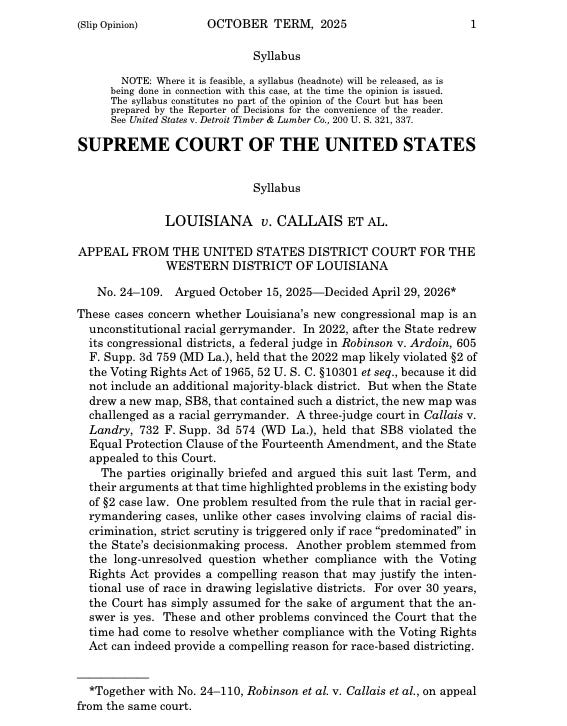
EXECUTIVE SUMMARY: Louisiana v. Callais, decided April 29, 2026, is the day six Supreme Court justices finished what they started in 2013 and gutted the Voting Rights Act. In a 6-3 ruling written by Justice Samuel Alito, the Court struck down Louisiana’s majority-Black congressional district and rewrote the forty-year-old legal standard that minority voters have used to challenge discriminatory maps, now requiring proof that a state intended to discriminate, a bar Justice Elena Kagan called in dissent “well-nigh impossible” to clear. Kagan said Section 2 of the Voting Rights Act is “all but a dead letter.” The White House called it a complete and total victory. Sixty-one years after John Lewis took a billy club to the skull on the Edmund Pettus Bridge so that every American could vote, the Court handed that victory to the people working hardest to make your vote disappear.
Today, six justices of the United States Supreme Court signed their names to a decision civil rights leaders are calling a betrayal. They struck down a Louisiana congressional map drawn to give Black voters fair representation. They told the country the Voting Rights Act of 1965 still stands. In truth, I stand with the three dissenting justices who said something different. They said the conservative majority gutted the law millions of Americans bled for.
I agree.
Here is what you need to know. This decision lands sixty-two years after Selma. Sixty-two years after John Lewis took a billy club to the skull on the Edmund Pettus Bridge to win the right to vote for every Black American in the South. The ruling lands during Donald Trump’s second term, in a country already torn down the middle. Within hours of the decision, Florida’s legislature passed a new congressional map handing Republicans as many as four additional seats. Other Southern states are lining up to do the same.
You should be angry. I am.
What The Court Did Today
Justice Samuel Alito wrote the majority opinion. He told the country Louisiana lawmakers violated the equal protection clause when they drew a second majority-Black district to comply with the Voting Rights Act. He said the forty-year-old framework courts have used to evaluate race in redistricting needs an update.
Translate his ruling into plain English. The Supreme Court has decided when a state tries to follow the Voting Rights Act, the state risks breaking the Constitution by following it. Read those words again until they sting.
Justice Elena Kagan, in dissent, said the conservatives took the final step in dismantling the most important civil rights law of the twentieth century. Martin Luther King III called the ruling a moral indictment. Marc Morial of the National Urban League called it a betrayal. You can read the entire case here.
The Blood That Built This Law
Before anyone tries to tell you the Voting Rights Act is some old, expired statute outliving its usefulness, sit with the history for a moment.
In 1964, fewer than seven percent of eligible Black adults in Mississippi were registered to vote. Across the South, election officials handed out literacy tests written to be impossible. They asked Black voters to recite the Constitution from memory. They asked them to count the bubbles in a bar of soap. They charged poll taxes working families had no way to afford. They unleashed sheriffs, dogs, and fire hoses on Americans who dared to register.
On March 7, 1965, approximately six hundred peaceful marchers crossed the Edmund Pettus Bridge in Selma, Alabama. State troopers attacked them with billy clubs and tear gas. The whole country watched on television. A young John Lewis took a club to the head and suffered a fractured skull. Americans named that day Bloody Sunday.
President Lyndon Johnson, watching the country erupt, stood before a joint session of Congress eight days later. He borrowed the rallying cry of the civil rights movement. And we shall overcome.
On August 6, 1965, he signed the Voting Rights Act into law.
How Well The Law Worked
Within two years, Black voter registration in Mississippi climbed from less than seven percent to nearly sixty percent. Within a decade, the number of Black elected officials in the seven Southern states originally covered by the Act grew from fewer than one hundred to more than nine hundred. Black mayors. Black sheriffs. Black members of Congress. Local school board members. State legislators. Federal judges. People who looked like the communities they served, finally choosing the people governing them.
The Voting Rights Act worked because the law let federal courts step in when state legislatures drew district lines designed to dilute the votes of Black Americans. Section 2 of the law allowed ordinary citizens to challenge maps submerging minority communities into white-majority districts where state lawmakers drowned out their voices at the ballot box.
The law worked because the law had teeth.
Today, The Supreme Court Pulled Those Teeth Out
What today’s ruling unleashes
Florida’s legislature did not wait for the ink to dry. Within hours, lawmakers there approved a new map handing Republicans up to four additional seats in Congress. Officials in states across the South are already preparing to redraw their lines before November.
Press Robinson, a civil rights activist in Baton Rouge who grew up during segregation in South Carolina, says the consequences will reach every level of government. Judges. School board members. City council seats. County commissioners. He predicts Black representation gets wiped out from the courthouse to the statehouse, and he believes this country will slide back toward where the country stood when slavery ended.
I think Mr. Robinson is right.
The Trump White House issued a statement calling the decision a complete and total victory for American voters. Read that line again. Civil rights leaders describe the ruling as a betrayal. The ruling erases political representation for millions of Black Americans across the South. The President of the United States calls the same ruling a victory for voters.
That single statement tells you exactly who the administration sees as a voter, and who the administration does not.
This Fight Belongs To You
You might be thinking this fight belongs to someone else. You would be wrong.
Here is why every American should be furious today, regardless of your race, your party, your zip code, or your tax bracket.
When the Court allows states to dilute the votes of any group of citizens, the principle protecting your vote weakens too. The Voting Rights Act stood as the last firewall between a self-governing republic and a system where politicians choose their voters instead of voters choosing their politicians. Today the Court took a sledgehammer to the firewall.
If you are a parent, your kids will grow up in a country where their representation in Congress depends on which party drew the map after the last census. If you are a small-business owner, the elected officials setting tax rates and regulations in your state increasingly answer to gerrymandered constituencies, not real communities. If you are a teacher, a nurse, a firefighter, a veteran, or a retiree, your vote loses weight every time a state legislature carves up your community to serve a partisan map.
This is not abstract. This is your government.
The Road Back To A Fair Map
Here is the truth no one in Washington wants to say out loud. The Supreme Court does not get the final word in a democracy. You do.
Turnout matters first. November is coming. Civil rights leaders have already named record turnout among pro-democracy voters as the strongest response available. They are right. A map drawn to suppress your community only works when your community stays home. Show up.
Local action matters next. School boards. City councils. State legislatures. County clerks who run elections. These offices decide how laws get put into practice. They decide how voter rolls get maintained. They certify elections. Pay attention to who runs in your county and your state, and back the candidates who defend your right to vote.
Then there is Congress. Elected representatives passed the Voting Rights Act of 1965. A president signed the law. Congress expanded the law multiple times across both parties. What Congress made, Congress repairs. The John R. Lewis Voting Rights Advancement Act has been reintroduced in the current session. Call your senator. Call your House representative. Send an email. Show up at a town hall. Tell them you remember today.
One last word from a trial lawyer
I have stood in courtrooms for forty years. I have looked juries in the eye. I have watched judges rule for me, and rule against me, on the strength of the law alone. I respect the rule of law. I respect the Supreme Court as a court of last resort.
Today The Court Got The Law Wrong
Six justices told the country the racism of the past has faded enough the strongest tool we own to fight the harm has become unnecessary. They said this in a country where racially polarized voting still shows up in every Southern state. They said this in a country where Black families face documented gaps in wealth, education, employment, and health outcomes. They said this with the President of the United States cheering them on.
You do not have to accept this.
Tell your friends. Tell your neighbors. Tell your family. Tell the cousin who never pays attention to politics until something hits home. Something hit home today.
Share this piece with anyone you love. Drop a comment with what the Voting Rights Act has meant in your community. Walk into November the way you would walk into a courtroom defending the most important client of your life. Your country.
Show up. Vote. Bring someone with you. Make November loud.
Mitch Jackson, Esq.
The bottom line in one sentence.
The Court took the one tool minority voters had left to fight discriminatory maps, replaced it with a standard Congress already rejected and courts already know is nearly impossible to meet, and handed state legislatures a blank check to draw your community out of political existence.
This is disgusting, revolting, and foreseen. This is the work of six deeply partisan individuals, three or four of whom are verifiably unfit. I have little respect for this Court.
If anyone had told me 12 years ago that we would be fighting the Civil War all over again I'd have thought that a bit over the top.
Tomorrow at 8 pm EST the No Kings coalition is hosting an emergency call on Callais. What should we do? I'm not waiting for November. This is one of the rare occasions I'm ready to go the 100 miles so I can bang on a cooking pot all day long outside the Court to show my disrespect.