

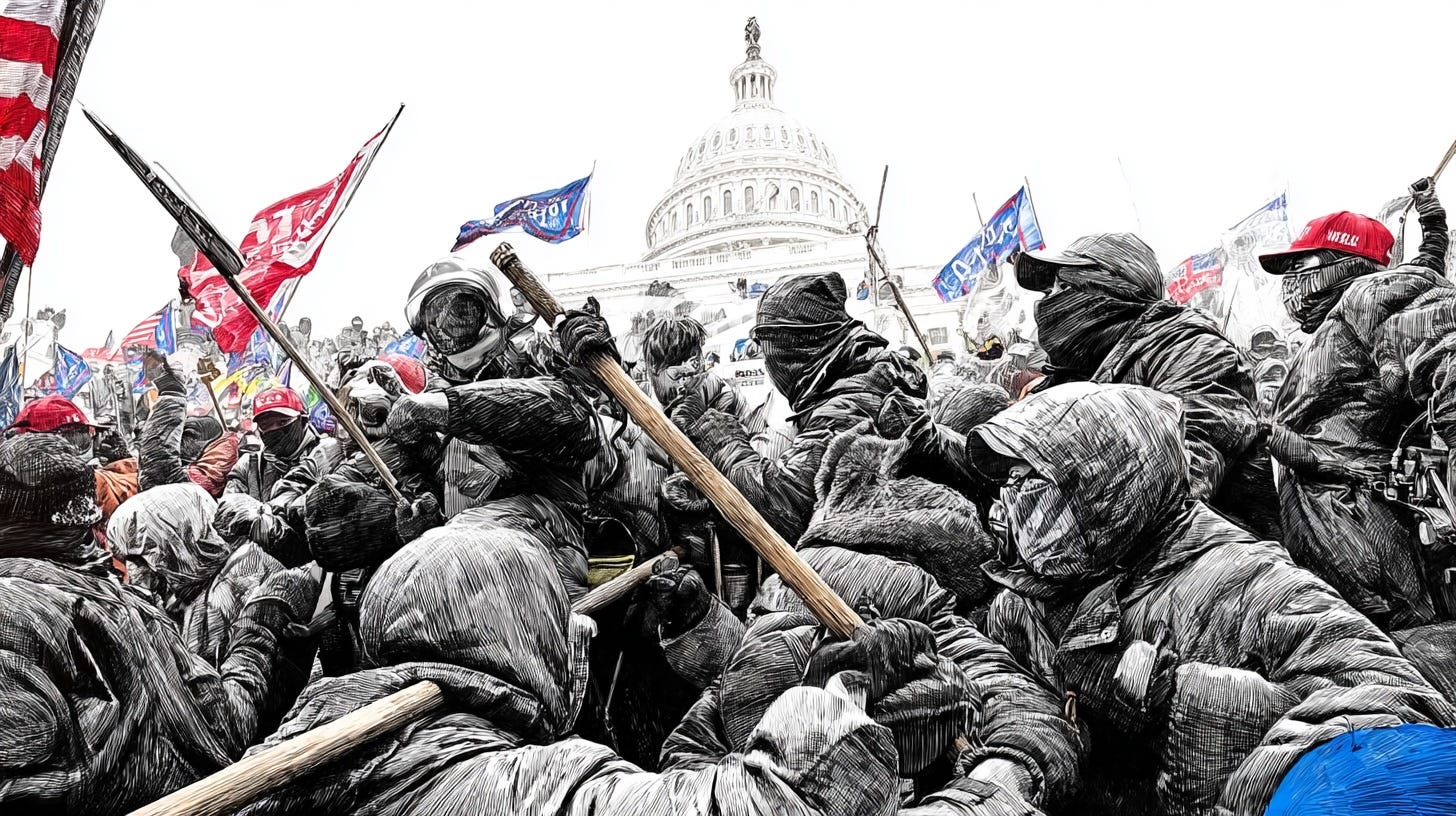
Last Friday, 46 participants in the January 6, 2021 Capitol riot filed a class action lawsuit against the United States in the U.S. District Court for the Middle District of Florida, Ocala Division, seeking $18,405,000 in damages. The three lead plaintiffs are Patrick Sullivan, Marie Sullivan, and Alan E. Fischer III, all Florida residents. Among the 46 named plaintiffs are multiple individuals who were criminally charged or convicted for their conduct during the riot and later received presidential clemency from Donald Trump.
The suit alleges that U.S. Capitol Police and the D.C. Metropolitan Police Department used excessive and unlawful force against a crowd on the Capitol’s west side by deploying chemical munitions, pepper spray, billy clubs, and other projectiles without issuing required warnings to disperse. The complaint characterizes the crowd as overwhelmingly peaceful protesters exercising their First Amendment rights to protest the certification of the 2020 presidential election. It seeks class certification for all individuals on the Capitol grounds that day who were struck by weapons or exposed to chemicals deployed by law enforcement.
Why This January 6 Excessive Force Lawsuit Is Dead on Arrival
Let me be direct. This lawsuit isn’t just weak. It’s an insult to every law enforcement officer who put their body on the line to defend the Capitol on January 6, 2021.
Here’s why it fails on the law and the facts.
The Credibility Problem Is Fatal
Start with the plaintiffs. Dominic Pezzola was filmed smashing a Capitol window with a stolen riot shield. After a three-month trial, a jury convicted him of assaulting an officer, robbing an officer of government property, destruction of government property, and obstruction of an official proceeding. He was sentenced to ten years.
Alan Fischer, a Proud Boys associate, was indicted on seven criminal charges including violent felonies after he was caught on video throwing chairs, a traffic cone, and a pole at officers. He was awaiting trial when he was pardoned.
Anthime Gionet pleaded guilty to a misdemeanor charge of parading, demonstrating, or picketing inside the Capitol after livestreaming himself for 27 minutes inside the building while berating officers.
These are not peaceful protesters. They are convicted, charged, and admitted participants in a violent breach of the United States Capitol. Some received presidential pardons from Donald Trump. Others, like Pezzola, received only a commutation of sentence, meaning their convictions still stand. Neither form of clemency rewrites history. And neither erases the conduct that a jury or a guilty plea already established.
Now they want a jury to believe they were innocent bystanders struck by unprovoked police violence. Good luck with that. Any competent defense attorney will play their own videos back to them frame by frame.
The “Peaceful Crowd” Narrative Collapses Under Its Own Weight
The complaint claims the crowd was “overwhelmingly peaceful” and that “no one intentionally harmed any officers.” This is not a legal argument. It is a fantasy.
One hundred and forty officers were injured that day. The Capitol was breached and ransacked. Members of Congress fled for their lives. Five people died within 36 hours, and four responding officers later died by suicide. The entire event was captured on thousands of hours of video from body cameras, security footage, and the rioters’ own phones.
You cannot look at that record and credibly argue that police had no justification to deploy crowd control measures. The Fourth Amendment excessive force analysis under Graham v. Connor requires courts to consider the severity of the situation, whether suspects posed an immediate threat, and whether they were actively resisting. Every one of those factors cuts against the plaintiffs here.
The Legal Framework Works Against Them
Qualified immunity will be a massive hurdle. Officers responding to an unprecedented violent assault on the seat of government were making split-second decisions under extreme duress. Courts have consistently held that officers are entitled to qualified immunity when their use of force is objectively reasonable under the circumstances, even if imperfect.
The plaintiffs will need to show that the officers violated clearly established constitutional rights. In a scenario where a mob had already overwhelmed barriers, assaulted officers, and was actively breaching the building, the deployment of tear gas and pepper spray into the surrounding crowd is textbook crowd control. There is no clearly established right to remain unmolested by chemical munitions while standing in the middle of an active insurrection.
And here is the kicker. Lead plaintiff Fischer already tried this. He previously filed a nearly identical putative class action in the U.S. District Court for the District of Columbia, alleging First, Fourth, Fifth, and Fourteenth Amendment violations against the Capitol Police, the Metropolitan Police, and various officials. The court dismissed his complaint, finding he failed to overcome qualified immunity and failed to establish Monell liability against the District of Columbia. This new Florida filing is a second bite at the same apple, and the first bite already came up empty.
The Class Certification Problem
The lawsuit wants to certify a class of potentially thousands of people. But class certification under Rule 23 requires commonality and typicality. The people in that crowd had radically different levels of involvement. Some were pushing through police lines. Some were throwing objects. Some may have been standing further back.
Their injuries are different. Their conduct is different. Their proximity to the violence is different. A court would have a very hard time finding that common questions of law and fact predominate when the individual circumstances vary this dramatically.
The Damages Theory Is Speculative
The suit seeks $18,405,000 for chemical burns, concussive trauma, emotional distress, and lost earnings. But the plaintiffs voluntarily traveled to the Capitol, voluntarily joined a crowd that turned violent, and voluntarily remained in an area where law enforcement was actively responding to a security emergency.
Comparative fault and assumption of risk doctrines will substantially reduce or eliminate any recovery. You chose to stand in the middle of a riot. You do not get to sue the police for doing their job.
The Real Purpose of This Lawsuit
This case is not about justice. It is about narrative. It is an attempt to use the civil courts to rewrite the story of January 6 from an assault on democracy into a police brutality case against peaceful patriots.
This is what happens when a president pardons convicted felons who attacked the Capitol. He does not just free them. He emboldens them. He empowers them. And now the same officers who bled defending democracy have to relive that day in court, sued by the very people they were protecting the rest of us from.
Mitch Jackson, Esq.
Help support Uncensored Objection…
I have been a trial lawyer for 40 years and I have zero tolerance for this kind of thing. These plaintiffs attacked the Capitol, assaulted officers, smashed windows, threw chairs and poles at police, got convicted, got pardoned, and now they want $18 million from the same government that let them walk free. But what makes it worse is the silence from the elected officials whose salaries we pay, the same people who watched 140 officers get beaten defending the building they work in and now cannot find the courage to say a single word about it. That silence is not neutrality. It is complicity.
This is why I write Uncensored Objection. Because somebody has to build the case, put it on the record, and say what the people in power refuse to say. Subscribe. Share this with someone who needs to read it. And if you are an elected official reading this right now, do your job. The officers who bled for you on January 6 are watching. So are we.