

What The Administration Says Happened
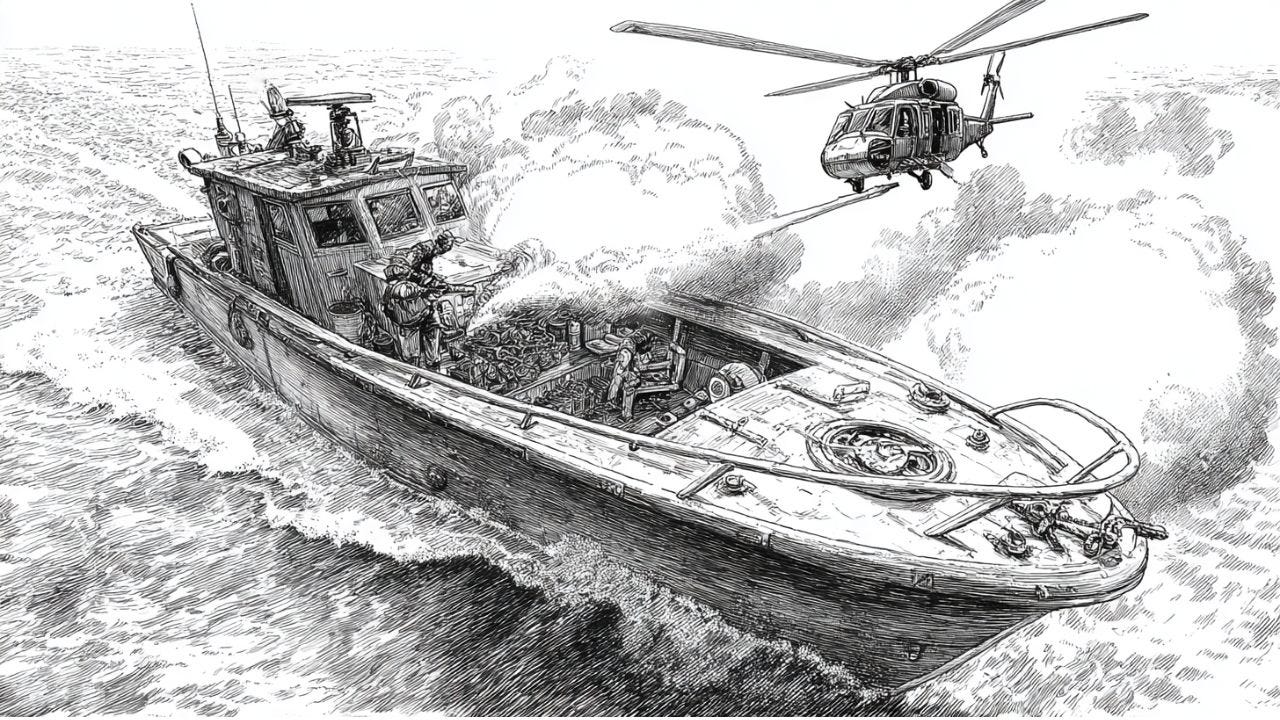
President Trump released a video of a U.S. military strike that destroyed a fast boat in the southern Caribbean on September 2, 2025, and said 11 people linked to Venezuela’s Tren de Aragua were killed. Secretary of State Marco Rubio said the goal was deterrence, and described a shift away from interdiction and arrests toward lethal action against “narco terrorists.” Defense Secretary Pete Hegseth said future strikes will follow. The administration pointed to the 2001 Authorization for Use of Military Force and executive authorities to justify the operation.
Where It Happened And Why Distance Matters
The strike occurred in international waters, far offshore, roughly six to eight hundred miles from U.S. territory such as Puerto Rico. One report had the boat about one thousand miles from the U.S. at the time of the attack. Distances from San Juan to Caracas and to Trinidad and Tobago range between roughly 550 and 640 miles, which places the scene of action far from the U.S. mainland and outside any territorial sea. The White House described the boat as departing Venezuela and heading north through the southern Caribbean.
Some Think This is OK
A few people are saying what happened is a good thing. That it shows strength against drug dealers and the cartel. I get the argument but as I explain in this post, killing suspected traffickers on a boat far offshore without trial or capture is not justice, it is lawlessness.
Our nation was built on the promise that even the worst offenders are held accountable through due process, not by missiles launched in the dark. If we normalize executions at sea, we trade the rule of law for raw power, and that is the same standard tyrants use to silence their enemies. You do not protect your children or your future by shredding the Constitution in the name of fighting crime.
Here are a few things I’d like my readers to consider.
The International Law Questions
The United Nations Charter prohibits the threat or use of force except in self defense or when the Security Council authorizes it. A strike on a nonstate criminal group in international waters requires a valid claim of self defense that meets necessity and proportionality, and requires evidence of an armed attack or imminent armed attack, not a general law enforcement objective.
No public record shows Security Council authorization. Legal scholars have already questioned the operation on these grounds. The end doesn’t justify the means.
The Law Of The Sea And Maritime Enforcement
UNCLOS treats drug trafficking on the high seas as a matter for cooperation and law enforcement. States board, search, and seize vessels through the right of visit with flag state consent, through bilateral agreements, or when a vessel is stateless. Summary destruction of a civilian vessel is not the standard response for narcotics cases. The treaty language on high seas freedoms and the right of approach points to boarding and seizure, not lethal strikes.
The Right To Life And Extrajudicial Killing
International human rights law protects the right to life and restricts lethal force to situations where it is absolutely necessary and not arbitrary. The Human Rights Committee’s General Comment No. 36 underscores that obligation and applies extraterritorially when a state’s agents exercise control over a situation that foreseeably risks life. Eleven people died without trial and without any announced attempt at capture, which raises a serious extrajudicial killing question under the Covenant.
The Domestic Law Questions
The Constitution gives Congress the authority to declare war and the War Powers Resolution requires the President to report to Congress within 48 hours when U.S. forces enter hostilities or when hostilities are clearly indicated by the circumstances. Lethal force by the armed forces at sea against suspected smugglers meets any practical test for hostilities. Members of Congress and outside monitors will look for a timely report that states the legal and factual basis for the strike.
War Powers And Congressional Authority
If the administration introduced U.S. forces into hostilities, Congress must receive a report, and if the situation extends, Congress must authorize the action. A single strike can still trigger reporting if hostilities occurred. The reporting requirement is not optional, and it exists to keep the public’s representatives in the loop when lethal force is used abroad.
The 2001 AUMF And Narcotics Gangs
The 2001 AUMF covers those responsible for the 9/11 attacks and associated forces such as al Qaeda, the Taliban, and ISIS. No official source lists Venezuelan cartels as associated forces under the 2001 authorization. Stretching the AUMF to cover a South American criminal gang creates a gap between the statute and the target, which invites judicial and congressional pushback.
The Assassination Ban And Constitutional Limits
Executive Order 12333 states that no one acting for the United States shall engage in or conspire to engage in assassination. The government has long argued that targeting in an armed conflict is not assassination. There is no recognized armed conflict between the United States and Venezuelan gangs. That contrast raises questions about whether an intelligence or military operation that kills suspected traffickers outside an armed conflict crosses the line set by the order and the Constitution’s due process guarantees.
Criminal Enforcement Tools Already On The Books
Congress gave U.S. authorities sweeping reach on the high seas through the Maritime Drug Law Enforcement Act. The MDLEA supports boarding, seizure, arrest, and prosecution in U.S. courts, including for stateless vessels and with flag state consent. The statute does not authorize summary destruction of suspect craft and points law enforcement toward capture and trial.
Regional Sovereignty And Treaties
Venezuela denounced the strike video and hinted it was AI generated, which speaks to rising information warfare claims in the region. Colombia’s president condemned the operation as murder. Trinidad and Tobago’s leadership expressed approval. The mix of outrage and praise signals a split that weakens regional cooperation and increases risk for U.S. sailors, Coast Guard crews, and regional mariners who will now operate in a tenser maritime environment.
Escalation Risks And U.S. Presence
U.S. leaders announced more maritime operations and confirmed a strengthened naval posture in the Caribbean. Reports describe multiple warships and a submarine deployed to the region following the strike. Each new operation increases the chance of an incident with regional forces and heightens the legal stakes if lethal force becomes a pattern rather than a last resort.
What This Means For Your Democracy
Rules of war, rules of the sea, and rules at home exist to keep lethal force under law. When an administration labels a criminal gang a narco terrorist group and uses missiles instead of arrests, your consent through Congress is sidelined.
When a president invokes a 2001 statute meant for the 9/11 perpetrators to target a South American gang far offshore, your government is moving the goalposts without your say. When the United States kills first in a zone usually handled by interdiction and prosecution, your country teaches others to do the same to vessels they dislike. Your sailors and aid workers will live with the consequences. Your courts and your Congress will inherit the mess.
What You Should Watch For
Watch for a War Powers report that lays out the legal basis and the facts. Watch for proof of an imminent threat, not general claims about drugs heading north someday. Watch for whether the target vessel was stateless or flagged, and whether any request to board was made. Watch for evidence that U.S. forces attempted capture and that lethal force was necessary under clear rules of engagement. Watch for Congress to hold hearings on the AUMF’s misuse and to demand new, precise authorization if the administration plans a campaign.
A Path Back To Law And Leadership
Your voice matters when force meets law. Call for transparency on the legal theory, the intelligence, and the rules used that day. Call for Congress to assert its authority and set guardrails that fit the real fight against transnational crime. Call for a Caribbean strategy that uses arrests, prosecutions, partner agreements, and targeted sanctions before missiles.
When all is said and done, demand a foreign policy that protects Americans and respects the line between war and policing. Demand leadership that values the Constitution at home and credibility abroad.
Mitch Jackson, Esq. | links
If you believe America should fight crime without destroying the Constitution, my newsletter is for you. I break down what’s happening in plain language, connect the dots politicians want you to miss, and give you the tools to push back. Subscribe and add your name, take your seat at the table, and be part of the fight to keep our democracy alive.

Why are they pursuing those in international waters, and yet pardoning the leader of MS13 and his family when he had them in hand? I'm confused. And then why are they supposed to be capturing the worst of the worst, yet instead grabbing unarmed immigrants and their families off the street, while wearing military equipment and guns to murder them?