

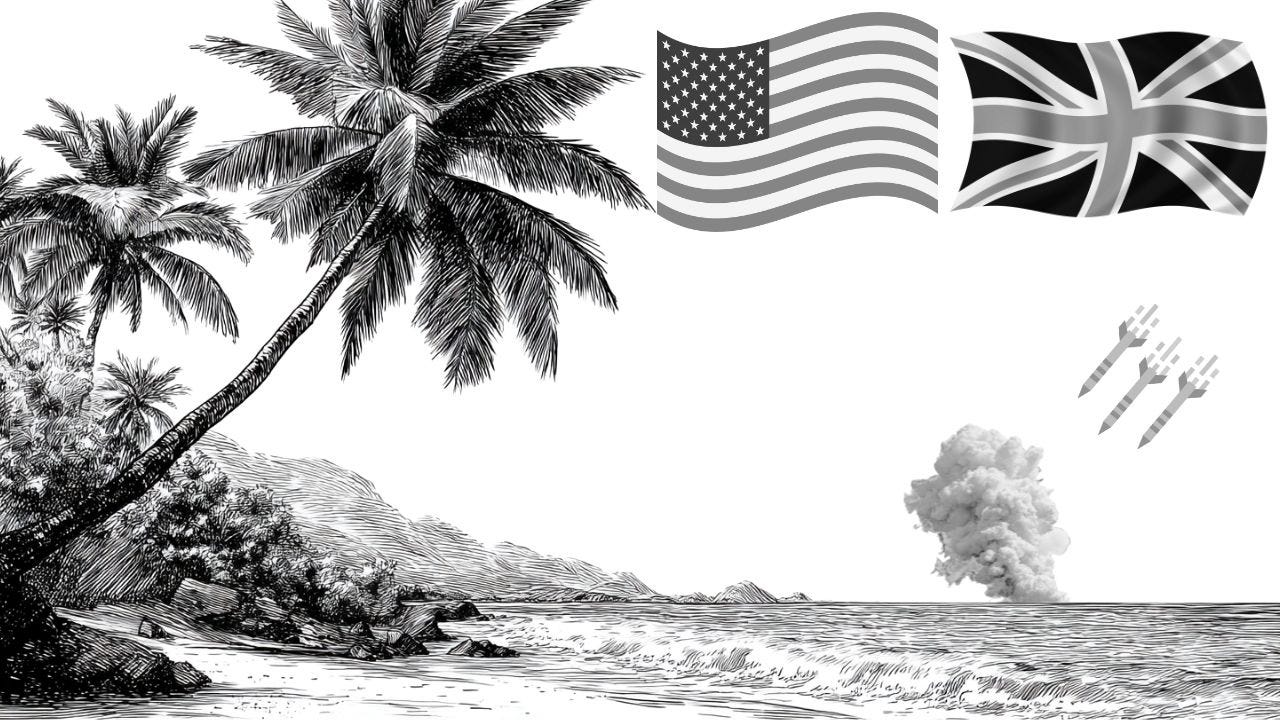
There are moments in global politics when a small crack in an alliance signals something much greater than anyone wants to admit. That’s exactly where we are right now.
The United Kingdom, America’s most enduring intelligence partner, has pulled back from sharing critical intelligence with the United States over what’s unfolding in the Caribbean. It’s not an official withdrawal from the Five Eyes alliance, but it is the most serious rift in the partnership in more than seventy years.
The Five Eyes intelligence partnership linking the United States, the United Kingdom, Canada, Australia, and New Zealand is unlike any other on earth. Born from post-war cooperation and strengthened through decades of geopolitical threats, it has grown into a seamless, highly sophisticated network.
And this pull back from Five Eyes is happening for one reason: the United States is carrying out lethal maritime strikes that our closest allies believe violate international law, basic morality, and the foundational rules of armed conflict.
This foreign-policy dispute is also a crisis of confidence in America’s judgment, its legality, and its moral compass.
The Caribbean Strikes That Triggered the Rift
To understand why the UK took this extraordinary step, you need to understand the nature of the operations that triggered the break.
Over the past year, U.S. forces, under explicit authorization and direction from the Trump administration, have conducted a series of missile strikes on boats in the Caribbean and eastern Pacific. These boats were suspected of being involved in narcotics trafficking. Some may have carried drugs. Others maybe money. Some might have simply been people trying to outrun poverty and corruption.
And in at least one instance, survivors of the initial strike, men who were injured, floating, shipwrecked, unarmed, no longer engaged in any threat whatsoever, were allegedly killed in follow-up attacks.
That is where everything changes.
Under international humanitarian law, attacking shipwrecked survivors is illegal. It’s a grave breach of the Geneva Conventions. It is the exact conduct that post-World War II tribunals prosecuted as war crimes. And it’s not ambiguous. Pilot manuals, field guides, international treaties, and customary practice all treat the killing of shipwrecked individuals as one of the clearest violations imaginable.
So when the U.S. defines these traffickers as “terrorists” or “combatants,” and treats them as lawful targets even when unarmed, injured, and incapable of resisting, the legal and moral ground collapses beneath the operation.
Other nations saw it immediately.
Why the UK Hit the Brakes
The UK’s intelligence agencies operate under strict domestic laws and international-law obligations. The UK government cannot knowingly provide intelligence that it believes will be used for unlawful killing. Once it became clear that U.S. strikes were targeting individuals who were out of the fight, British lawyers inside the Ministry of Defense and Foreign Office raised red flags.
Sources inside Parliament have acknowledged that concerns escalated rapidly. British officials feared that continuing to provide intelligence would expose the UK to legal liability under international law, including complicity in extrajudicial killings.
It’s important to note that the UK has been caught in similar traps before, for example in the post-9/11 era, when British intelligence played indirect roles in CIA rendition operations that led to torture. The political fallout was enormous. The legal liability was real. And nobody in London wants a repeat.
When the first reports surfaced of U.S. strikes killing shipwrecked survivors, lawyers inside Whitehall reportedly concluded:
We cannot share intelligence that will be used for unlawful lethal action.
The UK didn’t announce a withdrawal from Five Eyes. They didn’t hold a press conference. Instead, they did what serious governments do when their closest ally has crossed a legal red line: they quietly turned off the tap.
The Intelligence Pause and What It Actually Means
UK officials have downplayed the story. That’s expected. Five Eyes is built on trust, secrecy, and maintaining the appearance of unity.
But make no mistake, this is not a minor procedural issue.
The UK reportedly halted operational intelligence related to maritime counter-narcotics targeting, the exact data the U.S. uses to identify suspicious vessels. That means signals intelligence, aerial tracking, geolocation data, and other information that forms the backbone of maritime interdiction.
They did not suspend all intelligence sharing, that would be geopolitical nuclear winter. But they carved out the part that directly feeds lethal target selection.
That targeted pause is the diplomatic equivalent of looking your closest friend in the eyes and saying, “We can’t be part of this.”
Why the Caribbean Matters So Much
To outsiders, drug-smuggling boats in the Caribbean might feel like a peripheral issue. They aren’t. They’re a geopolitical pressure point.
The U.S. has long used military tools in the region to combat narcotics trafficking. But recent operations escalated beyond interdiction and entered the realm of targeted killing. Once you shift from policing to armed conflict, entire bodies of law change. The Trump administration has been attempting to blur that line, urging agencies to treat traffickers as terrorists and apply a war-based framework to them.
International law experts, including former JAG officers, academics, former Pentagon lawyers, and legal scholars, have publicly rejected that interpretation. The UK legal community appears to have reached the same conclusion.
For Caribbean nations already uneasy with U.S. power projection, the new American approach raises the specter of extrajudicial violence in their sovereign waters. Countries in the region are increasingly voicing concern that legitimate law enforcement has been replaced with militarized execution.
The UK’s pause amplifies those concerns. When America’s closest ally signals that the U.S. may be breaching international law, smaller nations start asking: if the UK won’t hand over intelligence for these operations, why should we?
Five Eyes — The Alliance That Was Never Supposed to Fracture
As I referenced earlier, the Five Eyes alliance consist of the U.S., UK, Canada, Australia, and New Zealand. It is the most integrated intelligence partnership in the world. It was built in the ashes of World War II, expanded through the Cold War, and solidified in the war on terror. The NSA and GCHQ share more than just data; they share infrastructure, technology, and operational planning.
So when the UK pulls back, even in a limited way, it sends a seismic message.
This isn’t France disagreeing with U.S. foreign policy. This isn’t Germany criticizing rhetoric. This is the closest ally the U.S. has on Earth concluding that America cannot be trusted to act lawfully with the intelligence it receives.
That is a diplomatic earthquake.
It signals something deeper, a crack in the moral framework that keeps the alliance functioning.
The U.S. Response, Or Lack of One
The U.S. government has largely dismissed concerns. Officials close to the President argue that the narcotics-terrorism nexus creates a new type of armed conflict, justifying lethal force. That interpretation has no grounding in treaty law, customary practice, or prior litigation.
Legal experts in the U.S. have publicly said the administration is warping legal doctrine beyond recognition. Former Pentagon lawyers have said the U.S. is risking catastrophic legal exposure. International Court of Justice lawyers have raised alarms. Human rights organizations have issued formal condemnations.
The administration’s response? Ride it out. And that’s exactly why the UK felt it had to act.
Why This Break Matters More Than People Realize
There are short-term consequences:
• U.S. operations in the Caribbean become less effective.
• Intelligence gaps appear that traffickers may exploit.
• Caribbean nations become more vocal and more skeptical.
• Other Five Eyes partners may follow the UK’s lead.
But the long-term consequences are far more dangerous:
1. The Five Eyes alliance loses credibility. If one partner begins conditioning intelligence based on legality concerns, the trust foundation cracks.
2. America’s reputation as a lawful actor erodes. If even the UK fears U.S. actions violate international law, global confidence collapses.
3. The global norm against extrajudicial killing weakens. If the U.S. expands targeted killing outside armed conflict, and allies refuse to go along, the legal order fractures.
4. Autocrats gain ammunition. Russia, China, Iran, and others will point to this rift as proof that the U.S. no longer respects international law.
5. The Caribbean becomes a region of escalating tension. With growing questions about legality, regional governments could restrict cooperation, demand accountability, or push cases into international courts.
Why the UK’s Move Was Not Political (It Was Legal and Ethical)
This wasn’t ideology. It wasn’t liberal vs conservative. It wasn’t diplomacy vs national security.
It was law.
The rules governing the use of force at sea are clear. Survivors of maritime attacks must be collected, protected, and cared for. They cannot be targeted. They cannot be executed. They cannot be left to die.
This isn’t contentious. This isn’t theoretical. This is some of the oldest, clearest, most universally accepted law in human history.
The UK recognized that its involvement, through intelligence sharing, risked crossing that line.
Governments don’t take such steps lightly. It means internal legal experts believe the U.S. operations carry real risk of constituting war crimes. And if a state knowingly contributes intelligence to a war crime, it becomes complicit.
That is why the UK acted. That is why this matters.
Where This Goes Next
This is not a temporary squabble. This is the beginning of a long and painful conversation about America’s adherence to international norms.
The possibilities:
1. Other Five Eyes nations follow the UK’s lead. If Australia or Canada assess the same legal risks, the fracture spreads.
2. Caribbean nations demand international investigations. These operations occurred near their waters, sometimes inside them.
3. The International Criminal Court becomes involved. If evidence indicates unlawful killing of shipwrecked individuals, the ICC’s jurisdiction may be triggered.
4. Congressional investigations open, or are blocked. Either scenario deepens the crisis.
5. The U.S. doubles down instead of reassessing. This outcome, sadly, is the most likely under current leadership.
Why the Public Should Care
This story is about the rule of law. It’s about what kind of nation America chooses to be. It’s about whether the world’s democracies can trust the United States when life-and-death decisions are on the line.
If America’s closest ally is unwilling to participate in operations it views as unlawful, we should all be paying attention.
Alliances don’t break overnight. They degrade in moments exactly like this.
Mitch Jackson, Esq.
Thank you for reading, sharing and caring.
Building a future rooted in truth and democracy takes real investment. If my work speaks to you, please consider supporting, because independent journalism that actually gives a damn is worth backing.
You say it all, right here, right now: "And this pull back from Five Eyes is happening for one reason: the United States is carrying out lethal maritime strikes that our closest allies believe violate international law, basic morality, and the foundational rules of armed conflict. This is a foreign-policy dispute. It’s also a crisis of confidence in America’s judgment, its legality, and its moral compass."
Dear Mitch,
Thanks so much for writing this article and doing all of the investigative work to inform us of what's going on in the Caribbean waters. I've never heard of The Five Eyes, so I learned a lot reading this article. UK is being smart, they clearly do not want to have anything to do w Trump and Hegseth's more than likely illegal attacks. The rule of warfare law seems pretty clear, and it seems pretty clear the US is not following the wartime laws.
Gees, it's scary as shit to me, but we all need to know about this, and figure out what's right and wrong as a Nation.
Take care, Judy
😔💔🐾🌿🌏