

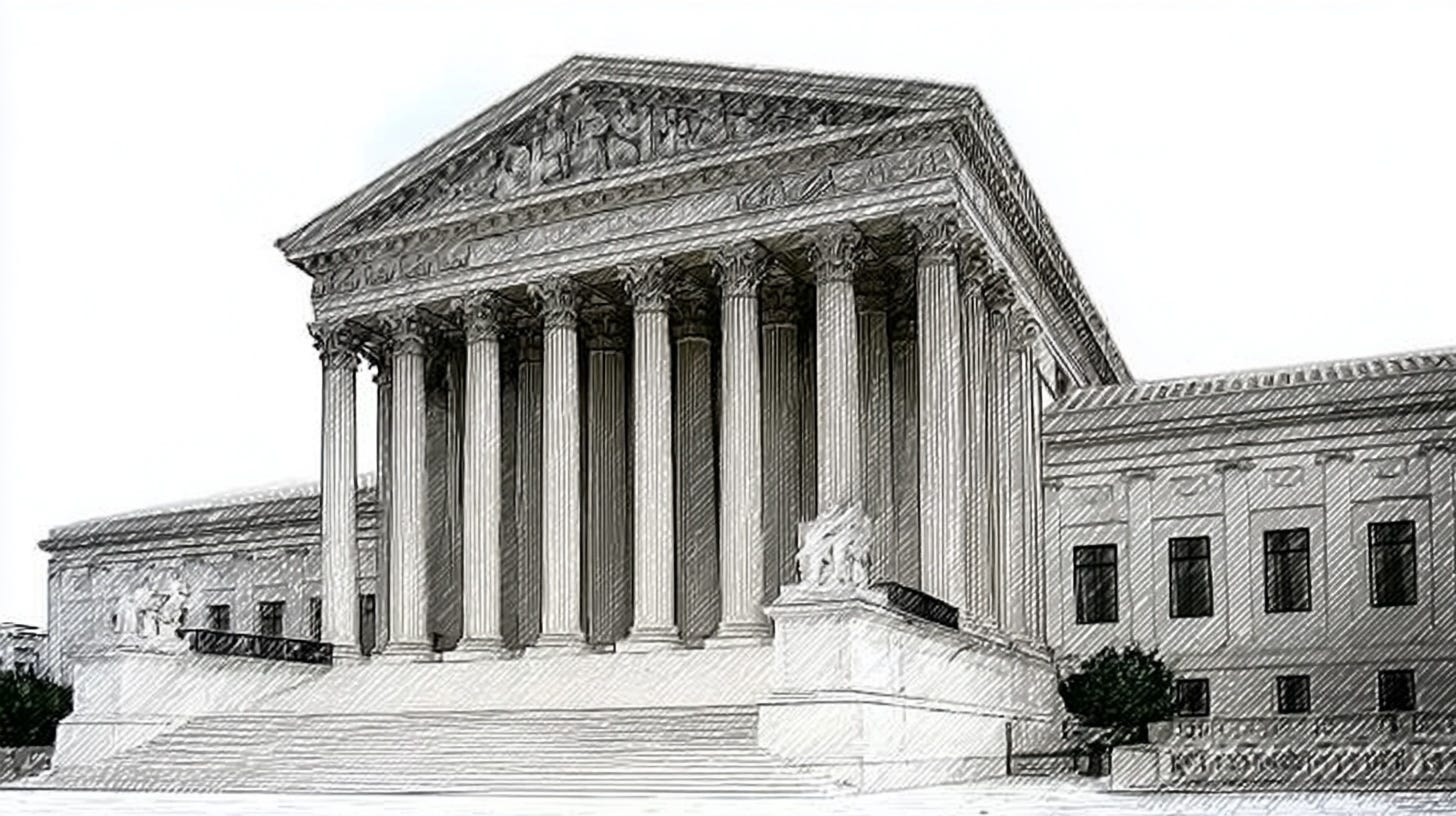
Executive Summary: The Supreme Court is going to shut down Trump’s tariff program. After Oral arguments in November, 2025, the justices will rule 7 to 2 that the president doesn’t have the authority under emergency powers to rewrite America’s tax and trade laws. Chief Justice Roberts will take the lead, with conservatives like Gorsuch and Barrett stressing limits on executive overreach and the three liberal justices standing firm on Congress’s role to control revenue. Only Alito and Thomas will side with Trump. The bottom line is this: Congress, not the president, controls the taxing power.
Introduction
Donald Trump built his trade agenda on sweeping tariffs that hit nearly ninety countries with new import taxes ranging from ten to fifty percent, claiming emergency powers under a 1977 law designed for short-term national security threats. These tariffs were not narrow or temporary, they were global, long-lasting, and used as leverage in negotiations with allies and rivals alike.
Small businesses and a dozen states sued, arguing that the Constitution reserves taxing power to Congress and that the International Emergency Economic Powers Act was never meant to let a president unilaterally rewrite the tariff code. They say the program inflicted real economic harm and threatened survival for companies already stretched thin.
Trump’s lawyers counter that the statute’s broad language allows the president to regulate imports when he declares an emergency, and they warn that striking down the program will undermine trade deals and weaken America’s bargaining position abroad. The Federal Circuit already sided with the challengers, striking at the heart of Trump’s program, and now the Supreme Court has agreed to hear the case on an expedited schedule.
At stake is not only the legality of these tariffs but the larger question of how far a president can stretch emergency powers when the Constitution clearly places the taxing pen in Congress’s hand.
What I Think Will Happen (75% confidence score)
The Supreme Court is about to send a powerful message. The justices will affirm by a 7 to 2 vote that Donald Trump’s sweeping tariff program is unlawful. Chief Justice Roberts will lead the majority, joined by Kavanaugh, Barrett, Gorsuch, Kagan, Sotomayor, and Jackson. Roberts will almost certainly write the opinion, making it clear that Congress holds the taxing power, not the president.
Gorsuch and Barrett will write separately to stress limits on delegation and the plain text of the law. Kagan will emphasize that the statute itself is enough. Alito and Thomas will dissent, arguing that presidents deserve wider latitude in foreign affairs.
Decisive Reasons
The case turns on the International Emergency Economic Powers Act, a 1977 statute that allows presidents to regulate imports during extraordinary threats to national security. For decades, that law has been used for targeted sanctions.
Trump tried to stretch it into a tool for permanent, across-the-board tariffs on almost every U.S. trading partner. The Federal Circuit already ruled that IEEPA does not give presidents a blank check to impose unlimited taxes on imports. That decision is in line with the Court’s recent major questions rulings, which demand a clear statement from Congress before presidents take actions with massive political and economic consequences.
With Chevron deference gone after Loper Bright, the justices will decide this one themselves. The record shows the tariffs were sweeping, long-lasting, and used as bargaining chips in negotiations. That scale tips the balance back to Congress, which already gave presidents specific tariff tools with express limits in Section 232, Section 301, and Section 122.
Justice-by-Justice Vote Map
Roberts will write for the Court, saying IEEPA cannot be read to hand over Congress’s taxing power. Thomas will dissent, grounded in his view of broad executive discretion in foreign commerce. Alito will dissent, focusing on deference to the president in foreign affairs. Gorsuch will concur, pushing for a stronger nondelegation doctrine. Kavanaugh will join the majority, highlighting the mismatch between emergency powers and revenue raising. Barrett will concur on textual grounds, stressing the limits of emergency statutes. Kagan will join and underscore that ordinary interpretation resolves the case. Sotomayor and Jackson will both vote to affirm, framing the decision around the Constitution’s explicit assignment of taxing authority to Congress.
Key Authorities
The majority will lean on West Virginia v. EPA and Biden v. Nebraska, both of which demand clear congressional authorization for sweeping programs with vast consequences. Loper Bright eliminates any Chevron deference, leaving the Court free to interpret IEEPA directly. Trump v. CASA will shape the remedy, keeping injunctions narrow rather than nationwide. The Yoshida case from the 1970s will surface in the dissents as evidence that presidents have historically enjoyed broad import powers, but the majority will reject that reading in favor of congressional primacy.
Triggers That Could Flip the Outcome
The only scenarios that might change this result are if the Solicitor General narrows the tariffs to look more like targeted sanctions with an expiration date, if Congress unexpectedly ratifies Trump’s program with clear statutory text, or if a vehicle defect undermines the plaintiffs’ standing. None of those are likely at this stage.
What Might Happen (25% confidence score)
The Supreme Court will uphold Donald Trump’s sweeping tariffs in a 6 to 3 decision, with Justice Kavanaugh writing for the majority and Roberts, Thomas, Alito, Gorsuch, and Barrett joining him.
The majority will lean on the plain text of the International Emergency Economic Powers Act, which gives the president broad authority to regulate imports during a declared national emergency, and they will defer to the executive branch on matters of foreign policy and national security. The record shows the administration linked these tariffs to a declared emergency, and the Court will treat that connection as enough to keep them in place without second-guessing the president’s judgment.
Roberts will see stability in trade policy as essential, Thomas and Alito will favor a strong executive, Gorsuch will accept the delegation of power, Kavanaugh will stress presidential discretion in trade and security, and Barrett will read the statute as granting clear authority.
On the other side, Sotomayor will write a dissent for the liberal justices, arguing that Congress alone holds the power to tax and that the statute cannot be stretched to cover tariffs of this magnitude. Kagan will side with her, skeptical of broad executive claims, and Jackson will write separately warning against unchecked presidential power.
Unless new filings or revelations disrupt the case, the Court will reverse the lower court and secure the president’s ability to impose these tariffs, a ruling that will shape how far emergency powers extend in America’s balance of government.
Why The Different Outcomes?
The restrained approach (my prediction) starts with the idea that the Court will demand clarity when Congress hands over power that carries sweeping economic and political consequences. This perspective relies on the major questions doctrine, which says Congress must use specific and unmistakable language if it intends to delegate something as significant as taxation.
Tariffs are, at their core, taxes, and the Constitution gives that power to Congress alone. Under this reasoning, the International Emergency Economic Powers Act does not go far enough. It authorizes presidents to regulate imports, but it does not say they can impose broad, permanent revenue-raising tariffs. If Congress wanted to grant that authority, it would have said so directly.
This view places more weight on the narrower trade statutes Congress already passed, and it positions the Court as a guardian of separation of powers, making sure Congress does not hand off its most essential responsibilities. In this version of events, the Court becomes the check against executive overreach, ensuring that no president stretches emergency powers beyond their proper limits.
The alternative path is built on the Court’s long record of deferring to presidents on foreign policy and national security. Especially this court and this president when it comes to other matters brought before it in 2025.
Under this analysis, the majority will treat IEEPA as a broad grant of authority that lets the president respond quickly to perceived threats (I’m not sure what those “threats” are but stay with me). From this perspective, Trump’s tariffs fit within the tools Congress provided, and the justices will avoid second-guessing the executive’s judgment.
The Court will see the administration’s stated emergency rationale as enough to justify the program, regardless of whether others view the policy as wise or effective. It will also see the presidency as an institution that needs stability and strength in international negotiations, and any decision weakening that hand could ripple across global trade relationships.
The question then becomes one of institutional role. The argument is that by writing IEEPA with wide language, Congress itself chose to put this power in the president’s hands, and the Court will respect that choice.
Final Word
The Court is about to draw a line in the sand. A 7 to 2 majority will strike down Trump’s tariffs and remind every president that Congress, not the White House, writes America’s tax laws. Roberts will put that in black and white in the majority opinion. Arguments kick off the first week of November 2025, and when the gavel falls, the future of executive power and congressional authority will be on the line.
Mitch Jackson, Esq. | links
Got questions? Visit my AI Agent and dig as deep as you want.