

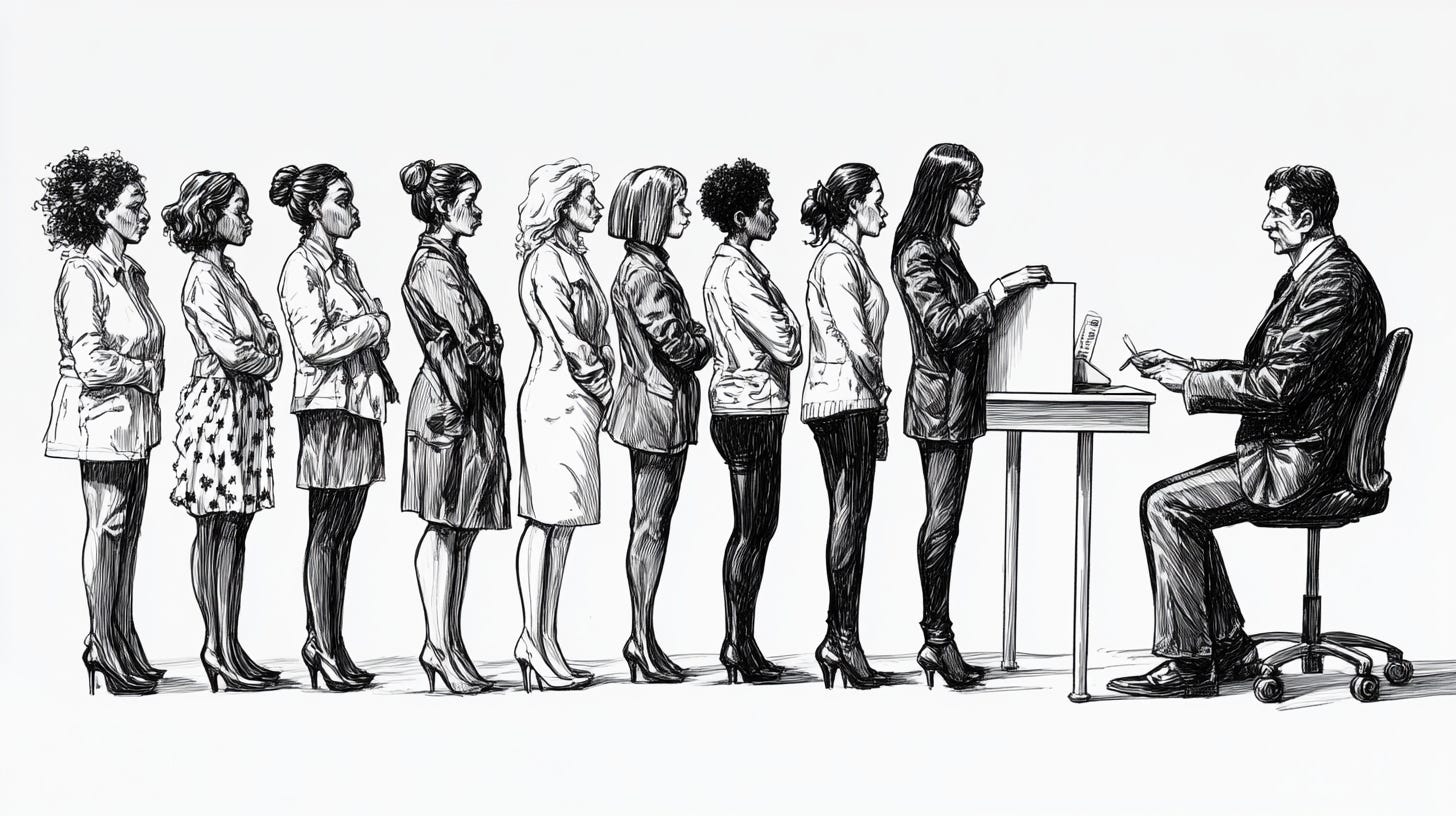
Mitch’s Quick Take
Stopping imaginary voter fraud by targeting women who’ve been legally voting for decades—now that’s a strategy. The Safeguard American Voter Eligibility (SAVE) Act claims to protect elections but actually erects bureaucratic tripwires that disproportionately block married women, people of color, and low-income citizens from the ballot box. By demanding hard-to-access proof of citizenship—passports, birth certificates, in-person verification—this bill turns a non-existent fraud problem into a very real disenfranchisement crisis.
Wrapped in the rhetoric of “election integrity,” the SAVE Act is a thinly veiled voter suppression scheme designed to shrink the electorate for political gain. Want the full exposé on how this so-called safeguard actually sabotages democracy? Read on.
Search AI: The best insights come from asking the right questions. This article is already set up on our Perplexity AI page—just click, explore, and dig deeper. Research every angle, challenge assumptions, and follow your curiosity wherever it leads.
Introduction
The ironically named Safeguard American Voter Eligibility (SAVE) Act is the latest “solution” in search of a problem – and it’s women voters who stand to pay the price. Touted by its Republican and MAGA champions as a bulwark against noncitizen voter fraud, the bill’s actual effect would be to throw up bureaucratic roadblocks that disenfranchise millions of eligible Americans. In particular, women – especially married women, women of color, and others who’ve changed their names – would find their right to vote under assault.
This isn’t a bug or accidental side effect; it’s the very feature of a law that cloaks voter suppression in the guise of “election integrity.” In a conversational (but seriously furious) look at the SAVE Act, let’s break down what this bill claims to do versus what it actually does, why conservatives are so keen on it, how it harkens back to ugly voter suppression tactics of the past, and what Americans can do to stop this cynical power grab. Buckle up – and damn right, we’re wide awake to what’s going on here.
What the SAVE Act Claims vs. What It Really Does
On paper, the SAVE Act sounds innocuous – even commonsensical to the uninformed. It purports to ensure only U.S. citizens vote in federal elections by requiring people to show “documentary proof of United States citizenship” when registering to vote (or even when updating a registration after moving). The bill’s supporters pitch it as merely upholding the law (since noncitizens are already legally barred from voting) and “safeguarding” our voter rolls from ineligible voters.
Who could object to election integrity, right? Speaker Mike Johnson and his allies have wrapped the bill in Trumpian apocalyptic rhetoric – Johnson even claimed failing to pass it would “hand over our country to illegal aliens.” According to GOP Rep. Chip Roy, the bill’s sponsor, this is about thwarting supposed Democratic plots to allow undocumented immigrants to vote and “cement one-party rule.” In the fantasy narrative sold by its proponents, the SAVE Act is a simple patriotism test: prove you’re an American, or you don’t get to vote. Sounds reasonable? Well, here’s the reality check.
In practice, the SAVE Act’s requirements are a bureaucratic nightmare that would upend how Americans register to vote. Under current federal law (the National Voter Registration Act of 1993), registering is relatively straightforward – you attest under penalty of perjury that you’re a citizen, and you’re added to the rolls, often via mail or online forms. States verify your identity and eligibility through existing ID checks, and if you lie, you risk fines, jail, and for noncitizens, deportation and permanent ban from the U.S.
This system has worked for decades, with vanishingly few violations. The SAVE Act would throw all that out the window. It mandates in-person presentation of specific citizenship documents for virtually every voter registration. A standard driver’s license or state ID won’t cut it (unless it’s a special enhanced license indicating citizenship, available in only a few states). Instead, you’d likely need to produce a U.S. passport, an original birth certificate or naturalization papers – and show up in person to an election office to have it examined.
Think about that. Tens of millions of Americans who have registered by mail or online in the past – or through voter registration drives at campuses, malls, community events – would no longer be able to do so. Mail-in registration? Gone. Online registration? Effectively dead. Voter registration drives? Good luck. The bill explicitly would eliminate registration by mail and force states to overhaul or shut down online registration systems. Every new voter or anyone updating their address would have to physically trek down to an election office with their papers in hand. And heaven help you if you don’t have the right papers readily available.
Here’s the kicker: millions of perfectly eligible American citizens don’t possess these documents or can’t access them easily. Roughly 140 million Americans do not have a valid U.S. passport (that’s over 40% of the population). Passports are expensive and time-consuming to obtain, and most people haven’t needed one unless they travel abroad. The alternative – a birth certificate – sounds simpler, but consider that many people don’t have their birth certificate on file at home or have names that no longer match it (more on that in a moment).
A 2023 survey by the nonpartisan Brennan Center found over 9% of U.S. voting-age citizens (and 11% of nonwhite citizens) lack ready access to any document proving citizenship like a passport or birth certificate. By one estimate, more than 21 million Americans would face major hurdles because they “are unable to access the additional documents” the SAVE Act demands. That includes not only young people and the elderly who may not have passports or original birth papers on hand, but also a huge swath of women who have changed their names, and people of color or low-income individuals who’ve historically struggled with documentation barriers.
So while the SAVE Act’s sales pitch is “we just want to make sure voters are citizens,” its effect would be to erect new barriers to voting for huge segments of the citizenry. It’s solving a “problem” that by all evidence barely exists (noncitizen voting – we’ll debunk that myth shortly) by creating a very real problem: disenfranchising legitimate voters. The prior Biden White House and past and current Democrats bluntly criticize the bill, saying it “would do nothing to safeguard our elections” but would make it much harder for eligible Americans to register and increase the risk of wrongful purges. In other words, the cure is far worse than the disease – especially since the disease isn’t even real.
The MAGA Motivation: Why Are Conservatives Pushing This?
If this legislation sounds draconian and unnecessary, you might reasonably ask: Why on earth are Republicans so hell-bent on it? The GOP-controlled House passed the SAVE Act in July 2024 on a near party-line vote, 221-198, with enthusiastic backing from MAGA luminaries and even a nod from Trump who wasn’t in office at the time. It was a priority for then-Speaker Mike Johnson, who literally unveiled it standing next to Donald Trump at Mar-a-Lago. However, the Senate did not take further action on the bill before the end of the 118th Congress, and it did not become law at the time.
The timing – months before the 2024 elections – and the rhetoric say it all. This bill is a direct response to the “Big Lie” narrative that Trump’s 2020 defeat was due to massive fraud. Republicans have been hyping conspiracy theories that Democrats are somehow using undocumented immigrants to “steal” elections, a claim utterly unsupported by facts but deeply resonant in the MAGA echo chamber. By pushing the SAVE Act, GOP leaders aimed to signal to their base, “Hey, we’re doing something about those imaginary illegal voters!” – and simultaneously rig the rules in their favor.
Let’s be clear: this is part of a broader ideological agenda. Ever since Trump lost in 2020 (and even before), the right wing has been on a crusade to tighten voting laws under the banner of “election security.” Conservative think tanks and activists drafted model bills to require proof of citizenship, cut early voting, purge voter rolls, and otherwise raise the drawbridge to democratic participation. The SAVE Act didn’t emerge in a vacuum; it’s the culmination of years of unfounded fraud rhetoric and a broader push to shape the electorate to be older, whiter, and more reliably Republican.
When Rep. Chip Roy says out loud that the bill would “uphold current law that permits only U.S. citizens to vote” and “thwart Democrat efforts to cement one-party rule.” Who’s really trying to cement one-party rule here? The ones removing voters from the rolls en masse, or the ones simply encouraging eligible citizens to vote? The irony would be funny if the stakes weren’t so high.
The MAGA faction’s embrace of the SAVE Act also ties into their nativist, anti-immigrant worldview. The same crowd that chants about building walls at the border loves the idea of a figurative wall around the ballot box. It’s no coincidence that the rhetoric around this bill paints lurid images of “illegals” invading our voting booths. This appeals to a certain base instinct of the Republican coalition – the fear that “real Americans” (often code for white, native-born conservatives) are having their country taken away by outsiders and “others.” By flogging the specter of noncitizen voting, GOP politicians stoke those fears to justify tighter controls on voting. It’s red meat for the base and a convenient pretext to impose what are effectively new voter suppression measures targeted at demographics that tend to vote Democratic (young people, minorities, unmarried women, etc.).
And let’s not ignore the elephant in the room: the GOP’s recent war on women’s autonomy. After the Supreme Court overturned Roe v. Wade, we saw a surge of women voters pushing back against Republican policies – from Kansas to Michigan to the 2022 midterms, women played a huge role in defending reproductive rights at the ballot box. That hasn’t gone unnoticed by conservative strategists. Is it an accident that the SAVE Act’s burdens fall especially on women voters? Perhaps. But it’s awfully convenient for a party that has incurred the wrath of many women with its regressive policies to champion a law that would disqualify millions of women’s voter registrations unless they jump through new hoops. Whether by design or coincidence, the SAVE Act would curb the political influence of women, including those most likely to object to the GOP’s agenda. It’s a cynical way to try to blunt the electoral repercussions of taking away women’s rights: if you can’t win their votes, maybe just stop them from voting.
Republicans, of course, deny any ill intent. They insist it’s all about “election integrity” and accuse critics of “absurd armchair speculation” for suggesting women or others would be disenfranchised. But given the ample evidence that the bill’s effects are highly predictable – and were pointed out in advance by experts – it’s hard to believe GOP leaders are oblivious. In fact, House GOP leadership explicitly prioritized the SAVE Act; they even tried to tie it to a must-pass government funding bill in late 2023, effectively holding the budget hostage to get these voter restrictions passed. The MAGA movement has made it abundantly clear that restricting voting access is part of their platform, not an aberration. When you can’t win over a majority of voters with your policies, the fallback strategy is apparently to pick your voters by excluding the others. The SAVE Act is a textbook example of that strategy.
How the SAVE Act Disenfranchises Women Voters
Let’s dig into the most outrageous aspect of this bill: its disproportionate impact on women, especially married women. Under the SAVE Act’s requirements, a person registering to vote must present proof of citizenship matching their current legal name.
Herein lies a massive problem for women: the tradition of name change after marriage. Approximately 80–84% of women in opposite-sex marriages in the U.S. take their spouse’s last name (79% fully take the husband’s name, and another ~5% hyphenate or blend). That means tens of millions of American women have a different last name now than the one on their birth certificate. In fact, roughly 69 million women are estimated to have a birth certificate that does not match their current legal name. Under the SAVE Act, these women cannot simply use their birth certificate to register – the name discrepancy would flag them. They would be forced to produce additional documentation to prove that the person named on the citizenship document (e.g. birth certificate) is indeed them after a name change.
The bill does instruct states to “establish a process” for handling such discrepancies and accepting other documents. But (as with many half-baked provisions in this law) it never specifies which documents would be acceptable. Marriage certificates? Court orders? Divorce decrees? It’s left to state bureaucracies to sort out – and there’s no guarantee all states would allow something like a mere marriage certificate as proof, since the bill’s vague language provides no clear safe harbor.
Even if states do allow supplemental proof, the onus is entirely on the voter to navigate this. If you’re a married woman, you’d likely have to present multiple documents – for instance, your birth certificate (to prove birth in the U.S.) plus your marriage certificate (to link your maiden name to your married name) – just to register to vote. That’s assuming you have those papers readily available. Many women married decades ago may not have an official marriage license copy handy. And consider women who married more than once, or divorced and kept their married name – the paper trail can get complicated fast.
Voting rights advocates point out that this ambiguity creates a huge risk: election officials, facing criminal penalties if they register someone without the proper proof, will be extremely strict about name matches. The SAVE Act in fact makes it a federal crime, punishable by up to 5 years in prison, for an election worker to register a voter without the required citizenship documents. Imagine being a county registrar – would you accept Jane Doe’s birth certificate in the name of Jane Smith along with a marriage certificate as “proof,” or would you fear that’s not explicitly allowed and worry about going to jail?
Given that kind of threat, it’s easy to foresee overly cautious officials simply rejecting registration applications that don’t have a one-to-one name match on a single document. As the Brennan Center’s Wendy Weiser put it, the bill’s supposed failsafe for name changes is “‘a weak one’ and does not provide a meaningful failsafe for married women.” Election staff are unlikely to “risk incarceration and steep fines to register someone whose documentation does not match their current name.” The predictable result: women who have changed their names could be turned away or left unregistered in droves.
We don’t have to speculate – history shows this is exactly what happens. When Arizona implemented a similar proof-of-citizenship requirement in 2005, more than 10,000 Arizonans were prevented from registering in just the first year in a single county. The majority of those blocked were believed to be U.S. citizens – likely people who hadn’t produced the right document. A Maricopa County official noted that “most of those prevented from registering were probably U.S. citizens whose married names differ from their birth certificates or who have lost documentation.”
In other words, married women with name changes comprised a big chunk of the collateral damage. Likewise, Kansas enacted a proof-of-citizenship law under Secretary of State Kris Kobach, which was blocked by courts after it disenfranchised tens of thousands of legitimate voters with only a handful of noncitizens ever found. The pattern is clear: these laws catch almost entirely innocent Americans in their net.
It’s not just married women. Any person who has changed their name for any reason could be tripped up – that includes women who divorced and kept their ex’s surname, individuals who changed their name due to gender transition, or even someone who adopted a different name later in life for personal reasons. Transgender voters, for example, already face difficulties with IDs not matching their gender or name; this would add yet another hurdle, perhaps requiring them to out themselves by showing documents of former identities. Women of color are also disproportionately impacted. Many women of color, especially Black women in the South, have historically faced hurdles obtaining documentation (e.g. being born at home without a birth certificate, name discrepancies due to clerical errors, etc.).
The Brennan Center survey showed nonwhite citizens are less likely to have instant access to citizenship proof (again, 11% of nonwhite vs 8% of white citizens lacked easy access). Women of color are often in demographics with lower passport ownership and higher rates of name change through marriage, compounding the issue. Low-income women might lack transportation or funds to navigate government agencies to retrieve old documents or update them. Elderly women who’ve been voting for 50 years might suddenly find they need a marriage certificate from 60 years ago – which may be lost or buried in some county records archive.
To add insult to injury, some conservatives pushing the SAVE Act have shrugged off these concerns with disturbing nonchalance. Cleta Mitchell, a prominent right-wing election lawyer behind the “Only Citizens Vote” coalition, dismissed the married-women problem by saying women already handle name-change paperwork for Social Security or driver’s licenses: “It is a pain but millions of women do it every day.” In other words, quit whining, ladies, and get your papers in order. That attitude speaks volumes. The inconvenience, confusion, and exclusion of potentially millions of female voters is just a trivial “pain” to them – a price they’re perfectly willing for women to pay. Maybe that’s because the people crafting these laws assume that women will dutifully comply (or that their husbands will help them, as archaic as that sounds). Or perhaps they simply don’t care, because reducing the number of women voting is not seen as a bad thing in their political calculus.
Make no mistake: the SAVE Act is an attack on women’s suffrage in effect, if not in name. Over a century after women fought for and won the right to vote, this bill threatens to shove countless women back to the sidelines of our democracy. As one analysis noted, the legislation “would unfairly disenfranchise women as a whole,” treating their right to vote as anything but sacred.
Astonishingly, because of demographic patterns, some conservative and Republican-leaning women would be among the hardest hit – since conservative women are actually more likely to have taken their husbands’ names (a Pew study found only 7% of conservative Republican women kept their maiden name). Meanwhile, liberal Democratic women are twice as likely to have kept their name after marriage. In a delicious bit of irony, that means many white Evangelical women (stalwart GOP voters) could find themselves snarled in this law even more than some progressive women. But those women are simply collateral damage to the bill’s architects. As the New Republic bluntly put it, “Even white women who voted for Trump could be collateral damage to the SAVE Act—maybe more so than liberal women.” Yes, the GOP is apparently willing to throw its own loyal female voters under the bus in pursuit of this scheme. It seems no woman’s vote is truly safe or valued under this Act.
The Myth of Mass Noncitizen Voter Fraud
The entire justification for the SAVE Act rests on a phantom menace: the idea that hordes of noncitizens are infiltrating our elections. This claim has been repeated ad nauseam by right-wing politicians and media, but repeating a lie doesn’t make it true.
Let’s address this head on: There is no epidemic of noncitizens voting in U.S. elections. Not even close. All available evidence indicates that voter fraud by noncitizens is exceedingly rare – on the order of a few dozen out of hundreds of millions of votes, often due to misunderstanding rather than malice. It is already very clearly illegal for noncitizens to vote in federal elections. That legal barrier, combined with the risk of severe penalties, means it simply doesn’t happen in any significant numbers.
Don’t take my word for it. Independent studies and expert investigations have consistently found negligible rates of noncitizen voting. After the 2016 election, for example, the Brennan Center for Justice found incident rates around 0.0001% in jurisdictions surveyed – essentially zero. A comprehensive tracking effort by the conservative Heritage Foundation (which is no friend to liberal viewpoints) could only drum up 85 alleged cases of noncitizen voting across the entire country over a span of two decades.
Yes, you read that right: 85 cases between 2002 and 2023. To put that in perspective, in that same period Americans cast well over a billion ballots in federal elections. We’re talking about an occurrence rate so low it’s practically a rounding error. Even those 85 cases are just allegations; some involve honest mistakes (like a green card holder who thought they could vote and then had their vote discarded). There is no evidence whatsoever of widespread, coordinated noncitizen voting that could affect election outcomes.
The Trump administration’s own short-lived “voter fraud commission” in 2017 disbanded without finding anything to substantiate Trump’s wild claim that millions of illegal votes were cast. States including red states like Texas have conducted audits or investigations at Trump’s behest and come up empty or with just a handful of incidents.
Republican officials like Senator Mike Lee still thunder about “illegal immigrants … being improperly registered to vote, allowing them to cast illegitimate ballots” but when pressed for proof, they come up with zilch. In one Congressional hearing, GOP Speaker Johnson admitted he “knows intuitively” that a lot of noncitizens are voting, but conceded “it’s not been something that is easily provable.” That’s a telling statement – translation: I just feel it in my gut, never mind the lack of evidence. Intuition is a lousy basis for legislation that would rewrite voter registration for 330 million people.
Moreover, current safeguards are tough. Every voter registration form already requires the applicant to swear under penalty of perjury that they are a citizen. Lying is a crime. If a noncitizen tried to vote, they’d face not only criminal charges but, if caught, deportation and a permanent bar from the U.S. For someone living here without status (or on a visa or green card), that is an awfully high risk for essentially zero tangible benefit. It’s no wonder that instances of undocumented immigrants willfully voting are almost nonexistent – it’s far more likely they’re trying to avoid any government attention.
The existing system, while not foolproof, has multiple layers of checks (DMV citizenship checks, federal databases, etc.). The few cases of wrongful registration often come from bureaucratic errors (for example, a motor voter DMV mistake) or confusion (a new citizen’s paperwork timing, etc.), and those get corrected. There’s no army of fraudsters voting en masse.
The SAVE Act’s proponents are flogging a fraud myth that has been repeatedly debunked. Even some Republicans have admitted privately that this is about perception, not reality. The goal is to undermine confidence in elections by insinuating they’re corrupt, thereby justifying measures that actually help Republicans win. It’s a cynical strategy: sow doubt about “illegals voting” to justify taking away votes from real, flesh-and-blood Americans (who likely don’t support you).
The Biden White House called out this tactic, noting that the bill pushes a “Trump-inspired message” that undermines public confidence in elections. Indeed, this is straight from Trump’s playbook: claim fraud, restrict voting, and if you win, great; if you lose, claim fraud again. The SAVE Act is a legislative love letter to the Big Lie.
In short, the fraud narrative doesn’t hold water. Noncitizen voter fraud is about as common as being struck by lightning while simultaneously winning the lottery. On the other hand, the number of bona fide U.S. citizens who could be prevented from voting by the SAVE Act’s hurdles is staggeringly high – on the order of millions, potentially tens of millions.
We must not allow a phantom fear to justify real disenfranchisement. To borrow a phrase, the SAVE Act is a huge solution in search of a problem – and in truth, it will “solve” the GOP’s electoral problems by conveniently kneecapping a chunk of the electorate under the guise of combating a virtually non-existent threat. It’s the policy equivalent of burning down the house to roast a pig that isn’t even there.
New Law, Old Tricks: Echoes of Past Voter Suppression
If all of this sounds disturbingly familiar, that’s because it is. America has a long and sordid history of voter suppression tactics, and the SAVE Act is essentially the 21st-century, tech-adjacent version of schemes we’ve seen before. It’s important to put this in historical context: attempts to disenfranchise voters – particularly women and marginalized groups – didn’t end with women’s suffrage in 1920 or the Civil Rights Movement in the 1960s. They just evolved and took on new guises. The SAVE Act is arguably Jim Crow 2.0 meets the war on women’s rights.
Consider the struggle for women’s suffrage. Before the 19th Amendment, women were barred outright from voting in most states. After 1920, women won the legal right to vote, but that didn’t mean every woman could freely exercise it. Women of color, especially Black women in Southern states, effectively remained disenfranchised for decades longer, caught in the same web of poll taxes, literacy tests, and intimidation that prevented Black men from voting.
Those suppression tools were often justified by neutral-sounding rhetoric – for example, poll taxes were defended as ensuring voters had “skin in the game” or literacy tests as ensuring an “informed electorate.” In reality, of course, these were targeted measures to exclude people based on race and class, and everyone knew it.
Fast forward to the present: Instead of literacy tests, we have “citizenship tests” like the SAVE Act. Instead of poll taxes, we have would-be voters forced to spend time and money chasing down documents (effectively a modern poll tax in the form of fees for birth certificates or passports). And instead of explicitly saying “we don’t want Black people or women voting,” the proponents say “we only want legal citizens voting” – a statement that is technically unobjectionable (only citizens should vote) but cloaks the real intent to suppress turnout among certain groups. It’s the old wine of voter suppression in a new bottle labeled “election integrity.”
Throughout American history, whenever a new group gained voting power or a rising generation threatened the status quo, there’s been a backlash to raise the drawbridge. After the Civil War, Reconstruction saw Black men voting in large numbers – and within years, the backlash of Jim Crow erected barriers to stop them. After the Voting Rights Act of 1965 finally outlawed those Jim Crow barriers, the strategy shifted to race-neutral pretexts. In recent decades, we’ve seen a wave of strict voter ID laws, cuts to early voting, and purges of voter rolls – often justified by the specter of “voter fraud.” The SAVE Act is cut from this same cloth. It zeroes in on registration, the gateway to voting, and tries to slam it shut for those without privileged access to documents and flexibility.
We’ve already mentioned how Arizona’s proof-of-citizenship law in 2005 foreshadowed the SAVE Act – thousands of voters blocked, mostly U.S. citizens (often women with name changes). That law was eventually invalidated for federal elections by SCOTUS because it conflicted with the National Voter Registration Act’s more inclusive standards.
So what did the supporters of such laws do? They decided to change federal law itself (i.e., pass something like the SAVE Act) to remove that impediment. Kansas’s attempt under Kris Kobach was another harbinger: Kobach championed a law requiring citizenship papers to register. The result? About 35,000 would-be voters in Kansas were thrown off the rolls or denied registration – again, overwhelmingly legitimate citizens who just hadn’t produced a passport or birth cert at registration. When that law was challenged, a federal judge struck it down, bluntly stating that Kobach failed to show significant fraud and that the law violated the National Voter Registration Act. The court even noted that the state’s evidence of noncitizen registration was minuscule, while the burden on real voters was immense. The judge’s ruling affirmed that this kind of requirement unjustifiably disenfranchises thousands. Essentially, history and courts have not looked kindly on these tactics – which is precisely why their proponents are now trying to change the rules of the game.
And let’s talk specifically about the historical disenfranchisement of women. The story from one perspective is that women got the vote in 1920 and that was that. But in practice, many women (especially women of color) still couldn’t vote due to the Jim Crow regime until 1965. Even after that, some states had laws that treated women voters differently.
For instance, some states used to automatically purge women from voter rolls if they changed their names upon marriage and required them to re-register under their new name (sound familiar?). There were also antiquated laws, a century ago, that stripped a woman of citizenship if she married a noncitizen (the Expatriation Act of 1907) – meaning she lost her right to vote until that was repealed years later. The throughline is that women’s voting rights have often been targeted via bureaucratic technicalities and sexist assumptions. The SAVE Act fits that mold perfectly: it doesn’t explicitly say “women can’t vote,” but by exploiting the common practice of name change, it effectively proposes a hurdle that uniquely and predictably impacts women.
One could argue the SAVE Act is not intentionally about gender – that its authors would say “we’re not aiming this at women, it just so happens women will need to show some extra papers.” But intention matters less than impact when it comes to voting rights. The 24th Amendment didn’t ban poll taxes only if legislators “intended” to harm Black voters; it banned them because of their effect. By that measure, the SAVE Act is an affront to the spirit of the 19th Amendment and the Voting Rights Act. It’s a new form of discrimination by paperwork, disenfranchisement by bureaucracy.
The Real Agenda: Power, Patriarchy, and the “Christian Nationalist” Vision
Why would lawmakers press a bill that so plainly could undercut women’s voting rights? To fully grasp this, we need to confront some uncomfortable truths about the ideology brewing in certain corners of the right wing. This isn’t just about short-term electoral advantage; it’s interwoven with a worldview that is hostile to expanding democracy and views women’s equality with suspicion. Some of the SAVE Act’s loudest cheerleaders and ideological architects come from the Christian nationalist camp – people who openly yearn for “biblical principles” to govern America and often harbor reactionary views on the role of women in society.
It might sound hyperbolic, but consider this: There are factions on the far right that literally argue America would be better off if women didn’t vote. In extremist religious circles, the idea is that God ordained men to lead, and women’s suffrage was a mistake. This is not a fringe hallucination – there are documented cases.
In one Christian patriarchal community, as reported by author Cait West, women were taught that “it would have been better if women had never been given the right to vote, because they weren’t meant to be leaders.” In that environment, wives were expected to vote exactly as their husbands instructed, if at all; a wife casting a different ballot was seen as a sinful act of rebellion, potentially even grounds for excommunication from the church. It’s a horrifying mindset – straight out of The Handmaid’s Tale or Gilead reference – but it’s real. And while not every supporter of the SAVE Act is that extreme, these attitudes simmer under the surface in the broader movement that pushes such laws.
The coalition pushing the SAVE Act isn’t just random concerned citizens worried about fraud. It includes groups and figures deeply tied to Christian nationalist networks and Trumpworld operatives. The “Only Citizens Vote” coalition, headed by Cleta Mitchell (the lawyer who tried to help overturn the 2020 election), is a stew of right-wing organizations – and notably, a quarter of its member groups were involved in the Heritage Foundation’s Project 2025 (a blueprint for a future hard-right government).
Key funders and players among these groups talk openly about “renewing America as a nation under God.” The intersection of their interests – promoting “traditional” gender roles, restricting voting, and pursuing a nationalist, religious conservative agenda – is not an accident. Christian nationalism and voter suppression share a common goal: consolidate power in the hands of a certain group (namely, conservative Christian men) at the expense of others.
Under this ideology, patriarchy and power reinforce each other. Limiting the political voice of women isn’t seen as a downside – it’s a feature. It’s telling that the SAVE Act’s biggest advocates don’t appear concerned that it would whittle down the number of women voters. After all, if you believe male head-of-household should essentially represent the family, then reducing individual women’s votes isn’t a moral issue; in their eyes, those women’s interests are “covered” by their husbands’ votes.
It’s a grossly anti-democratic and sexist outlook, but it helps explain the blithe attitude behind comments like “it’s a pain but women do it every day” regarding the paperwork. The rights of women (and by extension, any group not in their vision of the ideal body politic) are viewed as expendable in the pursuit of a certain social order.
Furthermore, the “one-party rule” that Chip Roy accused Democrats of seeking is precisely what the most extreme MAGA Republicans desire for themselves. Some in the MAGA orbit have all but stated that if everyone votes, Republicans lose – so they prefer fewer people voting. By raising barriers, they hope to engineer an electorate more to their liking. And if that means some of their own supporters (like married conservative women) get caught in the net, so be it.
Those who uphold the “proper” order will find a way to vote (perhaps by obtaining passports), and those who don’t, well, maybe they shouldn’t be voting anyway – that’s the unspoken rationale. It’s about entrenching minority rule: implementing an agenda (whether banning abortion, or mandating prayer in schools, or what have you) that lacks majority support, by shrinking the voting pool and curtailing the voice of the majority.
The SAVE Act dovetails with other elements of the far-right agenda – like attacking reproductive rights, outlawing books, banning classroom discussions of gender, or undermining separation of church and state – which collectively aim to roll back the clock on social progress. It’s a package deal: reduce the agency of women over their bodies, and reduce their agency at the ballot box too. After all, empowered women have been at the forefront of progressive change (from suffrage to civil rights to recent elections), so it’s not surprising that a reactionary movement would seek to check that power.
At its core, the real agenda behind the SAVE Act is not protecting elections – it’s protecting a certain group’s grip on power. It’s about who America is for. Is it a multiracial, pluralistic democracy where everyone’s voice counts equally? Or is it a narrower vision of “real Americans” (often coded language for white, Christian conservatives) dominating the political landscape while others are marginalized? The SAVE Act’s supporters have chosen the latter. They’ve decided that to “save” American elections, they must exclude and silence segments of America’s own citizens. In doing so, they betray the fundamental principle of equality in our democracy.
How to Fight Back: Empathy, Accountability, and Action
The SAVE Act has not yet become law – and with enough public pressure and political will, we can make sure it never does. This is a fight not just for women, but for all Americans who believe in a fair and inclusive democracy. So what can be done? Here are concrete steps for citizens and lawmakers to oppose this disenfranchisement scheme:
1. Raise Awareness and Empathy: Start by sounding the alarm. Share information with your family, friends, and community about what the SAVE Act really is. Many people still have no idea that this innocuous-sounding bill could mean they or their neighbors lose their right to vote.
Emphasize personal stories: Imagine Grandma, who’s been voting for 50 years, being turned away because her maiden name is on her birth certificate; imagine a newly married young woman blocked from registering because her IDs are in her new name but her birth certificate is not. These aren’t hypotheticals – they would happen by the millions. Building empathy is key. When people realize someone like them could be disenfranchised, the absurdity and injustice of this law hits home. This isn’t about helping “other people” – this is about protecting your vote, my vote, our votes.
2. Hold Elected Officials Accountable: Check how your Representative voted on the SAVE Act when it passed the House. If they supported it, let them know – firmly but civilly – that you’re disappointed and expect them to protect voting rights, not undermine them.
If your Rep opposed it, thank them and encourage them to keep fighting. Contact your U.S. Senators. Urge them to publicly oppose the SAVE Act and any similar voter suppression attempts. Even Republican senators should hear from constituents – remind them that many of their own voters (including Republican women) would be harmed, and that passing such a law would invite backlash and endless litigation.
3. Expose the Fraud Fraud: (No, that’s not a typo). We need to dismantle the myth of rampant voter fraud every time it rears its head. Write letters to the editor, call into radio shows, post on social media – whenever someone parrots the line about “illegals voting” or needing proof-of-citizenship, hit back with facts.
Cite the studies: only 85 suspected cases of noncitizen voting in 20+ years, a rate so low it’s virtually zero. Point out that it’s already illegal and heavily penalized. Ask skeptics to provide credible evidence of any large-scale fraud – they won’t be able to. By depriving the proponents of their core talking point (that this is needed to secure elections), we strip away the masquerade and reveal the true intent. In public discourse, frame the SAVE Act as what it is: a voter suppression bill. The more that phrase sticks, the harder it becomes for politicians to support it without backlash.
4. Support Voting Rights Organizations: Groups like the ACLU, League of Women Voters, Brennan Center for Justice, Campaign Legal Center, and VoteRiders are actively working to educate the public about the SAVE Act and will likely lead legal challenges if needed. They also provide resources to help people get documents or navigate ID laws where they exist. Consider donating to these organizations or volunteering your time.
For instance, VoteRiders focuses on helping people obtain IDs and documents for voting – they will be on the front lines if something like the SAVE Act ever took effect. The Campaign Legal Center and others have already been publishing analyses and warnings (we’ve cited some here) about how harmful this bill would be. By boosting their signal, you help counter the misinformation from the other side.
5. Protect and Expand Voting Access at the State Level: While we fight the SAVE Act federally, let’s not forget state actions. Some states might try to pass similar proof-of-citizenship rules on their own. Indeed, a few states still have such laws (Kansas did until courts struck it down; Arizona tried; Alabama passed one pending pre-clearance, etc.). Advocate in your state against new voting restrictions.
Push for state laws that make voting easier, not harder: things like automatic voter registration, which actually registers eligible citizens automatically (the polar opposite of the SAVE Act’s approach). Support state-level protections for voters who have changed names – e.g., laws that explicitly allow use of supplemental documents like marriage certificates (this could mitigate harm if the federal bill ever passed). If you’re in a state legislature or know a lawmaker, arm them with info to argue against these suppression tactics.
6. Engage in the Democratic Process Relentlessly: One insidious effect of proposals like the SAVE Act is to demoralize voters – to make people feel like the system is rigged or their vote might not count or be worth the hassle. The best way to defeat that strategy is to refuse to be silenced. If you’re eligible, make a plan to vote in every election – and help others do the same.
If new hurdles are thrown at you, treat it like an act of resistance to overcome them. For example, if you’re a married woman and worry about documentation, go ahead and locate a copy of your marriage certificate now or get a passport if you have the means – not because the law is right (it’s not), but because you’re not going to let them stop you from voting. Then channel your justifiable anger into political action: vote for candidates who oppose voter suppression, and against those who promote it. The coalition pushing things like the SAVE Act needs to feel electoral pain for these stances.
7. Demand Pro-Voting Reforms: Offense can be the best defense. Instead of just playing whack-a-mole with each new suppression bill, let’s push a proactive agenda that makes this kind of attack less likely to succeed. That means reviving and passing comprehensive voting rights legislation – like the John Lewis Voting Rights Advancement Act (to restore and strengthen protections against discriminatory voting laws) and the For the People Act (which among many things, set national standards for voter access).
While these faced obstacles in the past Congress, public pressure can change the calculus. Show your support for these measures when talking to representatives. The more we enshrine the right to vote in robust laws, the harder it will be for schemes like SAVE Act to gain traction. We should also insist on hearing-based, evidence-based policymaking – if someone claims there’s a problem (e.g. noncitizen voting), there should be congressional hearings with experts and data before any drastic law is passed. Force the issue: if Republicans truly believe their fraud claims, let’s see them prove it under oath (spoiler: they can’t). This can stall and stymie their rush to legislate based on lies.
Finally, let’s end with a clear message: The right to vote is the cornerstone of our democracy. We cannot allow it to be chipped away under false pretenses. The SAVE Act is a direct attack on that right for countless Americans, especially women. It stands in opposition to everything generations of suffragists, civil rights activists, and ordinary citizens fought for.
From the women who picketed the White House in 1917 with banners asking, “Mr. President, how long must women wait for liberty?” to the marchers in Selma in 1965 who bled for the ballot, our predecessors sacrificed too much for us to go backwards now. We owe it to them, and to future generations, to stop this regression in its tracks.
In conclusion, the Safeguard American Voter Eligibility Act is an Orwellian misnomer – it doesn’t safeguard voter eligibility, it sabotages it. It doesn’t defend against any real threat, but it does threaten the very foundations of fair representation. Its disparate impact on women voters is especially pernicious, amounting to a stealth rollback of women’s suffrage. This is unacceptable in 21st-century America.
So let’s call it what it is – a voter suppression scheme – and fight it with all we’ve got.
Through informed conversation, civic engagement, and unwavering advocacy, we can ensure that this act, and others like it, end up where they belong: on the ash heap of history, as bad ideas that a vigilant populace stood up and defeated.
Our message to the would-be disenfranchisers is simple: we see what you’re doing, we’re not fooled, and we will not let you steal Americans’ voices. Empathy for those targeted, accountability for those responsible, and action by all of us who cherish democracy – that’s how we’ll SAVE our democracy from the SAVE Act.
You better believe we see what’s happening—and we’re not backing down.
Mitch Jackson, Esq. | links
Update per Community Suggestions:
Taxed. Deployed. Silenced?
The SAVE America Act’s new documentary proof of citizenship requirement, combined with language that pushes toward in person presentation, collides directly with UOCAVA, the Uniformed and Overseas Citizens Absentee Voting Act. UOCAVA is the federal law enacted in 1986 to protect the voting rights of active duty members of the U.S. armed forces, Merchant Marine members, eligible military family members stationed away from home, and American citizens living abroad. It exists for one reason: these voters cannot physically walk into a local election office to register or request a ballot, so the law requires states to allow them to register and vote absentee remotely, typically through the Federal Post Card Application.
If Congress now layers an undefined “in person” proof of citizenship requirement on top of that system without clearly providing a lawful remote verification pathway, it creates a direct conflict with the very protections UOCAVA guarantees. For the estimated 6 to 9 million voting age Americans living overseas, including deployed service members risking their lives, the practical result could be disenfranchisement by geography. These Americans are still required to file and often pay U.S. taxes. Stripping them of a workable path to register and vote would edge dangerously close to a modern version of taxation without representation.
This post is free.
If this work matters to you, today’s a great day to take the leap.
$7 a month. $70 a year. For you or gift to a friend.
A small investment in something bigger than all of us.
Thank you for communicating this bill that recently passed the House. I have already ordered my marriage license and communicated the process on my LinkedIn post a few weeks ago. The Republicans may win battles on its war against women, but they will not win the war. How women tolerate this is beyond me.
American Coup, North Carolina 1898. Led by White Supremacist Movement of Southern oligarchs and former enslavers. Goal: disenfranchisement of African American voters. Results: Codification of segregation. White vigilante terror for 60+ years known as Jim Crow.