

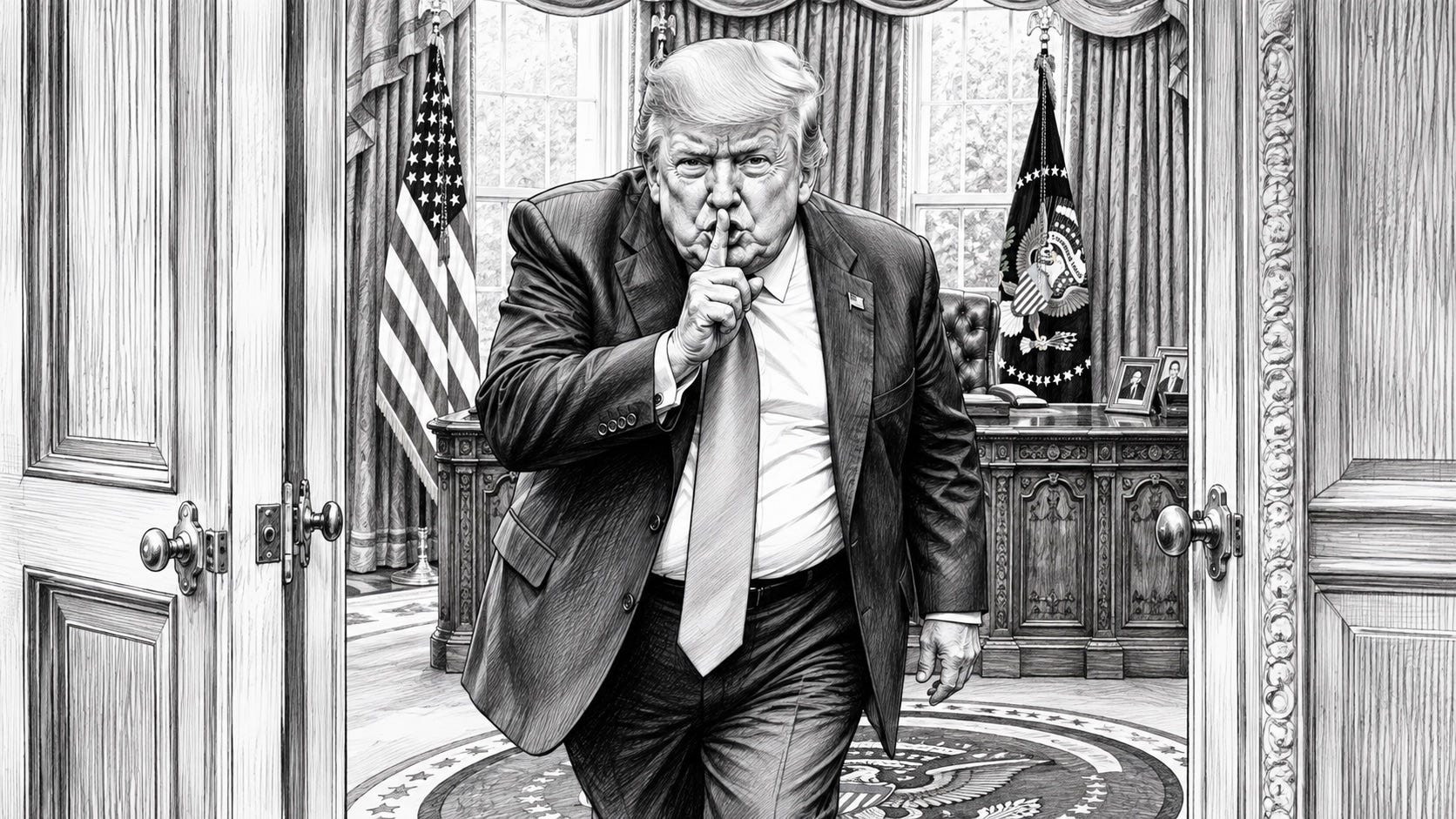
There is a name for what you are watching
Political scientists have a term for the pattern unfolding in front of us. They call it institutional capture, also known as state capture. I need you to understand what the phrase means, because the moment you have it, the last nineteen months stop reading like a pile of unrelated headlines and start reading like a plan.
Capture is quiet. A leader who wants to run a democracy the way he runs a private company almost never storms the building and burns the files, because that would wake up the entire country and hand his opponents a photograph nobody would need explained to them. He does something slower. He keeps the name on the door, the badge, the letterhead, the annual budget. He brings in loyalists and pushes out the professionals who might tell him no. The mission gets pointed somewhere new, the sign out front still says Department of Justice, and the work inside now answers to one man.
Start with the lawyers
Justice enforces the law the same way no matter who sits in the White House. At least it’s it’s supposed to work that way.
Look at what happened to the people who took that seriously. Seven federal prosecutors resigned in February 2025 after the acting deputy attorney general ordered them to drop the corruption case against the mayor of New York. That June the department fired at least three prosecutors who had worked the January 6 cases, two of them supervisors, in letters that stated no reason beyond Article II and the laws of the United States.
On January 7 of this year an ICE officer shot and killed Renee Nicole Good, a United States citizen, in Minneapolis. Six federal prosecutors in Minnesota resigned within days over pressure to investigate Good’s widow and over leadership’s reluctance to investigate the officer who fired. Senior lawyers in the Civil Rights Division in Washington quit the same week after the division declined to open a constitutional inquiry, and more than a dozen prosecutors walked in total.
On August 8 the Senate confirmed the president’s former personal defense attorney as attorney general, fifty to forty nine, in a vote gaveled through around four in the morning. Two Republicans voted no. He had been running the department as acting attorney general since April.
That same department indicted a former FBI director last fall for posting pictures of seashells on social media. A federal judge threw the indictment out in November because the prosecutor who brought it had been installed unlawfully, and the career prosecutor who declined to bring the case had already resigned under pressure to sign it. The appeal sits in the Fourth Circuit today.
Uniforms, and who they answer to now
Our military has held to an apolitical tradition for 250 years by design, because the Founders had watched armies swear themselves to a man and follow wherever he pointed, and they built a Constitution meant to make that ending hard to reach here. Beginning on January 21, 2025, with the removal of the Coast Guard commandant one day into the term, more than a dozen generals and admirals have been fired, among them the chairman of the Joint Chiefs, the chief of naval operations, the vice chief of the Air Force, and the chief of the Navy Reserve. Reasons were offered for a few of those removals. For most, none were given at all.
In February 2025 the defense secretary fired the top uniformed lawyers for the Army and the Air Force and moved to replace the acting Navy judge advocate general, saying he did not think those positions were well suited to giving the best recommendations no matter what lawful orders are given. Days later he said he wants lawyers who do not exist to be roadblocks.
In August 2025 he fired the director of the Defense Intelligence Agency, two months after that agency’s assessment found the strikes on Iran had set the nuclear program back by months, contradicting the president’s claim that the sites were obliterated. Officials gave no public reason.
The watchdogs went first
On January 24, 2025, the president fired roughly seventeen inspectors general overnight, without the thirty days notice federal law requires. The watchdogs stopped barking. More than seventy five percent of presidentially appointed inspector general posts across the government sit empty today, a figure that counts those firings along with later removals, resignations, and seats already open before any of this started. The offices left standing lost about a sixth of their workforce over the following year, and the Education Department’s oversight shop issued sixty six percent fewer reports in the first half of this year than its historical norm.
The end of the right to refuse
In February the Office of Personnel Management finalized a rule stripping civil service protections from an estimated fifty thousand career federal employees, and on June 3 the president signed an order converting nearly eight thousand of them, roughly ninety seven percent in the senior ranks at grade GS 15 and above, into at will workers who serve at pleasure. No appeal rights. Their whistleblower complaints now get handled inside the agency they might need to blow the whistle on. Unions have sued, and the rule is in active litigation.
Others already ran this experiment
Orbán did it in Hungary. Erdoğan did it in Turkey, Putin did it in Russia, Chávez did it in Venezuela. Methodically, office by office, until the courts and the prosecutors and the army and the press all pointed the same direction, which was his. The goal is control. And know this fact: once these offices are captured, winning them back is brutally hard, because the people inside them serve the regime now, and the ones who would have fought it from within are already gone.
Where this argument gets tested
Give the other side its due, because someone you know is going to raise it. A president is entitled to pick his own senior team, and the Supreme Court has read the removal power broadly. Scholars who study democratic decline disagree among themselves about how much of this counts as capture.
The courts have pushed back in real ways, holding in December that the president likely lacked authority to federalize the National Guard in Illinois, throwing out the indictments of two of his most prominent targets, and taking up union suits over the civil service rule. There are dozens of other examples but you get my point. The checks, for the most part, are holding in places. The people who staff them are being replaced one office at a time, and that trend line is the thing to watch.
What you do about it this week
Name it out loud. Talk about institutional or state capture. Use plain words at the dinner table and in the group chat, and back the people inside these agencies who are refusing to bend, because there are plenty of them and they are watching to see whether anyone out here has their back.
Call your two senators and your representative by phone at (202) 224-3121. Give your name and your town, and ask where their line sits. Refuse to treat any of this as normal, because it is not.
This is a pattern that you now recognize. The pattern is what you need to break, and it starts with the midterms.
Mitch Jackson, Esq.
PS- Also see my short video, How propaganda works. Why repeating a lie matters.
Subscribe free to Uncensored Objection and many of these breakdowns land in your inbox, written by a trial lawyer who reads the rulings and the resignation letters so you walk into your next argument holding the actual record. Go paid and you fund the research hours and everything else that keep this work answerable to you and to nobody I write about.
👏🏾 I think there is another part of this that people are not discussing enough: we have mistaken the existence of laws for proof that those laws can protect us.
The Constitution is not self-enforcing. A law only has power when there are people inside the government who are willing and able to enforce it—even when doing so means standing against the president, their political party or their own superiors.
That is why replacing career professionals with loyalists matters so much. The law does not necessarily have to be rewritten if the people responsible for enforcing it have already decided whom it will and will not apply to.
At that point, the country may still have courts, prosecutors and constitutional protections, but ordinary people no longer have any guarantee that those protections will actually reach them. Its belief in the law and its interpretation that I think is the issue.
I also think the manipulation of social media is also an important thing we need to discuss because it’s so seamless and adds fuel to the fire. The algorithm is why No one can conclusively agree on anything because the algorithm purposely divides people by using a proprietary blend of misinformation to get people emotional.
Emotional outrage creates attachment to people’s personal beliefs and all the tech oligarchs care about is engagement… because it makes them money.
I think the first people that need to be brought in for questioning and law reform are the ceos of the social media companies. Because their interpretation of what “the general population wants to see” manipulates the masses. No two algorithms are alike, that should tell you something.
Peter Thiel, Marc Andreessen and Elon Musk are in cahoots with Trump. Why do consumers support the businesses of people that are actively trying to destroy democracy?
We can vote with our dollars, but apathy seems to be contagious