

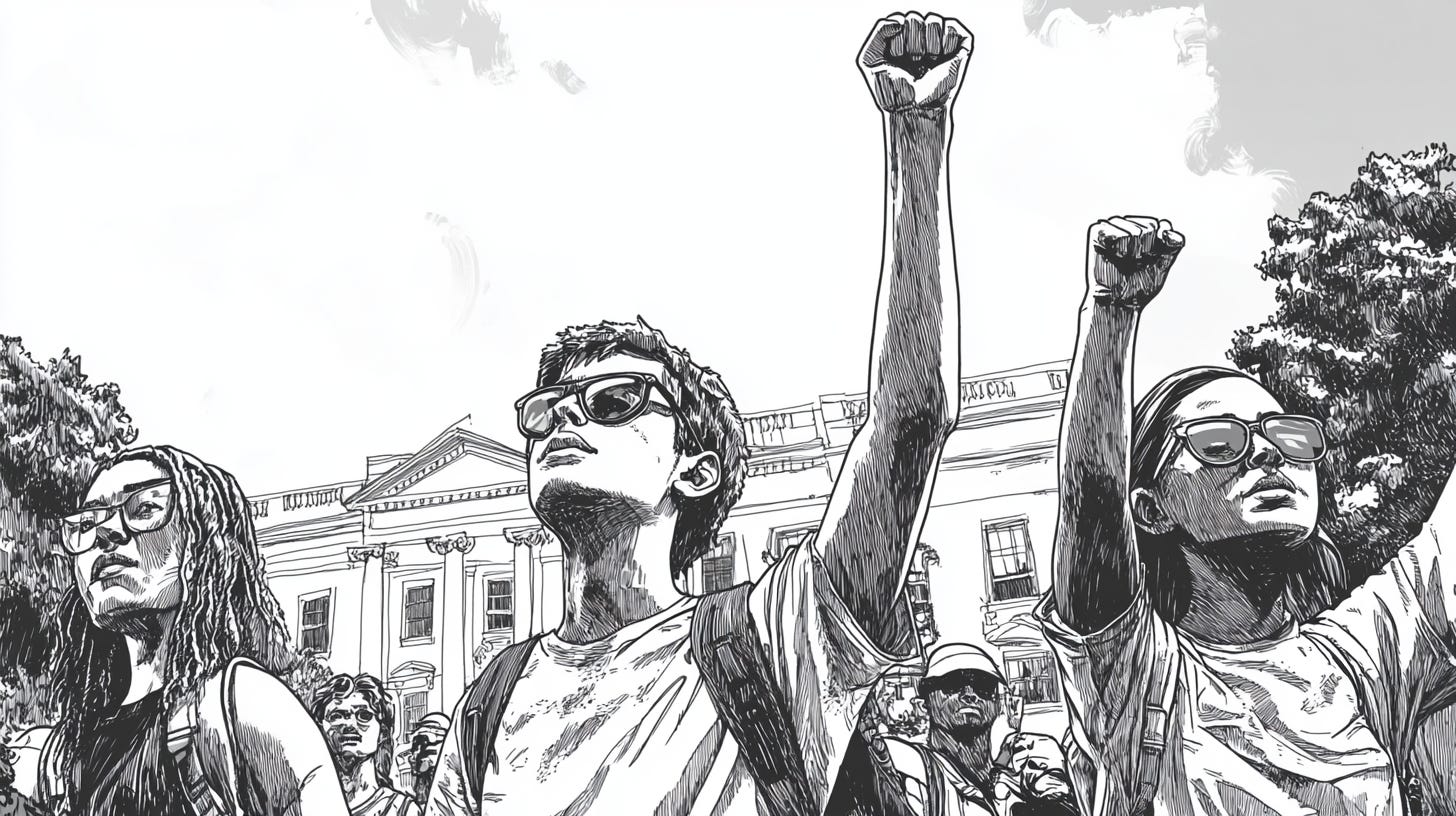
Summary
A single day, 50 states, and one movement—the 50501 protests are igniting a national reckoning on executive power and democracy itself. What began as a grassroots effort has swelled into a full-scale resistance against President Trump’s latest policies, from rolling back diversity initiatives to granting Elon Musk unprecedented governmental influence. With echoes of past movements that reshaped history, these demonstrations challenge what the limits of power should be in a democracy. Whether the movement alters policy or simply shifts public discourse, one thing is clear: the fight for democratic accountability is far from over.
The 50501 Movement and the Presidents Day Protests
Who are the protesters and what do they want? The Presidents Day protests are organized by a new grassroots network calling itself the 50501 Movement (a name signifying 50 protests in 50 states 1 day). This movement sprang up in late January via a Reddit community and quickly mobilized supporters nationwide.
On February 5, 2025, they held their first coordinated demonstrations, and now they are expanding the effort on Presidents Day (the national holiday honoring U.S. presidents) as a pointed statement. “We are going out and protesting because we are concerned by our current president’s actions,” explains Sydney Wilson, a 50501 press liaison, adding that Presidents Day is an ideal moment to highlight their message. The rallies are planned at state capitols and major cities in all states, as well as in Washington, D.C., truly nationwide in scope.
What unites these protesters? At core, the movement is reacting to what it calls anti-democratic abuses of power by the Trump administration. Their placards and chants underscore a few unifying demands and concerns:
Reversing Certain Executive Orders: Protesters oppose a series of executive actions signed by President Trump that they view as undermining civil rights and rule of law. For example, Trump’s new orders have rescinded diversity, equity, and inclusion (DEI) initiatives across the federal government. Activists want those inclusion programs reinstated, arguing that “Diversity hurts no one,” as one sign put it. Another flashpoint is transgender rights – demonstrators note that the administration is “taking away transgender rights” by ordering the government to recognize only gender assigned at birth. This effectively rolls back protections for transgender individuals, a move that has drawn outrage from LGBTQ+ communities and allies.
Opposing Elon Musk’s Government Role: A major rallying cry is resistance to the outsized role of Elon Musk in the current administration. In one of Trump’s early executive moves, he established a so-called Department of Government Efficiency (DOGE) – essentially an advisory board – with Musk at its helm. Musk, a tech billionaire with no prior public service, has been tasked with finding ways to slash federal spending and bureaucracy. Critics see this as an alarming privatization of governance.
In Raleigh, NC, thousands marched while objecting that “Trump gave an unelected billionaire…Elon Musk, control over government employees, agencies and funding.” Many Americans are uneasy that Musk now has access to federal personnel data and an influential say in agency budgets. “We find it very concerning that there is a non-government official that has the access that he does,” Sydney Wilson of 50501 says, calling for Musk’s removal from this role. The slogan “No Felon, No Elon” has even appeared – referencing that Trump (as the 47th president) is a convicted felon, and Musk’s influence is seen as part of the same problem of unaccountable power.
Accountability for Anti-Democratic Actions: Beyond specific policies, the 50501 Movement’s broader demand is to hold the administration accountable for what they term “the fascist takeover of the federal government.” They call for investigations into Trump’s appointees – especially those tied to “Project 2025,” a conservative plan to expand presidential control over government. Protesters are also angered by actions like mass pardons of January 6th Capitol rioters.
Indeed, on his first day back in office, Trump pardoned roughly 1,500 individuals convicted for the 2021 Capitol attack. To the 50501 activists, wiping clean the records of those who violently attempted to overturn an election is an “illegal” abuse of presidential power – one that they say signals a dangerous erosion of accountability. Signs reading “Stop the Coup” and “Impeach 47” (47 referring to Trump as the 47th president) encapsulate the fear that democratic institutions are under threat.
Defending Immigrant and Minority Rights: Many demonstrators are rallying for the rights of immigrants, racial minorities, and other marginalized groups. They point to Trump’s stringent new immigration measures – for instance, reports that deported people are being detained in camps and even flown to Guantánamo Bay – as evidence of cruelty and executive overreach. Protesters in multiple states carried American flags alongside messages like “No Kings,” “Long Live Democracy, Reject Fascism,” and “Deport Musk!” linking the fight for democratic norms with the protection of vulnerable communities. There is also a push against hateful rhetoric: the movement’s platform calls for stronger hate-speech laws and a ban on displays of Nazi symbols and salutes – a reaction to rising extremist behavior that they feel Trump has enabled.
Together, these points paint a picture of a citizen movement taking a stand for democratic governance, inclusion, and accountability. The “Not My President’s Day” slogan adopted by some of the protesters captures their sentiment that the current president’s actions do not represent the people’s will. In essence, the 50501 protests aim to check executive power by activating public pressure in every corner of the country.
Policies and Orders in the Crosshairs
To understand the protesters’ grievances, let’s break down the specific executive orders and policies they are responding to:
Dismantling of DEI Programs: In one of his first acts, President Trump rolled back federal diversity, equity, and inclusion initiatives via executive order. This meant canceling workplace diversity training, ending equity task forces, and other measures designed to promote fairness for minorities and women in government. Organizers argue this is a direct attack on civil rights progress – one that they are determined to reverse. (It’s worth noting that this rollback was part of a broader Day 1 package of orders; in the same swoop, Trump also scrapped various environmental regulations and pandemic-era policies fueling concern among environmentalists and public health advocates as well.
“Department of Government Efficiency” (DOGE) Led by Elon Musk: Perhaps the most novel – and controversial – move has been the creation of an outside advisory board dubbed the Department of Government Efficiency. By executive order, Elon Musk was appointed to lead this effort to slash federal spending and bureaucracy. The DOGE has been empowered to review federal agencies and recommend cuts or reorganizations. While the administration touts this as a cost-saving innovation, critics see it as outsourcing government functions to a private businessman. Protesters point out that Musk now has access to federal employee databases and sensitive information despite holding no official public office. “It certainly seems like a breach,” said one federal employee protesting in North Carolina, voicing alarm that her personal data could be an open book to Musk’s team. The slogan “Stop the Musk Monarchy” spotted at rallies reflects a fear that a tech oligarch is wielding king-like power without checks. For many, Musk’s involvement epitomizes what they call “unelected oligarchs” steering policy – exactly what democratic government is not supposed to be.
Mass Pardons and Clemency for Jan. 6 Offenders: True to his campaign promise, Trump swiftly pardoned or commuted sentences for hundreds of people charged in the January 6, 2021 Capitol riot. This blanket clemency has been condemned by opponents as a brazen subversion of justice – effectively nullifying the consequences for an anti-democratic insurrection. It outraged not only the families of Capitol police officers and lawmakers endangered that day, but also everyday Americans who believe in rule of law. The 50501 Movement cites these pardons as evidence that the administration is willing to “override justice to protect its allies,” undermining the principle that no one is above the law. By pardoning those who tried to overturn a democratic election by force, Trump, in the protesters’ view, crossed a line that demands a public rebuke. Their call for impeachment and removal from office is partly rooted in this action, arguing that it constitutes an abuse of power and a threat to democracy.
Hardline Immigration and “Law and Order” Policies: The new administration has aggressively moved to tighten immigration and policing, which protesters say violates human rights. On immigration, Trump signed orders to curb both legal and illegal immigration – including halting refugee admissions, expanding detention of asylum seekers, and deploying tactics not seen in decades. Activists point to reports of grim detention conditions and even the transfer of some deportees to the Guantánamo Bay facility as signs of “authoritarian-style” policies. Similarly, on domestic law enforcement, Trump has championed a “law and order” stance that includes empowering federal agents and local police while downplaying concerns about racial bias. He has even threatened to use military force in response to civil unrest. In this context, the multi-racial crowds protesting on Presidents Day see themselves as defending constitutional rights and humanitarian values against an administration they feel is veering into authoritarianism.
Restrictions on LGBTQ+ Rights: Alongside ending DEI programs, the administration took aim at protections for LGBTQ+ Americans. One order now requires the federal government to recognize only genders assigned at birth, essentially erasing recognition of transgender and non-binary identities in federal policy. It also withdrew support for gender-inclusive initiatives put in place by the previous administration. As a result, policies on healthcare, education, and the military are being rolled back to pre-2016 standards regarding transgender individuals. “Taking away transgender rights…trying to take federal money away from the people,” is how one protester, Deanna Rose, summarized her reasons for marching. The protests have a strong showing of LGBTQ+ activists and allies waving Pride and transgender flags, insisting that civil liberties must not be sacrificed. Many see the fight for transgender rights as a continuation of America’s broader civil rights struggle – hence the chant in some rallies that “an injury to one is an injury to all.”
Federal Workforce Purges and “Loyalty” Tests: Though less visible to the public, Trump’s early actions within the federal workforce have alarmed many who treasure nonpartisan governance. In line with the Project 2025 agenda, the administration has begun removing or pressuring independent civil servants and replacing them with loyalists. News broke that more than a dozen senior State Department diplomats were asked to resign en masse, and plans were set in motion to reclassify federal employees to ease firing of those deemed “disloyal.” A freeze on federal hiring and an end to remote work were also ordered. These moves prompted government employee unions and watchdog groups to cry foul, calling it a “politicization of the civil service.” The 50501 Movement echoes those concerns, fearing that such purges concentrate power in an echo chamber and dismantle the merit-based professional bureaucracy. The protesters’ demand to investigate Trump’s appointees and policies is partly to expose any illegal or unethical purge of public servants. They argue that a healthy democracy requires an independent administrative state – not one where jobs hinge on fealty to one leader.
In summary, the 50501 protests are answering a broad array of grievances with a simple stance: these policies threaten the foundations of American democracy and must be opposed by the people. From Musk’s extraordinary role to the tearing down of diversity protections and the pardoning of political violence, the protesters see a pattern of consolidating power and silencing dissent. Their response – peaceful mass protest – is a classic exercise of First Amendment rights intended to restore balance. “This is what democracy looks like!” was a frequent chant heard from Hawaii to Pennsylvania during the first wave of 50501 rallies. Now, on Presidents Day, that call is ringing out again in state capitals nationwide.
Significance and Potential Impact
Why do these protests matter? At first glance, a few hundred demonstrators at each state capitol might not seem earth-shattering compared to, say, millions who have marched in past protests. Indeed, the initial 50501 protest on Feb. 5 drew hundreds of participants in many cities, totaling nearly 80 protests in 88 cities – a respectable turnout, though not yet on the scale of some historic rallies. However, the significance of the 50501 Movement lies in its breadth and timing. This is the first coordinated national protest campaign of the new Trump term, arriving just weeks into the administration. It serves as an “early warning system” of public discontent, potentially shaping the narrative of this presidency’s start.
Several notable impacts could emerge:
Public Awareness and Discourse: The nationwide Presidents Day rallies have already attracted substantial media coverage, ensuring that the protesters’ concerns reach a wide audience. By highlighting issues like Elon Musk’s quasi-official power and the rollback of civil rights policies, the movement is forcing these topics into the national discourse. Not everyone reading or watching will agree with the protesters, of course, but the fact that ordinary Americans in every state are taking to the streets can prompt many citizens to ask: “What exactly is happening in Washington?” In this way, 50501 is sparking civic dialogue about executive overreach. As history has shown, sustained public pressure often compels leaders to at least address the issues raised – whether through press conferences, policy adjustments, or tweets. Already, signs suggest the administration feels the heat: reports have surfaced of officials defending Musk’s role as merely “advisory” and promising that “no laws are being broken” by the new initiatives. That defensive stance indicates the protests are hitting a nerve.
Political Momentum for the Opposition: Nationwide protests can galvanize the political opposition and shape election prospects. Just as massive anti-Trump marches in 2017 energized candidates to run in 2018, the 50501 protests may boost organizing on the ground. Local activists are networking across state lines through this movement, potentially laying the groundwork for a broader pro-democracy coalition. It’s telling that these events have drawn a diverse crowd – young and old, urban and rural, of various races and backgrounds – all united by concern for democracy. That kind of unity can translate into a potent political force. Lawmakers are likely watching their hometown protests; some Republican legislators have already faced pointed questions at town halls about Musk’s influence and the pardon spree. Meanwhile, Democratic leaders have praised the protesters. This dynamic might influence the 2026 midterm elections if the movement grows: public opinion could shift against policies seen as too extreme, pressuring moderate Republicans to distance themselves from the administration’s harder line. In short, 50501 could become a rallying banner for the president’s opponents, much like the Tea Party was for opposition to President Obama in 2010 (but in reverse, now progressives pushing back on a conservative president).
Constraining Policy Through Public Pressure: Even if the protests don’t directly change the President’s mind, they can have a chilling effect on some initiatives. For example, if there’s loud public outcry against certain executive orders, it might embolden judges to issue injunctions when those orders are challenged in court. (Federal courts pay attention to the context of cases- at least they used to, and widespread protest can signal broader constitutional concerns.) Additionally, federal agencies might be more cautious in implementing controversial directives if they know the public is mobilized against them. A case in point: the “Project 2025” reforms that aim to purge civil servants – these could face slower roll-out if agency heads fear backlash or whistleblowers (who are encouraged by seeing crowds of citizens backing them up). Moreover, sustained protests keep media and congressional scrutiny high. Congressional committees may hold hearings on Musk’s role or on the impact of ending DEI programs, especially if constituents keep the pressure on. In sum, the 50501 Movement’s presence in all states serves notice that many Americans are watching – and resisting – the administration’s agenda, which could deter its more extreme impulses.
Symbolic Reclaiming of Patriotism: By protesting on Presidents Day, the movement is also engaging in a battle of symbolism. Presidents Day traditionally celebrates the legacy of leaders like Washington and Lincoln. The protesters are implicitly asking: What kind of leadership do we honor today? Their slogan “Not My President’s Day” suggests that Trump’s conduct doesn’t merit celebration but rather protest. This reframing could influence public sentiment long-term. If large numbers of citizens annually mark Presidents Day with civic demonstrations, it revives a culture of active participation in democracy. Some historians note that dissent can be a form of patriotism – holding leaders accountable to the country’s ideals. The 50501 activists explicitly invoke founding principles; for example, one organizer in Texas quoted the Declaration of Independence on equality and rights while rallying her crowd. By wrapping themselves in the American flag (quite literally in many cases, as protesters wave flags alongside protest signs), they challenge the notion that only the administration’s supporters represent “real Americans.” This could have a unifying effect beyond partisan lines, reminding people that protest is a legitimate and time-honored American tradition when faced with government overreach.
It’s important to remember that protests often take time to yield tangible results. In some cases, they may not achieve their immediate policy goals, but still leave a lasting imprint on society or inspire future movements. The 50501 Movement’s true impact will be measured not just by whether certain executive orders are repealed (which might depend on court rulings or elections), but by whether it manages to sustain civic engagement. The early signs – two national days of action within a month, active online organizing, and significant press attention – indicate that this could be the beginning of a persistent citizens’ resistance in the 2025-2029 period.
To put the 50501 protests in perspective, it’s helpful to compare them with historic national protests that have shaped U.S. history. The United States has seen waves of popular protest at critical moments – some successful in achieving their aims, others not immediately so, but all influential in the long run. Below, we examine seven other major national protests and protest movements, outlining their causes, key figures, and how they brought about change. These examples provide a context for understanding how today’s demonstrations fit into the broader story of American activism.
Historical Parallels: Seven National Protests That Shaped America
American history is filled with moments when people took to the streets en masse to demand change. The 50501 Movement echoes elements of these past movements. Here are seven historic national protests, spanning over a century, that reshaped the country – each a testament to the power of citizen activism:
Women’s Suffrage Parade (1913): On March 3, 1913, the day before President Woodrow Wilson’s inauguration, over 5,000 women marched down Pennsylvania Avenue in Washington, D.C. calling for the vote. Organized by Alice Paul and the National American Woman Suffrage Association, this was the first major suffrage demonstration in the nation’s capital. Suffragists marched with banners and floats, enduring heckling and even physical attacks from hostile spectators as police largely stood by. The spectacle, however, succeeded in riveting the country’s attention.
How it facilitated change: The parade revitalized the women’s suffrage movement, pressuring Wilson and Congress to take the issue seriously. It kicked off several more years of protests, picketing, and civil disobedience. Finally, in 1920, the 19th Amendment was ratified, granting American women the right to vote. The 1913 march is remembered as a turning point that demonstrated women’s collective political power and set the stage for this landmark expansion of democracy.
March on Washington for Jobs and Freedom (1963): On August 28, 1963, an estimated 250,000 people gathered at the National Mall in Washington, D.C., making it one of the largest protests in U.S. history up to that time. People from all over the country – Black, white, and otherwise – marched peacefully, demanding civil and economic rights for African Americans. It was at this march that Dr. King delivered his famous “I Have a Dream” speech, with over 3,000 media members there to broadcast his words to the world.
How it facilitated change: The March on Washington put enormous pressure on the federal government to act. Just two weeks after the demonstration, President John F. Kennedy met with civil rights leaders, and the event is credited with building momentum for the Civil Rights Act of 1964. Indeed, within a year, Congress passed the Civil Rights Act, and the Voting Rights Act followed in 1965 – legislative victories that owed much to the urgency and public support generated by the march. This protest not only achieved concrete policy change but also etched an enduring moral vision of equality into the American consciousness.
Stonewall Riots (1969): In late June 1969, patrons of the Stonewall Inn – a gay bar in New York City’s Greenwich Village – spontaneously fought back against yet another police raid. Such raids to harass LGBTQ people were common at the time. But on June 28, 1969, the community reached a breaking point. Riots and demonstrations erupted in the streets around the bar for six consecutive days.
How it facilitated change: The Stonewall uprising is widely considered the catalyst for the modern gay rights movement. In the wake of the riots, activists like Johnson and Rivera co-founded groups such as the Gay Liberation Front to organize politically. Exactly one year later, on the anniversary of Stonewall, New York hosted the first Christopher Street Liberation Day march – essentially the first Pride Parade – and similar marches took place in cities like Los Angeles, Chicago, and San Francisco. This was the birth of annual Pride events. Over the next several decades, the LGBTQ+ rights movement achieved significant victories, from the declassification of homosexuality as a mental illness in 1973, to anti-discrimination laws, to the legalization of same-sex marriage nationwide in 2015. Stonewall’s significance was not that it immediately changed law (there were no instant policy shifts in 1969) but that it empowered a community to demand change. The protests made LGBTQ Americans visible and launched an organized fight for equality that has since transformed societal attitudes and laws.
Vietnam War Moratorium Protests (1969): By 1969, the Vietnam War had been raging for years, with mounting American casualties and widespread public disillusionment. On October 15, 1969, a nationwide protest called the Moratorium to End the War took place. Millions of Americans participated in anti-war demonstrations and peace vigils in towns and cities across the country – from college campuses to city halls. One month later, on November 15, 1969, an estimated 500,000 to 600,000 protesters marched in Washington, D.C. in the largest anti-war rally the nation had seen up to that point. These protests included not just students and activists but people from many walks of life, even some veterans and mothers of soldiers, all calling to “Bring Our Boys Home.”
How it facilitated change: The Moratorium and subsequent marches were a significant factor in shifting public opinion against the war. They signaled that opposition to Vietnam was mainstream, not fringe. President Richard Nixon famously responded with a televised speech about the “silent majority” supporting the war, but behind the scenes the protests registered. Under pressure, the Nixon administration began to gradually draw down U.S. troop levels in Vietnam starting in 1969 and engaged in peace negotiations. While the war continued until 1975, the anti-war movement succeeded in curbing its escalation. Notably, it also led to policy changes like the abolition of the military draft in 1973 (moving to an all-volunteer force in part due to the outrage over sending unwilling draftees to war). The Vietnam protests taught a generation that sustained public protest could help end an unpopular war – a lesson that has influenced how Americans respond to military conflicts since.
Earth Day Environmental Demonstrations (1970): On April 22, 1970, the first Earth Day was held. It wasn’t a protest against a single policy, but a nationwide demonstration for environmental protection – essentially a collective protest against decades of industrial pollution. An astonishing 20 million Americans (10% of the U.S. population at the time) took part in rallies, teach-ins, and clean-up events across the country. People gathered in city parks, on college campuses, and in the streets, holding signs like “Give Earth a Chance” and demanding action to clean up air and water.
How it facilitated change: Earth Day 1970 is directly credited with spurring the U.S. government to act on the environment. By the end of that year, a previously apathetic Congress authorized the creation of the Environmental Protection Agency (EPA) and passed landmark legislation including the Clean Air Act. Over the next few years, additional laws like the Clean Water Act and Endangered Species Act followed. It’s hard to overstate how quickly public policy shifted – going from almost no environmental regulations to a comprehensive framework by 1972. The mass participation on Earth Day demonstrated overwhelming public demand for change, giving politicians of both parties a mandate to respond. In the longer run, Earth Day became an annual event and helped nurture the modern environmental movement. The very notion that we have “environmental rights” – like the right to clean air – became widely accepted because millions of people had taken to the streets to voice that idea.
Women’s March (2017): On January 21, 2017, the day after Donald Trump’s inauguration as 45th president, women-led protests erupted in cities and towns across the United States, making it the largest single-day protest in American history. In Washington, D.C. alone, over 500,000 people marched – more than double the crowd at the inauguration ceremony the day before. Nationwide, an estimated 3.3 to 5 million Americans participated, which amounts to about 1.5% of the entire U.S. population rallying on that single day. Marchers wore pink “pussyhats” (a reclaiming response to an offensive comment by Trump) and carried signs with messages such as “Women’s Rights are Human Rights” and “Love is Love” – the latter reflecting that the march’s concerns extended to LGBTQ rights, racial justice, and more.
How it facilitated change: The Women’s March of 2017 did not have one specific policy demand; rather, it was a broad expression of resistance and solidarity. Its impact, therefore, was somewhat indirect but significant. Firstly, it sent a powerful message that millions would mobilize to watchdog the new administration on issues of equality and justice. This energy translated into sustained activism: many attendees went home and joined local advocacy groups, considered runs for office, or became more politically active. In the 2018 midterm elections that followed, a record number of women ran for office and won, leading analysts to dub it another “Year of the Woman.” Indeed, 2018 saw a surge of women elected to Congress and state offices (from both major parties), partly inspired by the empowerment and networks formed after the Women’s March. The march also spawned an organization that continued annual events and championed causes like voter registration and #MeToo anti-harassment efforts. Culturally, the image of seas of pink-hatted protesters worldwide (for the march went global, with sister rallies on all seven continents) underscored a rejuvenated feminist movement. It showed that mass protests could be organized rapidly via social media – a lesson the 50501 Movement has also taken to heart by using Reddit and online platforms.
Black Lives Matter Protests (2020): In the summer of 2020, amid the COVID-19 pandemic, America experienced a social eruption. After George Floyd, an unarmed Black man, was killed by a Minneapolis police officer on May 25, 2020 (an incident captured on video, horrifying millions), protests against racial injustice spread like wildfire. Within days, demonstrations had occurred in at least 75 cities from coast to coast. By June 6, an estimated half a million people protested on a single day across nearly 550 locations in the U.S., and over the following weeks, 15 to 26 million Americans participated in Black Lives Matter protests – making it the largest protest movement in U.S. history in terms of sheer numbers. The marches were diverse and widespread, including large gatherings in big cities and small vigils in rural towns, all chanting “I can’t breathe” and “No Justice, No Peace.”
How it facilitated change: The 2020 BLM protests had immediate and longer-term effects. In the immediate aftermath, many cities and states enacted police reform measures. At least 30 states plus Washington, D.C., passed new laws addressing police misconduct – for instance, banning chokeholds, mandating body cameras, or strengthening civilian oversight. Some cities reallocated portions of police budgets toward social services, and symbols of racism (like Confederate statues) were removed in several locales. While comprehensive federal police reform (the George Floyd Justice in Policing Act) stalled in the U.S. Senate, the protests unquestionably shifted public opinion: surveys showed a majority of Americans acknowledging systemic racism in policing, a significant change from prior years. The corporate and sports worlds also responded, with businesses instituting diversity training and athletes kneeling in solidarity. Importantly, the protests fueled voter turnout in November 2020 and 2022 among communities demanding change. In the broader sweep of history, the 2020 protests built on the civil rights activism of the 1960s and the Black Lives Matter movement that began in 2013, pushing the country to confront unfinished business regarding racial equality. The legacy is ongoing – debates on policing and racial justice continue, but they do so with far greater public engagement and awareness, thanks to those who marched in 2020.
Each of these historic protests was driven by ordinary people moved to extraordinary action. They demonstrate patterns that resonate with the 50501 Movement: a triggering injustice or threat, grassroots organization (sometimes spontaneous, sometimes planned for months), visible public demonstrations, and outcomes ranging from new laws to social awakenings. Not every protest achieves its goals right away, but even those deemed “unsuccessful” in the short term can set the stage for future victories or shift the national conversation. The Bonus Army protests of 1932, for instance, didn’t immediately get World War I veterans their bonuses – but the public sympathy generated by their mistreatment influenced the election of Franklin D. Roosevelt and, eventually, the bonus payout and the G.I. Bill. In that sense, protests can plant seeds for change that bloom later.
For the 50501 Movement, these precedents are both inspiration and instruction. The suffragists teach perseverance; the civil rights marchers teach moral clarity and strategic discipline; Stonewall teaches pride and not backing down; the anti-war and BLM protesters teach the power of sustained public pressure and broad coalitions. The Presidents Day protesters are keenly aware of walking in these historical footsteps. In fact, some signs at 50501 rallies explicitly reference past movements – such as “Selma taught us: no struggle, no progress,” or “We march for our children’s future like our grandparents marched for us.” By invoking these past struggles, today’s protesters remind observers that what seems radical or disruptive in the moment may later be seen as a courageous stand that helped bend the arc of history toward justice.
Conclusion
Circling back to the opening question – Can nationwide dissent defend democracy? – the story is still being written. The Presidents Day protests of 2025 illustrate a profound democratic spirit: citizens in every state raising their voices in unison to check what they perceive as abuses of power. It is a real-time experiment in civic action. If the 50501 Movement maintains momentum, compels transparency, and perhaps moderates some of the administration’s actions, it will vindicate those who believe that yes, peaceful protest remains one of the most potent tools Americans have to safeguard their democracy. If it falters or is met with repression, it will test the resilience of that democracy.
One thing is certain: the tradition of American protest is alive and well. From the Boston Tea Party in 1773 to the rallies of today, dissent has been a engine of change – an “act of patriotism,” as some scholars put it. The 50501 activists are tapping into this tradition, asserting that love of country can mean holding your leaders to its highest ideals. Their protests, like the seven historic ones we reviewed, are a reminder that We the People do not have to be passive when we see government actions that betray our values. Instead, we can speak out in the public square – loudly, creatively, and persistently – until our voices are heard and our institutions respond.
As the Presidents Day demonstrators pack up their signs and go home, they carry forward the legacy of past movements and perhaps ignite a few new sparks of change. Will these 50-state protests mark the beginning of a significant course correction in American politics? Only time will tell. But if history is a guide, even the act of coming together in unity for democracy will have echoes that last far beyond this one holiday.
The question itself – “What happens when citizens in all 50 states stand up at once?” – might well be answered in the months and years ahead, as the repercussions of this day reverberate through the halls of power and the hearts of the people.
Mitch Jackson, Esq. | links
This post is free.
But free doesn’t build the future.
Independent journalism only works when people like you choose to lean in—not just with attention, but with support.
If this work matters to you, today’s a great day to take the leap.
$5 a month. $50 a year. For you or gift to a friend.
A small investment in something bigger than all of us.
