

DISCLAIMER: Everything here comes from public reporting published in the last 48 hours, and this story is still moving, which means details will shift and some of what you read may look different in a week. Do your own due diligence, because I want you informed, not simply fired up.
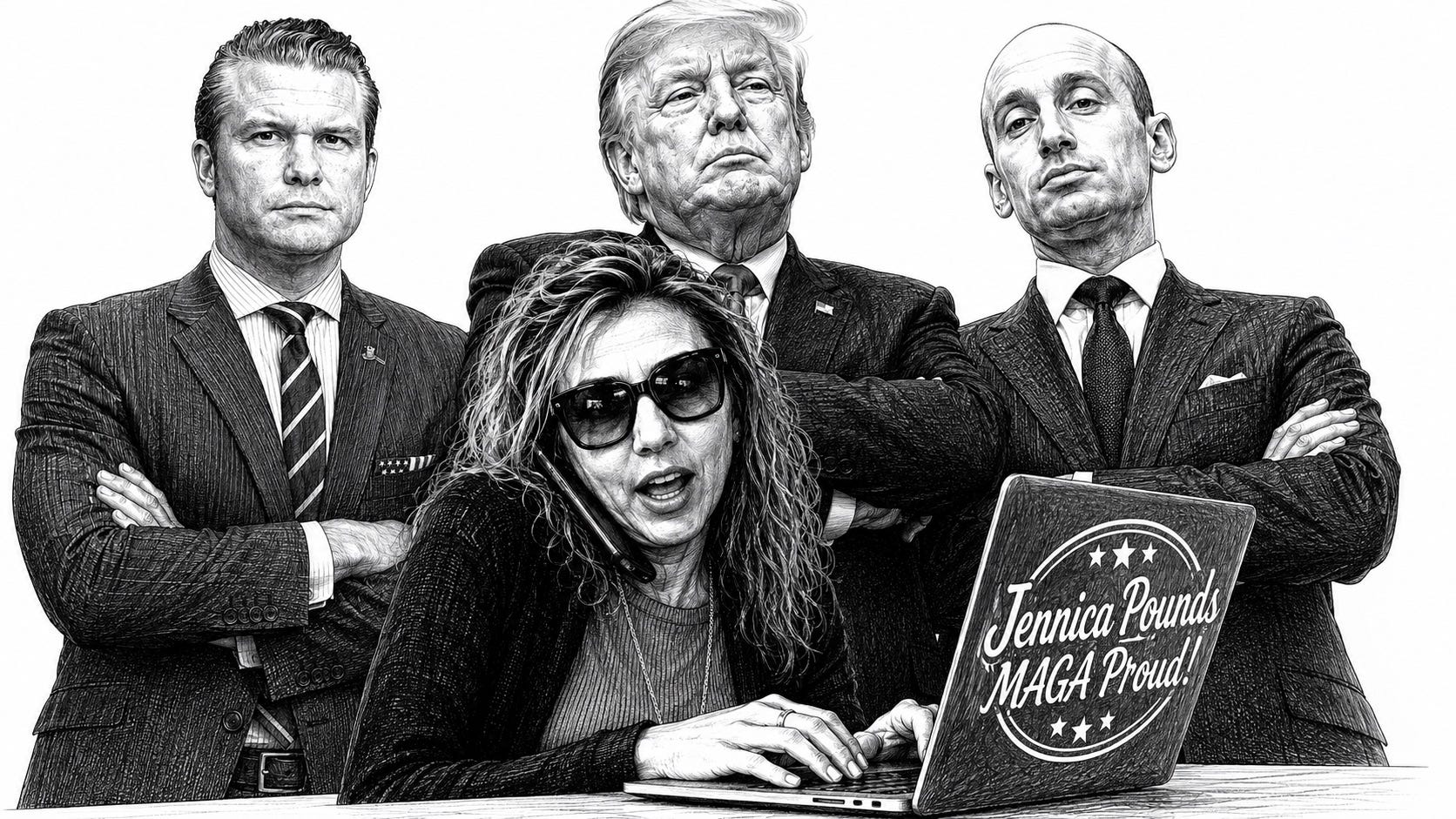
For most of the summer, one of the loudest MAGA influencers and political voices on X has been a Special Government Employee at the Department of Defense who was drawing a government check and telling you nothing about it. Her name is Jennica Pounds. She posts as DataRepublican to nearly a million followers, and through July and August she went after the people Pete Hegseth, the Secretary of Defense, happens to dislike.
All of it landing on your screen looking like the honest work of a private citizen with a laptop and an opinion she came to on her own. She started working for the Pentagon in July. Her Pentagon press badge had expired in June.
The department confirmed her employment just a few days ago on August 24. It came out by accident, after she publicly accused a State Department official of setting her up, and a rival account dropped the fact that she was on the payroll. Nobody in government volunteered it.
Then the list got longer
Yesterday, August 30, the Washington Post put three more names on the board. Add Pounds and you have four.
Rob Maness and Kurt Schlichter are both retired colonels with big online followings. Both hold active government email addresses ending in .civ. That little tag is not decoration. It marks the account holder as a civilian employee of the Defense Department, meaning these are not outside consultants or volunteers dropping by. Both men sit in the office of Anthony Tata, the undersecretary for personnel and readiness.
Thomas Anderson makes three. He is a retired Army colonel who writes online under the name Cynical Publius, and he had the exact same setup earlier this year. Then last week his name quietly disappeared from Pentagon records. Nobody has explained why.
Look at what Maness brings to the table. He ran for office in Louisiana as a Republican and lost every single race he entered. Then he joined a Trump campaign coalition. Now he has a desk inside the Defense Department, the one institution in American life that is supposed to belong to everybody, not to one party.
Add up the followers on these four accounts and you clear two million people.
Two million Americans getting their opinions shaped by voices they believed were independent. The Pentagon was asked a simple question about all of this: is even one of these people drawing a salary paid for with your tax dollars. The Pentagon refused to answer.
Secrecy is the whole problem
Stop and think about how you actually judge what you read online. You weigh a stranger’s post one way when you believe that stranger is speaking for himself, telling you what he honestly thinks, with nothing to gain and nobody standing behind him. You weigh that same post completely differently the second you find out he works for the very people he is writing about.
That shift in your head is not paranoia. It is protection. It is the same instinct that tells you your neighbor’s advice about a car is worth more than the salesman’s pitch about the same car, and you use it every day without thinking about it.
Hiding the paycheck takes that protection away from you before you ever get the chance to use it.
Here is the part that should really bother you. The government was warned about this exact behavior years ago. In 2005, the Government Accountability Office ruled that the Education Department broke federal law by paying commentator Armstrong Williams to promote a policy without telling the public who was funding him. The GAO had a name for it: covert propaganda. The offense was not the message. The offense was the hiding.
Now notice the timing. Months before the 2005 ruling landed, the Justice Department sent agencies a memo saying GAO’s findings did not bind them. That memo is still sitting there. I believe this tells you exactly how this administration plans to respond when somebody finally asks the question. And covert propaganda is only the beginning of what may have been violated here.1
What honest people should do about it
No public record proves anybody was hired specifically to post online. Nobody knows what these people are being paid, or whether they are being paid at all. No inspector general has opened a file. No congressional committee has opened an investigation. At least, not yet.
Those gaps are real, but pay attention to the following. Those same gaps are the entire point. Every one of them could be closed in a single afternoon by a department that already has the records sitting in a filing cabinet and simply will not hand them over.
Look at the shape of this, because you have seen it before. Push out the people whose job is to check you. Bring in people who owe you something. Refuse to explain yourself to anybody. Then wait for everyone to get tired and move on to the next headline. That is the pattern of this whole administration, running in a smaller room with fewer witnesses.
Here is what you do this week. Call your representative and both of your senators and ask them one question. Will they demand the day counts, the job descriptions, and the pay records for every social media personality on the Defense Department payroll. Put it in writing so there is a record of what they said back to you, and so their staff cannot pretend the call never happened.
Then send this to the people in your life who still believe those accounts are independent voices speaking their own minds, because a hidden operation only works as long as it stays hidden, and the fastest way to kill one is to make sure everybody can see it.
Mitch Jackson, Esq.
If you want more reporting that pulls the funding, the paychecks, and the hidden hands out into daylight where you can see them, subscribe (or upgrade your subscription) to Uncensored Objection and get it in your inbox. Free works, paid keeps the lights on and the digging going, and either one puts one more informed person between this administration and the quiet operations it counts on nobody noticing.
There is a permanent law on the books, 10 U.S.C. 2241a, that says the Defense Department cannot spend money on publicity or propaganda aimed at people inside the United States unless Congress approved it first. For decades, the Government Accountability Office, the watchdog agency that works for Congress, has said the thing that makes it illegal is hiding. An agency breaks the law when it pays someone to spread its message and then keeps its own name out of it. GAO has also made clear this rule covers social media, not only television and newspapers. The case that matters most here is a GAO opinion from 2009. Back then, the Pentagon had a program that gave retired military officers talking points and special access, and those officers went on TV as if they were independent experts. GAO said the Pentagon did not break the law, and it gave two reasons. There was no proof the Pentagon hid what it was doing, and no proof it paid those officers for saying nice things. Those two questions are the entire test. They are also the exact two questions the department will not answer today. When an agency spends money it had no legal power to spend, the Antideficiency Act kicks in at 31 U.S.C. 1341. The agency then has to report itself to the President and Congress under sections 1351 and 1517(b). If someone broke the rule knowingly and on purpose, section 1350 opens the door to criminal charges. There are limits. GAO opinions do not legally bind the executive branch. The Justice Department wrote a memo in 2005 rejecting GAO’s whole approach to hidden propaganda. And GAO itself admits it almost never finds a violation. Next is the Hatch Act, found at 5 U.S.C. 7321 through 7326. It stops federal civilian employees from doing partisan political work while they are on the clock, inside a federal building, on government equipment, in an official uniform, or in a government vehicle. A related rule, 5 C.F.R. 734.601, says a Special Government Employee is only covered on the days she is actually working for the government. That is why the records showing which days she worked matter so much. The Hatch Act only reaches activity meant to help or hurt a political party, a candidate, or a partisan group. Now sort out who is who. Only Pounds has been confirmed as a Special Government Employee. Under 18 U.S.C. 202(a), that role is capped at 130 days of work in any 365 day stretch. Once she passes 60 days, the limits in sections 203 and 205 on speaking for outside parties get tighter. The criminal conflict of interest law at section 208 applied to her fully from her very first day, because being a Special Government Employee never loosened that one. The three men reported to have .civ email addresses look like regular civilian employees, so the full Hatch Act covers them without the on-duty carve-out. Special Government Employees usually have to file a confidential financial disclosure form, though an agency has power to excuse that. Lying on one on purpose can bring discipline and a false statements charge under 18 U.S.C. 1001. On the money-making question, look at 5 C.F.R. 2635.807, which limits outside pay for writing that connects to your government job, and 5 C.F.R. 2635.702, which forbids using a government position for personal profit. For the officer still wearing the uniform, DoD Directive 1344.10 bans partisan political activity. Military service regulations make that enforceable under Article 92, with Articles 133 and 134 sitting behind it. None of this requires proof that anyone signed a contract to post online. It requires the day counts, the job descriptions, the payroll records, and the disclosure forms. Every one of those documents sits inside a building where the spokesman refuses to answer the question.
I emailed them all using Democracy.io.
https://democracy.io/
I sent this:
“Will you demand the day counts, the job descriptions, and the pay records for every social media personality on the Defense Department payroll?”
Apparently, Goebbels was not available to tout Hegseth for his exemplary work in destroying the US military.