

Listen to the audio version of this issue here
The EPA Just Sold Your Drinking Water to AI
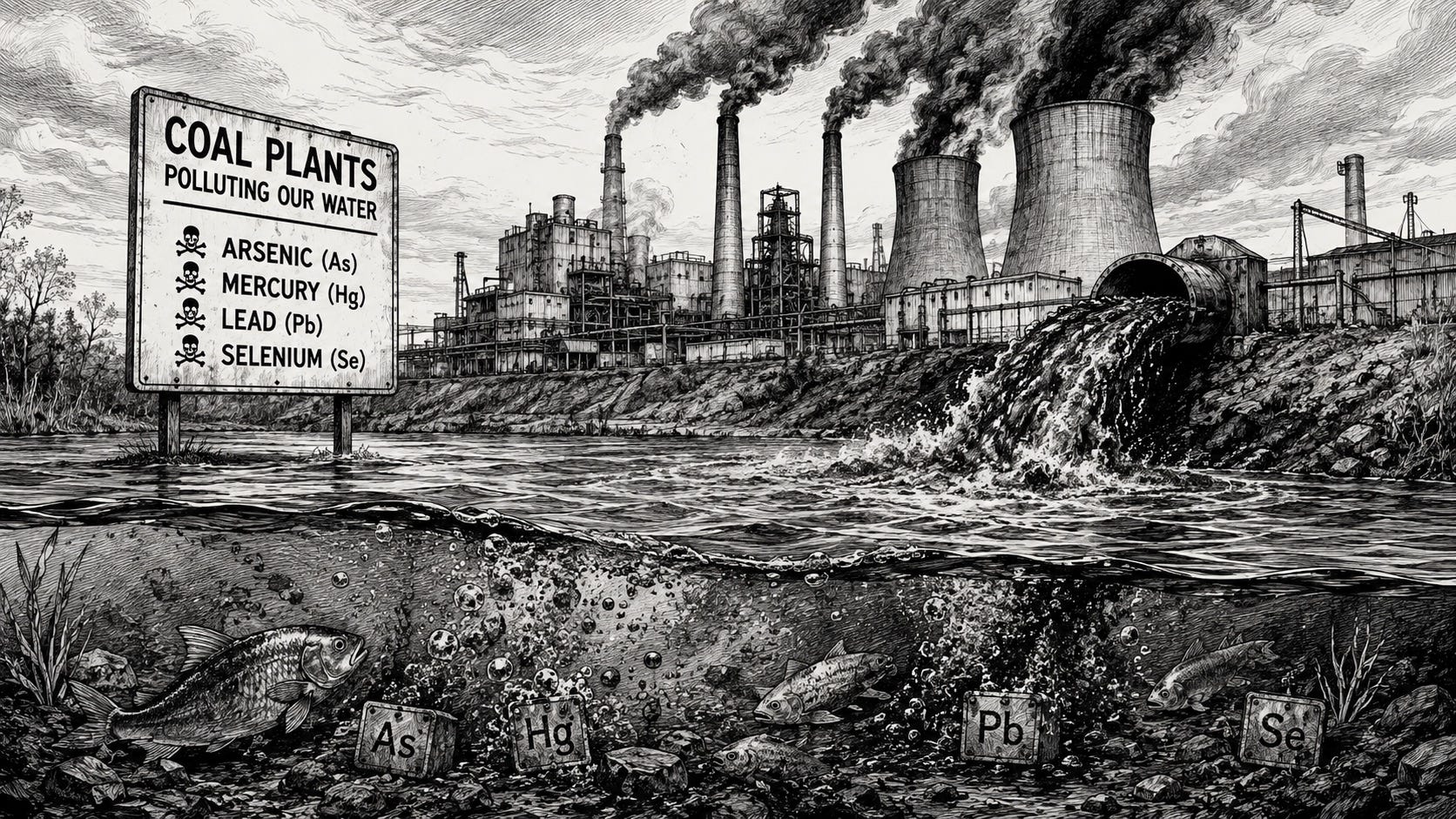
On Thursday afternoon, May 14, 2026, the Environmental Protection Agency proposed rolling back the rule that requires coal plants to stop dumping arsenic, mercury, lead, and selenium into the rivers and lakes that millions of Americans drink from.
The justification is one of the most cynical things I have read in months. EPA Administrator Lee Zeldin says the rollback is necessary because, in his words, “the AI and data center revolution is creating an electricity and baseload power demand that cannot be met under the overly restrictive policies of past administrations.” Translation: coal companies should be allowed to poison your tap water because tech companies need cheaper electricity to train chatbots.
That is not hyperbole. That is the actual stated reason.
What The Rollback Does
The 2024 Biden EPA rule required coal plants to treat what is called unmanaged combustion residual leachate. In plain English: coal ash sits in massive landfills and unlined ponds across the country. Rain and groundwater seep through the ash, pick up the heavy metals, and carry that toxic water into nearby rivers, lakes, and streams. The Biden rule required plants to capture and clean that contaminated water before it reached drinking water sources.
The new Trump EPA proposal exempts contaminated groundwater from mandatory treatment as long as it seeps into waterways on its own rather than being pumped out. The loophole is the entire point. If the poison flows naturally through the ground into the river, the coal company has no obligation to stop it.
EPA’s own estimates say this gives away between 113 and 601 million pounds of pollution per year at up to 104 coal plants nationwide. The full 2024 rule, covering this and two other waste streams, was projected to prevent 660 to 672 million pounds of toxic discharges annually and deliver $3.2 billion in public health benefits each year. The cost to the average household electricity bill if the rule had stayed in place? Less than $3.50 per year. Three dollars and fifty cents.
What Is In The Water
Coal ash contains at least 17 toxic heavy metals, including six neurotoxins and five known or suspected carcinogens. Arsenic causes cancer. Mercury and lead cause brain and nervous system damage, especially in children. Selenium kills aquatic life and harms humans at high concentrations. Chromium causes cancer. Boron causes low birth weight and reproductive problems. Cobalt damages the heart, blood, and thyroid.
EPA itself has found that people who drink well water near an unlined coal ash pond have a 1 in 50 chance of getting cancer from arsenic exposure. One in fifty. That is not an environmental advocacy talking point. That is EPA’s own Human and Ecological Risk Assessment.
A 2019 analysis by the Environmental Integrity Project and Earthjustice, examining utilities’ own self-reported monitoring data, found that 91 percent of coal plants in the United States were contaminating groundwater with unsafe levels of toxic pollutants. The contamination is documented at hundreds of sites. This is not a theoretical risk.
The Water Utilities Are Saying No
Here is the part that should stop every American cold. The American Water Works Association, whose 4,300 member utilities supply roughly 80 percent of North America’s drinking water, has formally opposed the weakening of these coal plant standards. They filed comments with EPA jointly with Clean Water Action laying out the structural injustice of the rollback in plain terms.
When coal plants are allowed to dump heavy metals into source waters, drinking water utilities have to clean that pollution back out. The cost does not disappear. It shifts from the polluter’s books to your water bill. Drinking water customers, who may not even buy electricity from the offending coal plant, end up paying twice. Once at the meter. Once at the tap.
The people whose job it is to deliver clean drinking water to 80 percent of this continent looked at this rollback and said no.
The Lobbying Trail
This rollback did not arrive by accident. It arrived by appointment.
The Office of Management and Budget met this spring with the Edison Electric Institute, the trade association that represents every investor-owned electric utility in the United States. EEI spent more than $7 million on federal lobbying through the first three quarters of 2025 alone, according to OpenSecrets, and the full-year number will land higher once Q4 filings are tallied. EEI’s president and CEO since July 1, 2025 is Drew Maloney, a former Treasury Department official under Trump’s first term, a former top lobbyist for Hess Corporation, and the former head of the American Investment Council. He brings two decades of Republican White House and Capitol Hill relationships into the chair of the largest utility lobby in the country, at exactly the moment that lobby needs them.
OMB also met with the Indiana Department of Environmental Management lobbying on behalf of Indiana utilities, DTE Energy in Michigan, and PPL Corporation, which owns LG&E and KU in Kentucky. PPL discloses $316,475 in 2025 trade-association lobbying dues alone, and that is only the nondeductible slice required under federal tax law. The total federal lobbying footprint runs higher once you add direct expenditures and outside firm contracts. LG&E and KU Energy have also been documented funneling money into state-level political vehicles, including a $15,000 contribution to a 527 organization in Kentucky whose executive director is a sitting Republican state senator who collected $80,500 in payments from the same fund, as reported by the Kentucky Lantern in April 2026. That story is not directly about the EPA wastewater rule. It is about the pattern.
America’s Power, the coal industry trade group, cheered the EPA announcement within hours. Its president and CEO Michelle Bloodworth praised the agency for rescinding what she called “one-size-fits-all” requirements.
Then there is the political infrastructure on Capitol Hill. The Senate Environment and Public Works Committee, which has primary jurisdiction over EPA regulations, is chaired by Senator Shelley Moore Capito of West Virginia, who founded the Congressional Coal Caucus and has built her career around protecting coal-fired energy. In January 2026, Capito convened EPW hearings explicitly aimed at conducting oversight of Biden-era environmental regulations, a process she described in her own words as wanting to “flex my muscle” against the prior administration’s rules. The committee that is supposed to oversee the EPA is now run by a coal-state senator publicly committed to dismantling the EPA rules her industry opposes.
The numbers behind the political ecosystem are documented and ugly. The coal mining industry has supported Republicans in every one of the past 13 election cycles, according to OpenSecrets. The Edison Electric Institute alone reported approximately $822,000 in contributions to political organizations, including 501(c)(4) and 527 groups, in 2024, with a similar budget projected for 2025. The electric utilities industry as a whole consistently ranks among the top federal lobbying spenders in any given year, and is a reliable donor to members of the Senate energy and environment committees on both sides of the aisle, with a heavy lean toward coal-state Republicans.
Those numbers are just the disclosed lobbying. They do not include dark money, trade association cross-funding, or the millions in coordinated industry advertising that frames coal as the patriotic answer to AI energy demand.
Follow the money. The fingerprints are not hidden. They are notarized.
The pattern
This is not one rule. This is a campaign.
September 29, 2025: Zeldin announces compliance extensions for seven deadlines in the 2024 rule. November 28, 2025: EPA withdraws its initial direct final rule after adverse public comments. December 23, 2025: EPA finalizes the deadline extension anyway, pushing zero-discharge compliance from December 31, 2029 all the way to December 31, 2034. That rule took effect March 2, 2026. May 13, 2026: Zeldin testifies before Senate Appropriations on the EPA budget, and the same afternoon signs the new proposed rollback. May 14, 2026: the agency releases the proposal publicly. The administration has already signaled another rulemaking later this year to gut standards for the remaining wastewater streams, including flue gas desulfurization and bottom ash transport water.
Step by step, deadline by deadline, the protections are being dismantled.
The environmental justice piece
Over half of the coal plants in this country sit in low-income communities. The 2024 rule’s own analysis stated it would especially benefit “low-income communities and communities of color that are disproportionately impacted by pollution from coal-fired power plants.” Coal ash waste from the catastrophic TVA Kingston spill in Tennessee was shipped to Perry County, Alabama, a largely Black community, where arsenic contamination reached 80 times the safe drinking water standard.
The people who live next to coal plants did not ask for the AI revolution. They are paying for it with their groundwater.
The bottom line
EPA estimates the rollback saves the power industry up to $1.1 billion a year. The 2024 rule it is dismantling was projected to deliver $3.2 billion in annual public health benefits. The agency is proposing to surrender three dollars of public health value to capture one dollar of industry savings, and to do it so AI companies can run more data centers on cheap coal power.
Coal companies pollute. Water utilities clean it up. You pay for both. Tech companies get the electricity. People living near coal plants get the cancer risk.
Read the proposal. File a public comment. This one is not subtle.
Mitch Jackson, Esq.
The coal companies have lobbyists. The tech giants have lawyers. Uncensored Objection has readers like you, free or paid, and that is exactly what makes accountability journalism possible in a moment when the EPA is selling your drinking water for cheap data center electricity.
1 in 50 cancer risk should be an immediate “hell no”.
As a person who has survived cancer, chemo, and radiation treatment, I am here to say this is not something you would wish on anybody. It was a brutal experience, and I am fortunate to have survived. We should be going out of our way to prevent toxic exposures like this.
Damn this administration to hell!