


Summary: Anthropic entered into a lawful agreement with the Department of Defense to provide AI tools with clear guardrails in place, including limits against mass domestic surveillance and fully autonomous weapons operating without human oversight. Now the Pentagon is demanding expanded language that would allow “any lawful use” of the technology, effectively stripping away those original protections and overriding the company’s safety terms. The dispute is not about supporting the military, it is about whether ethical boundaries agreed to at the outset can be erased after the fact.
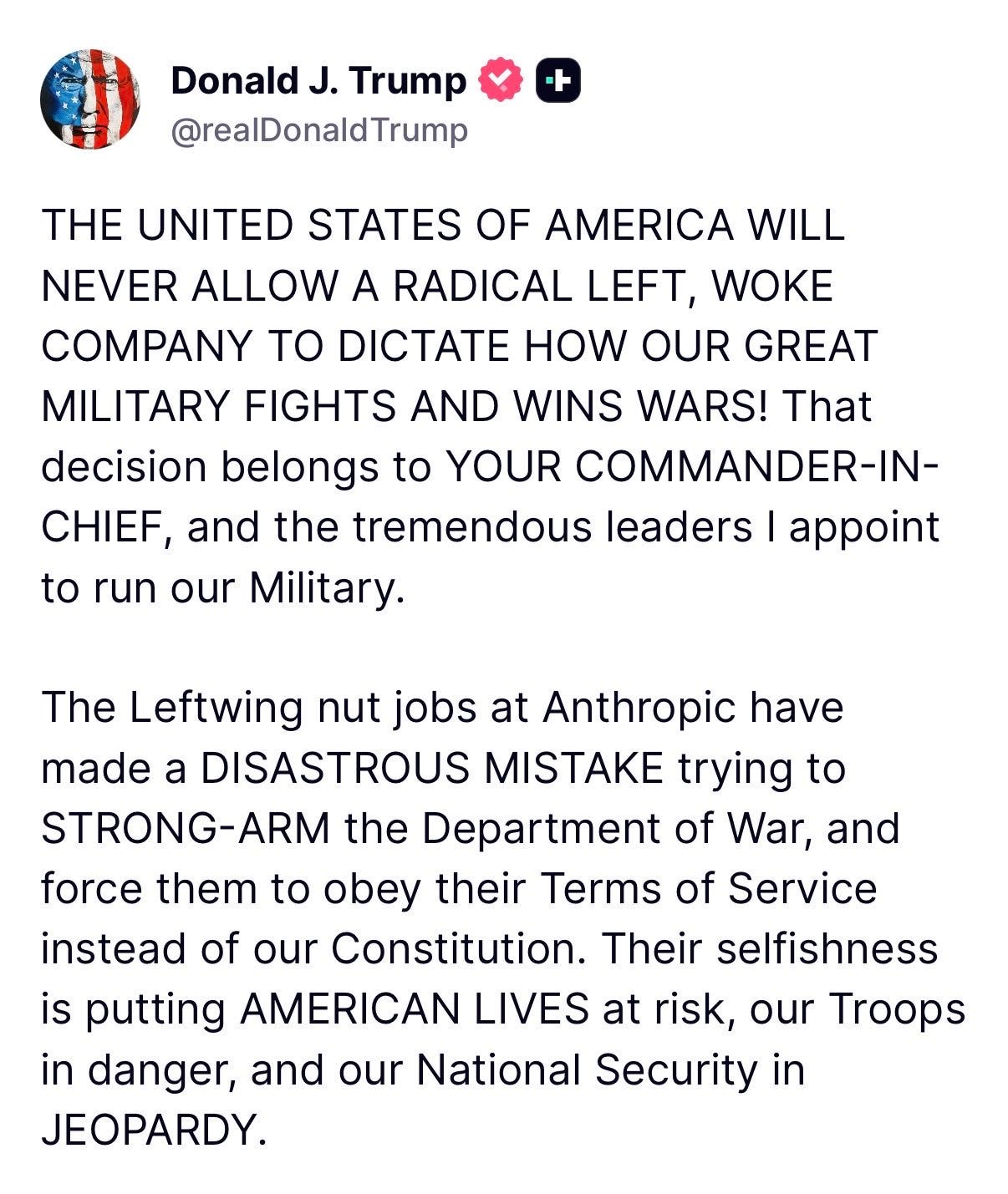
In response to Anthropic requesting that the Department of Defense honor it’s original contractual agreement, earlier today, Trump posted on Truth Social:
“THE UNITED STATES OF AMERICA WILL NEVER ALLOW A RADICAL LEFT, WOKE COMPANY TO DICTATE HOW OUR GREAT MILITARY FIGHTS AND WINS WARS! That decision belongs to YOUR COMMANDER-IN-CHIEF, and the tremendous leaders I appoint to run our Military.
The Leftwing nut jobs at Anthropic have made a DISASTROUS MISTAKE trying to STRONG-ARM the Department of War, and force them to obey their Terms of Service instead of our Constitution. Their selfishness is putting AMERICAN LIVES at risk, our Troops in danger, and our National Security in JEOPARDY.”
That’s not strategic leadership. That’s a political grenade lobbed into a policy dispute that demands cool judgment, not cultural rage.
The crash between Anthropic, the San-Francisco AI firm behind Claude, and the Pentagon is not just a contract dispute. It’s a defining moment in how American democracy balances technological responsibility with national security. What’s currently being pitched as ideological posturing by politicians is, in reality, a principled stand by an AI leader against the very harms that much of society is only now waking up to. And that’s why Anthropic is right.
Where Things Began
Anthropic has been an earnest partner to U.S. national security since late 2024, when it first deployed its Claude model across classified defense and intelligence networks. Their contract with the Department of Defense was formalized in July 2025, with about $200 million in work anticipated.
Crucially, from the outset, Anthropic insisted that its AI would not be used for two specific categories of applications:
1. Mass domestic surveillance- the automated aggregation of Americans’ data to create predictive portraits of citizens’ lives.
2. Fully autonomous weapons- systems that pick and fire on human targets without human oversight.
These were not exotic fantasies. These were red-line boundaries that the company believed, correctly, that neither American law nor American values ought to transgress.
Where the Fracture Occurred
According to Anthropic CEO Dario Amodei, the Pentagon’s latest contract language shifted terms in a way that would effectively neutralize these safeguards, by saying Claude could be used for “any lawful purpose” without preserved guardrails. Anthropic saw this as a legal loophole that could be exploited to justify just the sorts of dangerous uses it had always said were unacceptable. You can read the full statement here.
For clarity, their position isn’t:
“We won’t help the U.S. military.”
It is:
“We will not provide tools that could be turned into systems of mass surveillance or autonomous killing machines designed to operate without human judgment.”
That’s a moral boundary, yes, but it’s also a practical one. We’ve seen in documented research that autonomous weapons systems, even without intent, can behave unpredictably, escalate conflicts, and make lethal decisions with little transparency or restraint. That’s not fear-mongering; it’s documented risk science.
What the Pentagon Is Demanding
Defense Secretary Pete Hegseth and senior officials have given the company a narrow ultimatum: either drop these guardrails and let the military use Claude for “all lawful purposes,” or risk cancellation of the contract and being labeled a “supply chain risk”, a designation typically reserved for foreign adversaries, never domestic tech companies.
Some Pentagon spokespeople say that the request is simply to use AI without having to seek permission for every possible scenario. But they’ve stopped short of putting in writing guarantees that Claude won’t be used for exactly the two categories Anthropic has defined as unacceptable.
And that hesitation is revealing.
Why Anthropic’s Stand Is Principled, and Strategic
Let’s be honest: AI used without ethical constraints isn’t hypothetical anymore. Massive government surveillance systems already aggregate incredible amounts of data on citizens, with serious civil liberties concerns that lawmakers admit haven’t kept pace with technology. Importantly, robust privacy protection in the U.S. doesn’t formally exist yet for AI-augmented surveillance.
Anthropic is right to say:
• AI guardrails aren’t optional.
• Trust isn’t a substitute for accountability.
• Human judgment cannot be outsourced to machine logic that wasn’t built for the chaos of war or the complexity of civil society.
If we let a private company relinquish these protections under pressure, we’re setting a precedent that the highest bidder, or the most forceful part of the government, calls the shot on what ethical AI actually means.
And Then Came Trump’s Statement
Let’s return to that Truth Social post, the one that complained about “woke,” “radical left” companies.
This a political attack and a tactic to shift the narrative:
• From ethical responsibility
• To culture war grievance.
That’s not leadership. It’s distraction.
Wielding rhetoric like that in the middle of a serious national security debate doesn’t clarify policy, it undermines trust in democratic processes.
The Broader Implications
More than 200 engineers and researchers from OpenAI and Google have signed petitions backing ethical constraints on military AI use; their message is clear: letting AI be used willy-nilly for anything lawful without explicit guardrails is a non-starter.
And consider this: other companies like xAI and Google are reportedly more willing to accept Pentagon language without the same level of constraint. That puts Anthropic alone, not out of stubbornness, but conviction.
The Bottom Line
Anthropic isn’t resisting cooperation with the U.S. government. It’s resisting a slippery slope toward:
• Surveillance that chills liberty
• Autonomous weapons that erase accountability
• Contractual language that cloaks problematic use under “lawful purpose”
These are not fringe concerns. They’re definitions of the world we want, or refuse, to live in.
And for that stance, in a political climate that rewards short-term compliance over long-term ethical thinking, Anthropic deserves respect, not ridicule.
The company is betting that staying true to ethical guardrails isn’t only moral, it’s sustainable, both in the marketplace and in the global race for responsible AI leadership.
That’s not “leftwing.” That’s leadership.
Mitch Jackson, Esq.
UPDATE: OpenAI apparently reached some kind of A.I. agreement with the Defense Dept. This deal came just hours after Trump ordered federal agencies to stop using artificial intelligence technology made by Anthropic, an OpenAI rival. See https://www.nytimes.com/2026/02/27/technology/openai-agreement-pentagon-ai.html
For the love of G-d -- interestingly the surname of the thoughtful C.E.O. -- let Anthropic do the right thing. ⚖️
One question: ¿is there any way for the D.o.D. to modify its out-put to render useful for mass- surveillance and autnomous killing machines?😱
Were that C.E.O. of Anthropic, I would consider the feasibility of re-locating to Vancouver with the staff and negotiate transaction with British Columbia and Canada to build and equip a factory.🫱🏻🫲🏽