

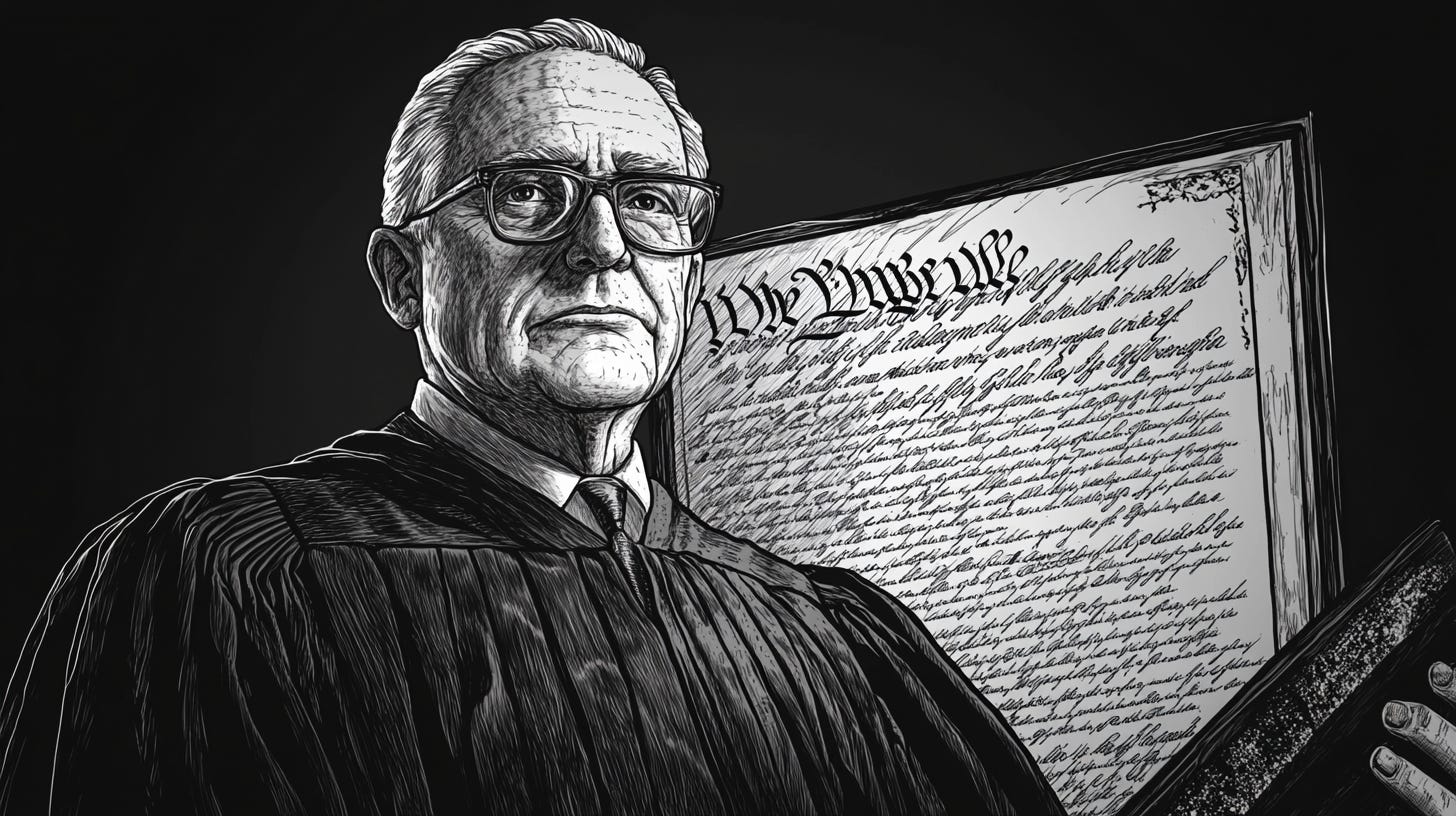
Federal Judges are insulated from politics (with lifetime tenure) so they can make tough decisions – like telling a president “no” – without fear of political retribution. That is a feature, not a bug, of our system. It protects all of us.
Introduction
Donald Trump and his allies have lately made it abundantly clear that they hold the federal judiciary in contempt – a stance as dangerous as it is ignorant. In just the past few days, we’ve heard White House Press Secretary Karoline Leavitt call a judge’s injunction “absurd” and “unconstitutional.”
We’ve seen former Trump adviser Stephen Miller insist that the President’s powers “will not be questioned” by judges. We’ve watched Secretary of State Marco Rubio blithely ignore a federal court order halting deportation flights. And we’ve heard Trump’s hand-picked “border czar,” Tom Homan, flat-out declare, “I don’t care what the judges think.” Each of these statements shows a stunning disregard for the power of federal judges – a power established by the U.S. Constitution – and together they amount to an attack on our democracy itself.
Do a Deep Dive with AI: When it comes to saving democracy, the stakes have never been higher. What you know—and how you voice your opinion—matters. This Perplexity AI page allows you do use AI to dig deeper on this article. No filters. No limits. Just more details, explanations and answers. Ask. Learn. Act.
Karoline Leavitt (White House Press Secretary)
Let’s start with Ms. Leavitt, the new mouthpiece of Trump’s war on the judiciary. Leavitt fumed that “you cannot have a low-level district court judge” issue an order that blocks the President’s will, scoffing that it’s “absurd.” Pardon the sarcasm, but it sounds like Leavitt slept through high school civics. In our constitutional system, any federal district judge – yes, even one Leavitt derides as “low-level” – has the authority to issue injunctions stopping unlawful executive actions. That’s not absurd; that’s their job.
The Constitution’s Article III doesn’t come with a footnote saying “judges can’t rule against the president.” In fact, it’s quite the opposite. Federal judges are supposed to check presidents when their actions likely violate the law or Constitution. That’s the essence of checks and balances, which Leavitt somehow labeled “entirely unconstitutional.” The irony would be hilarious if it weren’t so dangerous.
Leavitt even claimed it’s within the President’s power to “fire or hire” judges at will – a statement so utterly false that one wonders if she’s intentionally gaslighting the public. Federal judges are appointed for life and can only be removed by impeachment, precisely to prevent presidents from firing judges who inconvenience them. Leavitt’s comments reveal a profound misunderstanding of the separation of powers, or perhaps an intentional attempt to mislead Americans into thinking an independent judiciary is illegitimate. Either way, her rant is an embarrassment to constitutional literacy.
Stephen Miller (Deputy Chief of Staff for Policy and Homeland Security Advisor)
Next, consider Stephen Miller, Trump’s former policy adviser and resident architect of draconian immigration schemes. Miller has never hidden his disdain for judicial oversight – he once complained that judges’ rulings against Trump were a “judicial usurpation of power,” and he infamously declared on national television that “the president’s powers here are beyond question.” To Miller, there’s “no such thing as judicial supremacy,” and courts shouldn’t have the final say over a president’s decisions.
These claims are as bombastic as they are wrong. Our Constitution absolutely does give the judiciary the authority to overrule the other branches when they step out of line. Since 1803, when Chief Justice John Marshall decided Marbury v. Madison, it’s been settled that the Supreme Court (and by extension the judicial branch) has the power to review and nullify executive actions that violate the Constitution. That principle – judicial review – is a cornerstone of American law. Miller’s attempt to pretend it doesn’t exist is pure snake oil, likely intended to confuse the public. He’s effectively urging a doctrine of executive supremacy, where a president can do as he pleases without courts “interfering.” That is not how America works.
Miller might want you to believe a judge who stops Trump is “taking power that belongs to the president,” but in reality it’s Miller and his ilk trying to grab power that doesn’t belong to the president. His rhetoric is the very definition of misleading: claiming that upholding the rule of law is a coup against the presidency, when in truth it’s Trump attempting a coup against the rule of law. Miller’s contempt for judges is the mentality of an authoritarian masquerading as a legal argument. It deserves nothing but ridicule and rebuttal.
Marco Rubio (Secretary of State)
Then we have Marco Rubio – a sitting U.S. Senator-turned-Secretary of State – who really ought to know better. Rubio has long positioned himself as a champion of American democracy (at least when criticizing other countries), yet he’s now actively undermining our own judiciary. This weekend, Rubio brazenly ignored a federal judge’s order that was supposed to pause the Trump administration’s mass deportation of hundreds of immigrants.
The context: a U.S. District Judge issued a temporary restraining order telling the administration to hold off on deporting members of a Venezuelan gang for two weeks while a legal challenge was considered. That judge’s order was not a suggestion or a request; it was a binding legal command. How did Rubio respond? He promptly announced that the deportation flights had already taken off and that hundreds of people were expelled from the country under a dubious 1798 law. In other words, Rubio basically said “too late, we did it anyway.”
It’s a shocking defiance of the judiciary. By the time the judge could demand the planes turn around, Rubio’s State Department had ensured they were already overseas. The administration’s attitude was essentially: Sorry, Your Honor, we’re in international airspace – can’t hear you!
To make things worse, Rubio then retweeted a post from the President of El Salvador that read “Oopsie ... Too late" with a laughing-crying emoji. His retweet wasn’t just a response—it was a deliberate swipe at the rule of law. A U.S. federal judge ordered a halt to deportations of Venezuelan nationals. Instead of respect, Rubio offered mockery. His dismissive “oops” was childish—it was reckless, signaling open defiance of the courts. This was a direct challenge to judicial authority, raising serious questions about whether this administration believes the law applies to them at all.
Let’s be clear: defying a court order violates the Constitution’s separation of powers and the official’s oath of office. Rubio swore to uphold the Constitution, which implicitly means respecting judicial decisions. By ignoring the judge, he violated that oath. He’s not “playing by his own rules” as some kind of maverick – he’s breaking our rules, the fundamental rules that govern our republic. It’s both legally and morally wrong.
If a Democratic administration tried something like this, Rubio would be on the Senate floor raging about tyranny. His hypocrisy is stunning, and his actions are flat-out illegal. The courts have remedies – they can hold officials in contempt – but it shouldn’t come to that. A Secretary of State shouldn’t behave like he’s above the law. Rubio’s decision to shrug off the judiciary is a gift to authoritarians everywhere and a slap in the face to American democracy.
Tom Homan (“Border Czar”)
And let’s not forget Tom Homan, the former ICE director now serving as Trump’s “border czar.” Homan’s contribution to this circus was to loudly proclaim, “We’re not stopping. I don’t care what the judges think.” This is an astonishing statement from a former law enforcement officer.
Homan once wore a badge, which means he once swore to uphold the law. Yet now he openly declares that court orders carry no weight if they conflict with the Trump agenda. His message to the rank-and-file immigration officers and agents is crystal clear: Ignore the judges, do what we say anyway. That is a recipe for constitutional anarchy. Homan is effectively urging federal agents to break the law – because make no mistake, disregarding a judge’s order is breaking the law. His contempt for the judiciary is not wrapped in any clever lawyerly phrasing or quasi-academic theory like Miller’s; it’s just raw, unvarnished defiance.
In a way, Homan’s honesty about his disregard is useful, because it lays bare what’s really going on here. The Trump team doesn’t just have philosophical disagreements with how far courts should go. No, they’re literally telling us they will not abide by a judge’s ruling if they don’t like it. Homan’s stance – “I don’t care” – is the attitude of a renegade sheriff in some movie, not a U.S. government official in a constitutional democracy. It’s legally wrong and extremely dangerous.
If every official took Homan’s view, the rule of law would collapse overnight. Imagine if ordinary citizens adopted the same stance: “Got a court order against me? I don’t care, I’ll ignore it.” We’d have chaos. When government officials do it, we edge toward a tyranny where power, not law, prevails. Homan should be condemning lawlessness, not championing it.
The True Purpose and Power of Federal Judges
The common thread in all these outbursts is a profound disrespect for the judiciary’s role in our government. Federal judges derive their power straight from the Constitution. Article III establishes the judicial branch as co-equal to the executive and legislative branches. These judges are appointed by presidents (including Trump himself, who appointed plenty) and confirmed by the Senate. They’re not partisan operatives or “low-level” nobodies; they are fundamental to maintaining the rule of law.
When Federal Judges issue a ruling, the executive branch is constitutionally and legally obligated to comply – unless and until that ruling is stayed or overturned by a higher court. That’s not optional; that’s how separation of powers works. Trump and his allies know this – or they should, given how many times they’ve run to courts when it suits them. (Remember all those lawsuits Trump’s team filed when they wanted to stop recounts or block policies they didn’t like? They didn’t call the judges “absurd” then.)
The judiciary’s power is the reason we don’t live under kings or tyrants. It’s what allows an ordinary citizen to challenge the government and be heard by an impartial arbiter. It’s what allows minority rights to be protected even when the majority, or a powerful president, wants to steamroll them. Undermining this system means undermining American democracy.
Trump himself has a long history of attacking judges. He started as a candidate by smearing a federal judge (Gonzalo Curiel) as biased due to his Mexican heritage when Trump was unhappy with a ruling. Then, as President, Trump lashed out at judges who blocked his travel ban, calling one a “so-called judge” and accusing the judiciary of putting the country in peril. He blasted “Obama judges” for rulings he disliked – until even Chief Justice John Roberts (hardly a liberal activist) rebuked him publicly, reminding the nation that judges are independent and not mere extensions of the presidents who appoint them.
That fundamental judicial independence is what Trump and his cronies are trying to erode. They want a judiciary that either rubber-stamps their agenda or stays out of their way entirely. In Trump World, a judge who rules against them is illegitimate by definition. This is textbook gaslighting: they claim judges are “weaponizing” the law or “undermining democracy” by daring to check the executive branch, when in fact it is Trump and company weaponizing their political power to bully the courts and undermine the democratic order established by the Constitution.
Let’s talk about democracy for a moment. Trump’s allies argue that it’s wrong for “unelected” judges to overrule the actions of an elected president or the “will of the people.” At first blush, that might sound persuasive to someone who forgets Civics 101. But our system was deliberately designed so that certain principles – like the Constitution and the rule of law – can’t be tossed aside even by a majority vote or a powerful politician.
We are a constitutional republic, which means the Constitution (not the transient whims of whoever holds office) is the ultimate authority. Federal judges, though not elected, are confirmed by elected representatives and serve as guardians of that supreme law. They are insulated from politics (with lifetime tenure) so they can make tough decisions – like telling a president “no” – without fear of political retribution. That is a feature, not a bug, of our system. It protects all of us.
When a court strikes down an illegal executive action, it is defending democracy, not defying it. It’s making sure the government operates within the bounds set by the people’s fundamental law. If a president could ignore those bounds at will, we’d be on the road to autocracy. So don’t let Trump’s minions fool you: there is nothing “democratic” about an executive branch that can bulldoze past the courts. In fact, history shows that one of the first moves of any aspiring dictator is to neuter the judiciary – to remove judges who stand in the way or just ignore them outright. By echoing this autocratic playbook, Trump, Leavitt, Miller, Rubio, and Homan are the ones undermining democracy, not the judges.
It’s also worth noting that the judiciary they’re attacking includes many judges appointed by Trump or other Republicans. The judges issuing rulings against Trump’s actions aren’t doing it out of personal animus; they’re doing it because litigants brought cases and the law compelled those outcomes. When Judge James Boasberg (an appointee of President Obama, but also the presiding judge of the FISA court and hardly a partisan bomb-thrower) halted Trump’s deportation flights, it was because plaintiffs raised serious legal questions that deserve hearing. When Judge William Alsup (appointed by Clinton, but respected across the spectrum) ordered Trump’s administration to rehire unlawfully fired federal workers, it was because the law likely wasn’t followed. Dismissing these judges as “activists” or partisan is a cheap way to avoid dealing with the substance of their rulings. The Trump team doesn’t bother rebutting the legal reasons – they just attack the messengers. That’s how you know they’re out of legal ammo and are resorting to propaganda.
America is Being Gaslighted
Now, let’s dismantle the notion – floated by Leavitt and implied by others – that the executive branch can decide which court orders it finds valid. The Constitution’s Take Care Clause (Article II, Section 3) requires the President to “take Care that the Laws be faithfully executed.” That includes court orders, which are legal commands carrying the force of law. A president (and his subordinates) can’t choose to execute only the laws he likes and ignore the rest. Doing so is a direct violation of the constitutional oath of office.
When Trump’s people say they will “fight” or simply not comply, they’re announcing that they are reneging on their constitutional duties. That’s not just a political statement – it’s flirting with a constitutional crisis. In the past, when presidents have considered defying court orders, it has led to infamy.
In 1832, President Andrew Jackson reportedly shrugged off a Supreme Court decision he didn’t like (resulting in tragedy for Native Americans). In 1974, had President Nixon refused the Supreme Court’s order to turn over the Watergate tapes, we’d have plunged into a crisis; to his credit, Nixon obeyed that order (and then resigned). Even during desegregation, when states refused to follow court orders, Presidents Eisenhower and Kennedy sent federal troops to enforce them – executive power being used to support judicial authority, as it should be, not to undermine it. What Trump and his gang are doing now is the opposite: executive power used to thwart and defy the judiciary. It’s an affront to the rule of law.
Ignorance or Deception?
Karoline Leavitt’s claim that judicial review is “unconstitutional” is so inverted it would be laughable if she weren’t speaking for the White House. If she truly believes what she said, she has no business being anywhere near the levers of power. If she doesn’t believe it and said it anyway, she’s deliberately lying to the public to delegitimize a cornerstone of American governance – which is even worse.
Stephen Miller’s pronouncements are steeped in authoritarian ideology; he’s not misinformed (he’s too smart for that), so we can only conclude he’s trying to mislead. His talk of “no judicial supremacy” is a dog whistle to the far-right fringe that longs for an imperial presidency unchecked by courts. Miller is gaslighting Americans by painting normal judicial actions as outrageous, hoping to stir anger at the judges instead of at the administration that provoked the judges’ rulings by overreaching.
Marco Rubio’s actions show a willful disregard for legal correctness. Perhaps Rubio didn’t issue fiery soundbites like the others – he let his deeds do the talking – but his message was the same: the courts can’t stop us. By proceeding with legally questionable deportations in spite of a judge’s injunction, Rubio showed he either doesn’t understand the law or simply chose to break it. Given his background, it’s almost certainly the latter. He knowingly stepped over a clear legal line. That’s not toughness or leadership; that’s lawlessness.
Tom Homan’s statement, meanwhile, is outright false in suggesting that what judges think and order, doesn’t matter. It does matter – immensely. Homan’s bravado might play well on talk shows, but it has zero legal basis and undermines public respect for the courts. It encourages a dangerous notion among Trump’s supporters that court rulings can be ignored if you disagree. That’s how you sow chaos and violence – by convincing people that the umpire’s calls don’t count if you don’t like them.
Here’s What Should Be Happening
What should these individuals be doing instead of trashing judicial authority? Embracing the rule of law. If they truly believe a court’s decision is wrong, the remedy is to appeal through the legal system, not to delegitimize the court or disobey. That’s what the Justice Department and White House lawyers are for: to make your case in court, using evidence and precedent. And if you lose, you respect the outcome.
That’s what every administration in modern history has done, Republican or Democrat – until Trump’s. By all means, Trump’s team can express disagreement with a ruling and vow to seek its reversal at the next level. What they cannot do, in good faith within our system, is act as if the ruling just doesn’t exist.
They swore oaths to uphold our laws, which means they have to model respect for those laws. It’s telling that even Senate Republican Leader Mitch McConnell back in 2017 gently rebuked Miller’s “beyond question” nonsense by reminding him “all of our actions are subject to judicial review.” When Mitch McConnell is the voice of reason urging respect for courts, you know the Trump crowd has sailed off the edge of the map.
Respect for the judiciary is not some esoteric ideal; it is the linchpin of American democracy. If the day comes when court orders are openly flouted and judges cower before the executive branch, we will have ceased to be a government of laws. We’ll have descended into a government of one man. Every official who undermines judicial authority is chipping away at the foundations of our republic. It’s horrifying that the undermining is coming from within the government itself – from people who are the government.
Trump and his enablers are essentially telling the public: If a judge rules against us, it doesn’t count. Imagine the precedent that sets. Today they ignore rulings on immigration or firing federal employees; tomorrow it could be election laws or freedom of speech or anything else that stands in the way of their power. Once you normalize ignoring the judiciary, you’re on a fast track to authoritarian rule.
The executive branch’s defiance of court rulings isn’t just a political spat – it’s a violation of our Constitution and an existential threat to our system of checks and balances. Trump, Leavitt, Miller, Rubio, and Homan seem to have forgotten that they don’t get to unilaterally decide what the law is.
The remarks by these four individuals are misleading at best and flagrantly false at worst. They paint judges as villains for doing exactly what the Founders intended: preventing any one branch from running roughshod over the others. The Trump administration should be thanking the judiciary for doing its constitutional duty – after all, if their actions are truly legal and justified, they will ultimately prevail in court. But that’s the crux: deep down, they must suspect that much of what they’re doing isn’t legal, hence the fury at being reined in. Instead of acknowledging that, they lash out and try to minimize judicial authority. It’s the classic move of someone who knows the law is not on their side.
Conclusion
We must state this firmly and clearly: the judiciary’s authority must be respected, and any leader who undermines it is undermining America. Federal judges are not inconveniences to be brushed off; they are the guardians of the Constitution. Trump and his allies may not like having their actions reviewed and occasionally blocked, but that’s too bad – that’s how our democracy is built. If they cannot respect that, they have no business holding office. The dangers of their rhetoric and actions cannot be overstated. If a president can ignore court orders today, your rights and freedoms could be next on the chopping block tomorrow, with no court able to shield you. That’s why this matters to every American, regardless of politics.
Donald Trump once mused, “where’s my Article II, where I have the right to do whatever I want as president?” (He was joking – we hoped.) Well, Article II doesn’t give him that right, and Article III exists to make sure he never gets it. We should all be grateful for that. Trump, Leavitt, Miller, Rubio, Homan – they should stop treating the Constitution like a doormat and start honoring the rule of law they swore to uphold.
The moment we allow the executive branch to bully or ignore the judiciary is the moment we step off the cliff of democracy. We must not let that happen. Respect the courts, obey their rulings, and if you disagree, fight it the legal way – those are the bare minimum standards in a constitutional democracy. Anything less is an affront to our nation’s ideals and a peril to our freedom.
That’s my uncensored objection about how Federal judges will save our democracy, and I’m sticking to it.
Mitch Jackson, Esq. | links
The world moves fast. Politics moves even faster. If you’re relying on yesterday’s news, you’re already behind.
Get ahead with real-time insights that cut through the noise. Sharp commentary, deep analysis, and the updates that actually matter—delivered straight to your inbox.
No fluff. No spin. Just the truth you need to stay informed and in control.
Subscribe now. Stay sharp. Stay ahead.

Start with Vance on impeachment then charge all of them for their corruption then impeach the president so no one could pardon him then they'll all go to jail for undermining our constitution and the laws that govern the whole administration