

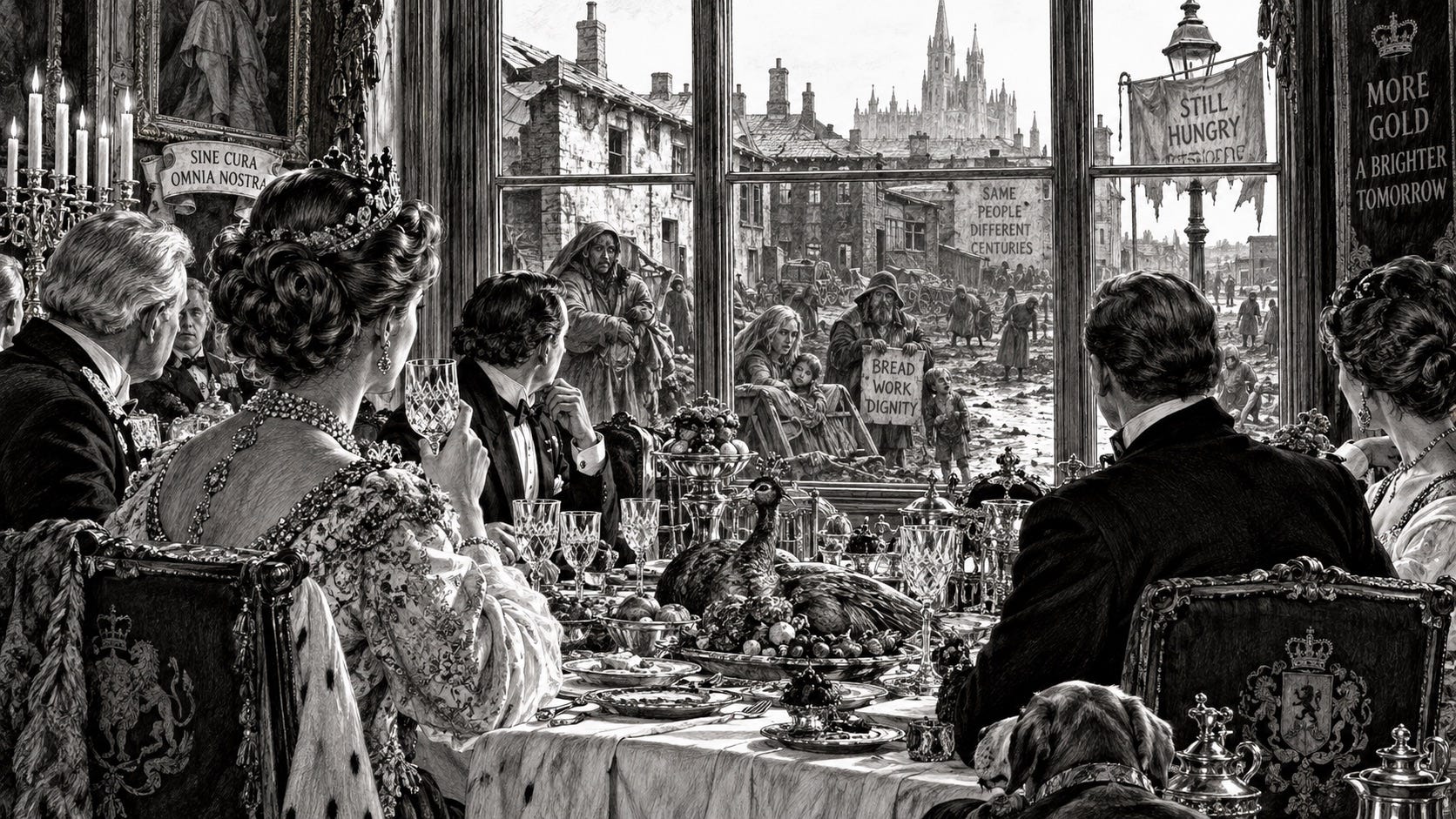
Let Them Eat Cake
On Thursday night, as you stood at the pump watching the numbers spin, some of the most influential people on earth sat down to sea bass crusted in sesame in the East Room of the White House.
President Trump hosted Chinese President Xi Jinping for a state dinner, and the guest list the White House released read like a page torn out of the Forbes billionaire rankings. Elon Musk, the richest man in the world, sat at the head table next to the First Lady. Jensen Huang of Nvidia, his wife Lori Huang, AMD’s Lisa Su, and Apple executive chairman Tim Cook sat there with him. Mark Zuckerberg, Sam Altman, Jeff Bezos, and Google CEO Sundar Pichai arrived in black tie. Paramount Skydance CEO David Ellison showed up days after his company settled to clear its takeover of Warner Bros.1
The room glowed with low light and red and gold place settings. Guests ate off fine china from the Reagan years. Then the President went off script. He invited Xi and every guest in the room to step through a curtain and view the construction site of his new ballroom, rising on the ground where the historical East Wing of the White House stood until the wrecking crews arrived last October.
I watched the coverage, and one image kept coming back to me.
I have traveled to Europe half a dozen times. I have walked through the castles and stood in the gilded halls, listening to guides explain how kings feasted as the families outside the walls lived on bread and potatoes. Every single time, I walked out wondering how and why people tolerated it.
Watching Trump return to office and get away with one thing after another, I finally understand how it happens. Speaker Mike Johnson and the MAGA Republicans who run Congress have spent every month since January 2025 down on one knee, kissing the ring. Last Thursday night handed me the answer to the question I carried out of every castle I toured in Europe. People tolerated it the same way too many Americans are tolerating it right now, one gilded room at a time.
The Fair Part First
Every modern president hosts state dinners. Barack Obama hosted Xi at the White House in 2015, and his guest list mixed tech and Hollywood executives too. Diplomacy with the world’s second largest economy matters, and a formal dinner is part of how nations do business with each other, which is a fact you deserve to know and a standard you should hold me to as you read the rest of this piece. Fair is fair.
Here is what you never saw from Obama or any other modern president: a president and his family turning the office into a family business, with the showmanship and the personal enrichment happening in plain view of the entire country. Hosting foreign leaders comes with the job, and this president added a cash register to it. Thursday night showed you only the tip of the iceberg. The rest of it sits below the waterline, and that is where we are headed next.
Gold Around the Table
Start with the ballroom. The administration tore down the entire East Wing, first built in 1902 during Theodore Roosevelt’s presidency and expanded in 1942, to put up a 90,000 square foot complex with a ballroom at its center. The public price tag kept climbing. It started at $200 million in July 2025, moved to $250 million, hit $300 million in October, and reached $400 million by December. The White House promised taxpayers would not pay a dime.
Now look at what the contractor told the White House behind closed doors. An internal estimate dated March 5, 2026, which reporters obtained in June, put the total project, including a secure underground facility, at $600 million, and only $293 million of that was slated to come from private sources (which hasn’t happened yet). The Secret Service was down for $155 million and the White House Military Office for $149 million. The Executive Residence budget added $3 million more. Those public budgets run on your tax money. The White House answered that the President and private donors are paying for the ballroom itself, at roughly $400 million.
The private donors include Apple, Amazon, Google, and Meta, four companies with enormous business in front of this administration. Alphabet steered $22 million from a legal settlement with Trump straight into the construction. The leaders of all four companies sat at Thursday’s dinner and walked through that curtain for the tour.
Then there is the gold. The Oval Office now carries gold trim along the ceiling and crown molding, gilded cherubs over the doorways, Rococo mirrors framed in gold, and a gold paperweight stamped TRUMP on the coffee table. A president’s office sends a message about priorities, and this one speaks fluent gold leaf.
His name keeps showing up on things that belong to you. In December 2025, Trump’s handpicked Kennedy Center board voted to rename the national memorial to a murdered president “The Donald J. Trump and The John F. Kennedy Memorial Center for the Performing Arts,” and workers bolted his name onto the facade the next day. On May 29, 2026, a federal judge ruled the renaming illegal and ordered the signs removed, and crews took them down by the middle of June. On September 15, the same judge rejected the board’s next move, a sign crediting the building as “renovated and restored” by Trump. The State Department added his name to the U.S. Institute of Peace. A visa program and a new line of children’s savings accounts carry his name too.
Then follow the money, because this is where the dinner stops looking like diplomacy. Trump’s own financial disclosure, released in July, reports at least $2.2 billion in income and revenue for 2025. Roughly $1.4 billion of it came from his family’s crypto ventures, including hundreds of millions from meme coins carrying the Trump brand and hundreds of millions more from World Liberty Financial.
The foreign money tells the rest. Four days before the inauguration, an investment vehicle tied to Sheikh Tahnoon bin Zayed Al Nahyan agreed to pay $500 million for a 49% stake in World Liberty. Tahnoon serves as the UAE’s national security adviser and belongs to the Abu Dhabi royal family. According to Trump’s disclosure, $263 million of that money went to Trump family entities. Months later, the administration cleared the UAE for access to hundreds of thousands of America’s most advanced AI chips. MGX, a fund backed by the Abu Dhabi state and chaired by the same sheikh, used $2 billion of World Liberty’s USD1 stablecoin to finance an investment in Binance. Trump later pardoned the founder of Binance. Connect those dots yourself, because nobody in that ballroom will do it for you.
Crypto billionaire Justin Sun put $30 million into World Liberty shortly after the inauguration. The SEC then paused its fraud and market manipulation case against him, and in March 2026 the agency settled, with an affiliated company paying $10 million and every claim against Sun personally dismissed with prejudice and no admission of wrongdoing.
During his first term, Trump at least announced a moratorium on new foreign business deals. This term, he has none. His name brought in $52 million in licensing fees last year, much of it from real estate developers across the Middle East, in countries whose leaders sit across the negotiating table from his administration on trade and on security, and whose deals land on his desk. The President now runs a major operation in the crypto industry and writes the country’s crypto policy at the same time.
Your Kitchen Table Looks Different
Here is what the people on the other side of that curtain are living with.
Consumer prices rose 3.4% over the past year, according to the government’s inflation report released September 11, and inflation has now run above the Federal Reserve’s 2% target for more than five years straight. The gasoline index sits more than 27% higher than a year ago. At the pump, regular gas averaged $4.48 a gallon nationally on September 21, about $1.30 more than a year earlier. Diesel hit a record $6.53 a gallon that same week, $2.78 higher than a year ago. That matters to every family in America, because diesel moves nearly every truckload of food in this country and truckers pass that cost straight into your grocery cart. Airfares climbed more than 23%. Grocery prices rose 2.2% and restaurant prices 3.4%, stacked on top of years of increases that never came back down.
The war with Iran is the biggest driver of the energy spike, and tariffs push prices up elsewhere. On September 16, the Federal Reserve raised interest rates for the first time since 2023 and signaled that more increases are likely coming. Your credit card and your car loan got more expensive that afternoon.
Now look at who is doing fine.
The Federal Reserve’s newest wealth data, released September 18, shows the top 1% of American households, about 1.35 million of them, holding $60.3 trillion, which is 32.5% of all household wealth in the country and the highest share since the Fed began keeping track in 1989. Let that sink in. Their fortune grew by about $5.5 trillion in a single quarter. In 1989, their share sat at about 23%.
The bottom half of American households holds 2.3%. The top 1% now owns 50.9% of all the stock held by American households. The bottom half owns 0.6%.
Read those numbers again. That is a castle and a village with new labels hung on the gates.
How Europe Let It Happen
The guides in those castles tell you what happened. They rarely tell you how it happened, so here is how.
Kings wrapped power in God. The Stuart kings of England claimed a divine right to rule, and official sermons preached obedience from the pulpit. Questioning the king meant questioning heaven, and that belief did more to protect royal wealth than any army ever did.
Spectacle worked as strategy. Louis XIV built Versailles and pulled the French nobility into its orbit, and nobles who once held independent power spent their fortunes and their days competing for a nod from the king. Magnificence was a management tool. Keep the nobles dazzled and dependent, and they stop challenging you.
Access went up for sale. Elizabeth I and James I handed out monopolies on everyday goods to favored courtiers. Parliament passed the Statute of Monopolies in 1624 to stop it. Charles I found his way around the law through its exemption for corporations and sold a monopoly on soap to a company of insiders, so ordinary families paid inflated prices for a household staple so the king’s circle could collect.
Charles I also skipped the people’s representatives entirely. He ruled without Parliament from 1629 to 1640 and collected “Ship Money” taxes on his own authority. A landowner named John Hampden refused to pay. He took his case to court and lost in 1638, by a narrow 7 to 5 vote of judges who served at the king’s pleasure.
Hunger lived right next door to plenty. During Ireland’s Great Famine from 1845 to 1852, roughly a million people died and another million emigrated. Grain and livestock kept leaving Irish ports for Britain during the famine. Food imports later outpaced those exports, and landlords, many of them living in England, kept evicting families who fell behind on rent.
People put up with all of it for four reasons that show up again and again in the history books. They believed God ordained the system. They depended on the lord for their land and their livelihood. They feared what happened to people who resisted, since the Peasants’ Revolt of 1381 ended with its leader Wat Tyler killed and the preacher John Ball executed, and the king revoked every promise he had made to the rebels. And the whole thing happened slowly, so each new outrage looked only slightly worse than the one before it.
Of those four reasons, the last one is the one that should keep you up at night, since it is the one that fits us best.
Line Them Up Side by Side
Put the two pictures next to each other and the parallels get specific.
Louis XIV received foreign ambassadors in the Hall of Mirrors, and on Thursday the President walked a foreign leader and a room full of billionaires through a curtain to admire his ballroom.
Stuart kings sold monopolies to courtiers. Today, companies with business before the government fund the President’s building project. A foreign royal buys into his family’s crypto company months before his country wins access to scarce American chips. A crypto executive receives a pardon. The pattern runs four centuries deep, and the only thing that has changed is the product on the shelf, which used to be a bar of soap sold to the king’s friends and now comes as a stablecoin sold to a foreign royal.
Monarchs stamped their royal cyphers on buildings and post boxes. This President put his name on a memorial to John F. Kennedy until a federal judge ordered it removed, and then the judge rejected his second try.
Charles I leaned on judges who served at his pleasure. Today a board the President appointed votes to rename a federal memorial after him, and Republican majorities in both chambers of Congress have turned down Democratic requests for hearings on the foreign money flowing into his family’s businesses.
Inside the walls, sea bass and gold settings. Outside, record diesel prices and a bottom half of the country holding 2.3% of the wealth.
This was wrong in the 1630s, and it is wrong in 2026.
What Finally Fixed It
Here is the part the tour guides skip, and it is the most useful part of the whole story. The British fixed this with rules, one fight at a time, over centuries, and every fix went after the same target, which was control of the money.
They took control of the purse. After a civil war and the Glorious Revolution, Parliament passed the Bill of Rights in 1689, and from then on the Crown needed Parliament’s consent to levy taxes or to keep a standing army in peacetime, a rule that put the people’s representatives in charge of the nation’s wallet for good. In 1760, George III surrendered the revenue from the Crown’s hereditary lands to Parliament in exchange for a fixed allowance that Parliament set, known as the Civil List. Today, the Sovereign Grant Act of 2011 funds the monarchy through a formula tied to Crown Estate profits. The National Audit Office audits the accounts, and they get published every year.
They replaced favoritism with merit. A report by Stafford Northcote and Charles Trevelyan in 1854 called for a civil service hired through competitive exams, and by 1870 open competition became the general rule, so government jobs stopped going automatically to people with the right connections.
They capped money in politics. The Corrupt and Illegal Practices Prevention Act of 1883 set strict limits on campaign spending and toughened penalties for buying votes. Britain still caps election spending tightly today.
They widened the vote. The Reform Act of 1832 started it, and later acts in 1867 and 1884 pushed the vote out to far more men. In 1918, women over 30 who met property requirements won the vote, and in 1928 women won voting rights equal to men’s. Each expansion made it harder for a small circle to run the country for itself.
They taxed great fortunes and broke the aristocrats’ veto. David Lloyd George’s “People’s Budget” of 1909 raised taxes on land and high incomes to pay for the new pensions for the elderly and other spending. The House of Lords blocked it. After two general elections in 1910, Parliament passed the Parliament Act of 1911, which stripped the Lords of their right to veto money bills. Decades later, Britain created the National Health Service in 1948.
They gave the land back. In Ireland, a series of Land Acts leading up to the Wyndham Act of 1903 let tenant farmers buy the land they worked with loans backed by the government. The old landlord system collapsed within a generation.
Look at the result. Britain has a king to this day, he lives in palaces, and his official duties run on public money that Parliament authorizes and auditors check. The castles I toured across Europe are museums now. Tourists pay admission to look at the gold, and much of that gold belongs to the public.
Royal power began shrinking the day ordinary people organized around the purse.
We Wrote the Rules Already
Here is what frustrates me as a trial lawyer. America learned these lessons before we were even a country, and we wrote them into the Constitution.
The Declaration of Independence reads as a list of complaints about a king who abused public power. The Founders then wrote the Foreign Emoluments Clause, which bars any federal officeholder from accepting any present, payment, office, or title from a foreign state without the consent of Congress. They meant every word. When Louis XVI gave Benjamin Franklin a snuffbox set with diamonds, Franklin needed Congress’s approval to keep it. The Constitution also bans titles of nobility and hands control of the purse to Congress alone.
The rules exist. Enforcement is the problem. During Trump’s first term, lawsuits over foreign payments to his businesses never reached a final ruling on the merits, and in January 2021, after he left office, the Supreme Court sent them back with orders to dismiss them as moot, which means the courts waited so long that the clock simply ran out on the whole question.
In America, the crown is whatever we tolerate.
Your Move This Week
The British timeline took centuries. You do not have centuries, so here is where to start this week.
Call your representative and both of your senators and ask them one specific thing, which is whether they will vote to require congressional consent for money from foreign governments flowing into the President’s businesses, crypto ventures included. Write down the answer.
Demand a divestment law that requires every president to sell off business holdings or use a true blind trust, and that bans selling personal crypto tokens or name licensing deals during a term in office.
Demand the ballroom numbers. You deserve to see every donor and every dollar, along with a ban on donations from companies with federal contracts, mergers, investigations, or permits pending. Congress controls appropriations, which means Congress decides where public money goes, and right now the contractor’s plan counts on $307 million in public money for this project. No public money should go into this building without public hearings, held on the record, with the contractor’s estimates on the table and the full donor list in plain view, so every American sees exactly who paid for a seat at the king’s table.
Act where you live. States pass their own disclosure and campaign finance rules, and here in California, where gas runs well above the national average, that fight is winnable.
Vote on November 3. The midterms decide who holds the purse strings, so check your registration today.
Tell the story, and share this piece with the people you love. Folks put up with the castles because the village never saw the ledger, and you hold the ledger now, so show it to them.
The castles in Europe are museums today because regular people decided the gold belonged to them, and that same decision sits in your hands right now.
Mitch Jackson, Esq.
That knot in your stomach while you read about the king’s table is your signal to stop scrolling and start moving. Subscribe to Uncensored Objection right now, before your brain talks you out of it, and let’s show up together for the country our kids deserve.
Please Don't Stop Reporting. Thank you
Excellent article on the history of Crown Castles. In the discussion about Charles I, I believe it would have been illustrative of what other options are available to the People!