

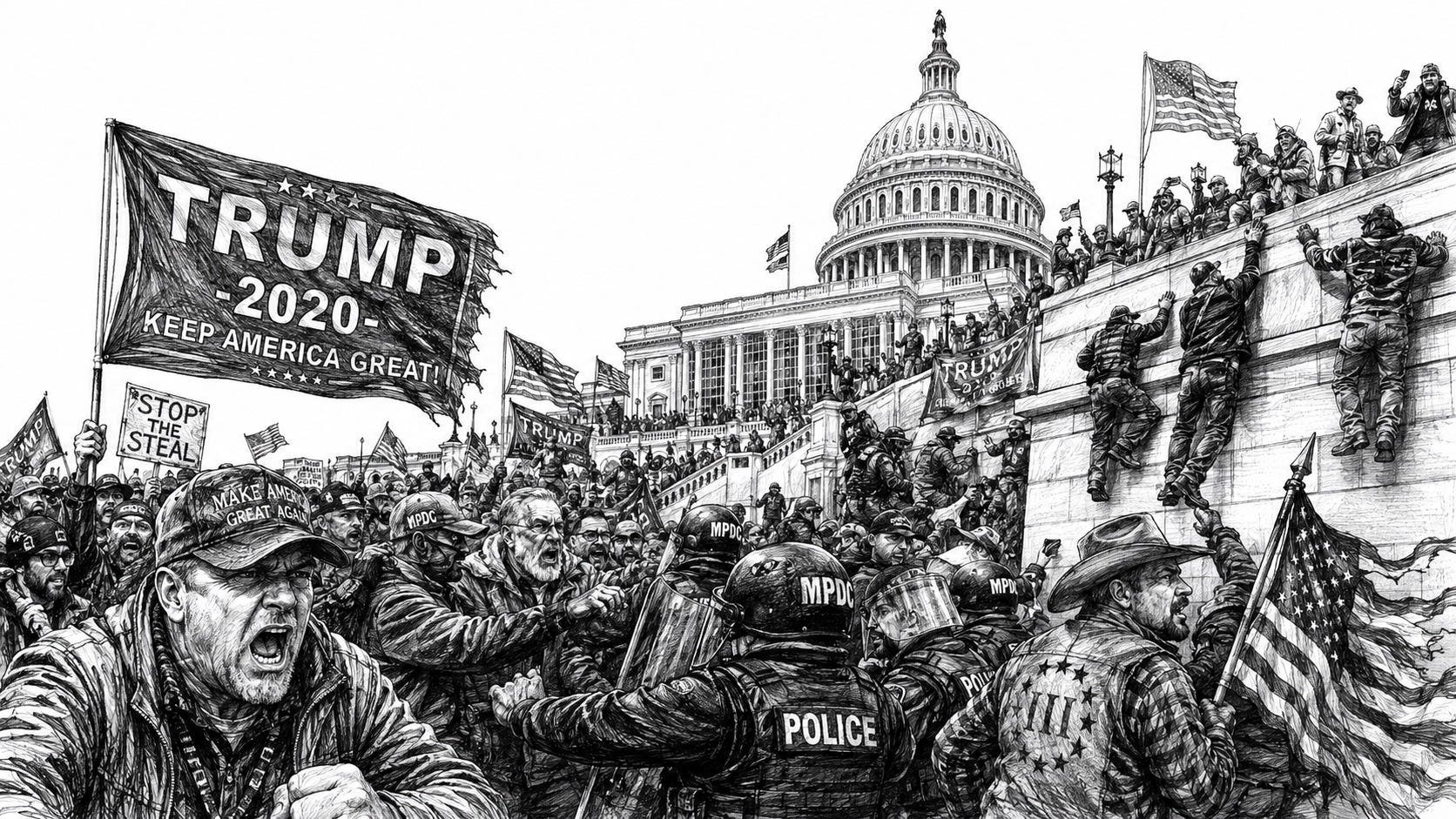
Last week the Department of Justice confirmed it had deleted hundreds of pages from its own website. Those pages documented the largest criminal investigation in modern department history.
They named the people who stormed the United States Capitol on January 6, 2021. They listed the charges, the guilty pleas, the convictions, and the prison terms. A Washington reporter caught the pages going dark. The department did not deny it. The department celebrated it, posting that it was proud to strip its website of what it called partisan propaganda.
You are watching your own government erase its own record. I have practiced law in California since 1986, and based upon my experience, I believe it’s important to show you three federal laws this conduct may violate. Read them in plain English. Then you will know exactly what the people running your government did, and why it should alarm you.
What They Did
This did not start last week. It started the day this president returned to power.
On his first day back in office in January 2025, President Trump pardoned or commuted the sentences of more than 1,500 people charged in the Capitol attack, and he ordered pending cases dismissed. That clemency reached people convicted of beating police officers with flagpoles and other weapons. Within days, the department pulled down a searchable database that had catalogued every January 6 case prosecuted in Washington. Reporters tracked cases through it. Defense lawyers mined it for comparable sentences on appeal. Researchers studied it to understand how the country answered a violent attack on its own government. It went dark in early 2025.
The erasure widened this month. In April the department asked a federal appeals court to throw out the seditious conspiracy convictions of Proud Boys and Oath Keepers leaders. The court granted that unopposed request on May 21. The next day, a reporter caught the department wiping the press releases that told the story of those prosecutions, page after page.
One deleted page described a man who carried bear spray into the Capitol and still faces a separate state charge for soliciting a minor. The department erased the public record of his Capitol conduct. That second case remains open. Sit with that.
The First Law: Concealing Federal Records
Title 18, Section 2071 of the United States Code makes it a federal crime to willfully and unlawfully conceal, remove, or destroy any record filed or deposited in a public office. The penalty reaches three years in prison.1
Section 2071 carries a second punch aimed straight at government officials. An official who holds custody of a record and removes it forfeits the office and loses the right to ever hold federal office again. Congress wrote that penalty for a reason. Public officials hold records in trust for you. When they destroy what they were hired to protect, the law strips them of the job and the path back to it.
I will give you the honest legal picture. A prosecutor would have to prove the conduct was both willful and unlawful, and the department will argue that a website press release is mere publicity outside the statute’s scope. That argument deserves a hard look. The conduct sits inside the zone this statute was written to reach, and the department’s public boasting about its intent makes the willful element easier to prove.
The Second Law: Obstruction Through Destruction
Title 18, Section 1519 came out of the Enron scandal, when an accounting firm shredded documents to bury the truth. The law makes it a crime to knowingly destroy, conceal, or cover up any record with the intent to obstruct or influence the proper administration of any matter within the authority of a federal agency. The penalty reaches twenty years in prison.
Twenty years. Congress treats document destruction as a serious offense because a government that erases its own records will manufacture any version of history it wants.
The administration will say there is no active matter left to obstruct. Look closer. Officers who defended the Capitol on January 6 have sued over the administration’s handling of these cases. The department built a fund worth roughly 1.8 billion taxpayer dollars to pay people it now calls wrongly prosecuted, and the eligibility fight over that money is live right now. Erasing the evidence of what these defendants did shapes every one of those open matters. Section 1519 may reach exactly that.
The Third Law: The Federal Records Act
The third law is the cleanest of the three. The Federal Records Act governs how every federal agency handles its records. No agency gets to delete federal records on a whim. It must follow a schedule approved by the National Archives. When records leave unlawfully, Section 3106 of Title 44 orders the head of the agency to notify the Archivist of the United States and the Attorney General so the records get recovered.
A government accountability group already raised this alarm. In early 2025, after the case database first vanished, the group sent a formal letter to the National Archives and the Justice Department Inspector General, laying out why the deletion broke federal records law. The same argument applies to the web-based press releases erased this month. Around that time, a federal judge ordered the administration to stop pulling January 6 video and court records from government websites. More than a year later, the department turned to its press releases. The erasure did not stop. It changed shape.
Why This Reaches You
You might think a fight over old press releases sits far from your life. It does not. The record of January 6 belongs to you. Your tax dollars funded those investigations. Your Capitol was attacked. Your democracy absorbed the blow. Your government now calls the people who carried out that attack patriots and victims, and it is pulling the official account of what they did offline, page by page.
Here is the part the department does not want you to dwell on. The court records survive. Every indictment, every guilty plea, every judgment, and every sentence still sits in the federal court files and the public docket system. Independent archives and trackers captured the deleted pages before they came down. The truth of January 6 still exists. The government decided you should have to work harder to find it.
A government that erases one inconvenient chapter will reach for the next. Today it is January 6. Tomorrow it is a contract, an audit, a death count, an election result. The habit is the danger. Once an administration learns it pays no price for rewriting the record, no record is safe, and no citizen has reason to trust what the government says.
Your children and grandchildren will learn the history of this moment from the documents that survive. Right now the people in charge of those documents are deciding which ones stay easy to find. They are making that decision for you, without you.
What You Do Now
Truth does not defend itself. People defend it.
Save the record. Copies of the deleted pages live in public archives. Download them. Back them up. Share them. Send them to your kids.
Call your senators and your representative. Tell them you want the Justice Department Inspector General and the National Archives to investigate these deletions under the laws above. Tell them you want answers in writing.
Talk about this out loud. At the dinner table. At work. With your neighbors. Online. Silence is the one thing that lets an erasure succeed.
And vote like the record depends on it, because it does.
I despise what this administration is doing to the rule of law, and I am saying so with my name attached and my license on the line. The Department of Justice took an oath to the law. It owes nothing to any single man. Erasing the official account of an attack on the Capitol betrays that oath.
Refuse to let them rewrite what you watched with your own eyes. Comment. Share this. Forward it to one person who still believes the truth is worth saving. Then do it again tomorrow.
Mitch Jackson, Esq.
Uncensored Objection exists because the people in power keep deleting what they do not want you to remember, and I refuse to let the record of this moment disappear the way the Justice Department is making January 6 disappear. Subscribe free to get every investigation and newsletter issue straight to your inbox, or go Premium to fuel the deeper digs, and know this: what I publish here stays published, because the truth only protects you when you can still find it.
A press release and a case-tracking database that a federal agency creates in the course of its work are federal records under the statutory definition, server-stored or not, because electronic records are squarely covered, and an agency does not get to delete them outside a National Archives approved schedule. Section 3106 then requires the agency head to report unlawful removal to the Archivist and the Attorney General, and there is no public sign that happened. That is a clean violation, and it does the heavy lifting. The two criminal statutes also mentioned in the post are harder, and they are still reachable. Yes, Section 2071 and Section 1519 grew up around tangible records and identifiable proceedings, and a webpage is not a paper file in a cabinet. That distinction matters less than it first appears. Section 2071 reaches anyone who willfully conceals or removes a record in a public office, and concealment is exactly what happened here: the information was made unreachable to the public on purpose. The department handed the public the willfulness element itself when it publicly boasted that the deletions were deliberate, which answers the hardest question a prosecutor usually faces. Section 1519 reaches the knowing concealment of a record with intent to obstruct any matter within a federal agency’s authority, and the timing builds that intent: the scrub landed alongside an active fight over a multibillion dollar compensation fund and live litigation by officers who defended the Capitol, and erasing the proof of what these defendants did shapes every one of those matters. The “it was only publicity” defense is weaker than it sounds, because the department deleted a structured case database, not a press kit, and the survival of the dockets on PACER goes to mitigation, not to innocence, since both statutes punish concealment and removal regardless of whether a backup exists somewhere else.
The cowardice is almost laughable. Initially, bold, with violence and threats, and now silent, sneaky kittens on the prowl. J6 is not over and may get worse in 2026, but definitely will never be forgotten.
maybe I should know this, but how do I download copies of the deleted pages live in public archives? Thanks